stock market gain

Newsom, California Legislature reach $351.7-billion budget deal

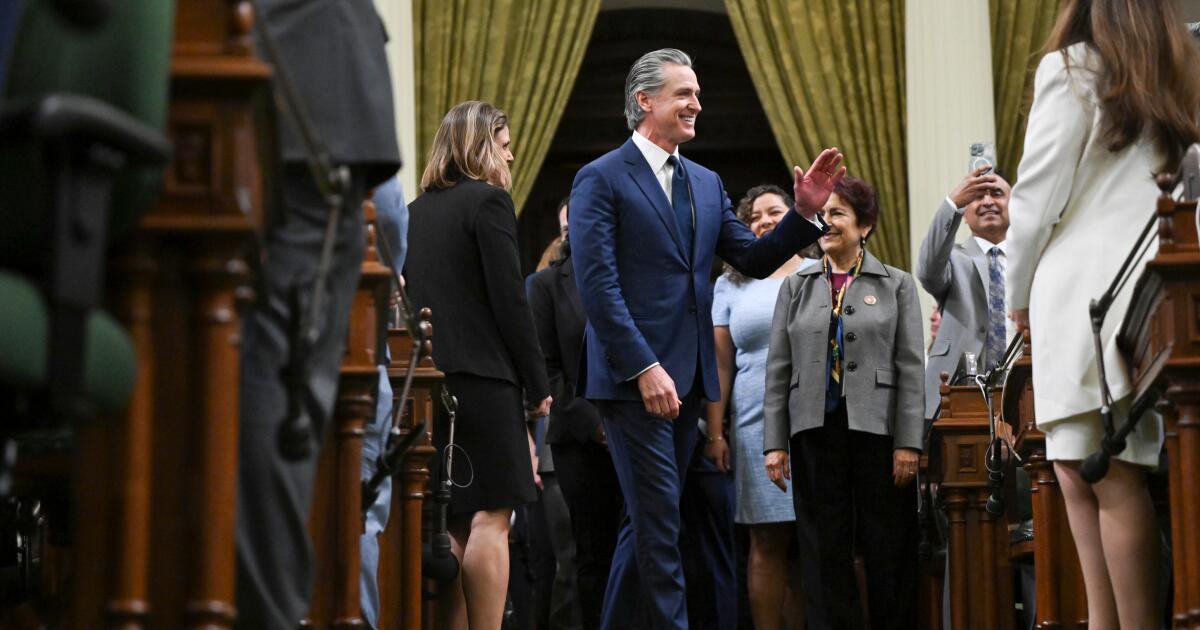
Gov. Gavin Newsom reached an agreement Friday with legislative leaders on a $351.7-billion state budget in his final year as governor, a spending plan that uses a tax windfall to avoid major cuts and lessen California’s chronic deficit in the years ahead.

The deal provides nearly $2 billion in state revenue next year through tax hikes on corporations, new levies on software sales and a revamped tax on managed healthcare organizations. Lawmakers and the governor continue major investments in education, healthcare and agreed to increase spending on subsidized childcare and affordable housing.

“We want to leave the next governor not only a balanced budget, but a budget that is substantially structurally sound, and we’re going to accomplish that,” Newsom said in an interview Friday. “We were very cautious in terms of new spending,”

The agreement ends weeks of lobbying by outside interests and negotiations among lawmakers and the governor at the state Capitol about how to handle a surge of income tax collected on stock market gains related to artificial intelligence.

Early forecasts last June projected a $12.6-billion deficit in 2026-27, according to the California Department of Finance. Updated predictions now suggest the state will end the year with a surplus of $4.5 billion.

Democrats, following Newsom’s lead, are tucking away $6.4 billion for future years, which allows the governor to knock down a deficit previously projected through 2027-28 and assuage criticism about his spending habits.

But economists say the fix and revenue increase is likely only temporary.

Spending in California has generally exceeded revenue growth during Newsom’s tenure in the governor’s office, creating a chronic shortfall. Despite the extra funding, the budget continues a trend of relying on reserves, shifting funds, borrowing and suspending debt payments to balance state spending.

The Legislative Analyst’s Office, the nonpartisan fiscal advisor for lawmakers, has warned of a roughly $10-billion gap between the amount of money the state brings in and spends, which could grow dramatically worse if the stock market turns downward. The LAO has said the existence of any operating deficit during a revenue boom is a red flag and that the state is “ill-prepared” for even a modest decline.

Christopher Thornberg, an economist and founder of the consulting firm Beacon Economics, said it’s business as usual in Sacramento.

“They love increasing spending. But it seems politically impossible to go the other way,” Thornberg said. “We’ve seen this play out over and over again.”

Lawmakers and the governor offered a different take and asserted that their decision to put the $6.4 billion into a short-term reserve, called the Projected Surplus Temporary Holding Account, and ask voters to allow them to store more money in the rainy day fund are examples of prudent budgeting.

“You see us save more and you see try to address the immediate needs of our community, but also the structural budget that potentially awaits us,” said Senate President Pro Tem Monique Limón (D-Goleta) in an interview. “We are forecasting a moment where we will need to address these issues and we want to start now to think about the future as well.”

Under a progressive tax structure, the state budget is dependent on income taxes paid by the ultra-rich on earnings largely from capital gains. The set up leaves California vulnerable to the unpredictable nature of the stock market, dramatic swings in revenue and, in recent years, reliant on poor projections.

Negotiations at the state Capitol included an agreement on a constitutional amendment that seeks to offset the revenue highs and lows.

If approved by voters on the statewide ballot in November, the amendment would raise a cap on mandatory deposits into the rainy day fund from 10% to 20% of general fund revenue. The measure would also allow lawmakers to exempt money they put into the rainy day fund and the temporary holding account from state spending limits.

Under an existing state appropriations restraint, also known as the Gann Limit, lawmakers cannot spend more than an amount determined by a formula that takes annual tax proceeds, changes to the population and cost of living into consideration. Tax revenue above the limit must be divided between schools and refunds to taxpayers.

With few exceptions, the limit applies to most appropriations of tax revenue, including when lawmakers put money away in the rainy day fund and other reserves.

Newsom said the change will leave the state in a much better position to weather the volatility. Though calls for tax reform remain in California, the governor said being able to place more money into the reserves could ultimately solve the state’s budget challenges.

“The one thing missing is the one thing that I think we finally landed, which is the change in the reserves,” Newsom said. “It changes the political dynamic, where now you’re not exchanging general fund priorities.”

Republicans criticized the proposed constitutional amendment, which passed in a budget trailer bill this week, for failing to require that excess revenue pays down the state’s $22 billion in unemployment insurance debt.

State Sen. Tony Strickland (R-Huntington Beach) called it a missed opportunity.

“It does not require debt payment to go to the UI debt,” Strickland said. “It facilitates more spending, exempting reserve deposits from the state spending limit.”

As part of the negotiations, lawmakers agreed to delay some healthcare cuts that would have required monthly premiums for immigrants and eliminated dental care. The deal adopts a Medi-Cal asset test of $21,000 on July 1, 2027, instead of a $2,000.

The budget agreement includes a provision requiring California’s next governor to develop options to reduce taxpayer subsidies for corporations whose employees receive state-sponsored healthcare through Medi-Cal instead of the company’s health plan. The plan is aimed at raising revenue to offset federal cuts that are expected to leave millions of Californians without access to healthcare.

The California Department of Finance said state reserves are expected to total $28.8 billion under the 2026-27 budget.

Source link

Hiltzik: Why the Trump accounts aren’t good for everyone

Proponents say the Trump accounts will be better than Social Security. Don’t believe them.

Here’s a riddle for you: A conservative Republican senator, a top economic advisor to the Trump White House and a venture capitalist walk into a conference room at a financial conference and claim a new government program will be a boon for all American families.

Question: Do you think these people are looking out for your interests?

If you trust Sen. Ted Cruz, economic advisor Kevin Hassett and millionaire Brad Gerstner to do so, feel free to stop reading here.

Here’s the dirty little secret: Trump accounts are Social Security personal accounts.

— Sen. Ted Cruz (R-Tex.) reveals that Trump accounts are designed to threaten Social Security

If you’re skeptical, read on.

But keep in mind that Cruz (R-Tex.) was last seen in these pages promoting yet another big tax break for the 1%, Hassett appeared the other day on Fox Business arguing that while Americans are spending a lot more on gasoline, “they’re spending more on everything else too” on their credit cards, as if forcing households to max out their credit is a good thing; and Gerstner is, well, a millionaire tech investor.

Get the latest from Michael Hiltzik

Commentary on economics and more from a Pulitzer Prize winner.

At their panel discussion on May 4 at the annual Milken conference, Cruz, Hassett, Gerstner and their interlocutor, Michael Milken, talked as though the Trump accounts would be so fabulous for average American families that they would obviate the need for Social Security.

“Here’s the dirty little secret,” Cruz said. “Trump accounts are Social Security personal accounts.”

Milken echoed that thought: “Do you have the right to decide where your money goes, or should you be giving it to the government and [letting] them decide where it goes?”

That gave the game away — this is yet another effort by Republicans and conservatives to end a program they’ve been trying to kill, and to give Wall Street firms a bigger bite of your retirement resources.

Let’s start with a primer about the Trump accounts, which were part of last year’s GOP budget bill and will be open to investment starting on July 4.

The headline pitch for these accounts is that they’ll be seeded with a one-time $1,000 government contribution for children born from 2025 through 2028, unless Congress extends the government donation. Accounts can be opened for children born before or after those dates, but they won’t get the government donation.

Families can add up to another $5,000 in contributions every year until the child reaches 18, but those donations won’t be tax-deductible.

The money must be invested in low-cost stock index funds or exchange-traded stock index funds, and can’t be withdrawn for any reason without penalty until age 18. After that, the funds can be withdrawn without penalty for certain purposes such as educational expenses or the purchase of a first home. The accounts eventually become converted to conventional individual retirement accounts, or IRAs, and distributions will be taxed as ordinary income, though family contributions will be returned tax-free.

That $1,000 donation is the best feature of the accounts. But that may be their only good feature. For almost all the financial goals confronting average American families, such as saving for college or retirement, they’re inferior to tax-advantaged savings plans already on the books.

Like those programs, they’re much more advantageous for wealthier than to low-income families: Wealthier families typically have the wherewithal to make their annual contributions, and get a larger break from the tax deferrals of investment growth within the accounts because their tax rates are higher.

Though their promoters claim that the accounts will level the economic playing field for all families — “helping the bottom 10%,” Hassett said on the panel — that’s not the case. “Clearly, the program is structured to subsidize savings for those who already have the capacity to save, rather than meaningfully closing the wealth gap,” observes Sheryl Rowling of Morningstar.

Another drawback cited by economists and financial planners is that the accounts are locked into corporate equity investments. Before the beneficiary reaches age 18, the investment mix can’t be adjusted. That’s dangerous because portfolio concentrations in corporate shares are inherently risky.

“A high school senior who plans to enroll in college next year cannot change the investment to a lower-risk portfolio,” say, to a mix of equities and bonds, notes Greg Leiserson of the Tax Law Center at NYU. “If the market crashes the summer before she plans to enroll, the Trump Account is of greatly reduced use.”

Trump account promoters have massively overstated the potential wealth gains for ordinary Americans. At the Milken conference, Cruz said that a child with a Trump account will have about $170,000 in it when he or she reaches 18 and $700,000 at age 35. “And very quickly after that, you get into the millions,” he said.

Cruz did acknowledge that those figures apply to households that “contribute regularly.” In fact, they apply largely to households that contribute the maximum $5,000 every year.

The White House estimates of potential returns are based on questionable assumptions about stock market gains over the 18-year periods in which the accounts will grow on a tax-deferred basis.

According to the government’s own estimates, the account of a family taking the $1,000 seed money but making no contributions beyond that would have as little as $2,577 in their account after 18 years if stock market returns come to 5.4% over that period.

The government estimates, however, that the account would hold $730,395 if the family contributes the maximum every year and the stock market returns more than 18%. Another 10 years of growth at that level, and the account would grow to $1.9 million when the child reaches age 28.

The problem with long-term market estimates, such as the ones offered by the White House, is that they’re highly variable. No 18-year periods are the same. One thousand dollars deposited in a hypothetical account invested in a Standard & Poor’s 500 index fund would grow to about $6,600 if its 18-year lifetime culminated in 2025; if the 18 years ended in 2008, however, that deposit would have grown only to $3,960. In the 18-year period that ended in 1960, the account would have grown only to $2,940. What will the next 18 years bring? Who knows?

Variability like this, along with the sheer uncertainty of stock market projections for the future, helped sink George W. Bush’s 2005 attempt to convert Social Security into private accounts, which was also pitched as a key to minting millionaires by the millions through the magic of the market.

I asked the White House to respond to these criticisms. Spokesman Kush Desai called my questions “both a stupid and out-of-touch take,” asserting that the accounts are “already shaping up to make a generational difference for working-class children.”

The truth is that if Trump were really intent on taking steps to “strengthen the financial security of American workers” and creating a “path to prosperity for a generation of American kids,” as he claims to be, he and his GOP followers in Congress wouldn’t have scissored away the American safety net, which is what they’ve done.

They wouldn’t have imposed new work requirements and narrowed eligibility standards for food stamps, resulting in the exclusion of more than 3 million people from the program, a decline of 8%. They wouldn’t have cut nearly $1 trillion in funding for Medicaid over 10 years, jeopardizing coverage for 3.6 million young adults. They wouldn’t have allowed Affordable Care Act premium subsidies to expire, resulting in a drop in Obamacare enrollments of about 1.2 million Americans this year compared with last year.

If they really cared about educational opportunities for “a generation of American kids,” they wouldn’t have narrowed eligibility for higher education Pell grants, and wouldn’t slash research grants for universities coast to coast.

So how can families better prepare for college and retirement expenses? For education, 529 plans are probably preferable to Trump accounts. The investment choices are more flexible, withdrawals are tax-free at the federal level and sometimes at state levels if used for most education expenses, and there are no federal limits on contributions (contributions aren’t tax-deductible).

For retirement, advisers have been favoring Roth IRAs. Contributions are not tax-deductible, and this year can be made by couples filing jointly with taxable income up to $242,000 ($153,000 for singles) and are limited to $7,500 a year ($8,600 for those 50 and older). But withdrawals aren’t taxed if you’ve held the account for at least five years and you take the money out after you turn 59 1⁄2.

The bottom line, then, is this. Take the $1,000 if your child is eligible. As Rowling wisely advises, “Any time the government offers free money, you should take it.”

As for the rest, treat any claims offered by Trump account promoters as inherently suspect.

Source link