steyer

Tom Steyer courted Latino voters in Santa Ana. Did he succeed?

When a friend asked if Tom Steyer could stop by my wife Delilah’s downtown Santa Ana restaurant, I had to explain to her who he was.

It’s not political apathy in my honey’s case. She’s just exhausted from running her small business, Alta Baja Market, in these inflationary times. She’s one of the 16% of undecided voters in a recent California Democratic Party poll — a group that may determine which two candidates for governor face each other in the general election.

Delilah agreed that Steyer could visit on Saturday after I told her that many of our friends support the billionaire’s progressive platform.

“Politics is your job, not mine,” she joked as we drove to Alta Baja and I named the other major candidates. The only ones she had heard of were Antonio Villaraigosa (“I liked him as mayor, but he needed to keep his pants on,” referring to his extramarital affairs) and Katie Porter (“Some of my workers like her, but I don’t know what she’s done”). She might be the last person left in the Golden State who hasn’t seen any of Steyer’s television and YouTube ads.

His campaign seems to have stalled in the polls even as he has spent more than $150 million of his own money amid doubts from some voters about whether they want a billionaire to lead the state.

So a visit to Santa Ana, the heart of Latino Orange County, was a good move. At Alta Baja, he could talk to my Mexican American wife and other blue-collar Latinos.

When rival Xavier Becerra came to O.C. a few weeks ago, on the other hand, he appeared at a private fundraiser attended mostly by professional Latinos.

“I just want someone who tells us where our taxes are going and treats this country like a business, and we’re not wasting money,” Delilah said. She’s a socially liberal and fiscally conservative Democrat who has been especially angered by President Trump’s deportation deluge, which left the streets of downtown Santa Ana empty for months last summer. “Because right now, our government is a hot-ass mess.”

I asked what questions she had for Steyer.

“So insurance had to cover all the disasters that happened with the fires,” Delilah replied. “So why is everybody else having to pay for it? And what are you really gonna do to help the state?”

She paused. “Tom is a Democrat, right?”

Delilah prepared for Steyer’s noontime stop as if it were any other day. She has fed the likes of U.S. Sen. Alex Padilla, Orange County Dist. Atty. Todd Spitzer and former Speaker of the Assembly Anthony Rendon. Republican gubernatorial candidate Steve Hilton is a fan of Alta Baja’s blue cornbread; Oakland Mayor Barbara Lee held a meet-and-greet there when she ran for president two years ago.

“You know who should ask questions?” Delilah said after she set the till for the day. “Angela.”

That would be 19-year-old Alta Baja employee Angela Nino, who will be voting in her first election.

“She’ll always be telling me, ‘Did you see the debate? Did you see the debate?’ And I always say, ‘No, I’m too tired to watch.’”

Nino soon clocked in.

“Guess who’s coming, Angela?” Delilah said before looking at me. “Is his name Tim or Tom?”

“It’s like I agree with some of his things, but he’s a billionaire,” said the Orange Coast College student and Santa Ana resident when I asked about Steyer. “His answers at debates have been pretty broad so far.”

Delilah smiled.

“You’re the future, girl, so ask him anything.”

Almost everyone who came in as we waited for Steyer was a campaign worker or volunteer. Former state Controller Betty Yee, who ended her campaign for governor last month and endorsed Steyer, sat at a table with her husband. Orange County Supervisor Vicente Sarmiento, who initiated Steyer’s Santa Ana visit, thanked Delilah for the opportunity. He has known her since the start of his political career on the Santa Ana City Council nearly 20 years ago,

“This is a city where our residents were criminalized because of ICE, our downtown suffered because of construction, and all this on the heels of a pandemic,” he told me. “These are the folks Tom needs to listen to.”

Sarmiento’s staffer got his attention. Steyer was here.

The candidate strolled in with a videographer and photographer. He wore his usual casual billionaire outfit — white-and-cardinal Nikes, jeans, checkered shirt with rolled-up sleeves and a colorful Southwestern-style fabric belt.

Steyer went straight to the counter.

“Are you running for governor?” he cracked while shaking Delilah’s hand.

“I don’t want to,” she replied.

“I knew you were a smart woman!”

He listened with wide eyes and a stern face as Delilah complained about a years-long light-rail project in front of Alta Baja “that has been worse for businesses here than COVID.” Insurance rates have gone up 30% in the last year alone, she said.

“Well, look, that’s my whole thing,” Steyer responded in his low, gravelly voice. “I’m willing to take on the big corporations who are ripping off California. And they’re all spending a lot of money against me.”

It was the Steyer I’ve heard on too many commercials: pugnacious, compassionate but spouting a whole bunch of boilerplate. Delilah smiled weakly.

“I appreciate that,” she said. “And we need more of that.”

Then she waved Nino over. Usually shy, the architecture major now channeled her inner Lesley Stahl.

“Why do you have to be governor in order to do something while you have billions of dollars?” she said.

Steyer didn’t flinch as he explained how he has funded ballot propositions and nonprofit initiatives to fight for a more equitable California.

“So I’ve been able to do something, but what I see in California — and what Delilah and I were just talking about — is big corporations actually run the state,” he said.

“That’s true,” Nino conceded.

“You have to take on the big corporations that are screwing everybody. And you can really only do that as governor,” Steyer continued.

“You want to tax the billionaires, is that correct?” Nino asked next, as Steyer nodded. “How come on some [campaign disclosure] forms, it shows that your billions are in different [countries] besides in the U.S.?”

The candidate vigorously shook his head.

“I might have investments outside the United States, but there’s nothing I’m doing to not pay — I pay full California and American taxes on everything, promise. There’s a lot of ways I could avoid taxes, but I don’t. And so, anything that I’m doing overseas is not to avoid taxes. … I give you my word.”

One more from Nino!

“And how can the people trust billionaires when currently they have been very disappointing towards us?”

“I understand why people are skeptical,” Steyer replied. “They couldn’t be more skeptical than I am.”

He argued that other moguls “are supporting every other candidate. Those people hate me — like, they think I stand for something really bad, which is making them pay their fair share,” referring to a proposed November ballot initiative that would impose a one-time 5% tax on billionaires like Steyer (he supports the measure).

“And they’re right,” Steyer concluded. “And so it’s like, they hate me, and that’s fine.”

Nino stayed silent. Delilah thanked Steyer, who was off to visit other local businesses owned by friends of ours. He bought a bottle of rosé, posed for photos with Delilah and Sarmiento and went off — but not before a staffer adjusted the back of his collar.

Delilah and Nino went back to prepping lunch orders. What did they think about Steyer?

“To be honest, I’m so skeptical,” Nino said. “I don’t think he has enough experience as some of the other candidates, and I feel like he could have been more into detail about his policies.”

What about you, honey?

“Gracious, very kind and not pompous, which is what I would expect from most politicians,” Delilah said. “I like that he heard out Angela — that’s important [that] politicians listen to the next generation, and I think everybody should be doing that. But I wasn’t satisfied with my insurance question.”

“And we don’t know if this is a performance,” Nino added, drawing a playful gasp from Delilah. “We’ve seen, like, throughout the years, many political people go into, like, regular [businesses] to seem like, ‘Oh, we’re relatable to the people. We know your struggles.’”

“Do they really?” Delilah interjected.

Nino frowned.

They could just be putting on a show for the cameras, she said.
Source link

‘Cálmate, Antonio’: The most fiery moments from the governor’s debate

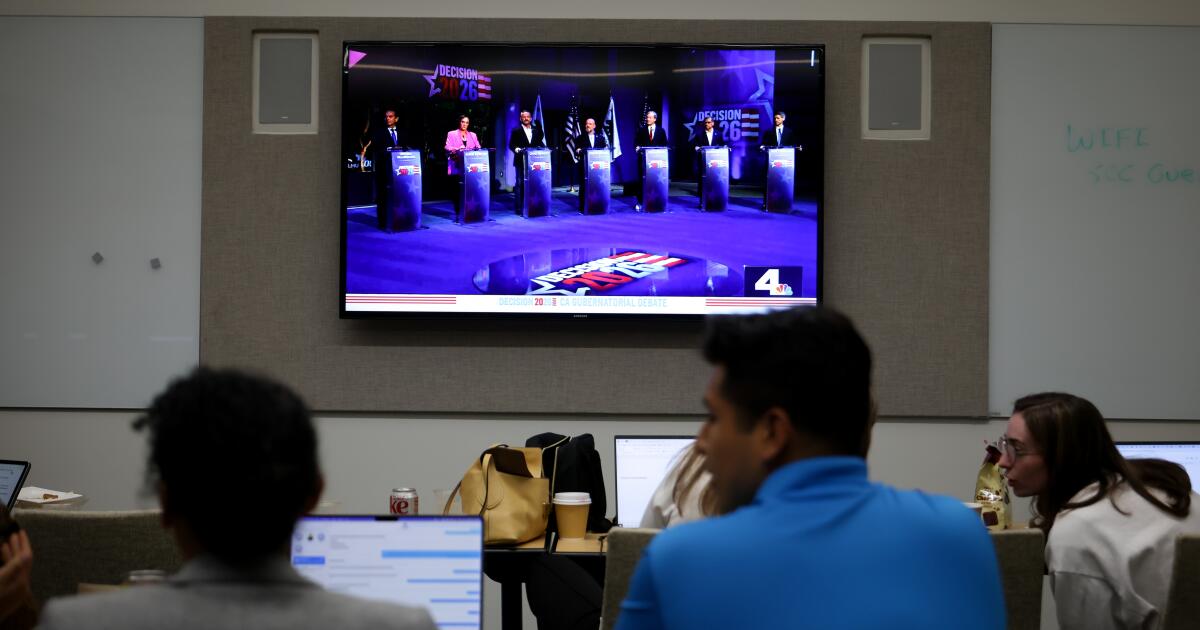
The top candidates in California’s wide-open race for governor took the stage Wednesday night in a Los Angeles debate that began politely but quickly devolved into another raucous clash.

Former Biden Cabinet member Xavier Becerra and billionaire Tom Steyer, both Democratic frontrunners, were primary targets of the political attacks — Becerra for his record as U.S. Health and Human Services secretary and Steyer over his past investments, including in private prisons that housed immigrant detainees.

San José Mayor Matt Mahan started off the debate by lashing out at both Republicans and Democrats.

“We do not need the leadership that MAGA candidates on this stage are offering that’s divisive. We don’t need the leadership of a billionaire who’s now against everything he made his money in, or a career politician who has failed again and again to deliver results,” Mahan said, taking shots at conservative commentator Steve Hilton and Riverside County Sheriff Chad Bianco, Steyer and Becerra, respectively.

Mahan had good reason to go on the attack. The moderate Democrat has struggled to meet early expectations that he would emerge as a top-tier candidate.

The California Democratic Party’s latest poll, released Monday, showed Hilton and Becerra tied at 18%, and Bianco, a Republican, with 14%. Steyer received the backing of 12%, while support for the other top Democrats in the race — former Orange County Rep. Katie Porter, Mahan, former L.A. Mayor Antonio Villaraigosa and state Supt. of Public Instruction Tony Thurmond — were in the single digits. Thurmond did not meet the polling threshold to qualify for the televised debates this week.

Sanctuary state policy leads to kerfuffle

In a tense exchange on immigration and the state’s sanctuary laws, Porter said, “We ought to enforce our sanctuary laws everywhere so we don’t have crazy cowboys taking the law into their own hands.”

It was a shot at Bianco, who has criticized the law that blocks local law enforcement from assisting federal immigration agents.

“Tell that to the crazy mother who lost her child,” Bianco said, referring to a case in his county involving a 14-year-old who was hit and killed by a driver who he said had two prior DUI arrests and was in the country illegally.

“Sir, I don’t need any lectures from you about being a mother,” Porter, a single mother of three and the only woman on the debate stage, shot back.

“You might,” Bianco said, prompting a nasty look from Porter and groans and boos from the studio audience.

The one-hour clash followed another Wednesday evening debate, among candidates for Los Angeles mayor, part of a doubleheader hosted and broadcast by NBC4 and Telemundo 52 in Los Angeles. Both took place at the Skirball Cultural Center and were moderated by NBC4 News anchor Colleen Williams, chief political reporter Conan Nolan and Telemundo 52 News anchor Enrique Chiabra.

Republicans and Democrats divided on immigration

Democrats were in lockstep on most issues related to immigration, including opposing Immigration & Customs Enforcement raids and supporting the sanctuary law that prohibits police from coordinating with the federal agency.

Republicans said the controversial state law, which was approved in 2017 during President Trump’s first term, has hurt public safety.

“I have someone in my jail right now … he’s convicted of a felony, but the three prior convictions for DUI, he was released from jail,” Bianco said. “He was deported on two of them, [came] back into the country, and then he killed a 14-year-old boy with another DUI. So we have to wait until somebody dies before we deport criminals who are in our jail.”

Villaraigosa countered that the law allows for violent criminals to be deported and that thousands have been by state and local law enforcement agencies.

Hilton, a British national who became a U.S. citizen in 2021, declared himself “the candidate of the legal immigrant community” and said the governor’s job is to enforce laws, whether they agree with them or not.

All the Democrats said they would restore full Medi-Cal coverage for undocumented immigrants, which has been rolled back due to budget constraints, while Republicans said they would not.

Courting Latino voters

One of the many undercurrents of Wednesday’s debate was the ongoing tussle between Becerra and Villaraigosa. Both have been competing for California’s pivotal Latino vote, and the former Los Angeles mayor’s attacks have become increasingly aggressive as Becerra has ascended in the governor’s race.

At about 40% of the state’s population, Latinos are California’s largest ethnic group but also among the groups least likely to vote, casting just 21% of ballots in the 2022 primary election.

Mindy Romero, director of the Center for Inclusive Democracy at USC, said Becerra’s surge in momentum could boost Latino turnout, “but I don’t see any evidence right now that actually tells us that will happen. The thing about primaries, unfortunately, is that turnout is always low. Even in a competitive primary like this.”

On Wednesday, Villaraigosa launched a new digital ad highlighting a former member of the Biden administration questioning Becerra’s record as U.S. Health and Human Services secretary.

He highlighted the issue during Wednesday’s debate after the moderates asked the candidates how they would address homelessness in California.

“Mr. Becerra, are you proud that you pushed out 85,000 migrant children? They were, according to the New York Times, they were maimed, they were exploited,” Villaraigosa said. “Some were even killed. You said those are MAGA talking points, it’s a MAGA hoax. Tell that to the children who died.”

“So I’m not sure what that had to do with homelessness, but cálmate, Antonio, cálmate,” Becerra responded, urging his opponent to “calm down.” He accused Villaraigosa of parroting the unfounded attacks that Trump deployed against former Democratic Vice President Kamala Harris in the 2024 presidential election.

“We protected kids. We did not let them be abused,” Becerra said. “Stop lying.”

Speaking of homelessness

The Democrats and Republicans on stage were sharply divided on the best way to address California’s ongoing homelessness crisis.

People living on the streets are “pawns in the homeless industrial complex,” Bianco said, adding: “This is not and has never been about homes. This is about drug and alcohol addiction.”

Mahan, Villaraigosa and Becerra touted their records building housing and expanding mental health services, saying those will help reduce homelessness. They, along with Porter, also called for more oversight of state homelessness spending.

Hilton said the issue is one of the state’s biggest failures and blamed the Democrats — the party that has controlled state government for the past 16 years.

“Some of these Democrats are on this stage, they talk as if we’re in some parallel universe where Democrats haven’t been running this state for the last 16 years of one-party rule,” he said.

Democratic shift on nuclear plants, high-speed rail

A series of lightning-round questions highlighted some subtle shifts on traditional Democratic policies as candidates aim to make the state more affordable.

Democrats led the charge to decommission nuclear power plants in California over concerns of potential environmental and health catastrophes, but as the state struggles with energy affordability, all the Democrats (and both Republicans) said they would support further extending operations at the state’s only remaining nuclear plant, Diablo Canyon in San Luis Obispo County.

Most of the Democrats also said they support finishing a high-speed rail line from Bakersfield to Modesto, despite the massive cost overruns and delays, but said the project should be done cheaper and more efficiently. Hilton and Bianco want to scuttle the project.

And all Democrats except Steyer said they would vote against a proposed billionaire tax that will likely be on the November ballot mostly to backfill federal cuts to healthcare coverage. Although most of the Democratic candidates aside from Mahan say they support higher taxes on the wealthy, they have raised issues with the details of the proposal, including the fact that it is a one-time tax.

Source link

Tom Steyer tries to sell voters on his own personal change

Tom Steyer is trying to sell himself to voters as an agent of change.

He has vowed to take on entrenched political and economic forces to create affordable housing, make the wealthy pay more in taxes, lower energy bills and protect the environment.

But perhaps the biggest change he is selling is his own.

The hedge-fund billionaire turned climate activist has faced criticism throughout his campaign for past investments in coal plants and private prisons, to name a few, that helped build his fortune and gave him the means to spend more than $150 million of his own money in his quest for the governor’s mansion.

Steyer’s prolific spending has blanketed the airwaves with television ads and helped propel him near the top of an unsettled gubernatorial field in the polls.

The 68-year-old San Franciscan has helped put many Democratic candidates in office as one of the party’s biggest political donors in the past two decades, but has never held public office himself.

He spent more than $340 million in the 2020 Democratic presidential primary, but dropped out after placing third in the primary in South Carolina, where he had invested heavily.

There is a long tradition of wealthy, self-funding candidates, and the results are mixed at best. Billionaire Michael Bloomberg spent more than $260 million to win three terms as New York City mayor. But he spent more than $1 billion on a 2020 presidential bid and lasted only four days longer in the race than Steyer. Two years later, real estate developer Rick Caruso spent more than $100 million in an effort to become Los Angeles mayor but lost handily to Karen Bass.

Hoping for a better result in his current race, Steyer has staked out a position as the most progressive candidate in the field — touting an endorsement from the Bernie Sanders-affiliated Our Revolution. He’s picked up other key endorsements, too, from the California Teachers Assn., California Nurses Assn. and numerous environmental groups.

But he faces the challenge of convincing enough liberal voters to support a billionaire with controversial past investments the same year a tax on billionaires, currently enjoying strong support, is poised to be on the November ballot.

“This election is about who you can trust to fight for you,” former Rep. Katie Porter said during an April 22 gubernatorial debate in San Francisco. “One candidate is a billionaire who got rich off polluters and ICE prisons and is now using that money to fund his election.”

Steyer said he understands the broad concerns about his wealth and is willing to vote for the billionaires’ tax in November.

“I know that people are skeptical of billionaires, and I’m skeptical of billionaires,” Steyer said Tuesday in an interview with The Times. “But if you look at this race, I’m the only progressive in the race. I’m the person who’s taking on the corporate special interests.”

He pointed to the millions spent by a super PAC supported by the real estate industry and Pacific Gas & Electric — which Steyer has pledged to break up to bring down utility costs — as evidence that he is the candidate most feared by moneyed interests in the state.

“The companies that are running up the costs are fighting like hell, because that’s how they make their money,” he said. “But somebody’s got to stand up to them.”

The departure of former Rep. Eric Swalwell from the race last month after sexual assault allegations doesn’t appear to have resulted in a major surge of support for Steyer. Rather, it is Xavier Becerra, the former Health and Human Services secretary, who seems to have gained momentum.

But veteran California pollster Mark Baldassare said that he hasn’t counted out Steyer yet.

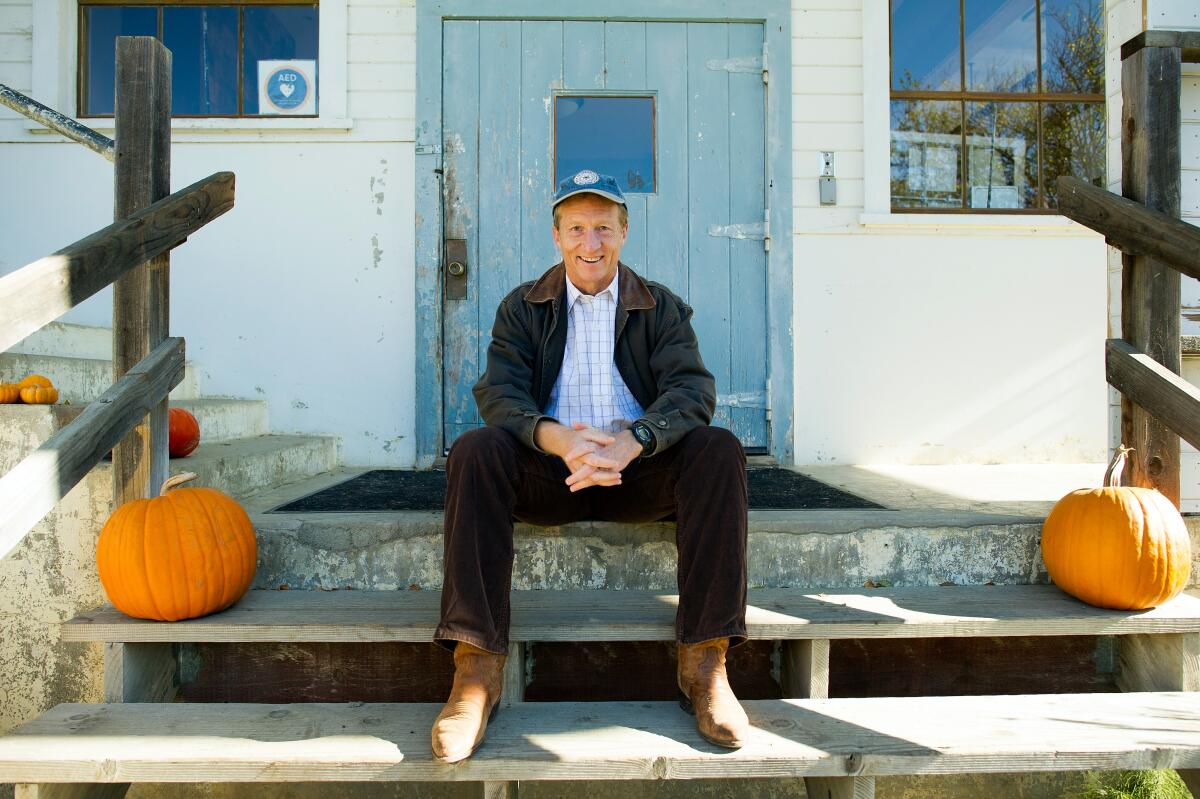
Tom Steyer sits on a porch with pumpkins.

Tom Steyer, in 2013, as he was campaigning against the Keystone XL oil pipeline.

(David Paul Morris / Bloomberg)

“It would be easy to say that he’s reached his peak, except for the fact that there are so many undecideds and Steyer has so many resources at his disposal,” said Baldassare, the statewide survey director for the Public Policy Institute of California.

Steyer has poured at least $875 million into federal and state political committees since 2010, according to an analysis conducted for The Times by OpenSecrets, and federal and state campaign finance records. That total includes the nearly half a billion dollars he has spent on his two races.

In 2013, Steyer left his investment firm and launched NextGen Climate, a progressive political action group geared toward addressing climate change. He has given nearly $270 million to a super PAC affiliated with the group, which was later renamed NextGen America.

The committee has spent tens of millions of dollars on campaigns opposing fossil fuel interests and supporting progressive candidates, though Steyer’s financial support for the group has decreased as he has run for office.

The billionaire also established his climate bona fides by opposing the Keystone XL pipeline during the Obama administration, which became a national proxy fight over climate policy, and by backing environmental ballot measures in California.

Among them was a $5-million investment in 2010’s “No on Prop. 23” campaign, which defeated a conservative effort to overturn California’s greenhouse gas emission reduction law.

Two years later, Steyer invested about $29.5 million in Proposition 39, a winning measure to recoup money from corporate tax breaks to help pay for clean energy projects.

Privileged upbringing and a ‘desire to compete’

Steyer’s unconventional path to politics began with a privileged upbringing on the Upper East Side of Manhattan. He studied at the elite Buckley School and Philips Exeter Academy before attending college at Yale University, where he captained the men’s soccer team and graduated in 1979.

After a brief stint on Wall Street, he got a master’s degree in business administration at Stanford University, where he met his future wife, Kat Taylor. They wed on the Stanford campus in 1986.

Steyer worked hard — very hard — at making money.

He was one of several “Wall Street Prodigies” featured in a Wall Street Journal profile from the same year he was married.

Steyer’s work began at 5 a.m. in the office and he seldom took days off — he fretted he wouldn’t have time for a honeymoon.

He eschewed the trappings of wealth — driving an eight-year-old Honda — motivated instead by a “desire to compete, excel and keep struggling to do better.”

Steyer began cutting political checks soon after, but his real emergence as a major political donor came during the 2004 presidential campaign, when he pledged to raise more than $100,000 for John Kerry’s campaign and was talked about as a potential political appointee at the U.S. Treasury Department in a Kerry administration.

Steyer hired Kerry to join his sustainable investment company Galvanize in 2024. Steyer stepped down from the company before entering the governor’s race.

The year 2004 was pivotal for another reason.

A group of students at his two alma maters, Yale and Stanford, along with those at a handful of other elite universities, began a campaign to pressure the endowments at their institutions to stop investing with Steyer’s hedge fund, Farallon Capital Management.

They cited concerns about some of the firm’s investments, including a coal burning plant in Indonesia and a joint venture between Farallon and Yale to pump out water from an aquifer in Colorado adjacent to the Great Sand Dunes National Park.

“Stated simply, we do not want our universities to profit from investments that harm other communities,” the students wrote in an open letter to Steyer. “We are concerned about the impact some of Farallon’s recent investments have had.”

Steyer told the students he appreciated “the importance of the issues that you raise,” but defended his firm’s work, saying that it acted “responsibly and ethically.”

Looking back on that time now, Steyer said it was a turning point.

“I think that experience really was a wake-up call to me,” he said. “It’s when I started to very seriously consider leaving Farallon. I really felt like if I was going to be the person with my values, I was going to have to leave and be independent and do what was right.”

Three years later, Steyer and his wife began their initial pivot to public service, opening a bank in Oakland that would cater to low-income customers

Tom Steyer leans against a railing near a U.S. flag.

Tom Steyer, seeking the Democratic presidential nomination, greets people at an event in Des Moines, Iowa, in 2019.

(Scott Olson / Getty Images)

But this initial venture highlighted the inevitable collision course between Steyer’s burgeoning activism and his firm’s investments.

At an event that year with then-Gov. Arnold Schwarzenegger and Oakland Mayor Ron Dellums, Steyer and Taylor pledged $1 million in loans to support vulnerable people in Oakland facing foreclosure in the wake of the subprime mortgage crisis.

Left unsaid was the fact that Steyer’s firm had extensive financial ties to San Diego’s Accredited Home Lenders, one of the biggest subprime mortgage lenders in the country.

The transformation to climate activist

Steyer and his wife began writing bigger philanthropic checks and in 2010 took the Giving Pledge, promising to donate at least half of their wealth before they died.

In 2009, they gave $40 million to endow the TomKat Center for Sustainable Energy at Stanford, the first of several multimillion-dollar gifts to Stanford and Yale to support climate-focused ventures. They pledged $7 million to create the Steyer-Taylor Center for Energy Policy and Finance, also at Stanford, in 2010. It closed last year after its endowment came to an end.

And in 2011, the couple donated $25 million to Yale to help establish an Energy Sciences Institute focused on developing sustainable energy solutions.

But even as Steyer undertook his public transformation from investor to climate activist, his firm continued to make decisions out of step with his newfound commitment.

In 2011, for example, the firm purchased 1.8 million shares of BP, a year after the Deepwater Horizon oil spill, in which a BP-operated project dumped nearly 5 million barrels of oil into the Gulf of Mexico.

Steyer resigned from the firm at the end of 2012, though he still has millions of dollars invested in the firm .

Environmentalists have largely been willing to forgive Steyer’s past investments.

“There’s no question he’d be the most knowledgeable and committed climate advocate that’s ever held really high office in America,” climate activist and author Bill McKibben recently told Politico.

While the nonprofit California Environmental Voters has endorsed both Katie Porter and Tom Steyer in the race, Steyer, in particular, has “taken on Big Oil dollar for dollar, toe to toe, and beaten them,” said Mary Creasman, the group’s chief executive.

“He has made this his career and his investment and his passion, so it’s authentic, and voters see that,” she said.

Leah Stokes, an associate professor of environmental politics at UC Santa Barbara, said she’s impressed by Steyer’s climate track record and progressive campaign platform, noting that he’s been an active presence in California’s climate movement for more than 15 years.

That includes not only his work on ballot initiatives and clean energy technology, but also his focus on biodiversity loss and carbon sequestration at his 1,800-acre TomKat Ranch in Pescadero, where researchers are studying regenerative agriculture.

But Steyer has also played a role in elevating climate into a national political issue — including in the early 2010s when it wasn’t a “politically hot topic,” Stokes said.

“He has been willing to spend an enormous amount of his personal money on elections on climate — whether it’s propositions, whether it’s himself running for president on basically a climate platform, whether it’s the Next Gen giant voter turnout campaign,” she said. “I think he has recognized … that politics is where we have to invest our time if we want to make a difference on the climate crisis.”

Despite concerns raised about Steyer’s early investments into fossil fuels through Farallon, Stokes said she’s more apt to criticize candidates who are taking money from oil companies today, such as Becerra, who accepted a $39,200 donation from Chevron for his gubernatorial campaign.

She was also heartened by the fact that Pacific Gas & Electric has funded a $10-million PAC opposing Steyer, because she said it indicates that he aims to hold utility companies accountable for skyrocketing electricity prices amid soaring profits.

“We could actually have a shot here at having somebody who cares about climate change, who wants to hold utilities accountable, who wants to hold big polluters accountable,” Stokes said. “That would just be transformative.”

Energy costs weigh heavily on voters

Steyer’s focus on climate issues and energy affordability could also be a strategic boon in the governor’s race.

Sixty percent of voters in the state see climate change as a major threat to the country and believe that the government is not doing enough to address it, according to polling from the Public Policy Institute of California.

“Californians connect the dots between what’s going on with extreme climate and wildfires and climate,” said Baldassare, the institute’s survey director.

Recent polling has also shown that voters are very concerned about energy affordability and rising utility costs, with 13% of Americans naming it as the most important financial problem facing their family — a 10-point increase from last year, according to an April Gallup poll.

Overall, energy costs tied housing costs as the second-biggest concern following the high cost of living, the poll found.

In November, Democrats who campaigned heavily around energy affordability swept the field in key races in New Jersey, Virginia and Georgia. Residential electric prices increased nearly 11% between January 2025 and this February, according to the latest available data from the U.S. Energy Information Administration.

“Voters are supporting candidates who are leaning into these issues,” Creasman said.

Wieder reported from Washington and Smith from Los Angeles.

Source link

Top takeaways from fiery, at times ugly, California governor debate

Democrat Xavier Becerra’s rapid rise in California’s race for governor made him a ripe and constant target during a combative nationally televised debate Tuesday evening, his first real test in a high-stakes election that remains highly volatile.

Becerra was ripped throughout the two-hour CNN debate, primarily by his Democratic rivals, who accused him of dodging questions about his stance on single-payer healthcare, falling short as a Biden Cabinet secretary and pocketing a campaign donation from Chevron.

“I think everyone’s invoking my name. It’s nice to hear my name quite a bit,” said Becerra, who served as the U.S. secretary of Health and Human Services during the Biden administration. “I will tell you this: Distorting the facts in your quest to be governor is never good, but using Trump lies to try to damage your opponents is worse, and that’s what we see happening.”

As ballots land in California voters’ mailboxes, the state’s seven top gubernatorial candidates clashed over immigration, President Trump, tax policy, political temperament and a hodgepodge of scandals, mudslinging and other unsavory actions that have risen to the forefront of the hotly contested race.

The snarky, sometimes petulant exchanges reflect how unsettled the race to replace termed-out Gov. Gavin Newsom is, as well as California’s outsize economic and political gravitas on the national and international stage.

Shortly after the debate began, former Orange County Rep. Katie Porter chastised her fellow candidates for their unceasing attacks.

“I can’t believe [the] interrupting and bickering and name calling and shouting and disrespect for everyone up here who’s stepping into public service that anyone wants to talk about my temperament,” said the former Democratic Congress member from Irvine.

Here are the top takeaways from a two-hour debate that somehow seemed even longer:

Becerra takes his lumps

Beccera, who has surged in the weeks before the June 2 primary, faced a barrage of attacks from his Republican and Democratic rivals about his oversight of unaccompanied immigrant minors during his tenure at the Health and Human Services Department and his relationship with a longtime adviser who, along with other consultants, skimmed about $225,000 from one of Becerra’s dormant campaign accounts.

Becerra is not accused of wrongdoing and has been painted as a victim in the prosecutor’s court filings. Still, conservative commentator Steve Hilton, a Republican, suggested Becerra knew about the scheme, and former Los Angeles Mayor Antonio Villaraigosa, a Democrat, questioned why Becerra paid an unusually high fee to one of the consultants named in the indictment.

“It doesn’t pass the smell test,” Villaraigosa said.

Becerra also was accused of changing his position on single-payer healthcare, a top priority of liberal voters that aims to create a healthcare system run and funded by the federal government.

Though Becerra has long supported single-payer healthcare, he recently assured members of the California Medical Assn. — one of the most influential medical lobbyinggroups in California, which has endorsed him — that he would not support it as governor, according to a KQED report.

When asked directly about this, Becerra said “those reports were inaccurate. I continue to be for Medicare for all.”

Becerra sidestepped repeated questions from Porter about whether he supported a state-sponsored single-payer healthcare system in California, saying that he wants to cover “everyone with something like Medicare for all.”

“Covering everyone with something is not single-payer. It’s not even federal Medicare for all. But you won’t say whether you support California having its own state-run single-payer system,” Porter said.

Single-payer healthcare is a telling issue

Democratic billionaire Tom Steyer also has taken heat for changing his position on the issue. The hedge fund founder turned environmental warrior opposed single-payer healthcare during his 2020 presidential bid and now supports a statewide single-payer system called CalCare. He is endorsed by the California Nurses Assn., one of CalCare’s biggest supporters.

A recent analysis by UC researchers estimates CalCare would cost $731 billion to implement in 2027 — a price tag that’s $14 billion larger than all anticipated healthcare spending in California next year.

Villaraigosa said creating a state-sponsored single-payer healthcare system — with a price tag larger than the entire state budget — is a “pie in the sky” proposal. He said he considers healthcare a human right but said a system such as CalCare would require approval from the Trump administration — and that’s not going to happen.

As a former British citizen, Hilton said he is the only candidate who has experienced government-run healthcare.

“As a patient, it nearly killed me,” he said. “That’s another story we don’t have time for. As a policymaker, you end up with the worst patient satisfaction, costs that you can’t afford, taxes, sky-high to pay for it. It is a total disaster.”

Race remains a toss-up

The 2026 gubernatorial contest has been an undulating, unpredictable whirlwind. Unlike every governor’s race for more than a quarter of a century, there is no clear frontrunner, leading to a sprawling field of candidates with notable resumes but little recognition among California’s 23.1 million registered voters.

On Monday, the state Democratic Party released its latest voter survey, which found Hilton and Becerra tied at 18%, and Bianco with 14%. Steyer received the backing of 12%, while support for the other top Democrats in the race — Porter, San José Mayor Matt Mahan, Villaraigosa and State Supt. of Public Instruction Tony Thurmond — was in the single digits. Thurmond did not meet the polling threshold to qualify for Tuesday’s debate or an NBC/Telemundo face-off taking place on Wednesday.

Tuesday’s debate with the leading candidates took place at East Los Angeles College and was hosted by CNN, the first time national media has paid such attention to a California statewide contest since 2010.

Partisan divide on immigration

On the debate stage in Los Angeles, a city that was targeted by Trump administration immigration raids, Bianco criticized California’s sanctuary state laws, which prevent local law enforcement from assisting with federal immigration enforcement.

Villaraigosa defended the undocumented immigrants residing in California, saying they are vital to the economic success of the state. He also accused Bianco of not understanding how California’s sanctuary state policy works — with the former Los Angeles mayor telling him that California has turned over thousands of undocumented immigrants convicted of crimes to federal immigration officials.

Bianco dismissed Villaraigosa’s comment immediately.

“I want Mr. Villaraigosa to tell the mother of the 14-year-old in my county that is dead because of an illegal immigrant that had been deported three times because of DUIs that sanctuary state policy keeps us safe. I don’t think she’s going to agree with you,” Bianco said.

Democrats Porter, Steyer, Mahan and Becerra accused the Trump administration of “terrorizing” Latino communities and targeting people for deportation based on the color of their skin.

Steyer said he would prosecute ICE agents “and the people who send them,” including former Homeland Security Secretary Kristi Noem and Trump advisor Stephen Miller, for illegal racial profiling.

Agreement on need for housing

On the issue of housing, the candidates agreed that California has fallen short of providing enough homes to make the state affordable. Mahan, the mayor of San José, said he has reduced the city’s homeless population by making it easier to build ADUs in people’s backyards, and by reducing red tape for additional types of housing.

Villaraigosa said he built more market-rate, affordable and workforce housing when he was mayor of Los Angeles than anyone else on the stage.

Hilton pressed for building single-family homes in areas of the state with space, rather than forcing more housing into places where residents don’t want them.

Steyer said, “Californians can’t afford to live here,” and there has to be a greater conversation about building more housing, and faster. He also said that cities and counties “do not want new housing” because they can’t afford to pay the health and education costs associated with more residents, and he will solve that issue by closing tax loopholes for big businesses.

Still, housing, homelessness and affordability — top-of-mind issues for California voters — overall received scant attention during the debate, even though CNN debate moderators Kaitlan Collins and Los Angeles-native Elex Michaelson pressed the candidates on the state’s incessant problems with affordability.

Steyer did use the affordability issue to criticize Becerra, currently his greatest political threat, for taking a campaign contribution from Chevron.

“Being in bed with oil companies is a mistake,” Steyer said. “Xavier Becerra has taken the max amount of money from Chevron, and he has said they’re good guys that we need. The truth of the matter is the oil companies are ripping us off at the pump. They’re polluting our air and they’re burning up the climate.”

Becerra responded that it was “a rich response from a guy who made his billions investing in fossil fuels and oil companies, in coal companies.”

“Now he makes the billions, and he has spent more than every other candidate combined in this campaign, using those profits to now try to buy his seat in the governor’s office,” Becerra said.

Where they stand on the proposed billionaire tax

A notable area of policy disagreement among Democrats is a proposal to levy a one-time 5% tax on the wealth and assets of billionaires. Supporters of the measure say they have gathered enough signatures to qualify it for the November ballot.

If approved, the funds would mostly pay for healthcare cuts approved by the Trump administration last year.

Porter said that, although she wants to increase taxes on the state’s wealthiest residents, she doesn’t support the proposal because it is a “one-time tax” that won’t solve the state’s underlying budget issues.

“Yes to a progressive tax code, yes to the wealthy paying more, but this tax is about cheap political points,” Porter said.

Steyer said he would vote for the tax, but he agreed that state leaders ought to go further, including by taxing corporate interests more.

Bianco agreed with Porter that the billionaire tax is a bad idea.

Villaraigosa said California relies too much on the its wealthiest residents to fill state coffers, which leads to “feast and famine” in its budgets. He said businesses and high-earners are leaving the state, and that a plan to tax the wealthiest Americans needs to be enacted at the federal level.

Republican vs. Republican

The two Republicans on stage appeared content to spend their time blasting the Democrats rather than each other.

Bianco was asked if he thought that Republican voters could trust Hilton.

“You’ve called Hilton unethical and dishonest and said that he swindled his way into the Republican side,” Collins said, citing an article from the Atlantic.

“I would never use the word swindled, but the context — yes, I have said that,” Bianco said after some back-and-forth about the particulars of his criticisms. “Have Steve and I disagreed? Absolutely we have.”

He avoided directly criticizing Hilton but said he was the only person on the stage “that their entire existence in their job revolves around honesty, integrity.”

Hilton swerved, saying voters cannot keep voting for the same thing — Democratic leadership — if they want to see change in the state.”

Times staff writers Dakota Smith and Doug Smith contributed to this report.

Source link

Tom Steyer gets little payoff for millions spent on green issues

Environmentalists had something in their arsenal for Tuesday’s election they never did before: a billionaire benefactor willing to empty his pockets of tens of millions of dollars to bring climate change to the forefront of political debate and elect candidates committed to fighting global warming.

But California hedge fund titan Tom Steyer’s $74-million bet — most of it from his own wallet — yielded little payoff. On Tuesday, voters elected the most hostile Congress environmentalists have faced in years.

The Republicans who won control are already making plans to roll back President Obama’s signature emission reduction efforts, green-light the controversial Keystone XL pipeline that would transport Canadian tar sands oil to the U.S. Gulf Coast, and cancel subsidies for renewable energy.

Steyer says he has no regrets.

“I feel great,” he said by phone from his organization’s San Francisco office. “We set out to put climate on the ballot in a bunch of states, to build an organization and to build a relationship with a bunch of voters.”

He argued that all of that happened, pointing to hundreds of thousands of climate-minded voters newly enlisted in his organization, NextGen Climate, the emergence of global warming in the debate in several races, and the retreat by various GOP candidates from a platform of outright denial of climate science.

He chalked up Tuesday’s results to “that part of the world we don’t control.” Steyer said there was no approach that would have overcome the Republican tide that gave the party control of Congress and defeated several of the candidates NextGen backed.

But the election results raise new questions about the approach deep-pocketed, green-minded donors are taking toward electoral politics. Despite their best efforts, and the huge amount of money invested, they are failing to get voters to set aside other concerns and cast their ballots on environmental issues. This time out, the president’s record and the economy were the forefront issues, with all others receding.

“The take-away here is this was not a successful strategy,” said Josh Freed, vice president for clean energy at Third Way, a group that seeks a middle path between the two warring parties. “Candidate positions on climate do not move the overwhelming majority of voters to pull the lever for or against them. I hope these organizations take a step back and come up with a different approach.”

Steyer’s group saw its candidates victorious in U.S. Senate races in Michigan and New Hampshire, and in state legislative races, including in Oregon. But candidates they backed lost in hotly contested Senate races in Colorado and Iowa. NextGen also failed to unseat the governors of Florida and Maine, targeted by the organization for their outspoken skepticism of climate science.

The unpopular GOP governor of Pennsylvania, Tom Corbett, which Steyer’s group campaigned against, lost. But even in that race — won by NextGen’s candidate, Democrat Tom Wolf — global warming hardly was a factor, according to G. Terry Madonna, who directs the Franklin & Marshall College Poll in Lancaster.

Steyer’s impact was “Zero. None. Zero,” he said. Climate change “was not an issue at all. It has literally no salience with voters. It didn’t ever come up.”

University of New Hampshire pollster Andrew Smith said much the same with regard to the Senate race in his state, which Democratic incumbent Jeanne Shaheen won. “I don’t think anybody paid any attention to global warming this election,” he said.

In part that is because much of Steyer’s money was spent airing ads on issues his organization thought were more likely to turn out the Democratic faithful. But that too sometimes backfired.

In Colorado, independent pollster Floyd Ciruli suggested Steyer’s heavy TV advertising, which seized on a Democratic theme emphasizing abortion rights, may have actually hurt Democratic Sen. Mark Udall, who lost to GOP Rep. Cory Gardner.

“It was probably a net negative,” Ciruli said. “It turned out to be one of those things that threw Udall on the defensive. He was being parodied and mocked for it and criticized for it.”

Even Steyer’s strategists acknowledge that climate change is not a top-tier issue now. The question is whether it ever will be. Advocates such as Freed say the push seems to be futile, and well-funded green political groups should shift their strategy to more narrowly focused efforts with bipartisan appeal. They might start, he said, by being more open to such GOP-favored options as nuclear energy.

The green campaign efforts instead focus on getting Congress back to where it was in 2010, when it almost passed a California-style law that would have capped greenhouse gas emissions nationwide.

NextGen officials say they are confident in their strategy — and persistent. “This is a multi-cycle effort,” said Chris Lehane, Steyer’s lead political strategist. “If it was easy, it already would have been done…. Social change like this is not like switching on a light bulb.”

The GOP takeover of the Senate occurs as the science of climate change has grown more definitive and the predictions of widespread effects more detailed and dire. On Sunday, a panel of hundreds of climate scientists convened by the United Nations warned that climate change driven by the burning of fossil fuels was already affecting life on every continent and in the oceans and that the window was closing rapidly for governments to avert the worst damage expected later this century.

Yet skepticism of climate science remains Republican orthodoxy. North Carolina Sen.-elect Thom Tillis said in a primary debate that climate change is not “a fact.” Sen. James M. Inhofe of Oklahoma, who is expected to take the helm of the Senate Environment and Public Works Committee, has called climate change “the greatest hoax ever perpetrated on the American people” and dismissed the U.N. science panel “as a front for the environmental left.”

Obama moved to cut greenhouse gas emissions by issuing new rules for power plants and the nation’s vehicle fleet. The GOP-run Congress will not be able to nix the rules outright. But it could so thoroughly weaken or delay them through riders to key legislation that they’d be rendered ineffective, analysts said. Deeper cuts to the nation’s emissions would probably require congressional action, and the current GOP position on climate change makes such action improbable.

Sierra Club Executive Director Michael Brune acknowledged there was a “copious amount of bad news” in Tuesday’s election. But he says there was “significant good news” as well.

“Candidates who formerly denied climate science are now saying they are not scientists and instead talk about clean energy and associate themselves with it,” he said.

“The money from Tom Steyer made a difference in elevating climate science and pushing all these lawmakers to move off a denial platform,” Brune said.

evan.halper@latimes.com

mark.barabak@latimes.com

Halper reported from New Orleans, Barabak from Los Angeles. Times staff writer Neela Banerjee in Washington contributed to this report.

Source link

California governor debate: Candidates scrap over gas tax, homelessness

The top candidates for California governor clashed over the high costs of gas, housing and homeowner’s insurance in a testy debate Tuesday evening, a fiery exchange that may finally draw voter attention as the June 2 primary election fast approaches.

Former U.S. Health and Human Services Secretary Xavier Becerra, whose campaign blossomed after former Rep. Eric Swalwell dropped out amid sexual assault and misconduct allegations, came under persistent attack during the 90-minute debate but also went on the offensive.

Former Fox News host Steve Hilton, a Republican who leads all candidates in the most recent opinion polls, ripped Becerra for promising to declare a state of emergency to address rising homeowner’s insurance rates, saying the governor lacks that constitutional authority.

“We can’t have a governor who doesn’t understand how the government works,” Hilton said.

Becerra, who served as California attorney general before joining the Biden administration, quickly defended himself, saying he knows the law better than Hilton does.

“We don’t need a talking head from Fox News to tell us how the government works,” he said.

And that was after Becerra got in an early dig at Hilton, who has been endorsed by President Trump, by referring to Trump as “Hilton’s daddy.”

The debate was broadcast and livestreamed by CBS stations around the state. Hundreds of people watched from Pomona College’s historic Bridges Auditorium, a Renaissance Revival-style landmark with Art Deco flourishes that was once among the premier performance venues in Southern California.

With eight major candidates from both parties participating, CBS moderators billed it as “the largest and most inclusive debate of the election.” Becerra and Hilton were joined by Republican candidate Riverside County Sheriff Chad Bianco and Democratic candidates San José Mayor Matt Mahan, former Orange County Rep. Katie Porter, billionaire Tom Steyer, state Supt. of Public Instruction Tony Thurmond and former Los Angeles Mayor Antonio Villaraigosa.

Some takeaways from the debate:

Candidates didn’t shy away from the top issues

Moderators set the theme for the first half-hour of the debate as “affordability,” a top concern among California voters, and almost immediately the candidates began sniping and talking over one another.

Almost all of them vowed to accelerate home construction in California, pivotal to reducing the state’s high cost of housing.

There was no shortage of ideas for other ways to ease the financial burdens facing Californians, but few specifics on how they would deliver on those promises given the state’s complex and arduous legislative process.

Hilton promised to cap the price of gas at $3 per gallon, and Mahan vowed to suspend the state gas tax. Bianco said Democrats have long overregulated and overtaxed Californians, and the state’s supermajority Democratic Legislature would have to get in line with him and end those things if he’s elected.

Becerra said he would reduce prescription drug prices. Thurmond said he would provide down-payment assistance grants to those trying to own their first home.

Barbs traded over climate-caused emergencies

Anchors and reporters from local CBS stations moderated the debate, including Los Angeles anchor Pat Harvey, Sacramento anchor Tony Lopez, Bay Area anchor Ryan Yamamoto and national investigative correspondent Julie Watts. They were joined by Sara Sadhwani, an assistant professor of politics at Pomona College and a member of California’s independent redistricting commission.

Moderators pointed to the surge in catastrophic wildfires across the state in recent years due to climate change, as well as the threat of earthquakes, and asked the candidates how they would respond to future emergencies.

As he did throughout most of the debate, Bianco responded by bashing California’s Democratic leadership, which he said created most of the ills facing the state.

Bianco said the root causes of fire disasters in the state are “not because of climate change” but due to “failed environmental activist policies” that prevented fire departments from clearing highly flammable brush around communities for years.

Mahan, after touting his actions as a Silicon Valley mayor during emergencies, quickly pivoted to take shots at Becerra and his role as U.S. Health and Human Services secretary during the pandemic.

He said Becerra had “never met a crisis that he couldn’t ignore” and accused Becerra of failing to deal with COVID-19, monkeypox and the surge of unaccompanied minors at the U.S.-Mexico border during the Biden administration.

Becerra responded by saying that his agency dealt with the crises by working with all 50 states and the federal government to quickly roll out vaccines and other resources.

“You’re not wearing a mask, are you, Matt? You’re not worried about catching monkeypox, right?” Becerra said.

Steyer also came under attack when he starting discussing his plans to “make polluters pay” for the effects of climate change. Porter criticized the former San Francisco hedge-fund founder for making millions off the oil and gas industry, and using those profits to fund his campaign for governor. Steyer has spent more than $143 million of his own money on his campaign, according to fundraising disclosures filed with the California secretary of state’s office.

“How about profiteers pay? You pay the lowest tax rate on this stage, and yet you made the billions that you’re using to fund your campaign off fossil fuels,” Porter said to Steyer.

Steyer responded that he is a “change agent” candidate opposed by special interests and pointed to campaign committees funded by utility and other industry groups opposing his bid. PG&E, the California Chamber of Commerce and the California Assn. of Realtors have put more than $29 million into a pair of committees to fund attack ads against the billionaire.

Republicans focus on blaming Democrats

Just weeks before the June 2 primary, the race to replace term-limited Newsom remains wide open, with many voters still undecided.

Republicans Hilton and Bianco have led numerous public opinion polls while the large field of Democrats have split the vote, leading to fears among Democrats that the party could get shut out of the general election, despite outnumbering Republicans nearly two-to-one among the state’s registered voters. In California’s open primary, the top two finishers advance to the general election, regardless of party affiliation.

The two Republicans avoided overtly attacking each other at the debate but were regularly the targets of other candidates on the stage.

Becerra, speaking about federal healthcare funding cuts approved by President Trump and congressional Republicans last year, referred to the president’s endorsement of Hilton. “The first thing we have to do is stop Steve Hilton’s daddy,” Becerra said.

Hilton responded jokingly that his father, who was the goalie for the Hungarian national ice hockey team, hadn’t weighed in on the race. And he said Becerra’s comment pointed to what is wrong with California politics — a fixation on Trump despite Democrats controlling the state for more than a decade.

“We’ve had the same people in charge for 16 years now, and it’s such a disaster and such a high cost of living for everyone, and the highest poverty rate in the country and the highest unemployment rate in the country, and the worst business plan,” Hilton said. “All these things going wrong, they can’t do anything except blame Trump. Let’s see how many times you hear that tonight.”

Bianco grew visibly frustrated several times over the debate’s format and his opponents’ answers. At different points, he compared the event to “The Twilight Zone” and called it “the hour and a half that [viewers] are never going to get back.”

Pressed on what he would do differently if elected, the Riverside sheriff also focused on criticizing Democrats and accusing them of lying.

“We have a group of of 20-ish-year-old kids and we’re just sitting here lying to them about broken Democrat policies in California for the last 20 years, and we’re going to sit here and blame a president who’s been president for a year. This is absolutely ridiculous,” he said.

Hilton has seen a bump in his polling numbers since he was endorsed by President Trump earlier this month. A CBS News/YouGov poll of more than 1,400 registered voters released Monday showed Hilton leading with 16%, followed by Steyer with 15%, Becerra with 13%, Bianco with 10%, Porter with 9%, Mahan and Villaraigosa with 4% and Thurmond with 1%. The largest group of voters — 26% — was undecided.

Nixon reported from Sacramento and Mehta reported from Claremont. Times staff writers Kevin Rector, Dakota Smith and Blanca Begert contributed to this report.

Source link

Here’s what to watch for in Tuesday’s California governor debate

Contenders in the race to be California’s next governor will meet on stage Tuesday night for the second of three planned debates before the June 2 primary.

Last week’s meet-up in San Francisco didn’t provide the fireworks or memorable moments the candidates, and many voters, were hoping for — but it did manage to remind us all that ballots will hit mailboxes in coming days and decisions must be made.

Ahead of the forum at Pomona College in Claremont, a trio of our Times columnists — Gustavo Arellano, Mark Z. Barabak and Anita Chabria — weigh in with a cheat sheet on what to look for, what to expect and why it matters.

Chabria: I’ll start us off with the obvious — let’s hope Tuesday gives us at least one breakout candidate who comes with some fire and vision.

After last week’s debate, there was lots of social media posturing about who won and who trolled whom the best. But as one of the six people who actually watched, I can tell you it was mostly bland with no clear winner.

That’s in large part because many of the Democrats have only slivers of daylight between their policies, and ditto for the two Republicans.

So my hope is that at least a single candidate ups their game and comes to voters with not just attacks, but something that inspires, something that sets them apart. This far into the race, that hope is slim, but I’m keeping it alive.

What are your hopes and dreams — and maybe fears — going into this?

Barabak: I know I sound like a broken record. (Google it, kids.) Anita, you and I, in particular, have gone round and round on this one. But I don’t feel a particular need for inspiration from the guys and gal that are running for governor. If I want inspiration, I’ll go back and reread the Rev. Martin Luther King Jr.’s “Letter From Birmingham Jail.” Or listen to a Grateful Dead show from May of ’77.

Give me someone who can work with the Legislature, and as difficult as it may be, President Trump, to get stuff done.

Pursue a “California First” agenda, to borrow a phrase. Put voters and their interests ahead of ego, careerism and personal ambition. Start by pledging, if elected, to serve a full four-year term and not run for president so long as they’re serving as governor.

Of course, that kind of promise can be broken. (See then-Gov. Pete Wilson, who made that vow when he sought reelection in 1994, then turned around and — unsuccessfully — sought the White House in 1995.)

At least we’d have them on the record.

Arellano: I’m all for this morass of democracy. A small part of me wants two Republicans to make it into the general election because the California Democratic Party deserves a meteor-like extinction event. No GOP statewide elected official since Schwarzenegger. Supermajority in Sacramento for most of a decade.

And what do they have to show for their one-party rule? This.

But then I hear Chad Bianco and Steve Hilton mewl, and I’m suddenly hoping alongside Anita that someone vanquishes their foes with an unassailable vision. Problem is, I think all the candidates have reached their ceiling. The only one who has any chance of showing us something new is Xavier Becerra, who needs to drop his Dudley Do-Right shtick for a second and channel the inner cholo we all know is in him.

Instead, he was at a fundraiser in Fullerton over the weekend with professional Latinos — you should’ve been kicking it with my cousins in Anaheim who were watching their Dodgers slaughter the Cubs, loco, because they’re the ones who’ll make or break you.

Chabria: How the first potential Latino governor is failing to excite Latino voters is exactly what I’m talking about. If you don’t give voters something to be excited about, they don’t vote, and our fragile democracy needs every voter it can get.

But if we are forced to vote on nuance, let’s do it informed. Here are some questions I hope these candidates have to answer:

For San José Mayor Matt Mahan, funded in the mega-millions by tech bros, it’s not enough to promise to regulate artificial intelligence, or billionaire influence, for that matter. Tell us what those regulations look like and tell us how you reconcile your own politics with those of big donors such as Joe Lonsdale, co-founder of Palantir, who has called Gen Z the “loser generation.”

For billionaire investor Tom Steyer, who has said he will reform Proposition 13 (which limits property taxes) for corporate land owners: What assurances do homeowners have that they won’t be next?

For former Rep. Katie Porter, polling third among Democrats, the clock is ticking — is there a point where you will drop out and endorse a fellow candidate if you can’t break through? Same-ies for state schools superintendent Tony Thurmond and former L.A. Mayor Antonio Villaraigosa, who are included in this debate but polling in the single digits.

And I agree with you, Gustavo, Becerra is coming across as resolutely bland, but to Mark’s point, he’s using that to position himself as drama-free and experienced. So in an era when fraud and abuse are the words of the day, how does Becerra explain not catching fraud in his own office?

Mark and Gustavo, what are the topics you hope candidates will be grilled on?

Arellano: Slight correction, Anita — California already had a Latino governor: Romualdo Pacheco, the lieutenant governor who replaced Newton Booth in 1875 when the latter became a U.S. senator. Pacheco — a Latino Republican! — served all of 10 months before becoming a Congress member.

See, Californians? Political musical chairs is as much a part of our state as free-spending oligarchs — but enough about Steyer.

Issues? Immigration, of course. I want each one to address the state’s undocumented immigrants for 90 seconds in whatever matter they choose. Water: Believe in climate change or not, but our supply is shrinking faster than the gubernatorial chances of Thurmond. And since I believe that the more random the question, the more you learn about who a candidate truly is: What’s the best song about California, and why? Anyone who says “California Girls” or “California Gurls” deserves disqualification, even if both songs rock.

Barabak: Not an issue, per se. What I’d like to see is a bit of backbone.

The next governor is going to have to make some tough decisions, especially around spending priorities and/or cuts to the state budget. Inevitably, the next governor is going to make some people unhappy. And I’m not talking about just those members of the opposite party, or folks who didn’t vote for them.

So I’d like each of them to name an issue where, for the good of the state, they’re willing to take on their friends and allies, knowing they’ll be displeased. If you’re a Democrat, name something you would do that would, say, tick off organized labor. And for Republicans Bianco and Hilton, what’s an area where you’re willing to say to Trump, “Sir” — the president imagines everyone bowing and calling him sir — “you’re dead wrong about this and California needs to go its own way, whether you like it or not.”

Arellano: Good luck seeing any candidate buck their masters. I think we need to lower our expectations way, way, well, lower. So a simple question to conclude: Who needs to do the most tonight besides Mahan’s beard? I think it’s my fellow Orange Countian, Katie Porter. She’s now to the right of Steyer and left of Becerra, which means she needs to peel off supporters from both of them and grab undecideds if she wants to advance. Not sure how she can pull that off — but if anyone can bring necessary fire, it’s her.

Chabria: Porter definitely has a lot on the line.

One standout moment for her, Steyer or Becerra — good or bad — could tilt this very-much-undecided race — not so much because people will be watching, but because it will fuel the social media and advertising sure to follow. These next two debates are high-stakes, not just to avoid a Biden performance, but to do something, anything, that fires up momentum.

Politics ain’t beanbag, as the old saying goes, and it’s time to bring the heat. So in the spirit of Gustavo’s song request, I’ll leave it with these lyrics from the Rivieras (or the Ramones, if you prefer): We’re out there having fun, in the warm California sun.

Barabak: Not to be the pooper at the party but I think we shouldn’t overstate the import of tonight’s debate. For one thing, as Anita suggested, the audience will be exceedingly small — minuscule, even, relative to the state’s 23 million registered voters.

We know, from experience, that most folks will take away what they do based not on the debate itself but rather the coverage of it and whatever soundbites, memes, chatter and advertising it produces — and that’s only to the extent people are paying attention.

So, yes, what’s said and done in Pomona, will matter some. But we’re still five weeks away from election day, and I suspect many folks will be waiting at least another week or three to start focusing on the race and finally make up their minds.

I’ll end with something that Jerry Garcia sang: All good things in all good time.

Source link