steve hilton

How a Del Taco in Barstow exposed Steve Hilton for who he really is

Out in the high desert city of Barstow stand three Del Tacos that bill themselves as better than their corporate cousins.

They’re the last ones owned and operated by Ed Hackbarth, the founder of the Mexican fast food chain. Two of them feature the word “Original” under their marquees, even though that’s historically inaccurate — Hackbarth opened the first Del Taco in the nearby town of Yermo in 1964.

That hasn’t stopped thousands of devotees — myself included — from trekking to these Cal-Mex shrines to buy memorabilia, gawk at historical photos and gorge on hard shell tacos, burritos and bun tacos that they insist are tastier than the ones at regular Del Tacos.

Among those visitors was Republican gubernatorial candidate Steve Hilton.

He stopped by the Original Del Taco off 1st Avenue on Saturday after a town hall with lieutenant governor candidate and Barstow native Gloria Romero. His campaign posted a short video on social media of him standing outside the spot — the oldest operating Del Taco — while holding something that looked like a melted Frisbee.

It was what the place calls a Barstow Taco: ground beef, a few strips of lettuce, a blizzard of bright yellow cheese and a thick red tomato slice on top, all inside a hard taco shell.

Hilton gleefully wielded the crunchy mass with one hand as he pointed to the Original Del Taco sign with the other.

“My Barstow street taco, I’m going to enjoy,” he concluded in an accent from his native England, while giving a thumbs-up. “See you soon.”

He didn’t take a bite.

The social media blowback exploded like a digital Montezuma’s revenge. Haters ridiculed Hilton for visiting a Mexican restaurant in what seemed like an attempt to attract Latino voters — if he was going to do that, why on Earth pick a multimillion-dollar empire founded by a gringo? Others noted that “street tacos” are made with corn tortillas and bought from a food truck or street stall. As the author of a book about the history of Mexican food in the United States, I pointed out that this Del Taco isn’t actually the original, despite what the marquee says.

A humble man would have immediately owned up to his mistakes. Hilton is not a humble man.

To someone who pointed out that “Barstow street taco” is a misnomer, Hilton shot back, “It’s what they call it!” To someone who accused him of supporting bland corporations instead of mom-and-pop shops, Hilton responded that he went there because Romero once worked there.

“Not everything in life has to be turned into a political argument!!” he whined.

Hilton and his followers are treating Del Taco-gate as much ado about nada — and yet it tells voters everything they need to know about the man.

Three hard shell tacos on a plate.

Three hard shell beef tacos from Mitla Cafe, the San Bernardino restaurant that indirectly served as the inspiration for Taco Bell and Del Taco.

(Jenn Harris / Los Angeles Times)

Endorsed by President Trump, he has consistently topped the polls this year, mainly because the many Democratic candidates have split the vote. Hilton has outperformed his main Republican rival, Riverside County Sheriff Chad Bianco, by promoting a message of positivity with weak-salsa slogans like “Make California Golden Again” and “Califordable.”

During debates, the former Fox News host has relied on his dry wit and posh tone to make his answers sound stronger than they are. He has especially focused on selling himself to Latinos. Months before announcing his run, we sat down at my wife’s restaurant in Santa Ana as he tried to pick my brain about this crucial swing vote, asking questions I kept telling him I had already answered in my columna.

Hilton is no pendejo. But I have to wonder about his judgment after that Del Taco video.

I have no problem with Hilton campaigning at a Mexican restaurant — it’s a political trope practiced by candidates of all persuasions. It’s unfair to expect a British immigrant who’s been in California only since 2012 to be fully versed in taco culture, as essential to the state as it is. And people shouldn’t bash him for highlighting a California culinary institution that’s one of the better legacy fast food chains out there, even though the Barstow Taco is, well, whatever. (Del Taco’s half-pound bean and cheese burrito, on the other hand, is as silky as a Luther Vandross slow jam.)

A proper hard shell taco is a beautiful thing. Just head out to San Bernardino’s Mitla Cafe, where Hackbarth’s former boss, Glen Bell, learned to make the tacos that turned the two of them into millionaires. But bragging about enjoying a hard shell taco nowadays is like showing up to a street takeover in a horse buggy.

As relevant to modern-day California as tamale pie, hard shell tacos are a reflection of Hilton’s pitch to voters: Instead of offering a bold vision for the future, he offers a return to a past that will never happen again and that wasn’t as great as people make it out to be.

I’ve tried to be as open as possible to Hilton’s campaign. California could benefit from a governor who didn’t emerge from the Sacramento swamp. It might even benefit from a Republican, as in the 2000s when Arnold Schwarzenegger forced Democrats to fight instead of fester.

But Hilton disappoints again and again. He launched his campaign in Huntington Beach, enamored of politicians there who seek to silo their city from the rest of California and humiliate liberals at every opportunity. His embrace of Trump‘s endorsement and refusal to admit that Joe Biden legitimately won the 2020 presidential election expose him as a toady. Hilton’s ongoing boast that he is the candidate for legal immigrants disqualifies my father, who originally came to this country without papers yet has contributed more to the California experiment (and is now a U.S. citizen) than Hilton ever has.

I’ll even be gracious and excuse Hilton for wrongly calling the Del Taco he visited the original one — the background is admittedly confusing. But his Barstow street taco flub is a stand-in for his campaign, which will flop come November if he doesn’t get his Mexican meals straight.

Hilton told me over the phone that it was his first time eating at a Del Taco (he enjoyed the Barstow Taco off-camera but felt their fish taco was better). He didn’t stop by “for the food, frankly,” but rather for its meaning to Romero and to California entrepreneurship.

“The idea of going to the first location of a business that ends up going big is actually pretty cool,” the former restaurateur said, noting that he had shot a video at the San Bernardino location of the first McDonald’s, which is now a museum.

He didn’t get defensive when I told him the Del Taco wasn’t the first one and that what he ordered wasn’t actually a street taco — “I would say I’m learning, and I love learning and I love food, and exploring places and community through food, and I really would love to learn more, for sure.”

Hilton said he does enjoy “real” tacos but couldn’t name any places he favored. He asked for recommendations. I suggested we go get some tacos with my dad, and he immediately agreed.

“So you can explain to him how you’re the candidate of legal immigrants,” I added. “My dad came to this country in the trunk of a Chevy.”

Hilton stayed silent for a second. “OK, let’s have that conversation,” he said.

Dear reader: Where should we eat?

Source link

Winners, losers of the CNN California gubernatorial debate

For the third time in as many weeks, the leading candidates for California governor met on the debate stage Tuesday night.

The latest installment was a two-hour session, hosted and carried live from Monterey Park by CNN. The debate marked the first time the candidates appeared before a national audience and came as mail ballots have begun arriving in homes throughout the state.

Columnists Gustavo Arellano, Mark Z. Barabak and Anita Chabria took in all 120 minutes, absorbed every zinger — scripted and otherwise — and dutifully observed each parry and thrust. Here’s what they took away:

Arellano: Antonio Villaraigosa finally rises above his gubernatorial rivals. Is it too late?

I wrote my thoughts about this debate while writing my next columna on … something, stopping to pay attention only when issues in my bailiwick like immigration and the failure of the Democratic Party were the subject of discussion. The rest of the time, what the candidates said came off as one giant shout-fest straight out of the studios of the late, great Wally George, with everyone playing true to form.

Chad Bianco raged, Steve Hilton tried to mask his MAGA-ness with his British accent. Katie Porter scolded, Tom Steyer channeled Bernie. Xavier Becerra did his best impression of the old Bunsen character from “The Muppet Show.” Matt Mahan was just … there.

You know who sounded the best? Antonio Villaraigosa.

Anyone who really knows the former L.A. mayor has always seen him as Chicano Prince Hal, someone who doesn’t take himself as seriously as he should. His infidelities effectively killed his political career after his mayoral years; his consulting for the nutritional supplement company Herbalife made Villaraigosa a walking joke among too many Latinos I know.

He has spent the last decade effectively embodying Marlon Brando’s famous quote in “On the Waterfront”: He coulda been a contender. Even his gubernatorial run, announced way before many of his opponents, has mostly had the air of a has-been — that’s one of the reasons why Villaraigosa has polled so low through most of the race to the point he was excluded from many of the early debates.

But that hangdog Villaraigosa was nowhere to be seen tonight.

His wisecracks were kept to a minimum. He stayed mostly within his time limits and didn’t interrupt much. He hammered Hilton over his refusal to admit that President Trump lost the 2020 presidential election and his dismissal of undocumented immigrants.

Villaraigosa especially went hard on his forever frenemy Xavier Becerra on everything from his time as President Biden’s health secretary to how former staffers have been charged with stealing millions of dollars from his campaign funds. (Becerra has not been accused of any wrongdoing.)

When CNN co-moderator Elex Michaelson asked Villaraigosa if he would cancel California’s much-maligned high-speed rail project, the candidate’s emphatic “No” thundered down like a Lebron James dunk. He called out the waste on the multibillion-dollar project, said he revived L.A.’s subway to the sea, and spoke with a passionate gravitas that Becerra could only dream of doing.

“When I make a mistake, I’m accountable,” Villaraigosa said at the end of the debate. This sounded like a candidate who can win — and now he has a month to make a comeback worthy of his political mentor, the late, great Gloria Molina.

Four weeks to prove them wrong, Antonio.

Barabak: It was a no-hitter.

No startling breakthrough. No game-changing moment. No candidate so irresistibly charming he or she knocked the race akimbo and stamped themselves as the far-and-away front-runner in the slowly consolidating contest.

By now, the candidates are plowing well-furrowed ground.

To anyone who has watched each of the debates — and there may not be a great many of those viewers out there — it was all quite familiar.

What is new, and what may have been the draw for those just tuning in, is a sense the race is finally taking a coherent shape, with Xavier Becerra unexpectedly emerging as the candidate to beat.

A month ago, Eric Swalwell was a leading contender in the dozy contest and Becerra was an afterthought, being urged to quit for the sake of his dignity and the good of the Democratic Party. (Fears of a Democratic shutout in the June 2 primary have greatly receded.)

When Swalwell left the race and vacated his congressional seat amid allegations of sexual assault and other potentially illegal misconduct, it was widely assumed much of his support would move to either Steyer or Porter, the two other leading Democratic contenders.

But Becerra has been the clear-cut beneficiary and his new status was evident Tuesday night as he faced repeated attacks. He didn’t particularly dazzle, but that’s not his appeal. It’s his steadiness and seeming unflappability in a time of great upheaval and stress, and that was again evident.

With less than four weeks to election day — and voting already underway — time is waning for another dramatic shake-up like the one that took place between Swalwell’s implosion in April and Becerra’s surge in May.

It seems, however, as though little to nothing will change, with Becerra steadily gaining ground, Hilton consolidating GOP support and the remainder of the field looking for something — or someone — to drastically shake up the race one more time.

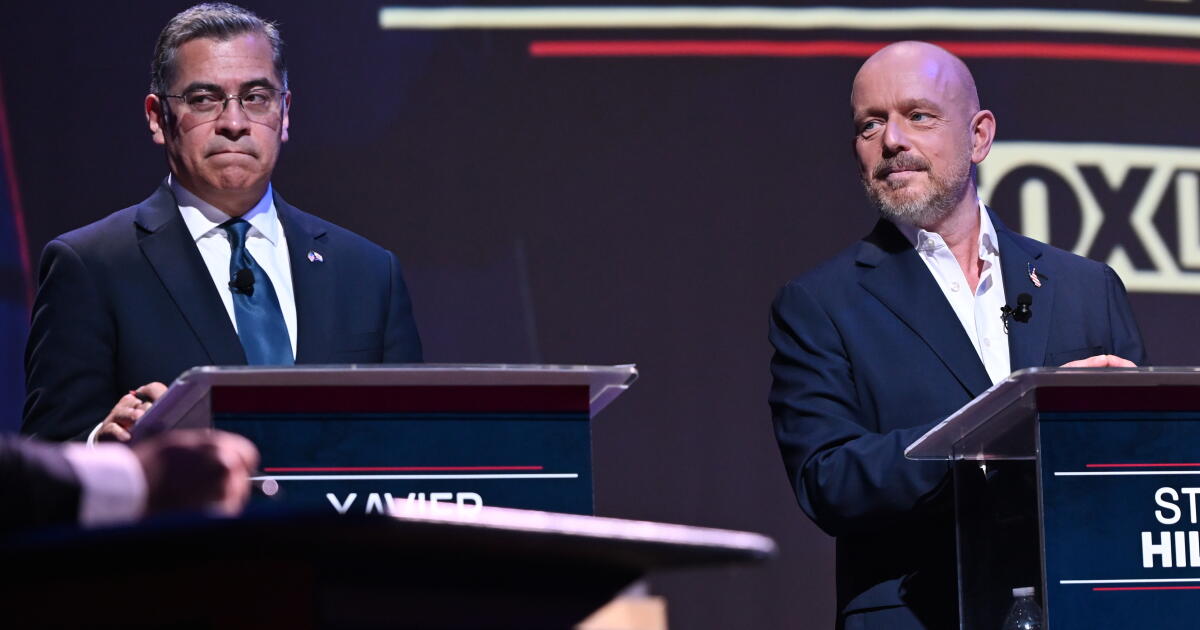
Chabria: I don’t know about a winner, but the debate definitely had a biggest loser: Bianco. The Riverside County sheriff, to his credit I guess, didn’t try for a hot second to hide who he really is — a conspiracy-loving immigration hardliner with ties to an extremist group.

Bianco sort-of said he was a member of the Oath Keepers, a far-right organization best known for some of its members participating in the Jan. 6, 2021, storming of the Capitol. He threw out election fraud theories, even suggesting state Atty. Gen. Rob Bonta could be involved. He made it clear that undocumented folks are breaking the law by existing in the state.

Maybe some MAGA voters will stick by that shtick, but I’m guessing independents and more moderate Republicans will find Hilton, the Trump-endorsed Republican, even more appealing after Bianco’s ragey ramblings. Hilton may well be sending his opponent a thank-you note and a bottle of bubbly for that performance.

As for winners, a couple of the Democrats had their moments. Porter spoke with clarity and force on issues including single-payer healthcare (she supports it) and resisting Trump’s immigration policies in this state of immigrants.

But she also directly addressed the criticism of her having a bad temper in a way that I think may haunt her.

As her male opponents bickered back and forth, taking swipes at each other, Porter said that given all the “shouting” and “disrespect” onstage, she was shocked that “anyone wants to talk about my temperament.” It’s a pushback she tried out earlier in the week with a new advertisement that sought to make a punchline out of the criticism.

I get her point and I don’t think a male candidate would face the same scrutiny for yelling at a staffer as she has, but also — what’s more unappealing to voters than an angry woman? A complaining one. That moment of resistance against the narrative may not land the way she intends with voters.

I agree with Gustavo that Villaraigosa had a good night, and that Steyer had Bernie energy — which may be good.

Steyer was the most lively and direct he’s been in a debate, landing a few punches and making points with clarity (far less wonky than he’s been in the past). He’s owning his far-left politics, and labeling himself the “change-maker.”

Steyer has been trailing Becerra in the polls, but Becerra again had a steady if less-than-thrilling appearance. For fed-up Democrats, Steyer may be looking better all the time.

Source link

Worst-run state? In Britain, Steve Hilton was inspired by California

Steve Hilton is a former Fox News host who has unexpectedly emerged as a leading candidate in the race for governor with a message that California is a failed state in need of radical reform.

But his sudden rise in California politics comes a decade and a half after he pitched the U.K. Conservative Party with a very different idea: Britain could learn a lot from the Golden State.

Back in 2010, when Hilton was a top strategist during David Cameron’s rise to power as Conservative prime minister, he looked to Silicon Valley’s high-charged ethos of techno-optimism and green innovation for inspiration as he sought to revitalize the ailing Conservative Party and the U.K.

Splitting his time between London and the Bay Area — his wife worked for Google — Hilton was instrumental in getting California companies to invest in the U.K. and persuading Google to open its first wholly owned and designed building outside the U.S. in London. So infatuated was he with California that one British political commentator dubbed the Cameron administration’s philosophy ”Thatcherism on a surfboard.”

But Hilton is now utterly unsparing in his criticism of California.

After moving to the Bay Area full time, teaching at Stanford University and hosting Fox News’ “The Next Revolution,” Hilton is running as a Republican on a platform of “Making California Golden Again.”

To the dismay of many Democrats, the 56-year-old British immigrant, a supporter of President Trump who dubs California “America’s worst-run state,” is ahead in multiple polls in a crowded race with no front-runner.

Even after former Democratic Rep. Eric Swalwell dropped out April 12 after multiple women accused him of sexual assault, Democrats are struggling to unite around one candidate. And Trump’s endorsement of Hilton this month almost seems to guarantee Hilton will secure enough Republican votes to make it past the June primary.

Hilton accuses Democratic leaders of turning the state into the “Wuhan lab of modern leftism.” As Democrats amassed power in Sacramento, seizing control of statewide offices and the Legislature, he argues, California government has become “a massive, bloated, bureaucratic nanny state,” so overregulated and poorly run, it is failing its people.

“We have the highest poverty rate in the country in California, tied with Louisiana, which is shameful, really, for a state that prides itself on being the home of innovation and opportunity,” he told The Times. “We’re ranked by U.S. News and World Report 50 out of 50 for opportunity. The performance of California, when measured against the rest of the country, is really dire.”

Most California voters rank affordability and cost of living as important as they weigh whom to elect as governor. But whether Hilton can persuade them that Democrats are responsible for the state’s problems, or make inroads as a Republican aligned with Trump on immigration and abortion, is unlikely in a state where Democrats outnumber Republicans nearly two to one.

Many Californians who do not watch Fox News know little about Hilton. Even some of Britain’s political observers who followed Hilton for years admit it’s been a struggle at times to make sense of his political odyssey.

Dubbed a “barefoot revolutionary” for his habit of striding around Downing Street without shoes, Hilton was credited with pulling the Conservatives into the 21st century and ushering in a more green, socially liberal strain of British conservatism. He helped turn around their image by highlighting climate change and supporting gay marriage.

Fraser Nelson, a columnist for the Times in London, said Hilton had been seen in Britain as a figure closer to Democratic Gov. Gavin Newsom than to Trump.

“When he popped up on Fox, it was like somebody reborn,” Nelson said. “Somebody who seemed to be on the left of politics was somehow on the Trumpish right. We thought it was like a joke. I’m not saying he is not sincere, just … the political journey of Steve Hilton … to being Newsom’s nemesis is something to behold.”

Born in London to Hungarian refugees who fled their homeland during the 1956 revolution, Hilton grew up in a household without much money.

After studying at Oxford University, a life-changing experience for a son of immigrants, Hilton worked at Conservative Party headquarters and as an ad executive on the Conservatives’ 1997 election campaign. When Labour’s Tony Blair won in a landslide, Hilton co-founded a consulting firm, Good Business, advising corporations on how to make money by investing in social and environmental causes.

In 2001, Hilton voted Green. But he returned to the Conservative fold in 2005 to try to detoxify the Tory brand. As an author of the party’s 2010 manifesto, he came up with Cameron’s “Big Society” agenda, which sought to scale back the state and hand more power to local communities. Critics, however, argued that the focus on local control was a fig leaf for austerity and dismantling the welfare state.

When Cameron won in 2010, Hilton infuriated colleagues in the coalition government, the British press reported, proposing a stream of wacky ideas: scrapping maternity leave, abolishing job centers, even buying cloud-bursting technology so Britain would have more sunshine.

Hilton ultimately became disillusioned with Westminster, deciding U.K. politics was stymied by excessive bureaucracy. In 2012, he moved full time to the Bay Area.

Hilton says he was drawn to California because of its “rebel spirit.”

But what he liked about California was the specific Silicon Valley ethos of disruption that emphasized meritocracy and risk-taking, not the state’s ascendant liberal identity politics.

Hilton settled in California precisely when Democrats were consolidating their political and cultural power. Just months after his move, Democrats gained full control of the Legislature with a two-thirds supermajority.

Meanwhile, populism was rising across the U.S. and Britain.

On the 2016 Brexit referendum on whether the U.K. should leave the European Union, Hilton was firmly pro Leave.

Hilton also disagreed with many fellow conservatives on Trump. In November 2016, George Osborne, chancellor of the exchequer under Cameron, watched the U.S. election on Hilton’s couch in Atherton, Calif. “Steve was the only person in the room who said, ‘I think Donald Trump’s going to win,’” Osborne said. “I think he identifies with Trump, although they’re obviously very different. … The outsider challenging the system.”

After the election, Hilton joined Fox News as a contributor and in 2017 was given his own Sunday night show, “The Next Revolution.” Produced out of Los Angeles, it explored populism in the U.S. and globally.

Like many conservatives, Hilton became agitated in 2020 by the COVID-19 lockdowns and Black Lives Matter protests that swept U.S. cities.

Early in the pandemic, Hilton invited Jay Bhattacharya, a professor of health policy at Stanford, to discuss COVID-19 after his study in Santa Clara County indicated the virus was more widespread and less deadly than initially thought. Bhattacharya argued the best path forward was not a general lockdown, but focused protection of the vulnerable. California leaders went on to impose some of the nation’s most stringent lockdowns.

After Joe Biden defeated Trump in November 2020, Hilton repeated Trump’s false allegations of voter fraud on air and called for an investigation.

Hilton became a U.S. citizen in 2021. Asked how his worldview changed in 2020, Hilton said: “I don’t think it changed. I think it actually enhanced my skepticism of centralized bureaucracy and it made me even more determined to dismantle it in California, because you saw all the worst features of it in California.”

In 2023, Hilton left Fox to launch a supposedly nonpartisan policy group, Golden Together, to develop “common sense” solutions to California’s problems. Two years later, he published “Califailure: Reversing the Ruin of America’s Worst-Run State,” a screed against Democrats. He accused them of spending “their time — and taxpayers’ money — pushing increasingly fringe race, gender, and ‘climate’ extremism instead of attending to the basics of good governance.”

A month later, Hilton announced he was running for governor “to make this beautiful state, that we love so much, truly golden again.”

On the campaign trail, Hilton has pledged to slash taxes, make housing more affordable and bring the cost of gas down to $3 a gallon. But how he plans to achieve some of these goals is controversial.

Hilton advocates scaling back environmental regulations. State agencies such as the California Coastal Commission and the California Air Resources Board, he argues, are a “massive roadblock” to housing development.

To lower gasoline prices, Hilton would ramp up California domestic production of oil and natural gas and reduce regulations on refineries.

Hilton would likely struggle to persuade a majority of voters to roll back environmental protections. According to the Public Policy Institute of California, about 55% of Californians think stricter state environmental regulations are worth the cost, while 43% believe they hurt the economy and jobs market.

Hilton is also at odds with most Californians on major issues from immigration to abortion.

If elected, he would foster more local cooperation with U.S. Immigration and Customs Enforcement and rescind state healthcare to undocumented immigrants. He would work with states such as Louisiana to extradite California doctors accused of prescribing and mailing abortion pills to women in states where abortion is illegal. He would also establish a Covid Accountability Commission to examine officials’ decisions during the pandemic.

Asked if Newsom and other Democrats could face prosecution, Hilton said: “They need to be held accountable for these crimes.”

With Trump in the White House, 2026 is a difficult year to mount a right-wing populist campaign for California governor, said Christian Grose, a professor of political science and public policy at USC.

“That message of ‘Newsom and the Democrats have been a disaster for California,’ that’s like, if you’re running in South Carolina,” Grose said. “It’s a caricature of California. While many California voters think there have been problems and the state is not doing as well, a Fox News presentation for East Coast viewers … that’s not going to win 50%.”

To make inroads past the primary, Grose said, Hilton would need to focus on governance and affordability and ditch the anti-Democratic red meat: “He has to massively soft pedal the kind of Fox News conservative stuff.”

Hilton’s Republican rival in the race, Riverside County Sheriff Chad Bianco, has questioned Hilton’s MAGA credentials, raising his green advocacy in the U.K. to cast him as an unprincipled opportunist.

Hilton, however, said he considers himself a “very strong environmentalist.” The problem, he argued, is the movement has become too narrowly focused on climate change and CO2 reduction. As crude oil production within California has fallen in recent decades and refineries have closed, he questioned California importing the bulk of its oil from as far away as Iraq and Ecuador.

“We are shipping oil halfway across the world in giant supertankers that run on bunker fuel, the most polluting form of transportation you can think of, rather than producing in Kern County and sending it in a nice, clean pipeline to the refineries in Long Beach,” Hilton said. “It’s total insanity. We are increasing carbon emissions in the name of climate change.”

Some political observers in the U.K. argue that Hilton’s questioning of California’s policy isn’t necessarily intellectually inconsistent.

“Perhaps in 2010 we needed more environmental policies,” Nelson said. “Perhaps in 2026 they’re doing more harm than good.”

Nor is it so odd, he argued, that Hilton now views California with a more critical eye.

“Even from a distance, when you look at California, there’s so much going fundamentally wrong,” Nelson said, citing its energy policy, homelessness and the exodus of residents to other states. “I’m not surprised by that, and I think it’s entirely consistent with Steve Hilton in 2010.”

Times staff writer Stephen Battaglio contributed to this report

Source link