Coming soon to L.A.: A bookshop that’s like stepping into a fairy tale
Genres Book Society, a new bookshop coming to L.A., is hiding a few secrets. The first indication that something a bit fantastical is going on here is the fact that the boutique store has a mascot.
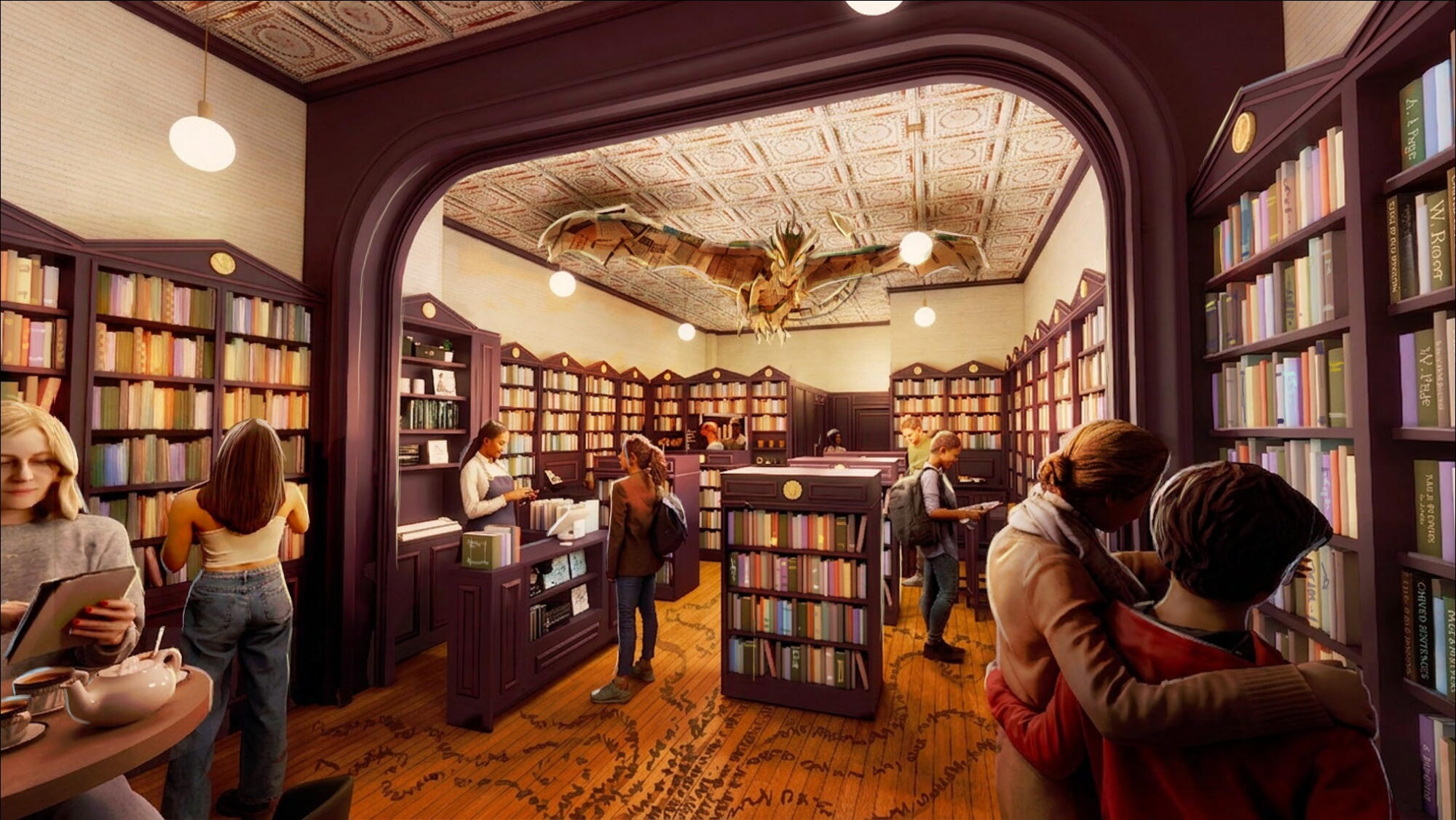
Look up upon entering the space, and you’ll meet Lore. Lore is a dragon, and this dragon is made of books. The striking sculpture will hover over a cozy space with modular bookshelves that are arranged on a floor covered in book quotes. Peer closely and you’ll see the quotes are designed in the shape of a tree.
A story is being built, a narrative that signifies that Genres aims to be not just a bookshop, but a place that feels like a real-life fairy tale. For this bookstore is also concealing a speakeasy of sorts, a secluded cafe and bar with multiple themed spaces and a two-story tree with glowing books growing out of its branches.
Stories, Genres is telling us, are life.
“This is for people who want to enter into story worlds,” says Ann Morrow Johnson of design firm Gensler. Johnson, a former creative with Walt Disney Imagineering, leads Gensler’s entertainment and experiences division, which is designing the bookshop.
She wants guests to feel transported into a fantasy universe, and understands how to make that happen. For instance? “Adding just a little bit of theatricality and sparkle helps create an invitation of suspension of disbelief,” she says.

The centerpiece of Genre’s bookstore, shown in an artist’s rendering, will be a dragon named Lore.
(Gensler)
Genres, on track to open in mid-2027 near the intersection of Melrose and Fairfax avenues, is tapping into a local trend of heavily designed thematic spaces with a penchant for fantasy. Think, for instance, of the Witch’s Cottage in North Hollywood, or the Last Canteen in the shadow of Universal Studios Hollywood. Consider it the latest evolution of the themed restaurant, and a way to bring the heavily theatrical worlds of theme parks closer to home. Johnson, for instance, says the firm’s research with the the Immersive Experience Institute has shown a hunger in younger generations to embrace spaces such as the Rainforest Cafe.
“People are seeking out a moment,” Johnson says. “Those more theatrical, highly scenic spaces are more likely to get you off your phone. Little moments of delight center you.”
Genres was dreamed up Clare Grant and Karissa Marston, who brought the project to Gensler and tapped them to lead its design. Grant, an actor/producer, says the idea came to her while experiencing the regret of missing a retreat hosted by her girlfriends, who had rented a cabin to read the latest edition in the fantasy “Crescent City” series.
“Just having a newborn, I was like, ‘Why can’t I go read this book in a fantasy-themed cabin?’ That’s literally my dream,” Grant says. “Then I started thinking about it. Why don’t I have something like this in Los Angeles, where I can pop in for an afternoon or evening where someone is handing me drinks and food in an immersive space?”
Marston, it turns out, who has experience in hospitality and marketing with an emphasis on fandom, was already dreaming of such a space. The two of them crafted a business plan for a bookstore, one that wouldn’t look out of place in a sword and sorcery fantasy novel, with a hidden speakeasy.
“I was in Paris, and I went to the Shakespeare bookstore, and it was truly the most magical experience I have ever had,” Marston says. “I walked in and felt so immersed in the books and the history and I went up to the second floor and sat up there and wept. I was like, ‘I never want to leave this place. I only ever want to feel this way and be surrounded by books and people who love books.’”
Their vision is grand. The bookstore, they hope, will become a gathering spot for authors in the fantasy and sci-fi realms. And they talk of the speakeasy as not just being a safe eatery to sit and read all day, but also a future venue for, say, immersive theater. The two-story space will house multiple themed rooms, either for hanging out and hiding, or for potential events.
“I think it’s safe to say that if you wanted to be transported to outer space, you would be pleasantly surprised,” Marston says. “Or if you wanted to escape to Dracula’s castle or some of these other really big genres that you have, readers will be pleasantly surprised at the worlds that we are building.”
Johnson says Genres will be flexible enough to welcome introverts who want to dream away the day with a book, but can also be a home for a baby shower in addition to an author signing or a theatrical event. That’s in part why the shop and ground floor of the speakeasy have a familiar fantasy vibe, one not out of place in, say, the fairy tales of the Brothers Grimm, albeit with the welcoming tone of Disney.

Genres’ founders cited “A Midsummer Night’s Dream” as an inspiration for the bookshop’s bar, depicted in an artist’s rendering.
(Gensler)
“The focal point of the space is this sort of epic woodland fantasy,” Marston says. “When we first brought this to Gensler, and showed them our inspo deck, we kept saying ‘A Midsummer Night’s Dream.’”
That’s key, as everything in the space will spring from the written word. Genres, in that sense, also feels refreshing, emphasizing actual books and tactile media at a cultural moment when AI is often dominating conversations. Grant and Marston speak of being influenced by passionate social media creators who celebrate books, wanting to build a community as much as an event space. A prerequisite to be a bartender, says Marston, will need to be a love of books.
“We’re calling all our bartenders book-tenders,” Marston says. “Not only will they be well-versed in all things spirits and cocktails, but they are also someone who can give you the next book recommendation. These are very specialized employees. They can curate cocktails and books for you.”
Consider Genres a place for dinner and drinks, but one where story is always on the menu.
“People are craving more than dinner,” Grant says. “They want experience. They want magical memories that can get them through harder moments because nothing is easy right now. People want to spend money on something that is more than just dinner or going to a bar. Like whimsy.”