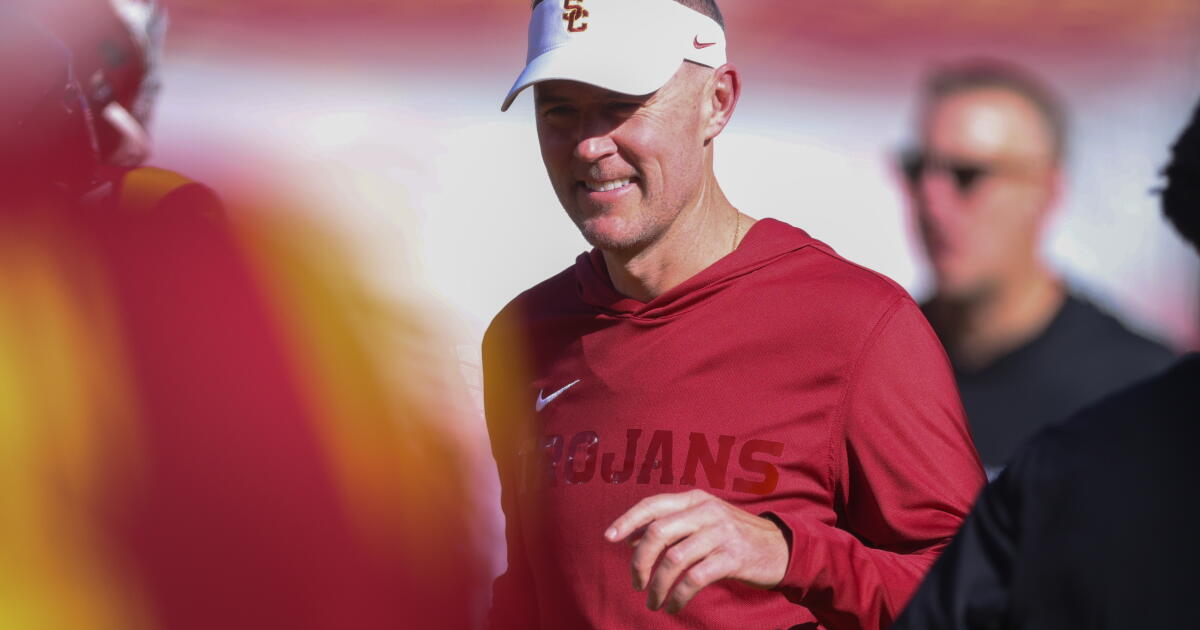
USC coach Lincoln Riley says quarterback Jayden Maiava isn’t injured
USC quarterback Jayden Maiava has been playing above-average football, but the signal-caller’s deep throws have not been as sharp lately and he has shied away from some contact after taking a big hit to his shoulder during a 39-0 shutout of Fresno State on Sept. 4.
When asked about his quarterback on Tuesday, Trojans coach Lincoln Riley quickly replied that Maiava is not injured.
“Jayden has been pretty healthy,” Riley said. “They’ve kept him upright all season long.”
Maiava has adapted to shifting receiving options, calling it a learning experience as he connects with new pass catchers. USC freshman Trent Mosley was an early breakout star, but Maiava has had to look to others with Mosley out the past two games because of injury.
“I’ve been trusting myself, trusting the plan and trusting those guys on the perimeter,” Maiava said
He credits co-offensive coordinator Dennis Simmons for having his receivers ready whenever their names are called.
“It’s the next-man up mentality and we are all going to do the same thing,“ Maiava said.
A key building block

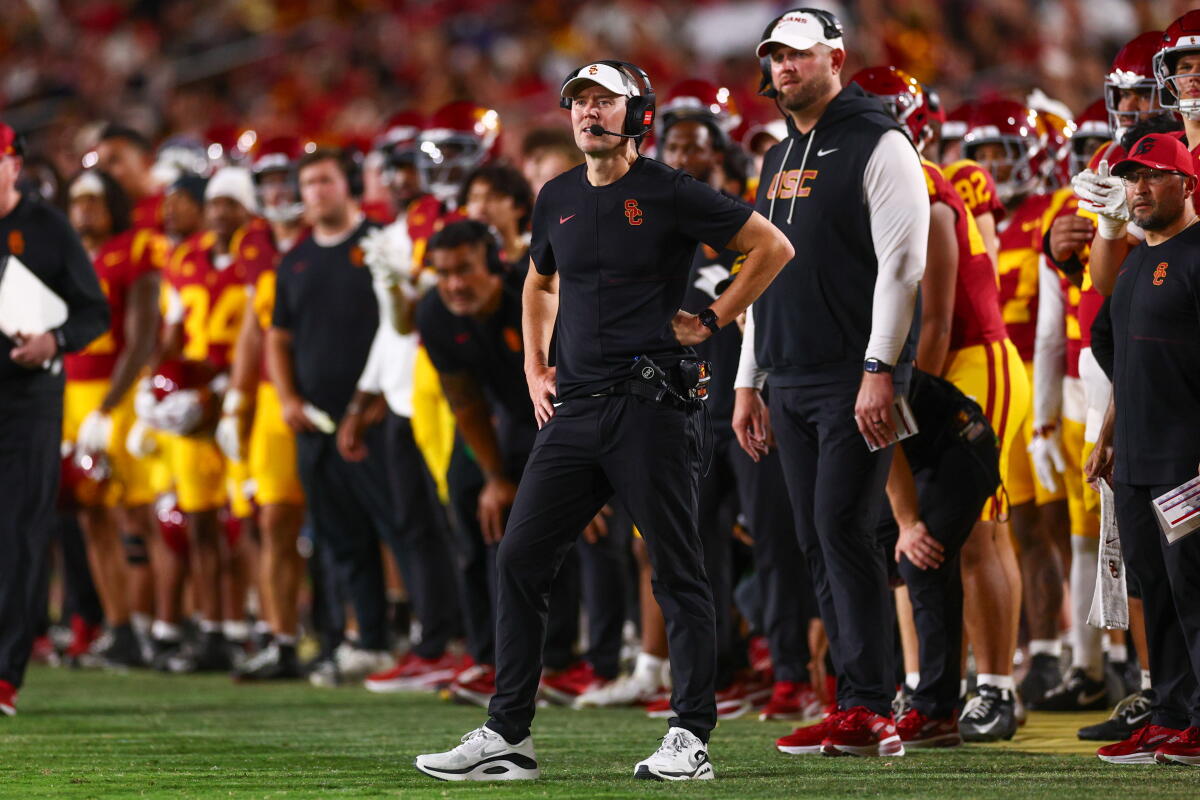
USC coach Lincoln Riley watches from the sideline during the fourth quarter of a win over Washington at the Coliseum on Oct. 3.
(Ronaldo Bolaños / Los Angeles Times)
As USC chases the program’s first win over Penn State in Happy Valley, Riley said he expects the Trojans to draw on the resilience they showed against Washington.
He called the rally for a victory over the Huskies a potential turning point for a program that can’t afford another loss if it hopes to reach the College Football Playoff for the first time during Riley’s tenure.
“It wouldn’t shock me if six to eight weeks down the road you’re going to look back at us and see that’s the game that was critical in the season,” Riley said of the Washington win. “Those are important. It helps develop the personality of your team. Most importantly, the biggest thing it shows is the brotherhood within our locker room right now.”
Supporting the defense

USC cornerbacks Chasen Johnson and Prophet Brown break up a pass intended for Washington receiver Dezmen Roebuck in the end zone to secure the Trojans’ win at the Coliseum on Oct. 3.
(Ronaldo Bolaños / Los Angeles Times)
Hiring College Football Hall of Fame coach Gary Patterson was supposed to turn the Trojans into a potent Big Ten defensive team.
Through six games, the Trojans have allowed an average of 25.5 points per game, ranking 89th in the country, and have given up 348.8 yards.
“[Patterson] is one of the best coaches of our generation. One of the best defensive minds in college football history,” Riley said, backing up his coordinator when asked about his progress.
Riley, however, did not defend poor tackling on Washington’s final touchdown drive that put the Trojans on the brink of a loss.
When asked whether the mistakes were addressed with the players, Riley responded, “Oh yeah. … It was a bad play. Not near our standard.”
He later added, “I bet we don’t see it again.”
While the Huskies’ scoring drive exposed some problems, the defense held its ground late in the fourth quarter to seal the win.
The Trojans’ secondary got a boost from Ta’Mere Robinson, who played well in place of suspended defensive back Desman Stephens II.
Stephens served a one-game suspension for a late hit to the head on Oregon quarterback Dante Moore and his behavior celebrating as Moore was being treated by medical staff before leaving the Coliseum in an ambulance.
USC released an apology from Stephens a day after the game. Riley was asked Tuesday whether Stephens would get his starting job back after Robinson’s strong play. While he didn’t specifically address the starting role, Riley did suggest Robinson earned more snaps.
“It was an opportunity for some other guys to step up and they did. … When you see guys that are there for that opportunity and rise to the occasion, it’s going to create more opportunities for some of those guys, there’s no question about it,” he said. “But Des is a good player and an important part of this football team. We view this a lot like just we’re coming back off any normal football game, like nothing else happened. … I think what we learned this week is we have a handful of guys who can go out there and play really, really well. … We look at it as a positive.”