stephen miller

Nvidia scandal widens rift between Trump and GOP as Congress unites in alarm

President Trump’s extraordinary effort to put Jensen Huang back at the head of Nvidia has done what few of his other moves have managed: It has united much of Congress against him.

The president’s assurances that Huang poses no national security risk, despite an affair with an alleged Chinese spy, have done little to quiet concern in Capitol Hill. Now, Republicans and Democrats alike are demanding evidence to show why they should not be worried, and have lined up hearings for Huang to testify in Washington next week.

“The NVIDIA board’s brief internal investigation and reinstatement of Jensen Huang do not erase the national security threats and questions that must be addressed,” the chairs of the Republican-led House foreign affairs and intelligence committees as well as the House select committee on the Chinese Communist Party wrote in a joint statement.

The chairmen — Reps. Brian Mast of Florida, Rick Crawford of Arkansas and John Moolenaar of Michigan — said they want answers on the “mass smuggling” of Nvidia’s advanced artificial chips to China. The chip maker, which is worth roughly $4 trillion, has been at the center of a fierce race with China for superiority in artificial intelligence, and the lawmakers said they want to know whether their products played a role in “advancing our foremost adversary’s AI capabilities.”

As of Tuesday, no congressional Republicans had defended the decision to reinstate Huang. Instead, they openly criticized the president’s intervention efforts, called for more transparency on the matter or opted to remain silent.

“This is a declaration of independence on the part of many Republicans,” said Darrell West, a senior fellow at the Brookings Institution. “They have been toeing the Trump line for several years, but he has gone too far, and now they’re openly criticizing him.”

Democrats, who are poised to take control of Congress in January, have been fiercely critical of Trump and called for the passage of bipartisan export control measures to block the shipping of American-made chips to China.

“Huang shipped extremely advanced chips to China, violating US export control law, in what amounts to the equivalent of selling rocket engines to the Soviets during the Space Race,” Sen. Chuck Schumer (D-N.Y.), the minority leader, said in a statement Tuesday. “This is an unfathomable failure of enforcement by the Trump administration.”

Criticism came from across the Republican spectrum. Mitt Romney, the former senator from Utah and the party presidential nominee in 2012, accused the Trump administration of contradicting itself on China.

“Let me get this straight: we rushed AI along without regulating safeguards in order to stay ahead of China and at the same time, we sold China the very chips they’d need to get ahead of us. Smells of profit, corruption and perhaps much worse,” Romney wrote on X.

Far-right activist Laura Loomer argued that Huang’s reinstatement is “going to blow back on our national security.”

While there is unity against Huang’s return and the administration’s lax concerns over national security, Democrats are hopeful the bipartisan backlash will expedite bipartisan legislation on AI product regulation, but question how long Republicans will push back on the scandal.

“Courage is something that Republicans lose whenever Donald Trump speaks, but when it comes to some of the export controls that we are trying to legislate, there is going to be a lot of support,” Sen. Ruben Gallego (D-Ariz.) said on MS NOW on Tuesday. “I think at the end of the day they are going to back off. But that does not stop our responsibility.”

Leaders in the executive branch, meanwhile, have largely supported Trump’s narrative that there is no need to worry about America’s security being compromised. Vice President JD Vance, who is weighing a run for the party’s 2028 nomination, has touted the fact that he personally urged Trump to reinstate Huang.

When asked how the administration determined Huang posed no national security risk, Atty. Gen. Todd Blanche said Tuesday there was a “collective consensus” reached among members of the intelligence community, law enforcement partners and various federal agencies.

“Nvidia is a good corporate citizen,” Blanche said. “That shouldn’t be groundbreaking, that is something the president has talked about, that the vice president has talked about.”

Blanche skirted several questions about the Department of Justice’s investigations into Huang and the Singapore-based chip exporter Megaspeed, where the alleged Chinese spy formerly worked.

“I don’t know what you’re talking about,” Blanche said. “We have hundreds, if not more, export investigations going at any time at the Department of Justice.”

These assurances have done little to allay mounting concerns on Capitol Hill about both the threat of China as well as corruption in the Trump administration — a key issue that pushed voters left in November.

“Everything Trump has done since the election betrays no learning about that midterm election,” said West, pointing to the appointment of Stephen Miller as White House chief of staff, despite the unpopularity of Miller’s extreme immigration methods, as another example. “He’s not changing course. He’s digging the hole deeper.”

The president appears to fail to understand that tech billionaires remain largely unpopular with the overall electorate, West argued. Elon Musk, the world’s richest man, spent roughly $500 million trying to boost Republican candidates and “got nothing for it,” West said.

Though Musk distanced himself from Trump following the Republicans’ midterm flop, he joined fellow tech titans such as Sam Altman in praising Huang’s return. In a meeting Tuesday, Huang apologized to his employees for violating the company’s code of conduct and told them he is in therapy every day, multiple outlets reported.

But for Democrats, Huang’s reinstatement is not only about one executive’s judgment. It is about the president’s, too, and who stands to profit from it.

Democrats have long accused Trump of blurring the line between his finances and the nation’s interests. The Nvidia episode has given them more political ammunition to make that case.

On Monday, Schumer said the president was “putting his own financial interests and the needs of his billionaire buddies before our national security, emphasizing that he’s learned nothing from his resounding election defeat.”

The president owned at least $12 million in Nvidia shares at the end of last year, and Nvidia donated $25 million to his White House ballroom project. After Huang’s reinstatement, the company’s stock rose more than 30%, which is estimated to have increased the value of the president’s holdings by about $15 million.

Democrats say they intend to make that connection central to their investigations. The scandal is also giving momentum to a longstanding Democratic goal: banning lawmakers and senior government officials from trading individual stocks. Congressional Democrats are expected to pursue a stock trading bill when they take control of the House and Senate in January.

But legislators are racing against the clock to get either export control or anti-corruption legislation passed as the lame duck session of congress winds to a close and the threat of a government shutdown looms.

“They’ve got a lot of things to get done, and I think that the business of the schedule threatens to crowd out what I do think is a very real bipartisan push for tighter export control legislation,” said Lanhee Chen, fellow in American Public Policy Studies at Stanford University.

Chen noted that economic and security threat posed to America by China has made protective actions against the country one of the only issues Democrat and Republican legislators agree upon.

“This is a unique issue,” he said. “I attribute this current desire of Republicans to potentially break with the president to be related to their concern about China, and I don’t necessarily see it applying to other issues.”

Source link

Examining “hatemonger’ Stephen Miller’s new plan to assail Latinos

Last week voters across the country rejected Republican politicians and the Trump administration’s agenda. Democrats gained control of both the House of Representatives and the Senate — nabbing historic pickups in Republican strongholds such as Kansas, South Carolina and Texas.

Notably, Latino voters turned their back on Republicans after giving Donald Trump 48% of the vote in 2024. A New York Times voter analysis found that Latino voters shifted 29 points toward Democrats between 2024 and 2026, compared with a 15-point shift among voters overall.

After the monumental about-face, President Trump processed the defeat by blaming everyone around him for the blue tsunami.

After Trump-endorsed candidates lost pivotal Senate seats, the president posted on social media, “I wasn’t on the Ballot and if I was, we would have won IN A LANDSLIDE!”

The resignation of White House Chief of Staff Susie Wiles last week was perhaps the most telling move about how Trump plans to deal with Republican losses nationwide. Wiles was promptly replaced with far-right advisor Stephen Miller, who previously served as the deputy chief of staff.

“I wanted to make a change,” Trump told reporters Nov. 6. “I think Susie’s done a very good job. … Stephen’s been great and we’ve got to make moves.”

Political observers now fear the appointment signals Trump will double down on an agenda that has alienated broad swaths of voters, including Latinos, who were among the most targeted demographic in the administration’s campaign of aggressive immigration enforcement spearheaded by Miller.

To better understand what Miller’s promotion will mean for the president’s future plans, The Times spoke with New York Times contributing writer and USC associate professor of journalism Jean Guerrero, who literally wrote the book on Miller.

Her 2020 book, “Hatemonger: Stephen Miller, Donald Trump, and the White Nationalist Agenda,” examined Miller’s upbringing, the political forces that shaped his ideologies and the origins of his anti-immigrant policies.

This interview has been edited for clarity and length.

With the big news of this election cycle being that Latinos turned their back on Trump, do you see the appointment of Stephen Miller as an act of revenge by Trump? What do you think he’s trying to signal for his agenda over the next two years with this promotion?

I think he’s trying to signal that he plans to double down on talking down on Latino and immigrant communities because [Trump and his allies] need the war on immigrants to continue their war on the working classes, which is what this is all about.

The general public is fed up with this administration because of how de-prioritized working families have been, and that’s across the board: white, Latino, Black, Asian. The war on immigrants is central to that de-prioritization because by criminalizing a sector of the population and keeping [them] in the shadows and in fear, they are able to suppress wages for the entire working class and they’re able to keep immigrants from being able to organize with their citizen co-workers in the workplace.

What do you think we can expect to happen to immigrant Latino communities specifically under this era of Stephen Miller?

I think what we’re going to see is an extreme expansion of the war on immigrant communities and their allies specifically. That is going to disproportionately target U.S. citizen Latinos — using what power and privilege they’ve been able to accumulate through the sacrifices of their parents and grandparents — who are at the front lines of defending their community members.

Your book discussed how Miller’s high school years helped shape his anti-immigrant, anti-Latino sentiment and how that seems to have stemmed a bit from going to a public school in Santa Monica. Can you talk a little bit about that?

A lot of people get surprised when they learn that Stephen Miller was from Santa Monica, because it’s a liberal enclave, but he is very much a product of the liberal hypocrisy that he witnessed growing up in California. What he witnessed remains true of establishment and corporate Democrats today, which is a professed concern for marginalized communities and performative support for social justice, while completely neglecting to pursue any concrete policies that would make the lives of marginalized communities any better.

One of the ways he exploited that fact to rise in power was by aligning himself with the conservative movement that was growing rapidly in California during the 1990s, led by David Horowitz — a conservative activist in Studio City — who became one of Stephen Miller’s main mentors and who groomed a generation of young conservatives to use the tools and terms of the civil rights movement against the gains of the civil rights movement. Miller learned to perceive multiculturalism and people of color as an existential threat to the U.S.

Do you think that putting Miller in the position of chief of staff is a way for Trump to reposition this war on immigrants as his main thing and to move away from the more economic and cost-of-living concerns that people also seem aggravated by?

They’re going to continue to try to frame immigrants as the enemies of the working classes, which is masterful gaslighting. By doing that, they are ensuring that citizen workers don’t organize alongside immigrants for higher wages, for economic equality. I think the immigration issue is actually at the heart of the economic issues that people are upset about. I say that because you saw the mass deportations affecting things like construction sites, which were left empty of workers, so people who were trying to build housing at a time of housing scarcity were being targeted. You saw farmworkers getting targeted in the fields, which led to higher food prices.

The war on immigrants is a war on the working classes. By doubling down on it, Trump is going to be trying desperately to confuse people into thinking that immigrants are to blame for the economic pain that everybody is feeling. When in reality, the economic pain that everybody is feeling is because of this war on immigrants which is pouring billions of taxpayer dollars into mass surveillance, mass incarceration of people based on their race and language. It is a huge waste of taxpayer dollars.

Trump has been speaking out of both sides of his mouth on his immigration messaging. He recently acknowledged that people might have thought he was too tough on immigration, but this appointment of Miller signals that he will be going harder on the issue. What is the calculation there in your view?

He’s trying to exploit the echo chambers, which makes sense for a dear friend of the tech elites for him to know how to do that. He’s hoping that one piece of information will reach one audience and another piece of information will reach the other audience. So the people who are fed up with the war on immigrants will hear him say that he’s scaling it back and they’ll be happy and they’ll support him. The people who love the war on immigrants, which are fewer and fewer every day, will hear about Stephen Miller and get really excited about that. He’s just hoping that the [online] algorithm will work in his favor.

You’ve previously spoken about noticing a shift in Miller’s immigration mindset over the years, can you talk about that change?

During the first administration, he was focused entirely on strangling legal pathways into this country, such as gutting the asylum and refugee systems, and restricting green card access and separating families at the U.S.-Mexico border. All of this geared towards racially reengineering the demographics of this country. During the second administration, he’s done some of that with these mass deportations where he’s directed agents to round people up at worksites and where they’ve been racially profiling people and detaining people based on their skin color and language and blue-collar jobs as opposed to their criminal records.

At the same time, Miller has been one of the most vocal proponents of Trump’s foreign interventions and invasions, which have set the stage for the mass displacement of new refugees and immigrants. Watching Miller be so vocally supportive of these interventions, I realized he had shifted, and that he was no longer primarily motivated by restrictionist ideologies and white nationalist ideologies — it was about class.

Trump and Miller are using the war on immigrants to manufacture and maintain a permanent underclass in the United States, which is something that has been done by many administrations for many generations. But they’ve taken it to an astounding level that has caused an unprecedented amount of economic, spiritual and psychological pain across this country.

With Democrats gaining a bunch of seats in the Senate and the House, and taking control of a bunch of state legislatures, what can they do to potentially minimize Miller’s effect in the White House?

It is imperative that the Democrats use their majorities not only to investigate the crimes against humanity that this administration has been committing, but also to deliver on behalf of working families. At the center of that has to be ending the war on immigrants. They have to abolish ICE. They have to pass legislation to protect the longtime undocumented population — who Democrats have said that they’ve been going to protect for many administrations and have not prioritized, even when they previously had majorities in Congress.

If they do not deliver on behalf of working families by emancipating the subjugated classes, then they’re admitting they too are in alliance with the pillaging classes and that they are no different from Trump and Miller. The main thing they have to do is counter any maneuvers that Miller is going to be making from the White House. They can’t just be all talk. They have to deliver in concrete ways for working families and they’re not going to be able to do that if they ignore the immigrant community that has been at the center of the Trump administration’s persecution.

Nithya Raman’s win upends L.A. Latino politics

A few weeks back in this newsletter, I discussed how Latino voters would be the deciding factor in the L.A. mayoral race as the demographic helped carry Mayor Karen Bass in the primary, with her winning 35 Latino-majority neighborhoods in the June 2 election.

Five months, much campaigning and the botched response to a massive warehouse fire in heavily Latino Boyle Heights later, Bass’s competitor, Councilmember Nithya Raman, courted the Latino vote in last week’s election. A Times analysis of early election returns showed Raman won big in the heavily Latino neighborhoods such as Wilmington, South L.A. and Pico-Union.

My colleague and Latino voting expert Gustavo Arellano wrote about how Raman’s win was the death knell for L.A.’s Latino political establishment.

Arellano discussed how Bass consistently aligned herself with a cohort of moderate Latino politicians — such as City Councilmembers Monica Rodriguez and Imelda Padilla, Assemblymember Celeste Rodriguez and Rep. Luz Rivas — at reelection events. Conversely, Raman focused on activating younger, more progressive Latinos throughout her campaign.

The L.A. Latinos’ traditional political machine was in trouble before hitching its wagon to Bass’s failed reelection campaign, Arellano noted. It began in 2022 when three City Council members were embroiled in an audio leak scandal, which created an avenue for two democratic socialists to grab council seats. The Latino old guard also lost two more council members in 2024, and former L.A. Mayor Antonio Villaraigosa, bastion of that political class, ran a supremely unsuccessful gubernatorial campaign this year.

Raman’s grassroots approach met Latino voters where they were and not where she thought they were supposed to be — something Bass’ chief campaign strategist, Julie Chavez Rodriguez, could learn a lesson from.

“The mayor ran on a very institutional playbook of getting a bunch of Latino politicians together so they could tell Latinos how to vote,” Marco Santana, who ran for City Council earlier this year, told Arellano. “That doesn’t work anymore. Latinos want deeds.”

One actor’s pursuit to dub “The Lion King” in Quechua

Voice actor Fernando Valencia grew up in the Andean Peruvian town of Huanimpampa, where the Indigenous language of Quechua is still an integral part of everyday life. He noticed that the dialect is never represented in dubbed versions of Hollywood family hits, which creates a barrier for comprehension among children whose primary language is Quechua.

To point out this lack of availability and to show that an avenue for accessibility was possible, Valencia dubbed segments of Hollywood blockbusters such as “Star Wars: The Empire Strikes Back” and “The Lion King” into the language spoken by nearly 10 million South Americans.

He has since dared to dub “The Lion King” — the first movie Valencia watched in its entirety as a child — fully into Quechua. Valencia’s attempts are documented in Peruvian filmmaker Augusto Zegarra’s debut feature, “Runa Simi,” which is the name of the Quechua language in Quechua and translates to ”language of the people.”

De Los contributor Carlos Aguilar recently spoke with Valencia and Zegarra about the film and the voice actor’s monumental undertaking.

“If I keep my language and culture in a fragile little jar, someone will come along and trample it, and it will disappear forever,” Valencia said. “But if I open this little jar and build bridges, it will be difficult to eliminate it because it will be integrated into the world.”

A similar linguistic venture to preserve a native language was completed by Tweedie Waititi, the sister of Oscar-winning director Taika Waititi, who partnered with Disney to dub multiple titles into te reo Māori.

Valencia’s mission was given a major bump after Peter and Benjamin Bratt, whose mother, Eldy Banda, is an Indigenous activist of Quechua descent, signed on to the project as executive producers.

“It felt like a statement to have someone who has never heard of the Quechua language, maybe someone in Europe or the U.S., ask what runa simi is and then being able to tell them: ‘You’re already speaking it! By saying the words runa simi, you’re already using the language,’” Zegarra said.

Stories we read this week that we think you should read

Unless otherwise noted, stories below were published by the Los Angeles Times.

Politics and immigration

Arts and entertainment

Southern California

Source link

‘TrumpCare’ and commemorative plaques — how Democrats are pitching deal-making with the president

Jonathan J. Cooper and Lisa Mascaro

Abdul El-Sayed has proposed “TrumpCare,” a golden insurance card providing universal healthcare, dangling the president’s name on the ambitious Democratic plan.

James Talarico has suggested Donald Trump could become a man of history like Lyndon B. Johnson, who was seen as a master of congressional dealmaking.

And even Hakeem Jeffries, in line to become the House speaker in January, has left the door open to working with the other side of the aisle “wherever and whenever possible” to deliver for the American people.

Democrats who swept into power by riding voter backlash to Trump are now pitching ways to collaborate with the president, playing to his vanity and his love of making deals to propel their own agenda.

The offers coming from the Democrats carry both practical and political applications — a strategy to show that the party is serious about the hard work of legislating and also an acknowledgment that Trump’s signature is needed for new laws.

Trump himself has said he doesn’t want to spend the final two years of his presidency simply vetoing bills from the Democrats in control of Congress. It was only a few short years ago, during his first term, that Trump stunned Republicans by cutting deals with the Democratic leaders he called “Chuck and Nancy” — Senate Leader Chuck Schumer and then-Speaker Nancy Pelosi.

Democrats appeal to Trump’s vanity

Before the next Congress begins in January, Democrats are trying to entice Trump with the prospect of timeless glory to a president fixated on making his mark on Washington.

All he has to do, they say, is work with them to deliver sweeping policies like Medicare for All.

“Donald, this is on the table. Guarantee healthcare for every American, from cradle to grave,” El-Sayed, who won the U.S. Senate race in Michigan after Trump branded him a terrorist sympathizer, wrote on social media.

He attached mock-ups of a gold-colored card, with Trump’s name and signature far more prominent than the small text reading “Medicare for All.”

Universal healthcare has long been anathema to Republicans, although Congress — and even the Republican president himself — will face pressure to deal with rising costs.

Trump’s willingness to slog through extended negotiations with Democrats is an open question, and his past promises of dealmaking have been hit and miss. He reiterated Thursday he is willing to work with Democrats.

“I’m going to be vetoing a lot of things that they’re going to send me initially that are bad for the country, and I think eventually they’re going to call in, they’re going to say, ‘Let’s make a deal,’ and we’ll be able to make deals on healthcare, on drug prices,” the president told commentator Stephen A. Smith in an interview.

Trump’s choice of Stephen Miller as his new White House chief of staff may foreclose some of those opportunities, however. Jeffries described Miller as a “stone-cold racist” and said he has “zero interest” in working with him.

The pitches from Democrats keep coming

The pitches from some of Democrats’ most high-profile new arrivals in Washington will help shape the party’s approach for the rest of Trump’s presidency.

Talarico, the Democrat elected to the U.S. Senate from Texas, described the ways that Johnson is memorialized on Capitol Hill and remembered for shaping civil rights and social services as a senator and president.

“If President Trump wants the same plaques and portraits and busts as LBJ, we can help make that a reality,” Talarico said Thursday at the What’s Next conference in Denver, where many Democrats gathered to plot their way forward.

Talarico made his pitch to Democrats as much as to Trump. After getting the fulsome repudiation of Trump they’ve been seeking for a decade, the party’s base voters may not be eager to see their newly elected leaders standing with him for a bipartisan signing ceremony at the White House Rose Garden that he paved over to create a patio resembling his Mar-a-Lago resort.

However, Talarico said Americans are counting on bold changes before the next president takes office after Trump’s second term ends.

“Some of these reforms may not pass until 2029, but the American people cannot wait two years for change,” he said. “So we must work with President Trump.”

The eagerness to work with Trump is notable from El-Sayed and Talarico, who were among the president’s most frequent targets as he hop-scotched the country for Republicans ahead of the midterms. He singled them out for especially personal attacks, questioning El-Sayed’s loyalty to the United States and labeling the Texan as “Talafreako.”

Cooper and Mascaro write for the Associated Press. Cooper reported from Phoenix.

Source link

In search of post-midterm message, Trump waffles on trusting election, immigration policy

After initially congratulating Democrats on their midterm wins, which he said he was “absolutely willing to accept,” President Trump posted a baseless missive to social media about not trusting early ballot totals or voting machines.

“Does anybody really believe that this ‘Election’ was honest. How could the Polls be so wrong???” he wrote.

The post was a return to the unsubstantiated election denial that has animated his political career since its inception. It was also the latest swing in public messaging from the president and his administration since Republicans lost control of both chambers of Congress and key governorships across the country last week.

Trump — notoriously hard to pin down and prone to meandering tangents — has waffled for nearly a week now on several key policy positions. Other leaders in his administration have split on the same issues, further confusing the public.

On Friday, Trump named Stephen Miller — chief architect of his administration’s sweeping immigration crackdown — as his new chief of staff, which many took as an unambiguous sign that Trump intends to double down on those policies through the second half of his term.

In a “60 Minutes” interview taped the same day and aired Sunday, Trump said that some of those same policies were “too tough,” and that he was open to working with Democrats to find a pathway for undocumented but law-abiding immigrants to remain in the country legally.

On Monday, Trump said he hadn’t told Miller to change his approach, that his administration has a “very strong deportation policy” and that there would be “no amnesty, no anything” for undocumented immigrants, though the administration will be focusing on “the worst of the worst.”

“My policy hasn’t changed,” he said. U.S. Immigration and Customs Enforcement posted, “If you are here illegally, we will find you, arrest you, and DEPORT you.”

After Vice President JD Vance last week blamed the party’s stunning losses squarely on the Iran war, Trump acknowledged that the war — and the spiking gas prices it caused — probably hurt his party at the polls.

But he has since dismissed growing calls from both sides of the aisle for Defense Secretary Pete Hegseth to be fired, claimed the war has already been “won,” and suggested Americans’ displeasure with the economy was based on little more than bad messaging on the nation’s economic “numbers,” which he claimed are strong.

Hegseth said he wasn’t going to get into a “finger pointing exercise” over Vance’s remarks, but that the war “doesn’t have to be necessarily popular” to be necessary.

The White House did not respond to a request for comment on Trump’s shifting postelection messaging.

Leading Democrats, smelling political blood and preparing to take control in Washington, have seized on Trump’s vacillations and doubling down on unpopular positions to paint him as badly out of touch and stubbornly resistant to the will of the American people.

After his Friday appointment of Miller, for example, California Gov. Gavin Newsom wrote, “The American people just delivered Donald Trump a historic rejection. So naturally, he hands keys to the architect of his most cruel and inhumane policies. Absolutely disgraceful.”

After Trump’s post Monday about voting machines, Senate Minority Leader Chuck Schumer (D-N.Y.) wrote, “Donald Trump’s pathetic return to election denialism was inevitable. He can whine all he wants, but nothing will stop this inescapable truth: For the last two years of his presidency, Trump will face the largest Democratic congressional majorities in decades, all because he has been an unprecedented failure.”

Experts who have long studied the president’s rhetoric said it should come as no surprise, as it is perfectly in line with his mantra of never admitting defeat, never accepting blame and never showing weakness — even in the face of an overwhelming defeat.

“He is caught between a rock and a hard place,” said Robert C. Rowland, a professor of rhetoric at the University of Kansas and author of “The Rhetoric of Donald Trump: Nationalist Populism and American Democracy.” “He’s seen the anger of the country, but he’s trying desperately to blame someone else — when all of the data says that this was mostly about him and the results or failures of his policies.”

After Republicans suffered substantial midterm losses in 2006, President George W. Bush acknowledged his party got a “thumping” and immediately fired Defense Secretary Donald Rumsfeld, who was closely tied to the unpopular Iraq war. After Democrats suffered losses in 2010, President Obama acknowledged what he called a “shellacking” and also recalibrated, becoming less “post-partisan” in his messaging and more pragmatic, Rowland said.

Trump’s message about working with Democrats on certain issues could be seen as his own attempt to pivot, if only slightly, Rowland said, but it has been completely undermined by his moves to elevate Miller and reject accountability from Hegseth and others tied to the Iran war.

More than anything, Rowland said Trump’s baseline instinct is to project masculine power and deny culpability for any political failings, in part to hold on to his MAGA base, which is “pretty much all he has left,” and in part to resist any move by Republican moderates to reclaim power in the party.

“He doesn’t want to send any messages of weakness that would allow the remaining Reagan Republicans to kind of stick their heads back up and try to become involved again in conservative politics,” and is loath to “fire any of the men who screw up for him” lest he undercut his message of masculine power, Rowland said.

Trump is ultimately desperate to leave a mark — as evidenced by his ballroom and other vanity projects in Washington — and cares less about substantial policy accomplishments than “his name being in lights in historical terms,” Rowland said.

In his “60 Minutes” interview Sunday, Trump repeatedly avoided accepting blame. Instead, he suggested those who disagreed with him were wrong or misunderstand the reality before them.

He said the American people’s displeasure with the economy, for instance, was due to “bad messaging,” which he blamed in part on the press not covering “positive news for Republicans.”

Others in his administration have also dug in on pre-midterm messaging about the Trump administration being on the side of the American people, ignoring the fact that the electorate clearly and resoundingly rejected its policies last week.

Miller took an immediately combative tone after his promotion to chief of staff was announced, writing on X that Trump has saved the nation “from those who would destroy it,” and that the “mission now is more clear than ever: Fight with all of our soul to support our President and defend this magnificent Republic.”

On Monday, Homeland Security Secretary Markwayne Mullin wrote on X, “While Americans enjoyed their weekend, the patriots of [ICE] worked around the clock to arrest and remove dangerous criminals from our communities, including murderers, pedophiles, and sexual predators.”

Over the weekend, Hegseth posted a video to U.S. military troops, telling them, “Don’t blink. Ignore the noise. Never hesitate.”

“You see, all this is politics. You do real things. 
You stay the course. And as always, President Trump leads the way. And I’ll assure you, we have only just begun to fight,” Hegseth said.

Whether such bravado will hold is unclear.

On Monday, Rep. Thomas Massie (R-Ky.) filed articles of impeachment against Hegseth, calling for his ouster on eight charges, including for “waging the Iran war despite no declaration of war, statutory authorization, attack on the United States, or imminent threat”; for launching “extrajudicial killings” against alleged drug smugglers in offshore boats; and for the “kidnapping of a sovereign foreign leader,” a reference to the U.S. capture of now-former Venezuelan President Nicolás Maduro.

About the same time, Trump posted an AI-generated video of Ultimate Fighting Championship Chief Executive Dana White serving as White House press secretary, telling reporters to “sit down and shut up.”

Hours later, he and White were actually in the White House briefing room — where Trump defended the Iran war as “won” by the U.S., called Massie a “loser” and said he will “stand by” Hegseth even if he’s impeached.

“He won two wars,” Trump said.

Source link

Democrats set sights on Trump’s immigration crackdown

As it became clear on election day that Republicans would lose the House of Representatives, House Homeland Security Committee Democrats posted a three-word message on social media to Markwayne Mullin, who leads the agency: “clear your calendar.”

The next day, Mullin posted a three-word message of his own: “Deportations will continue.”

After affordability and the Iran war, immigration was a defining issue in the midterm elections, and now that Democrats won majorities in the House and Senate, they plan to increase agency oversight and attempt to rein in the Trump administration’s aggressive immigration enforcement policies.

Come January, Democrats will control every House seat along the U.S.-Mexico border. But while they will have wider leeway to investigate alleged wrongdoings of the last two years, how much they can advance their immigration agenda will likely depend on how much Republicans will collaborate with them. Any advances would also require the approval of President Trump, who on Friday appointed Stephen Miller, the architect of many of his administration’s most stringent immigration policies, as his new chief of staff.

Democrats have already started outlining their goals for next year and preparing to staff up. Job listings posted last week seek investigators, lawyers and law clerks whose duties would include immigration.

Rep. Robert Garcia (D-Long Beach), who is poised to lead the House Committee on Oversight and Government Reform, said one of his major focus areas would be the Department of Homeland Security and abuses by immigration agents. Garcia specifically named former Homeland Security Secretary Kristi Noem and her advisor Corey Lewandowski, saying they would face accountability and justice.

“When people are being kidnapped and detained, thrown to the ground, arms broken, people snatched up on their way to immigration appointments that we the government gave them, that’s inhumane, it’s wrong, and I think the American public — regardless of party — are sick of it,” Garcia said Wednesday at a news conference in Huntington Beach.

Rep. Bennie Thompson of Mississippi, the top Democrat on the House Homeland Security Committee, sent a letter to Mullin the same day demanding that his department preserve all documents, including emails and contracts, and prepare to hand them over.

Sen. Richard Blumenthal of Connecticut, the top Democrat on the investigations subcommittee of the Committee on Homeland Security and Governmental Affairs, made a similar request. Blumenthal said he has written Homeland Security leaders more than a dozen times and received no records.

But that was when Republicans controlled the subcommittee. Last week, he wrote, “Please also note that failure to voluntarily produce the requested records and information by January 4, 2027, will leave the Subcommittee with no choice but to consider alternative measures to obtain compliance.”

Republicans, too, have begun preparing for the coming power shift. House Majority Leader Rep. Steve Scalise (R-La.) told GOP committee chairs to identify possible targets of Democratic scrutiny and to consider how recent Supreme Court decisions will factor into oversight moving forward.

“They will use their oversight authorities to harass the President, his family, cabinet officials, and they will seek to destroy our allies,” Scalise said in a letter Thursday. “You will all be a key line of defense in this fight, and we must maximize our remaining days in power to prepare for what is coming.”

Planning by companies that operate immigrant detention facilities for Immigration and Customs Enforcement is already factoring in Democratic control of Congress. During a call with investors on Thursday, Lucibeth Mayberry, the chief executive of CoreCivic, was asked whether election results will affect future sales of privately run detention facilities to Homeland Security.

“We would urge the ICE administration to move quickly,” she said, adding that “there’s no reason to wait.”

Asked if the election results would affect ICE activity, Mayberry did not anticipate any immediate change, noting that ICE has already increased enforcement and expanded the number of detainees, currently around 69,000.

While immigration enforcement is unlikely to change, the administration signaled an openness to modifying some tactics. In a statement on social media the day after the election, Vice President JD Vance said he’s “open to the idea that we should change enforcement — by focusing more on businesses that hire illegal labor, for instance.”

Trump, speaking to reporters Friday in Florida, said that immigration is one Democratic-led initiative he could get behind.

But in tapping Miller as his chief of staff, Trump signals a desire to continue the aggressive tactics of the last two years, said Sen. Alex Padilla (D-Calif.).

“Voters demand lower costs, an end to the chaos, and a government that works for them,” he wrote in a statement Friday. “I know Trump heard them, but sadly and predictably, he’s choosing to double down, handing the keys of the West Wing to the man most responsible for this Administration’s failures and most harmful policies.”

A majority of voters support a path to citizenship for longtime immigrants, banning immigration agents from wearing masks, mandating use of body cameras and limiting use of force, according to a poll by the Los Angeles-based analytics firm BSP Research of more than 10,000 midterm voters.

Most poll respondents also support redirecting billions of dollars appropriated by Congress for immigration enforcement to other government programs.

Rep. Pramila Jayapal of Washington, the top Democrat on the House Judiciary Subcommittee on Immigration Integrity, Security and Enforcement, acknowledged Trump may not sign a comprehensive immigration reform bill. But she said Trump would be going against the will of American voters.

“Especially now that Stephen Miller has become the chief of staff, we will have to pass our comprehensive reforms on immigration and send it to Trump’s desk,” she said. “If he and Stephen Miller want to veto it and continue their cruel sweep, we can hold them accountable, not give them any money for it and show them what a real solution looks like.”

Blumenthal said the investigations subcommittee will focus not just on enforcement, but alleged corruption, such as the airplanes reportedly purchased at inflated prices from a political donor to Noem when she was Homeland Security secretary.

Blumenthal said he’s hopeful that a handful of Republican senators up for reelection in 2028 will work with Democrats on legislation that would require immigration agents to wear badges and identify themselves, bar them from wearing masks, and hold them to account when they kill people.

“We don’t have 60 Democratic votes,” he said, referring to the threshold needed to stop a filibuster, “but I’m hopeful Republicans will insist on decency and humanity.”

Chris Tausanovitch, a political science professor who studies Congress and the federal government, said it’s very unlikely Democrats can overcome a presidential veto, which requires two-thirds votes in both chambers.

That leaves the budget process as their main vehicle for change, Tausanovitch said. Trump could veto a budget passed through a simple majority, but he’d face the prospect of a government shutdown.

Similar budget negotiations have taken place in the second half of the second term of recent presidents, he said. The party that won the midterms usually got something they wanted by making a narrow change in the budget. But Trump is unlikely to give ground on immigration.

“Part of the problem is that, unlike before the Biden administration, when there were a lot of proposals to pair citizenship for undocumented people with border security in some sort of grand compromise, the Republicans have gotten a lot of what they wanted on immigration,” he said. “There’s not an opportunity for a bargain like that, because the enforcement part of the bargain is already done.”

Instead, Tausanovitch said, Democrats will probably focus their political capital on healthcare and affordability — issues where they have the greatest popularity and can create a winning message for 2028.

Source link

Stephen Miller: Immigration hard-liner and critic of Democrats

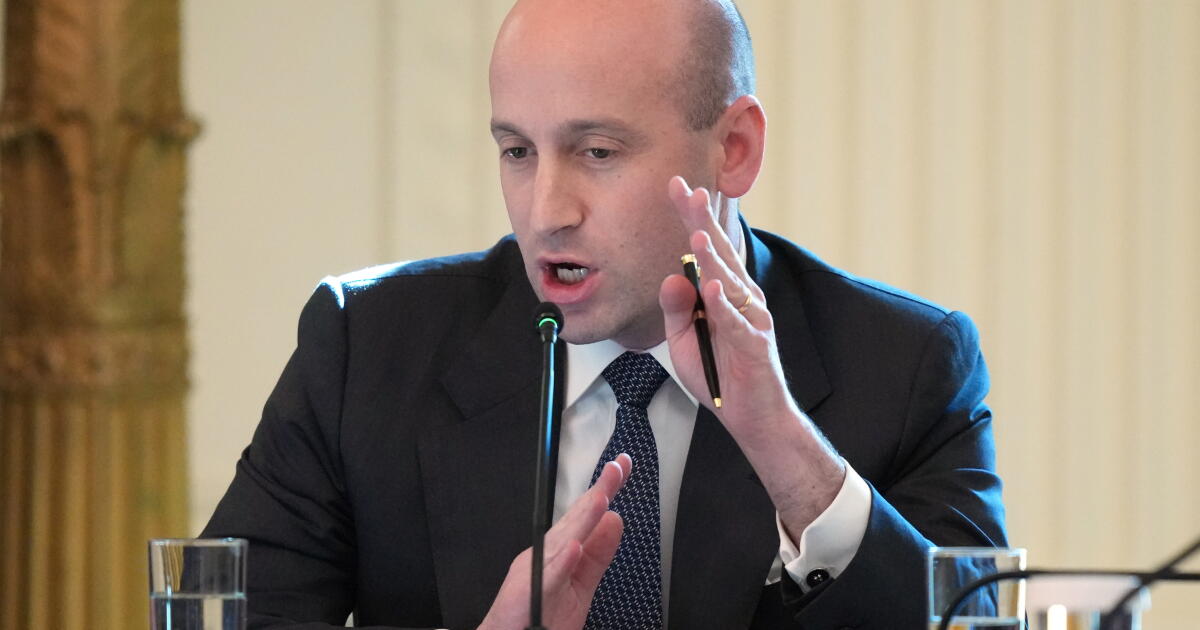
President Trump’s new White House chief of staff, Stephen Miller, is behind many of the administration’s signature domestic policy initiatives, especially its sweeping crackdown on immigration.

An outspoken defender of Trump’s most far-reaching goals to remake government going back to his 2016 run for president, Miller is known for his harsh language and unrelenting bombast, attracting outsize attention from supporters and critics alike. His record is likely to be scrutinized by Democrats in his powerful new role as he leads Trump’s White House through a lame-duck period after the Republican Party lost both houses of Congress in overwhelming fashion.

Here are some memorable things Miller has said through the years:

On immigration

During a surge in illegal border crossings during the Biden administration, Miller described migrants as invaders, even though many were escaping poverty and violence in their home countries.

“We are being conquered,” he told Fox News in December 2023. “We have millions of people coming in from different cultures and different ways of living and different belief systems.”

Miller also warned that “a generation from now,” people “will not know the country that they are living in. These consequences are permanent. Unless there’s massive large-scale deportations by the millions, it will be irrevocable.”

On federal agents’ killing of Alex Pretti

After federal agents shot and killed Alex Pretti during protests against the Trump administration’s immigration crackdown in January, Miller posted on social media that the 37-year-old Minneapolis resident was a “domestic terrorist” and an “assassin” who had “tried to murder federal agents.”

Later, Miller said in a statement that the federal officers in Minneapolis “may not have been following” protocol.

On Venezuela and Greenland

In January, after a U.S. military invasion captured Venezuelan President Nicolás Maduro, Miller used a lengthy post on X to decry “reverse colonization” in which he suggested that Western nations were sacrificing too much for the developing world and that such a practice “has been a long self-punishment of the places and peoples that built the modern world.”

In another post, he defended the right of the U.S. to take over Venezuela’s vast oil reserves, writing: “American sweat, ingenuity and toil created the oil industry in Venezuela. Its tyrannical expropriation was the largest recorded theft of American wealth and property. These pillaged assets were then used to fund terrorism and flood our streets with killers, mercenaries and drugs.”

He defended Trump’s assertion that the U.S. was now running Venezuela, by telling CNN’s Jake Tapper: “You can talk all you want about international niceties and everything else. But we live in a world, in the real world, Jake, that is governed by strength, that is governed by force, that is governed by power. These are the iron laws of the world.”

In the same interview, Miller also argued that the U.S. could seize Greenland by military force from NATO ally Denmark. “Obviously, Greenland should be part of the United States,” he said.

“Nobody’s going to fight the United States militarily over the future of Greenland,” Miller said.

On deportations

In May of 2025, Miller suggested that the Trump administration was looking for ways to expand its power to deport migrants who are in the United States illegally. To achieve that, he said, officials were “actively looking at” suspending habeas corpus — the constitutional right for people to legally challenge their detention by the government.

“The Constitution is clear — and that, of course, is the supreme law of the land — that the privilege of the writ of habeas corpus can be suspended in a time of invasion,” Miller said. “So, I would say that’s an option we’re actively looking at. Look, a lot of it depends on whether the courts do the right thing or not.”

In the nearly 18 months since, the idea has not been publicly pursued by the Trump administration.

On family separation

During Trump’s first term, Miller championed a strict immigration deterrence policy that previous administrations had been hesitant to adopt: family separation. It called for routinely having federal agents separate children from their parents if families were apprehended illegally crossing the border.

Miller defended the policy to the New York Times in 2018, saying it “was a simple decision by the administration to have a zero-tolerance policy for illegal entry, period.”

“The message is that no one is exempt from immigration law,” he added.

The tactic sparked widespread outcry, and the Trump administration did not revive it in its second term. Still, Miller has helped promote mass deportation of people already living illegally in the U.S. that has divided families according to legal status.

On the Statue of Liberty

During Trump’s first term in 2017, Miller appeared in the White House briefing room to detail for reporters plans to cut back on the number of green cards issued, while prioritizing English speakers and skilled workers.

Asked if doing so might violate the spirit of the poem on the Statue of Liberty, that reads in part, “Give me your tired, your poor, your huddled masses yearning to breathe free,” Miller responded, “I don’t want to get off into a whole thing about history here.” He then did just that.

“The poem that you’re referring to, that was added later, is not actually a part of the original Statue of Liberty,” Miller said.

On birthright citizenship

When the U.S. Supreme Court blocked Trump’s attempt to throw out birthright citizenship — which grants citizenship to any child born on U.S. soil — Miller said immigrants and their children pose an existential threat to the nation.

“This is absolutely a deep knife wound in the heart of the American republic,” he told Fox News in June. “If your ruling requires you to suicide your civilization, your reading of the Constitution is wrong.”

On vaccines

Miller is one of many members of the administration who has expressed skepticism about childhood vaccines. In August, he praised the president for signing an executive order aimed at curtailing the vaccine schedule for children.

“Millions and millions of parents feel they’ve been pressured when their children are just weeks out of the hospital to take five shots, six shots, seven shots all at once,” said Miller, a father of four, including an infant born in June. “Nobody has studied it. Nobody’s looked at it. Nobody’s thought about it.”

His comments contradict what the Centers for Disease Control and Prevention has said, which is that research shows getting several vaccines simultaneously “does not cause any chronic health problems.”

On the Democratic Party

In August 2025, Miller appeared on Fox News to respond to criticism from Democrats over Trump’s deployment of the National Guard in Washington and other U.S. cities — brushing aside concerns that the presence of troops was frightening residents, while having only a questionable impact on crime.

Miller used the occasion to take aim at Democrats more broadly.

“The Democrat Party does not fight for, care about or represent American citizens,” he said. “It is an entity devoted exclusively to the defense of hardened criminals, gang bangers and illegal alien killers and terrorists.”

Miller added: “The Democrat Party is not a political party. It is a domestic extremist organization.”

Weissert and Balingit write for the Associated Press.

Source link

Stephen Miller rises, but California hopes it can blunt his force

President Trump’s appointment of Stephen Miller — the architect of the administration’s extreme crackdown on immigration — to White House chief of staff is sparking alarm among immigrant advocates and politicians across California.

But this week’s sweeping Democratic victories are giving immigrant communities hope that control of Congress will give them more tools to fight Miller’s policies.

Miller grew up in Santa Monica but has become a relentless critic of California, specifically its immigration policies, protections and, in many ways, identity. Southern California was the first city targeted by widespread immigration raids last year, upending the region in ways that continue to reverberate, particularly for immigrant communities.

Miller’s promotion, announced Friday, is seen by many as an indication that the president has no intention of backing away from some of his most polarizing policies during his last two years in office, despite devastating midterm losses for Republicans across the country. Many viewed the nationwide Democratic swing — in South Carolina, Texas, California’s Central Valley and across the Midwest — as a rebuke of the administration’s first two years, particularly the major immigration crackdown that went far beyond Trump’s promise to focus on the “worst of the worst,” instead arresting thousands without criminal convictions, many of whom had lived in the country for decades.

“We’re concerned that this means the president may be doubling down on his domestic agenda of ICE crackdowns and on deportations if Stephen Miller is at the helm,” said Jamal Abdi, the president of the National Iranian American Council. “He thinks that every problem starts with the immigrant community — and that getting rid of them is the solution.”

Abdi worries that Miller’s latest promotion will further anti-immigrant policies, which have long painted Iranians and other immigrant communities as threats. He is hopeful Miller will help end the military’s war in Iran but fears that may mean more focus domestically on immigrants, especially Iranians, who have been demonized amid hostilities. The diaspora is highly concentrated in Los Angeles, which is home to the largest group of people of Iranian descent outside of Iran.

“We are definitely not out of the woods, and it seems like maybe the president might do less damage abroad but will really focus energy domestically,” Abdi said.

Angelica Salas, executive director of the Coalition for Humane Immigrant Rights in Los Angeles, said seeing more power in the hands of Miller — who she said was behind the Trump administration’s strategies that included “warrantless arrest, racial profiling, excessive use of force, medical neglect in detention centers, people deported illegally” — is threatening.

“Now he’s the chief of staff, and so that means that he has access to every single Cabinet secretary to unleash his reign of terror on our people,” Salas said. During the midterm elections, she said her team was aware of an influx of Department of Homeland Security sightings and activity in the Southland.

“We saw people arrested the day after the election in a massive way and it almost feels very vengeful,” she said. “Almost [like saying], ‘You know you can’t stop us.’”

Now, she and other immigration advocates are preparing themselves for “even more abuse from this administration,” Salas said.

But Ahilan Arulanantham, faculty co-director of UCLA’s Miñana Family Center for Immigration Law and Policy, said Miller’s promotion doesn’t change anything for him.

“He’s been adopting the most extreme authoritarian and racist views and espousing it publicly … for the entire two years of this administration,” Arulanantham said. “Whether he does it as the deputy chief of staff or chief of staff … I don’t have a view of the difference.”

Despite widespread backlash to the immigration raids last year, particularly after federal agents killed two civilians in Minnesota, the administration did pull back some of its most aggressive tactics. But Miller has remained intensely focused on his goal to limit immigration dramatically and deport undocumented migrants.

Miller’s new role will come as the administration prepares to face a Democratic-led House of Representatives and Senate, which could provide the strongest check yet on the executive branch since Trump began his second term.

“Congress has tremendous opportunity to constrain what the federal government can do in the form of abusive immigration practices,” Arulanantham said. “Congress has a huge amount of leverage that it could choose to use to force the administration to change its conduct — in the way that voters have clearly demanded.”

He hopes Congress will pass laws that limit how the Department of Homeland Security enforces immigration laws, including how agents use warrants — or don’t, what they wear while on duty and what factors they can consider when stopping someone.

Members of Congress appeared to agree with that approach.

“Stephen Miller should lawyer up,” U.S. Rep. Robert Garcia (D-Long Beach), who is set to lead the House Oversight Committee once the next Congress is sworn in, wrote in a statement Friday. He and his colleagues are committed to fighting “against his hateful policies in Congress and the courts.”

“Just days after the American people rejected his corrupt and lawless presidency, Donald Trump is doubling down,” Garcia said. “Stephen Miller is the architect of the unconstitutional ICE raids that have terrorized our communities and kidnapped and killed American citizens and immigrant families.”

Sen. Alex Padilla (D-California) characterized Miller as the man most responsible for “the cruelest immigration policies this country has seen in modern times: family separations, detainment of babies and children, militarized raids, arbitrary arrest quotas, and the horror unleashed in communities across the country,” Padilla said.

“We will use every tool at our disposal — oversight, investigations, subpoenas, and our leverage over federal funding — to expose this Administration’s abuse of power and hold those responsible accountable.”

Standing up to the administration was a similar response for lawmakers in Los Angeles. City Councilmember Eunisses Hernandez, whose district was targeted by some of the most extreme immigration sweeps last year, called Miller’s appointment an act of desperation by Trump.

The councilmember said it won’t deter her office or the community from resisting harsh immigration policies and continued activity in L.A.

“We’re going to fight back,” Hernandez said. “Even when we were on the losing side, when we didn’t have the majority in the Senate or the House, many of us were still fighting against those raids, fighting for our communities, fighting to make sure people are fed and housed.”

Source link

Trump names Stephen Miller chief of staff, replacing Susie Wiles

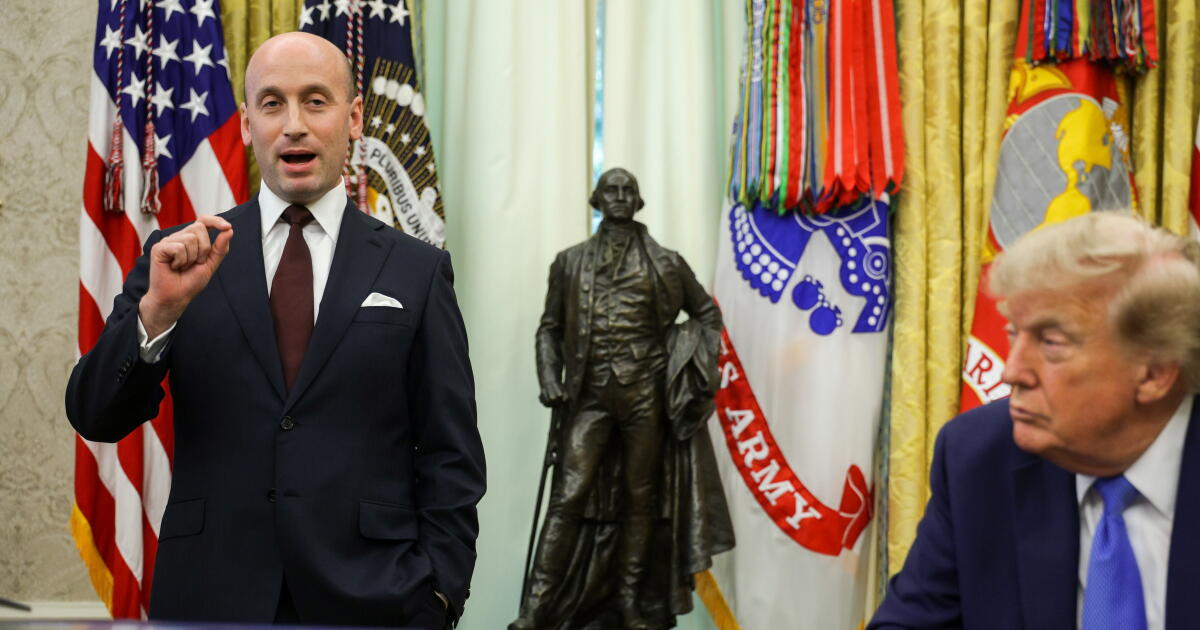
President Trump on Friday announced his appointment of Stephen Miller as his chief of staff, to replace Susie Wiles.

Miller, the current deputy chief of staff, has helped design Trump’s immigration policies and spearhead his mass deportation campaign.

His appointment as chief of staff, a powerful position for driving the president’s policy agenda, managing his staff and twisting the arms of allies and opponents alike to bend to the executive’s will, ends speculation that Trump might ease back from his less popular policies or moderate following devastating losses for his party in the midterms. The losses were driven in part to losing Latino voters and many congressional seats along the southern border.

Miller is widely seen as among Trump’s more extreme advisors. But Trump on Friday called Miller one of his “most trusted advisors,” and said he would take over as chief of staff Monday.

Trump said Wiles “has done an outstanding job,” and will be moving to his political operation.

This is a developing story and will be updated.

Source link