status

High court weighs temporary protected status for Haitian, Syrian people

1 of 4 | A pro-temporary protected status activist protests outside Supreme Court. Photo by Jamie Gareh/Medill News Service

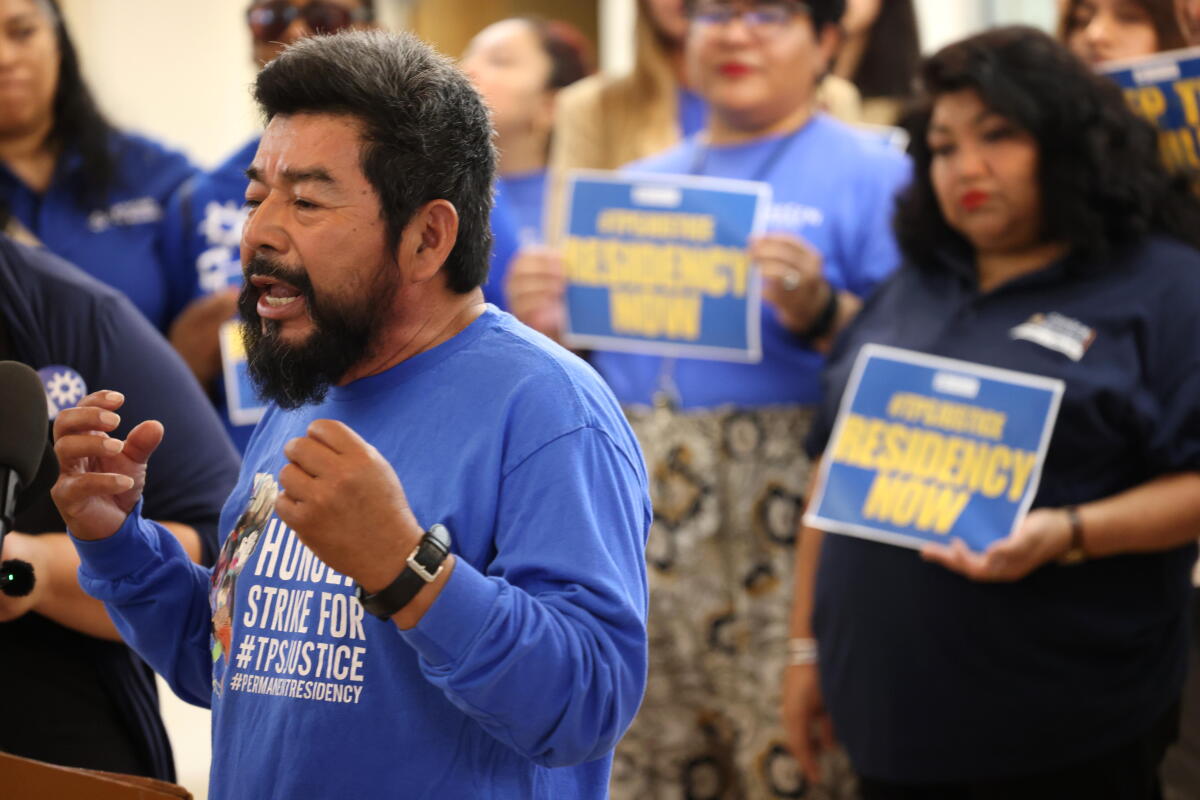
WASHINGTON. April 29 (UPI) — Fritz Emmanuel Lesly Miot left Haiti in 2010 after a deadly earthquake hit the island nation. As hundreds of thousands of Haitians died in the catastrophe, Miot fled to the United States, where he was granted temporary protected status, a short-term visa program.

Miot, 33, has lived in the States ever since and now researches Alzheimer’s disease in California as a doctoral candidate.

But last year, the Trump administration attempted to revoke his status and send him back to Haiti, along with all other Haitians who had been granted temporary protected status.

On Wednesday, the Supreme Court heard arguments in Miot’s case, along with a similar case that affects Syrian nationals living under temporary protected status. These legal battles, Trump vs. Miot and Mullin vs. Doe, could decide the future of some 350,000 Haitians and 6,000 Syrians living in the United States.

What is TPS?

Temporary protected status began in 1990, enacted as a way to provide foreign nationals relief from war, natural disaster or other “extraordinary and temporary conditions.”

Those with temporary protected status are granted legal status for up to 18 month periods, which can be extended based on an evaluation of the safety conditions in the countries they have left behind.

Currently 1.3 million people in the United States — from 17 countries — rely on temporary protected status. The Trump administration has attempted to terminate that status for those from 13 of those nations in the last year, including Afghanistan, Venezuela, South Sudan and Nicaragua.

Lower courts have blocked many of these terminations, deeming them unlawful, and immigrants under temporary protected status have remained in a state of limbo since. The results of these cases could set a legal precedent that would allow the termination of temporary protected status for citizens from these countries, with minimal oversight.

Two questions

Central to Wednesday’s debate were two questions: First, did then Secretary of Department of Homeland Security Kristi Noem follow correct procedure when deciding it would be safe to send people back to Haiti and Syria? Second, did the judicial branch have the legal right to interfere in the secretary’s decisions on temporary protected status?

Noem was criticized for not sufficiently consulting other state agencies when evaluating Haiti and Syria’s safety conditions. She was accused of violating the Administrative Procedures Act. Some Democratic-appointed Justices highlighted brief email exchanges Noem made with the State Department that led her to terminate Haiti and Syria’s status.

In the case of Haiti, she wrote last September to the State Department in an email, “Can you advise on State’s views on the matter?” The State Department simply replied, “State believes there would be no foreign policy concerns with respect to a change in the TPS status of Haiti.”

Justice Ketanji Brown Jackson on Wednesday questioned whether a “meaningful exchange” of information was made and whether Noem made any effort to actually evaluate the nation’s safety conditions, which is the basis of how temporary protected status is granted.

The government’s attorney, Solicitor General John Sauer, argued that minimal oversight was required of the DHS secretary in these decisions. But Jackson took issue with that, saying it would mean that Noem “can basically do whatever she wants.”

Sauer also vehemently argued that the DHS secretary’s actions should not even be open to judicial review, citing a law that states judges cannot interfere in “any determination with respect to the designation, or termination or extension,” of temporary protected status.

However, Justice Sonia Sotomayor responded that while the courts can’t challenge the secretary’s ultimate decision, they can question whether the procedures taken to come to those decisions fall within the law.

The immigrants’ attorney, Sotomayor and Jackson all later grilled Sauer on whether the Trump administration’s terminations were racially discriminatory.

Sotomayor and Jackson referenced Trump’s previous hostile rhetoric toward both communities. The justices repeatedly referenced one particular post on Truth Social in which Trump said that immigrants are “poisoning the blood of our country.”

Sotomayor said Trump’s statement showed that “discriminatory purpose may have played a part in this decision.”

Immigrant advocates watched the case closely.

“Certainly the goal of this Trump administration is to make people… immediately vulnerable,” Lucas Guttentag, a Stanford law professor who started the ACLU’s Immigrants’ Rights Project, said in an interview.

He said this was part of a much larger campaign to “de-legalize” lawful immigrants and potentially “eviscerate the immigration and asylum protection system covered in this country for decades and generations.”

However, Ira Mehlman, the media director for the Federation for American Immigration Reform, said that many of the immigrants living under temporary protected status had been here far too long.

He said many Haitians arrived 16 years ago. “By no reasonable assessment of the law or English language could you consider that time frame temporary,” he said in an interview.

He added that refugees from many countries, including Haiti and Syria, received temporary protected status because of natural disasters or civil wars that have already ended. So the reason to keep them in the United States has also ended.

“None of them were the Garden of Eden before the earthquake or hurricane … and they’re probably never going to be,” he added.

Kavanaugh echoed this sentiment, saying “The whole thing was the Assad regime was 53 years of brutal treatment and repression. It’s gone.”

Return to literally nothing

Liana Zogbi, a spokesperson from the non-profit Syrian Forum USA, painted a different picture. She said that Syrians would be “returning to literally nothing” should the Supreme Court rule in the government’s favor and Syrians be sent home.

“The majority of the country has been destroyed physically,” she said, explaining that schools, hospitals and even roads are still being rebuilt.

The State Department currently advises U.S. citizens not to travel to Syria “for any reason due to the risk of terrorism, unrest, kidnapping, hostage-taking, crime and armed conflict.”

Haiti is under a similar travel advisory from the State Department, which cites “crime, terrorism, unrest and limited healthcare.” Zogbi said the government would be contradicting itself were it to rule these countries safe for its nationals’ return but not safe enough for U.S. citizens to visit.

Hundreds of thousands of immigrants await a decision by the court, which is expected before July.

“Not only does it bring back up … the kind of trauma around instability and destabilizing their lives,” Zogbi said. “They [TPS holders] never know what can happen and how fast they have to leave. They constantly have to make plan A, B, C and D to just kind of prepare for any outcome of a situation.”

Source link

Trump to again end legal status of people who entered US with CBP One app | Donald Trump News

Judge had previously blocked move to end temporary legal status for those who entered US via Biden-era application.

The administration of President Donald Trump plans to again end the temporary legal status of hundreds of thousands of people who applied for asylum in the United States via the CBP One app.

The plan was detailed in a court filing in Boston, Massachusetts, and comes after a judge ruled that Trump’s earlier effort to terminate the legal status of those individuals was unlawful.

Recommended Stories

list of 3 itemsend of list

Under US President Joe Biden, individuals who registered for an appointment with US Customs and Border Protection (CBP) were preliminarily vetted and granted temporary legal status in the US as their asylum cases were adjudicated.

About 900,000 people were granted so-called humanitarian parole under the programme.

But in April of last year, just months after Trump took office for a second term, many of those individuals received emails saying their status had been terminated.

The message told its recipients it was “time for you to leave the United States”.

Federal Judge Allison Burroughs subsequently ruled that the Department of Homeland Security did not follow the proper procedures in terminating the legal status immigration status of CBP One users.

The US Department of Justice, in the new filings, told Burroughs that the Trump administration was complying with ⁠her order.

However, the department said the administration would begin issuing new parole termination notices, pursuant to a Tuesday memo from CBP’s head, Rodney Scott.

The memo is not public, but according to the Justice Department, Scott provided ‌an explanation for why, in his opinion, “parole is no longer appropriate for those aliens”.

Lawyers for Democracy Forward and Massachusetts Law Reform Institute, which represent the individuals whose status faces termination, urged Burroughs in a subsequent filing to prevent what they called a “deliberate attempt to evade compliance with the court’s order”.

The next hearing was set for May 6.

During his second term, Trump has pursued a hardline immigration policy that has included staunching nearly all asylum claims at the southern border.

Shortly after taking office, Trump’s officials also dissolved the CBP One app and relaunched it as CBP Home, a tool for self-deportation.

His administration has claimed there was an “invasion” at the border that constituted a “national emergency”, thereby allowing Trump to bypass legal requirements to allow individuals seeking asylum into the country.

Asylum, however, is a right enshrined both in domestic and international law, to protect people fleeing persecution on the basis of race, religion, nationality, political opinion or membership in a particular social group.

Separately, on Friday, a federal appeals court ruled against the Trump administration’s ban on asylum at the southern US border, potentially clearing the way for applications to once again be processed.

The administration is expected to appeal the decision.

Source link

Lamine Yamal’s World Cup status unclear after Barcelona injury | Football News

Lamine Yamal pulled up injured when scoring the winning goal for Barcelona in their La Liga win against Celta Vigo.

The consensus World Cup favourite could ‌be in danger of missing its top attacking option after Spanish ⁠forward Lamine Yamal ⁠sustained an injury while playing for Barcelona on Wednesday in a La Liga match.

According to reports, club officials believe Yamal sustained a ⁠torn hamstring, though a full prognosis won’t be known until he undergoes scans on Thursday.

Recommended Stories

list of 4 itemsend of list

The 18-year-old superstar drew a foul that led to a penalty kick, ⁠which Yamal stepped up and scored in the 40th minute against visiting Celta Vigo. However, once the ball hit the net, Yamal didn’t celebrate. Instead, he went down injured, clutching his left hamstring.

“We have to wait,” Barcelona ‌coach Hansi Flick said after the game. “We have to see what it is. There is something. He felt it. After the goal, he would not leave the pitch without reason.

“So it’s something. Something happened. Hopefully it’s not so bad, but we have to wait until tomorrow.”

Midfielder Pedri, Yamal’s teammate with both Barca and the Spanish national team, said, according to ESPN: “Hopefully Lamine will only miss ⁠a few weeks. I wish him the best of luck. ⁠He needs to remain calm because he’s young and will surely recover well”.

The goal was Yamal’s 16th in 28 La Liga matches this season (his 24th in 45 games in all competitions), and ⁠led Barcelona to a 1-0 win. The result leaves Barcelona with a nine-point lead on second-place Real Madrid in ⁠the league standings, so Barca are comfortably on course ⁠to claim the league title, regardless of Yamal’s health.

The bigger question is whether the injury could impact Spain’s chances at the World Cup this summer in North America.

Spain are scheduled for Group H ‌matches on June 15 against Cape Verde and on June 21 against Saudi Arabia, both in Atlanta, then play Uruguay on June 26 in Zapopan, Mexico.

Spain won ‌UEFA ‌Euro 2024, in part due to contributions from the then-16-year-old Yamal. A sublime playmaker and finisher, Yamal has six goals in 25 career appearances for the Spanish national team.

Source link

How will Zachariah Branch’s arrest impact his NFL draft status?

Former USC and Georgia receiver Zachariah Branch was arrested early Sunday in Athens, Ga., for not moving far enough on a public sidewalk when a police officer asked him to do so.

Branch, widely projected to go in the second round of the NFL draft later this week, faces misdemeanor charges of obstructing public sidewalks, prowling and obstructing a law enforcement officer. According to a police report, he was booked at 1:26 a.m. and released at 3:44 a.m. after posting a $39 bond.

Branch, who led the Southeastern Conference and set a Georgia record with 81 receptions in 2025, was in Athens for Georgia’s spring game on Saturday. He transferred to Georgia after two seasons at USC, where he had 78 catches for 823 yards. He also was a first-team All-American kick returner as a freshman.

The Athens Clarke County police report was obtained by NFL Network:

“A male, later identified as Zacharia [sic] Branch, continued to stand on the sidewalk without making an attempt to move. I continued to give Zacharia Branch verbal commands to move from blocking the sidewalk and advised that if he did not, he would receive a citation for blocking the sidewalk.

“Zacharia Branch smirked, then stepped backwards and to the right, then remained standing upon the public sidewalk, so as to obstruct, hinder, and impede free passage upon the sidewalk as well as impede free ingress/egress to or from the adjacent places of business.

“Due to those actions and Zacharia Branch’s failure to comply with multiple verbal lawful commands, he was placed under arrest for misdemeanor Obstruction of LEO and received a citation for Obstructing Public Sidewalks.”

Branch, 22, declared for the draft one year after transferring from USC along with his twin, Zion, who plays safety for Georgia. Branch was ranked as the nation’s No. 1 wide receiver out of Las Vegas Bishop Gorman High and considered a landmark recruiting win for USC coach Lincoln Riley.

Branch, a grand nephew of former Raiders great and Hall of Fame receiver Cliff Branch, established himself quickly with the Trojans, returning a kickoff 96 yards for a touchdown in his debut against San Jose State in 2023. He also caught a touchdown pass in the game while accumulating 232 all-purpose yards.

In a Times story in 2023, Branch was lauded by teammates “for his ever-present smile and easy-going nature.”

“I just love the energy every day, it brings a smile to my face,” USC guard Justin Dedich said at the time. “That’s just one of those things. It just shows on the field. It correlates, just his positive energy, his positive attitude and he plays like a beast.”

The timing of the arrest isn’t ideal: The NFL draft begins Thursday. The relatively innocuous nature of the incident shouldn’t greatly impact Branch’s draft status, according to team personnel executives interviewed by NFL Network.

Cue the social media jokes about Branch increasing his draft status because he demonstrated his ability to block …. even if it was a sidewalk.

“‘Willing and eager blocker’ always a good note on a WR’s draft profile,” one person posted.

Others pointed out that ignoring instructions from a police officer at 2 a.m. is an indication of poor judgment.

“Zero self awareness putting yourself in this position a few days before the draft,” a person posted.

Source link

House passes a bill to protect Haitian immigrants, in slap back to the Trump administration

In a rare bipartisan moment, the House passed legislation Thursday that would extend temporary protections for Haitian immigrants, a long-shot effort fighting back against President Trump’s attempts to end the program.

The bill, pushed forward by House Democrats with a group of Republicans over the objections of the GOP leadership, would require a three-year extension of temporary protected status for Haitians by the Trump administration. That would allow hundreds of thousands of qualifying immigrants to remain in the United States without fear of deportation.

The vote was 224-204, drawing applause in the chamber. But it faces uncertainty in the Senate, and the Republican president would almost certainly seek to veto it.

“I know firsthand how important our Haitian neighbors are to our communities, to our civic life, to our culture, to our workforce, to our economy,” said Democratic Rep. Ayanna Pressley of Massachusetts, who is co-chair of the House Haiti Caucus and represents one of the largest Haitian communities in the country.

During the debate, she recounted the number of Haitian immigrants working in healthcare, housing construction and other industries. Haitians with temporary legal status “are not the problem, quite the contrary, they are part of the solution,” she said.

Pressley has said deporting Haitians back to the troubled Caribbean country would be a “death sentence,” given the effects of natural disasters and gang violence. “Congress can do the right thing,” she said.

Ten Republicans, many from districts with large numbers of Haitian residents, joined all Democrats and one independent in voting for passage.

Congress tries to act before the Supreme Court does

The effort to help 350,000 Haitians living lawfully in the United States comes as the administration is working to end the temporary legal status for several groups, exposing them to deportation.

In less than two weeks, the Supreme Court is prepared to consider a fast-track case that would end the protected status for Haitian and Syrian immigrants in a challenge widely seen as threatening the broader program. The administration filed emergency appeals after lower courts stopped the immediate end of the program.

It is part of the administration’s efforts to strip certain immigrant groups of legal status as the White House works to fulfill Trump’s campaign promise of conducting the largest mass deportation operation in history. Some 1.3 million people fleeing countries around the world have been granted temporary protected status in the U.S.

The protections for Haiti, first approved after a devastating 2010 earthquake, have been extended multiple times. The State Department warns Americans not to travel to Haiti “due to kidnapping, crime, terrorist activity, civil unrest.”

Guerline Jozef, executive director of the Haitian Bridge Alliance, an advocacy organization, fought back tears as she described the fear of deportations coursing through the community.

“We are asking, where will you be? On the right side of history?” she said at a news conference outside the Capitol. “Or continuing to cause trauma to people who are asking for nothing other than safety and protection?”

Trump has described migrants from poorer countries in vulgar terms, and he has falsely accused Haitian migrants in Ohio of eating their neighbors’ cats and dogs.

The conservative majority court has allowed the end of temporary legal status for a total of 600,000 people from Venezuela while lawsuits play out, leaving them to face potential deportation.

Lawmakers debate whether to help Haitians or stick with Trump

Rep. Laura Gillen (D-N.Y.) whose district includes Long Island’s Haitian community, said she promised constituents she would work to protect their status. She introduced the legislation with Republican Rep. Mike Lawler of New York as soon as she took office last year.

“It’s cruel to expect Haitians to be forced to return to these deadly, dangerous conditions,” she said at a news conference. “Human lives are at risk.”

Lawler said there are differences of opinion on immigration policy, but that Haitian immigrants have become vital to his community and forcing them out would be unjust and unwise.

“They are small business owners, they are nurses, they are caregivers, they participate in our economy and take care of American citizens,” he said. “Congress has a responsibility to act.”

But Rep. Jim Jordan (R-Ohio) decried the number of immigrants, including Haitians, who have entered the U.S., and cited Democratic efforts to halt funding for enforcement and deportation efforts.

“Make temporary permanent,” he said, “that’s their plan.”

Rep. Brandon Gill (R-Texas) said the program was “backdoor amnesty” for foreigners.

To Rep. Tom McClintock (R-Calif.), the temporary status first granted under the Obama administration has become “an open-ended invitation” for immigrants to enter the country, including some illegally, and remain.

“The Trump administration has heeded the cries of the American people,” he said.

Using a discharge petition to force votes

The vote was the latest effort by House Democrats to maneuver past the Republican majority using a discharge petition — once a rare tool, but now used increasingly to form bipartisan coalitions.

The discharge petition process forces the bill to the House floor for consideration, powering past House Speaker Mike Johnson (R-La.) and GOP leaders. It was used to help pass legislation that required the Justice Department to release the files of the sex trafficking investigation of Jeffrey Epstein.

Republicans hold a slim majority in the House and are typically able to swat back such efforts from Democrats. But Democrats and Republicans have formed bipartisan alliances to reach the majority needed on the discharge petitions.

Pressley’s effort to discharge the bill won support from four Republicans on the initial petition, and several more once it came to the floor vote.

Mascaro writes for the Associated Press.

Source link

Ukraine says captured North Korean soldiers granted POW status

Yoo Yong-weon, a lawmaker of South Korea’s ruling People Power Party, speaks during an interview with Yonhap News Agency about his recent meetings with two North Korean soldiers captured by Ukraine at the National Assembly in Seoul, South Korea, 07 March 2025. The two photographs Yoo is holding were taken from his meetings with the soldiers in Kyiv on 25 February 2025. Photo by YONHAP / EPA

March 24 (Asia Today) — Ukraine’s Defense Ministry has told a South Korean civic group that two captured North Korean soldiers are recognized as prisoners of war and are being protected under the Geneva Convention on the treatment of POWs.

According to a reply disclosed Tuesday by an emergency committee campaigning for the soldiers’ transfer, the Ukrainian ministry said the men are being guaranteed contact with the outside world, access by international monitors and human rights organizations, and other protections required under international humanitarian law.

The ministry also said the principle of non-refoulement, which bars forced return to a country where a person may face harm, is being taken into account in their treatment.

The statement aligns with remarks made March 6 by South Korean Foreign Minister Cho Hyun, who said he had received assurances from his Ukrainian counterpart that the soldiers would not be repatriated to North Korea or Russia. (Yonhap News)

The civic group, however, said the two men remain in a military detention facility under the authority of Ukraine’s Defense Ministry and still hold legal POW status, leaving open the possibility that they could become subjects of negotiations between governments.

The group said the soldiers should be shifted from military custody to an internationally protected status. It called for their transfer to a civilian protection facility and urged direct involvement by the U.N. refugee agency, the U.N. human rights office and the International Committee of the Red Cross.

It also proposed that procedures begin to determine whether the two soldiers should receive refugee status or another form of international protection.

Photo made available by the Emergency Committee for the Free Repatriation of North Korean Soldiers shows a reply from Ukraine’s Defense Ministry regarding two captured North Korean soldiers. /Provided by the committee

— Reported by Asia Today; translated by UPI

© Asia Today. Unauthorized reproduction or redistribution prohibited.

Original Korean report: https://www.asiatoday.co.kr/kn/view.php?key=20260324010007333

Source link