WASHINGTON — President Trump is set to deliver a high-stakes State of the Union address on Tuesday night at 6 p.m. Pacific time before a joint session of Congress in the U.S. Capitol.
The president is expected to emphasize economic issues, an immigration crackdown that has been central to his agenda, and tariffs in the wake of a recent legal setback to his trade agenda.
Trump is expected to focus on his immigration crackdown and his promises to go after what he says is government “waste, fraud and abuse,” as previewed in two White House videos on Monday.
One year back in office, Trump has led an aggressive deportation campaign that has involved violent arrests, troops in American cities and an uptick in detentions. The tactics used by federal immigration agents have raised concerns among lawmakers in the aftermath of the fatal shooting of two U.S. citizens in Minneapolis. Those concerns are central to ongoing standoff over funding for the Department of Homeland Security.
It will also be worth watching how Trump talks about future efforts to target waste and abuse in public spending, an effort that has often roped in blue states like California.
Who will deliver responses?
Democrats have picked Gov. Abigail Spanberger of Virginia and Sen. Alex Padilla of California to deliver the Democratic responses to Trump’s speech.
Spanberger will give her remarks in English, while Padilla will deliver the Spanish-language response.
On January 20, 2004, I took a seat in the gallery of the House of Representatives to hear President Bush deliver his State of the Union address. The seat came courtesy of House Minority Leader Nancy Pelosi. Ten months earlier, Bush had made the decision to invade Iraq after his administration’s historic campaign of lies convinced the American people that Saddam Hussein possessed weapons of mass destruction. We would not extricate ourselves from that costly conflict for another seventeen years. Much of his speech that night was a further attempt to sell to the nation the justification for his war. “Had we failed to act, the dictator’s weapons of mass destruction programs would continue to this day,” Bush said. He characterized the Patriot Act, which had unleashed a new magnitude of spying on American citizens, as “one of those essential tools” in the war on terror.
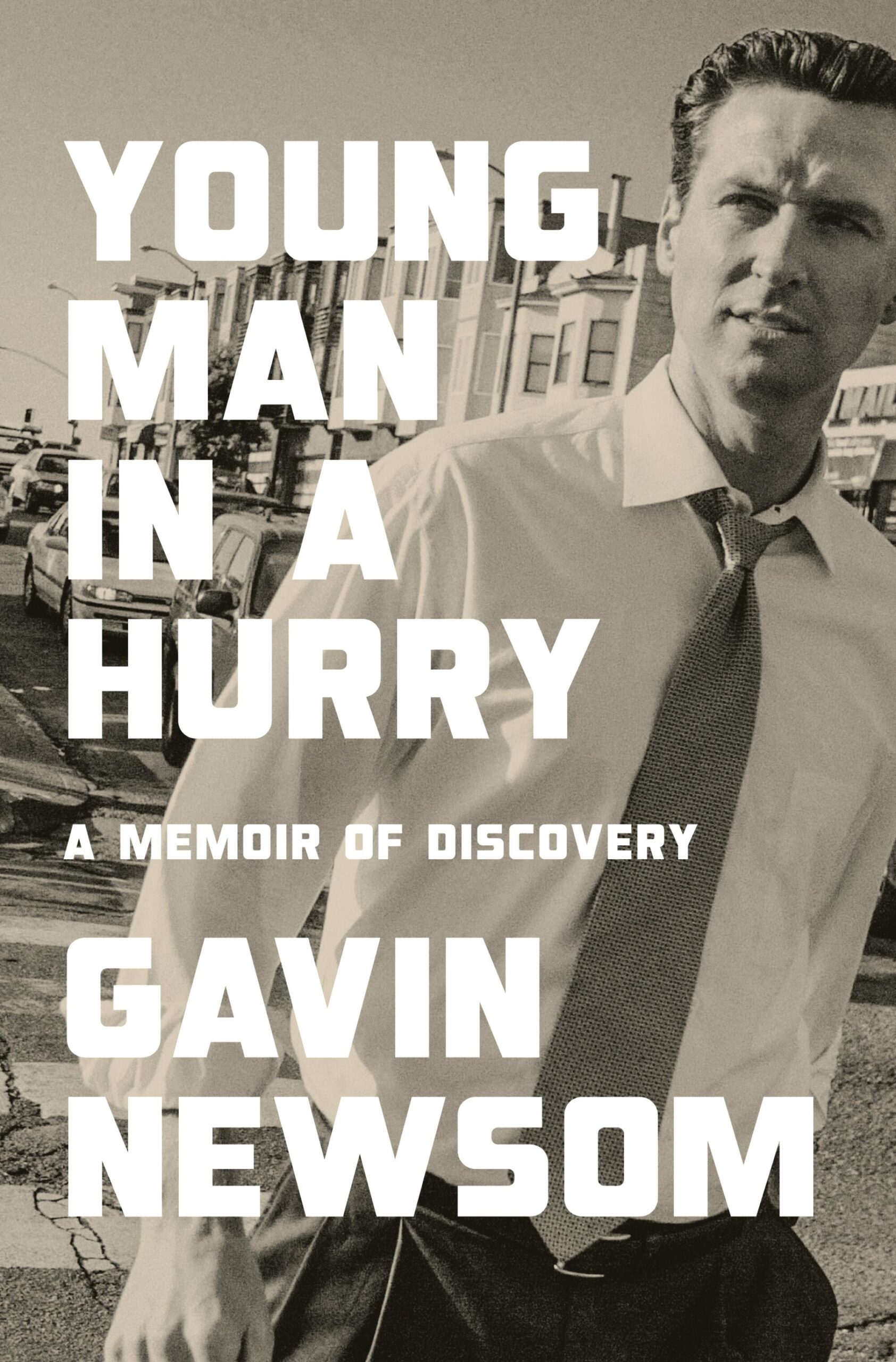
“Young Man in a Hurry: A Memoir of Discovery” by Gavin Newsom
(Penguin Press)
On the Shelf
Young Man in a Hurry: A Memoir of Discovery
By Gavin Newsom Penguin Press: 304 pages, $30
If you buy books linked on our site, The Times may earn a commission from Bookshop.org, whose fees support independent bookstores.
The rest of his speech was standard fare, ho-hum really, until he reached a section near the end about American values and the need for us to “work together to counter the negative influences of the culture and to send the right messages to our children.” He said he was troubled by activist judges in activist states who were threatening to undo the Defense of Marriage Act signed into law by his predecessor, President Bill Clinton. We had to “defend the sanctity of marriage” as the union of one man and one woman, he said. If need be, he would seek a constitutional amendment to ban same-sex marriage.
As I was leaving the chamber, a middle-aged couple next to me was talking about how pleased they were that their president was finally confronting the “homosexual agenda.” The word homosexual came out of their mouths bent by contempt. I was supposed to head downstairs for a reception with Congresswoman Pelosi and a delegation of California Democrats, but I needed a breath of fresh air. Outside the Capitol, I kept walking and muttering to myself. “These are my people Bush is attacking. My constituents. My staff. My closest advisers.” In the cold and dark of Washington, I called one of my aides back in San Francisco and pledged that I was “going to do something about it” as soon as I returned home.
The law in our state was no different from the law in every other state. Same-sex unions could not be recognized by the local assessor-recorder’s office. They were illegal. As I explained to aides my willingness to now defy that law, I held up a copy of the California Constitution. In Article I, the first section promises that “all people are by nature free and independent and have inalienable rights.” Among these rights are pursuing and obtaining “safety, happiness and privacy.” It was not until Section 7.5 that these rights were then abridged: “Only a marriage between a man and a woman is valid or recognized in California.” This not only contradicted the first section but was discriminatory on its face.
My top staff didn’t disagree with my reading, but almost to a person they were opposed to my taking on the issue. Steve Kawa, my chief of staff, a gay Bostonian whose accent cut through all nonsense, pulled me aside and spoke from his heart. His father had renounced him for being gay, and he wanted nothing more than to live in an America where homophobia was no longer the norm. But swinging open the doors to the city clerk’s office and inviting gay men and lesbian women to the marriage altar was political suicide, he argued. We were new to office, for one thing. And polls showed that less than one third of Californians supported gay marriage.
The “go it slow” admonition was the mother’s milk of Democratic politics. In the endless battle for the hearts and minds of moderates, it seemed the only feasible way for a Democrat to get elected and govern. But this was San Francisco, and we were talking about equal protection under the law for a class of people whose ostracism by family, friends, and community had brought them to San Francisco in the first place. If not here, where? Eric Jaye, one of my campaign consultants, could see my quandary. I was caught between my conscience and the sound political advice of the people closest to me. We had several late-night conversations on the phone. “What the f— are you doing here? Why did we work so hard to win if you can’t do something bold?” he asked. “This is a short life, Gavin. Your time as a politician to get things done is just a blip.”
I thought back to my model for the wine store. The entire purpose was to turn the staid on its head and create a new reality. I called Joyce Newstat, my policy director, who was also gay. “We need to do this,” I told her. She could hear in my voice that I had made up my mind. “OK, but we can’t afford to take a wrong step,” she said. “Gays and lesbians have a history of being blindsided, and you don’t want to become part of that narrative. Give me a week or two to reach out to the community.” Joyce sat down with Kate Kendell, the brilliant executive director of the National Center for Lesbian Rights, based in San Francisco. “Who is this guy?” Kendell wondered. “He can’t just come waltzing in here and upset the delicate balance we’ve taken years to achieve.” Joyce told her I couldn’t be talked out of it, that it had become internalized after I had gone to Washington and heard the words of bigotry ring out in the Capitol. “Well, OK. But if he’s going to do it, he has to do it right,” Kendell said. She directed her attorneys at the center to work with our team on fashioning a plan.
I then went to Mabel Teng, my former colleague on the board of supervisors who was now the assessor-recorder of San Francisco. I asked her what complications would be presented to her official duties if we allowed same-sex marriages at city hall. Mabel, who began her career in politics as an activist with Jesse Jackson’s Rainbow Coalition, did not surprise me with her reply. “It would be no problem at all, Mayor.” The marriage of a man and a man, or a woman and a woman, would require hardly any change to the paperwork. Rather than “man and wife,” they would show up in her computer as “Applicant One” and “Applicant Two.”
Alarmed by my plans, my father and Uncle Brennan and their close friend Joe Cotchett — each one steeped in law and politics but only Joe standing six foot four and a former Special Forces paratrooper —attempted a last-minute intervention. They lured me to the Balboa Cafe for dinner and wine. They weren’t the kind to beat around the bush. Did I realize that I was about to torpedo my political career?
Joe got right in my face. “Why are you doing this, Gavin?”
“I’ll tell you why I’m doing this,” I said defiantly. “Because it’s the right thing to do.”
I could not have given him a more simple and true answer, and it seemed to hit Joe, who had built his career out of representing the underdog, right in the gut.
“OK,” he said in a different voice. “Then let’s do it.”
With that, my father and uncle went quiet. Not another word was said about it. I left there that night thinking that even my Newsom kin, the ones who had my best interests at heart, could get it wrong from time to time. While I was open to skepticism and second-guessing, indeed I welcomed such a process, in the end I had to trust my own gut. On the matter of civil rights for all Californians, there was no turning back. As for big Joe Cotchett, he ended up joining the ranks of lawyers fighting for the legal right to same-sex marriage.
Disney California Adventure this month turns 25. Though Disneyland Park’s littler and much younger sibling, the park has grown into a respectable offering, one that ranks among my favorite Disney parks in North America. No small feat, considering its checkered, less-than-ambitious launch.
California Adventure is today emblematic of some of the best that Disney has to offer. And yet it remains a work in progress. The subject of constant tinkering, another reimagining is on the horizon.
With more Marvel, more “Avatar” and more Pixar due to be injected into the park, California Adventure stands at a crossroads. But also one with risks: Will it soon feel like a collection of brand deposits? This, of course, has appeared to be the vision of the company’s theme parks in the recent past. This doesn’t always have to be a negative. Consider it more a word of caution.
A “Coco” boat ride is destined for Disney California Adventure. The ride is under construction.
(Pixar / Disneyland Resort)
Few Disney properties, for instance, seem more ripe for exploration in a California-focused theme park than “Coco.” Under construction where Paradise Gardens and Pixar Pier meet, a “Coco”-inspired boat ride will give the park at long last a permanent home to recognize our state’s Latin culture and heritage. While fans may long for the days of original attractions such as Pirates of the Caribbean and the Haunted Mansion, those based on intellectual property — IP in industry speak — aren’t evil, especially when used to heighten the overall themes of the park. California Adventure’s own Cars Land is a key example.
When it starts to feel like retail, however, parks can become exhausting. Looking at you, Avengers Campus, a half-finished land with a bombastic orchestral score and familiar, urban design that wouldn’t be out of place in downtown L.A. In its current state, the land works best as a backdrop for live entertainment as it lacks the welcoming feel of Disney’s top creations.
California Adventure, at its most idealized, stood for more than an assortment of film properties. Its pitch was to show the Golden State as a romanticized destination, one that in the post-Gold Rush era has often given America permission to dream. It would capture our people, our nature, our food and our glamour through a lighthearted, optimistic lens. When completed, the park had a mini Golden Gate Bridge and giant letters that spelled out the name of our state (which were removed about a decade later).
By the time California Adventure opened in February 2001, it had already been the subject of much revision. The Walt Disney Co. wanted it to be a West Coast answer to Walt Disney World’s Epcot. Its plans at the time were well-documented, with the Walt Disney Co. initially giving Westcot, as it was to be called, a spherical answer to the Florida park’s Spaceship Earth. In time, and in attempts to quell neighborhood concerns, the globe’s design would shift to become a large, futuristic needle.
California Adventure in 2001 was meant to depict a romanticized vision of California.
(Mark Boster / Los Angeles Times)
None of it was to be. Financial headaches, caused in part by the early-year struggles of Disneyland Paris, inspired Disney to change course. Disney California Adventure would open with few attractions that rose to the Disneyland level, and yet The Times was kind in its opening coverage, praising the park’s change of pace from its neighbor and admiring how its architecture blurred fiction and reality.
The hang-gliding simulation Soarin’ Over California was an instant hit, and Eureka! A California Parade was Disney theatricality at its weirdest, with floats that depicted Old Town San Diego, Watts and more. But California Adventure’s prevalence of dressed-up county fair-like rides failed to command crowds. Disney’s own documentary “The Imagineering Story” took a tough-love approach, comparing some of its initial designs to those of a local mall.
The grand opening of California Adventure in February 2001.
(Mark Boster / Los Angeles Times)
And yet today it’s home to one of the Walt Disney Co.’s most fully-realized areas in Cars Land, which opened in 2012. Flanked by sun-scarred, reddish rocks that look lifted from Arizona, Cars Land is a marvel, and on par with the best of Walt Disney Imagineering’s designs (see New Orleans Square, Star Wars: Galaxy’s Edge and Pandora — the World of Avatar). Nodding to our Route 66 history, the land is a neon-lit, ‘50s rock leaning hub of activity, complete with the showstopping Radiator Springs Racers.
Cars Land led a major makeover of the park that also included the nostalgic Buena Vista Street, a nod to the Los Feliz era of the 1920s. And by the mid-2010s, many of California Adventure’s most insufferable traits, such as its ghastly puns (San Andreas Shakes was bad, but the Philip A. Couch Casting Agency was cringe-inducing) as well as the short-lived disaster of a ride that was Superstar Limo, had begun to disappear.
Cars Land, added to California Adventure in 2012, is one of Walt Disney Imagineering’s grandest achievements.
(Mark Boster / Los Angeles Times)
With the nighttime show World of Color, and a bevy of in-park entertainment, California Adventure pre-pandemic began to feel like something akin to a full-day park. It wasn’t perfect, of course — no park is.
The Little Mermaid — Ariel’s Undersea Adventure, though lightly charming, suffers from being a hodgepodge of familiar scenes from the film rather than a narrative tableau that can stand on its own. Too many empty buildings clutter its Hollywood Land area, the makeover of Paradise Pier into Pixar Pier did little but add garish film-referencing art to the land and the crowd-pleasing transformation of the Twilight Zone Tower of Terror into Guardians of the Galaxy — Mission: Breakout! was completed at the expense of the park’s prime Southern California theming.
Paradise Pier at California Adventure in 2002. The land has since been remade into Pixar Pier.
(Don Kelsen / Los Angeles Times)
But there is much about California Adventure to adore. It shines during holidays, whether that’s Lunar New Year at the top of the year or the back-to-back combo of Halloween and Christmas seasons near its end. Here is when California Adventure’s entertainment comes to the fore, bringing the park alive with cultural tales that at last reflect the diversity of the modern theme park audience.
How grand it would be, however, if California Adventure were blessed with this level of entertainment year-round. The Hyperion Theater, a 2,000-seat venue at the end of Hollywood Land, and once home to shows inspired by “Frozen,” “Aladdin” and “Captain America,” today sits empty. If the Walt Disney Co. can’t justify funding the theater, jettison it with the park’s upcoming makeover, as it stands as a reminder of how fickle the corporation can be when it comes to live performance (also gone, the great newsboy-inspired street show).
Staff at California Adventure put the final bit of polish on the letters that spell out “California” ahead of the park’s 2001 opening. The letters once stood at the entrance of the park.
(Mark Boster / Los Angeles Times)
Looking ahead, I expect Disney to deliver a powerful “Avatar” ride, and early concept art has shown a thrilling boat attraction that appears to use a similar ride system to Shanghai’s Pirates of the Caribbean: Battle for the Sunken Treasure, which is hailed by many as one of the company’s strongest modern additions. Worthy of debate, however, is how the pure fantasy landscape of “Avatar” fits in a park that still nominally tries to reflect California and our diversity.
And does it matter?
The company would likely argue that if the ride wows guests and extends the “Avatar” brand into another generation, that it does not. But Disneyland next door isn’t timeless because it has “Peter Pan” and “Star Wars.” It has endured for 70 years because its attractions, by and large, reflect cultural myths. And it’s a park we want to spend days in, thanks to its gorgeous landscaping, calming Rivers of America, and human tales of avarice, unity and romance spread throughout its attractions.
For theme parks, after all, can jump the shark, so to speak. Spend some time, for instance, sitting in California Adventure’s San Fransokyo Square. It’s a needless, post-pandemic makeover. What was once a simple food court has been transformed into a loud nook stuffed with a “Big Hero 6” meet-and-greet and gift shop. You’ll be transported, but to a place more akin to a marketing event.
So happy 25, California Adventure. We love you, and you’re a park worth celebrating, but like most post-collegiate kids, there’s still some room to learn.
Weekly insights and analysis on the latest developments in military technology, strategy, and foreign policy.
The U.S. buildup of forces in the Middle East ahead of a possible attack on Iran relies very heavily on the performance of the U.S. Air Force Air Mobility Command (AMC). Hundreds of its cargo jets and aerial refueling tankers have moved materiel into theater and helped tactical jets, radar planes and other aircraft deploy across oceans to places like Muwaffaq Salti Air Base in Jordan, among many other locations. At the same time, the current crisis in the Middle East pales in comparison to the massive spike in demand for airborne logistics that would occur during a Pacific fight against China. Regardless, ever greater demand is being placed on an increasingly aging AMC fleet.
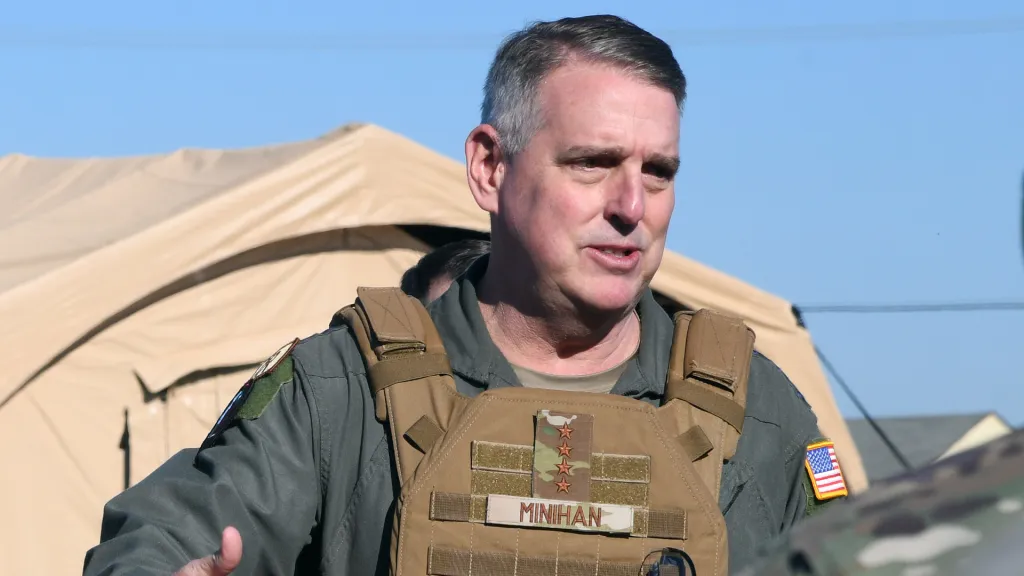
Few people know the nuts and bolts of AMC and its mission better than Michael “Mini” Minihan, a retired Air Force general who led the command from October 2021 to November 2024. In a 45-minute interview, Minihan offered his insights on that and a whole host of other topics. They include the current crisis and its airlift demands, challenges from China, future airframes, arming airlifters and refuelers, the connectivity issues he championed, AI and the leaked memo that put a cap on his career.
Michael Minihan led U.S. Air Force Air Mobility Command (AMC) from October 2021 until his retirement in November 2024. (USAF) AMC commander Gen. Mike Minihan. USAF
Since retiring, Minihan serves as a strategic advisor and board member to defense and technology companies, non-profits, and think tanks while continuing to write and speak on leadership, national security, and the future of air mobility and global power projection.
Some of the questions and answers have been edited for clarity.
Q: The C-17 Globemaster III heavy lifters have been supporting one crisis after another it seems. Have the hours accumulated faster on those airframes? What do you think should replace them and when?
A: All the things I was concerned about while I was in uniform, I remain concerned about right now. The options on the table are service life extension programs [SLEP] that the C-17 is already a candidate for. There was talk late last year about the KC-135 Stratotanker receiving another [SLEP]. You know, those types of things are concerning to me. At the end of the day, I think this nation needs to pay for the Air Force it needs, and the Air Force that it needs has a modern, capable mobility fleet. It’s not just old stuff that keeps getting patched up to get older. That’s the reality. So I’m concerned.
C-17 Globemaster. (USAF)
Q: Right now, a massive buildup is underway in the Middle East. AMC is doing the heavy lifting there as always. But in a crisis in the Pacific, would we have enough airlift aircraft to support moving quick enough across that vast theater, especially to respond to an invasion of Taiwan?
A: What you’re talking about is always a concern, regardless of the scenario. The reality is that America relies on the mobility fleet to project its power… So there’s not any scenario, even in the day-to-day competition, where you’re happy with the supply-demand intersection. So I think that we’ve got to work on capacity, certainly out of the entire mobility fleet, when it comes to the airlift and the air refueling. And then if you overlay that in contested environments, the concern gets bigger.
This KC-46 Pegasus aerial refueling tanker remains at Moron Air Base in Spain after suffering a mishap earlier this momth. (Pepe Jimenez)
Q: Considering how long it has taken to build up forces in the Middle East, where tankers and cargo jets are flying over uncontested airspace, how concerned are you about being able to project enough power over long distances to protect Taiwan from an attack by China?
A: The alarm that I had when I was active duty exists today… So the reason I’m a civilian right now is because I was ringing the bell on the exact questions that you’re asking right now and that concern still remains. The reality is against a China or against a Russia, they’re going to challenge you in all domains, from great distances. They absolutely understand that the mobility fleet is America’s capability to project power quickly. So there’s going to be a focus on it. But once again, you’re describing concerns that I had and expressed when I was active duty, and I still have those same concerns.
Inside Taiwan’s Strategy to Counter a Chinese Invasion | WSJ
A: The leak created antibodies that would want me in another job. That memo was getting after all the things that you’re asking about right now. It was getting after capability and capacity. It was getting after readiness. It was getting after explode into theater. It was getting after the mobility fleet being able to do what it’s asked to do, despite being extremely vulnerable, despite it being extremely antiquated – all those things.
A portion of the memo AMC Commander Gen. Michael Minihan wrote that was leaked to the public. (USAF via X) USAF via Twitter
I believe that the Chief of Staff of the Air Force [Gen. Kenneth S. Wilsbach] now is focused on modernization and readiness. Those were 100% things that I was championing very early. And I think those things exist now, and I think we need to continue to put pressure on [those things] to get the resourcing, to get not just the Air Force, but America’s mobility fleet, to the capability and capacity that it needs to be at, so that we can not have concerns about China and not have concern about [deploying] to Europe when needed.
Q: Were you fired over the memo?
A: I was not fired. I thought for two weeks that I was going to be fired, but I was thankfully allowed to serve out the rest of my command tour. But I was asked to retire.
Gen. Mike Minihan, U.S. Air Force retired, delivers a speech at the Herk Nation Legacy Monument Award at Little Rock Air Force Base, Arkansas, May 5, 2025. The event honored Minihan as the second recipient of the Herk Nation Legacy Award, recognizing his outstanding contributions to Herk Nation and the Air Force. (U.S. Air Force photo by Airman Rachel Bates-Jones)
Q: What were the biggest lessons learned by Mobility Guardian and our readiness to meet the challenge China poses in the Pacific?
A: We’ve got to explode into theater very quickly. We’ve got to be able to explode into theater in numbers and volumes and challenges that we’ve not experienced in any of the modern…operations. We’ve got to put the entire joint force in place. We’ve got to do it quick enough that it gives an enormous deterrent value and also be able to provide that decisive victory, should it get to that.
We’ve got to transition from a deploy to an employ phase very quickly. So that’s establishing hubs and spokes. And then the last thing I’ll say – this is about maneuver. We have got to maneuver at a tempo required to win. So we got to put America’s unique and amazing capabilities in a position of advantage, and then once they’re in that position of advantage, we’ve got to be lethal, and that requires logistics, sustainment, supply maneuver, all the things that have to come together in the joint force to be lethal have to be there, and we need to work extremely hard to do that.
So Mobility Guardian was really a rehearsal, and we demonstrated that we couldn’t explode into theater. We demonstrated that we could go from deploy to employ. But we also learned some hard lessons, and to get it to the scale and the volume of the tempo that we needed to be, we’ve got work to do.
Mobility Guardian 2023
Q: What were some of these lessons?
A: The lessons are connectivity. You probably heard me say that a bunch both in uniform and out of uniform, but connectivity became my number one thing. I testified before the House Readiness Committee on that. I came up with a concept called 25% of the fleet by 2025, but the reality is that the car I rented right now driving from the airport to my hotel room has more connectivity in it than the overwhelming majority of the mobility fleet. So connectivity matters.
We’ve got to operate at a tempo required to win, which means we need to do extremely long missions. We need to have exquisite situational awareness. We need to understand the changing dynamic of the operational environment. When it comes to red forces, blue forces, threats, priority receivers, priority users. We’ve got diffuse information and logistic priorities across services, so there’s almost an unlimited amount of lessons learned. And then command relationships matter as well as command and control. All those things matter too. So plenty of lessons learned. I don’t think any of those are surprising. I think they’re accounted for in the Air Force’s readiness and modernization. But we also need to get resources so that we can be the Air Force this country needs.
An F-15 Eagle from the 159th Fighter Wing receives mid-flight refueling from a KC-135 Stratotanker assigned to the 128th Air Refueling Wing of Milwaukee during Sentry Aloha off the coast of Honolulu, Hawaii on January 15, 2026. (Master Sgt. Lauren Kmiec photo) Master Sgt. Lauren Kmiec
Q: How would you peg our overall readiness, realistically, to confront China in the Pacific militarily?
A: We’re ready. I like the way that [IndoPacific Command leader] Adm. [Sam] Paparo uses it. He says we’re ready, but he’ll never admit to being ready enough. This is kind of like the coaches that you love to play for – they are never satisfied. I would broaden it beyond readiness. I would say readiness, integration and agility of the joint force is what matters. And as ready, integrated and agile as we are, we need to be more. And those things have a deterrent value in themselves, and they’re also the essentials to decisive victory. So China enjoys positional advantage, but America enjoys extreme warfighting capabilities that can always get better, and it starts with readiness, integration and agility. We want to get to the point where we’re so ready that they don’t want to take us on.
Q; What were the three biggest problems you faced in your job and how did you go about solving them? Were you successful?
A: The three biggest problems I faced during my command tour at Air Mobility Command was resourcing, resourcing and resourcing – articulating the state of the mobility platforms and securing the resources necessary to get them on step to where they need to be. And so I said resourcing three times, and I mean it.
The Pentagon. (Department of War) (Photo By Bill Clark/CQ-Roll Call, Inc via Getty Images)
This is all about money. You can say everything you want. You can say all the things are important. You can say ‘you’re right, General Minihan, we agree with you,’ but if it’s not followed up with resourcing, then it’s meaningless, you know? So at the end of the day, this is all about resourcing. Can we decide to be the Air Force, the joint military that puts the resourcing behind what it means to decisively defeat a near peer adversary? Or do we wait until another December 7, or another September 11 event to finally get all the things pulled together that we need to pull together. So I get it. This is expensive.
We’ve got a chance of a century right now, I believe, with this administration. When you line up the executive orders, when you line up the acquisition reform, when you look up the possibility of a $1.5 trillion defense budget, you know those things come together means that we can move faster and move differently than we’ve ever done but we’ve got to be ready to do it.
We can’t apply all the opportunities over the same template of how we acquire, how we take risk, how we get our warfighters the things that they need and expect a different outcome at the end of the day. The overall statement for this, and this is big into problem statements. If I were to describe the problem statement we’re trying to solve is, can we get critical war-winning capabilities to our warfighters faster than China? At the end of the day, if we can answer yes to that question, then we’re going to be okay. If it’s a maybe or a no, then we’re going to have some significant concerns moving forward.
Trump Calls For Massive Increase To Defense Spending: $1.5 Trillion For 2027
Q: Were you successful in your efforts to solve those problems?
A: Was I successful? I would say I was successful at ringing the bell. I needed three more years to get it across the line. And I’m not comparing myself to a Gen. [Curtis E.] LeMay or a Gen. [Wilbur L.] Creech, but those two [Major Command] MAJCOM commanders – who are the fathers of the modern strategic bomber force and the father of the modern fighter force – were both MAJCOM commanders for over six years. So if I had to give myself a grade, I would say me and my teams were A-plus for effort and articulation and at the end of the day, getting the system to react quickly within three years proved extremely challenging.
Q: What was your grade for that?
A: It’s to be determined. You know, the money process takes a little time. I think there’s money for connectivity coming up in the current and the next few years, which is a great sign and a big change. If I were to grade it for what I wanted, I would have given myself a C, but I think it’s a higher grade than that, due to the circumstances, due to the realities of the budgeting and the resourcing process.
A: The problems are getting resourcing across the line. Can you deliver them? Money. You know, at the end of the day, MAJCOMs don’t have the money to get the things that they need and under the current process. So how do you affect the organizations and entities above you, so that you can align the resourcing to do the things that it needs to do, and the timelines that you need to do it when that’s always a challenge for everybody.
Air Mobility Command (AMC) Change of Command Ceremony – Scott AFB
But if you’re asking what [Lamontagne] needs to worry about…if you look at the first Iran operation, if you look at the Venezuela operation, whatever is going to happen over the next short-term future for the Middle East, you can walk away saying, ‘we’re just fine.’ You can walk away saying, ‘Hey, we can project power over long distances. We can impose America’s will. We can do the things that our president and our nation asked us to do.’ And that’s right, you can do it under those circumstances.
The courage of the joint team is phenomenal. The capability of the joint team is phenomenal, but it does not compare to what will happen in a near-peer fight in the Pacific or in Europe. We are going to be contested from long distances in all domains, and the fleet that we have now is not going to be successful in that environment unless we take quick action and fix things.
A B-2 bomber drops a GBU-57/B Massive Ordnance Penetrator (MOP) bunker buster bomb during a test. (USAF) USAF
Q: There is a lot of hype around Rapid Dragon and giving the airlift community a ‘shooter’ role. But in a major conflict, won’t the fleet be tasked to the max just with its core logistics mission? Do we need more airframes to really do the Rapid Dragon concept justice?
A: I hear this one a lot. So here’s the reality. I’ve got to carry the missile, the bomb anyway. Okay, I’m not trying to be Global Strike. I’m not trying to be a fighter. I’m not trying to compete with capabilities that are legit and high-end when it comes to delivering kinetic effects. But if I have to carry it anyway, and there’s an ability for C-130s, C-17s and other airlift platforms, why would you not want that capability?
So I’m not saying it can go into the high-threat areas or the medium-threat areas. I’m not saying that it needs to be a primary mission. But let’s really look at the thing – at the entire process here. I’ve got to carry that stuff anyways, so I am either gonna stop and drop it off for someone else to shoot, or I could have the ability to do it. If a combatant commander needs a demand signal, there’s a ton of C-130s. Our foreign partners and allies operate them. These aren’t complex systems. The munitions already exist. It’s essentially air-dropping it out of the airplane. And I think it has enormous viability in the Pacific. It can service medium- to low-[threat] targets all day long that need servicing and free up the other sets to get after the high-end threat environments where they need to be focused. So I think it’s something we need to consider.
Rapid Dragon
Q: That segues nicely to my next question. What are the biggest threats China poses to our tankers and airlifters during a time of war?
A: The ability to get out of town by dropping electrical grids and navigation signals. This is true for all the platforms. This is why I say we’ll be contested at great distances in all domains. Critical infrastructure matters and getting out of town – we already talked about what it means to explode into theater. So it’d be silly to think that they’re going to not take a very inexpensive way to disrupt our ability to do that. And then, the farther you get to the threat, regardless of which way you’re heading around the ocean, you know is going to increase their ability to reach out with long-range effects and stop mobility.
If you stop one tanker, you stop six fighters. That sounds like a good return on investment if you’re an adversary trying to prevent us from projecting power. I don’t think I’m saying anything I haven’t said before, and I don’t think I’m saying anything that’s inconsistent with others [are saying] about what the real environment is going to look like.
They’re students of us. They have unimpeded access to our critical infrastructure for a decade or more, and we’re going to expect them to call in on their investment and impose a cost on us a great distance.
Q: Is there any particular Chinese system or munition that worries you the most?
A: What worries me the most? I’m worried, just like I was in uniform, about the multi-domain aspect for which they’re going to go after us. I’m worrying about how those all come together. Certainly, without connectivity in the mobility fleet, it’s hard for mobility aircraft to understand where the threats are, especially the kinetic threats. So our ability to understand if you’re in a threat ring or a dynamic threat environment is extremely handicapped. And certainly the kinetic ones are of the biggest concern. Like they are in any war.
1/2 During the 3rd Sept 🇨🇳CCP Military parade in Beijing, some Air Defense Missile systems were shown in CCTV 4K: HQ-9C, HQ-11, HQ-19, HQ-22A & HQ-29… pic.twitter.com/cIxoX5Tc7Z
A: The single biggest contributor to survivability in a big airplane is connectivity. The biggest contributor is not having a 12-hour-old Intel brief that you’re relying on to get you through the mission. So real-world updates, real-time updates, just like our fighters and our bombers enjoy. Battle management that gets after maneuver and not just kill chain. Those things matter.
If you were to ask me what I would want most when it comes to survivability, it would be connectivity that gives me the situational awareness to let our young crews – our captains, our lieutenants, our NCO – go out there and make great decisions as they’re operating under delegated authorities. Connectivity matters most. No doubt. Connectivity is why I put the priority on it when I was in uniform, because it’s the single biggest contributor to survivability. I just don’t think because of the size of these airplanes, in the maturity of the threat, that we’re going to be able to rely on traditional means of survivability.
U.S. Air Force Capt. Jarod Suhr, left, 100th Operations Support Squadron pilot and wing tactics officer, clarifies points of the Real-time Information in the Cockpit system to Capt. Anthony Vecchio, 100th OSS pilot and wing tactics officer, on a KC-135 Stratotanker at Royal Air Force Mildenhall, England, Oct. 18, 2023. The newly installed communications system gives aircrew the ability to access vital information including threats, target data and locations of friendly forces, providing much more accurate and instant information. (U.S. Air Force photo by Karen Abeyasekere) Karen Abeyasekere
Q: What about mini interceptors, or pairing these aircraft with CCA-like companions? Would that work?
A: I mean, I love it. The whole concept we came up with, the next-generation air lift [NGAL] and next-generation air refueling systems [NGAS]. I definitely see a role for CCA beyond just loyal wingman to fighter. So we can do this with everything from a CCA version of a tanker. We can do it with a stealth version of a tanker. I don’t think we need huge numbers of those. We can do stealth-like characteristics, like blended wing.
We can certainly have aircraft that are multirole, both cargo and air refueling. And so then you can have a lot of tankers that look like the tankers that we have now, the ability for small CCA and drones and other things to do electronic warfare and spoof and jam and other things like that are all on the table in my book and things that we should be exploring.
A rendering of the blended wing body demonstrator aircraft now in development for the Air Force. (USAF) A rendering of the blended wing body demonstrator aircraft now in development for the Air Force. USAF
A: I think that we’ve got to have a family approach to air refueling, and that’s where the NGAS concept came up. It’s hard for me to believe, to think that you’re going to be able, in a highly contested environment, to get our highest capabilities into the high-threat environments without having some sort of stealth-like CCA air refueling capability. I don’t think we need big numbers of them. I understand completely that they’re expensive, but we’ve got to work through that process, and we’re doing it with NGAS. So everything I’m telling you, I’ve said for years, and I’ve got a lot on the record out there that’s getting after the questions you’re asking, and I’ve not changed since I got out of uniform.
A rendering of a notional stealth tanker refueling an F-35 Joint Strike Fighter. (Lockheed Martin Skunk Works) Lockheed Martin Skunk Works
The announcement by Northrop Grumman, the partnership with Embraer gets after this. If you go tackle that announcement, it gets after creating a family-of-systems approach to the problem, as opposed to we’re just going to field one piece of the problem at a time. We’re not going to work the integration in advance. We’re not going to work the readiness in advance. We’re not going to work the agility in advance, and I was happy to see in that announcement that they’re approaching the problem differently, because that’s the kind of approach I think we need to be successful.
Q: Have you looked at adapting the B-21 for this kind of stealth tanker role?
A: I don’t know what they’re looking at adapting, but I think there’s eloquence in the solutions that exist and that they’re working on, and then broadening their missions to beyond just the original intent for which they were designed. So I think that there’s great value in looking at those opportunities.
A B-21 Raider conducts flight testing, which includes ground testing, taxiing, and flying operations, at Edwards Air Force Base, California. (Courtesy photo) 412th Test Wing
Q: What about an Agile Combat Employment (ACE) tanker capable of supporting small numbers of fighters from forward airfields? The KC-390 is being pitched for such a role. Do we need smaller tankers capable of operating from shorter fields?
A: We need a family of tankers that can address all the warfighter needs in all the warfighter environments. So we need tankers that look a lot like the ones we have now, that can handle the low-threat environments. We need tankers that can push into the medium-threat environments and service the big volume offloads in the abundant amount of receivers that will be out there. We need tankers that can operate in a medium- to high-threat with blended wing and stealth characteristics. And then we need stealth like tankers that can go into a higher-threat environment, as well as unmanned and CCA.
Northrop Grumman and Embraer are working together to evolve the multi-mission KC-390 Millennium aircraft, to provide advanced tanking capabilities for the United States Air Force and allied nations. (Photo Credit: Northrop Grumman)
I believe there’s room in the Air Force for all in that capability. Let’s be clear, it’s what the kinetic force needs, you know. So the strike force and the bomber force are [fifth-generation] fifth-gen and [sixth-generation] sixth-gen, and yet we still operate a mobility force that’s on its best day, 2.5 Gen and in some cases, second generation. So we’ve got to catch up, not because of ego, but because of capability. At the end of the day, this is about equilibrium of the enabling force to actually do what it needs to do, so that the strike force can carry out its missions in all environments. That’s what needs to happen.
Q: Is there money to do that? Is there a will from higher headquarters and then the administration to make that happen?
A: Well, there needs to be. Like I said, I think the opportunity is here with this administration. Its executive orders, its acquisition reform, and the possibility of a significant increase in the budget. But this gets back to, are we going to pay for the Air Force that this country needs? It’s been under-invested in, especially in mobility, and we need to ensure that this president and every future president, when they call on the Air Force to support the joint force, to project America’s power to serve the national interests and impose our will when needed, that we need to develop these kind of things. We have to do this if we want to be the Air Force that this country needs.
The last KC-135 Stratotanker aerial refueling jet was delivered to the Air Force in 1965. (USAF)
Q: Have you talked to anybody in the current administration or the current Department of War about this, and what’s your sense of the interest there?
A: I think the conversation is turning where it needs to go. I have not talked to the current administration about this specifically, but I think there’s an appreciation, when you line up the talking points that align the priorities of where the department is going, I think that there is 100% alignment with what my priorities were when I was in uniform, what my priorities are now that I’m out of uniform, with the priorities of where this administration is going.
I realize it’s still hard. I realize there are still challenges. I realize there are no easy answers to any of this, and I realize that there’s more to modernization and readiness than just the mobility fleet. And I also realize that these are the things that we need to do.
Q: Low-end drones are a big problem, especially for big airplanes sitting idle on the ground. What do you think should be done to defend our airlift assets against lower-end drones?
A: Just like everyone else, I watched the [Operation Spider Web] attack that Ukraine carried out on Russia’s strategic forces. And the only thing that surprised me about that is that people were surprised and that it took so long for them to do it. This is a real threat. It gets down to air base defense. It’s something that we championed in Air Mobility Command during my time there, because of the drone incursions that were happening over multiple Air Mobility Command bases and multiple Air Mobility Command missions. So this isn’t a surprise to me.
Over 4-minutes of drone footage from Operation Spiderweb has just been released by the Security Service of Ukraine (SBU), showing the targeting of roughly two dozen Tu-95MS and Tu-22M3 Long-Range Strategic Bombers as well as two of the Russian Air Force’s extremely limited A-50… pic.twitter.com/ZpW85oPb7M
This is going to have to be a joint solution, and I know the Army is working very hard on this, but there’s also going to have to be a capability of the Air Force and wings that are deploying to be able to do this on their own as well. So no easy answers here.
I feel like we’re behind, but catching up. I think it nests nicely into the Golden Dome opportunity as well. But you know, you gotta be able to handle everything from the low-cost drones all the way up to the highest capability missiles that could attack the homeland. This all fits in a spectrum of threats that we need to be concerned about.
A graphic of how the Golden Dome missile defense system will be designed to work. (DIA)
Q: You brought up drone incursions. When and where did they happen and was the source ever found?
A: The incursions took place in late 2021 and early 2022 for Joint Base Andrews in Maryland and constantly at Joint Base McGuire-Dix-Lakehurst in New Jersey throughout my command. I’m not tracking that the source of those incursions was identified. It doesn’t mean that they weren’t. To my knowledge they weren’t. But, you know, at the end of the day, if you can’t control the airspace, including the airspace that drones are using, that’s a problem. It doesn’t matter if you’re in garrison or deployed. We’ve got to have the ability to defend at a greater capability than we have.
Q: How are the C-5M Galaxy cargo jets doing? Are readiness rates improving? Will we need a direct replacement of something its size when their time finally comes to head to the boneyard? Was the M upgrade program successful?
A: I’m a year and a half out of the conversation. The last data point I got was from U.S. Transportation Command (TRANSCOM) commander Gen. [Randall] Reed‘s congressional testimony, where he said that the mission reliability rate, I believe, had fallen to 46%. So, if that’s true, then it’s still an enormous concern. I don’t know any part of your life where you tolerate a critical capability operating less than half the time when you need it. So C-5s are an enormous concern for me.
I think there are options out there when it comes to large-volume aircraft that exist, that are being worked now, that can help us get capability quickly. And then I think there are concepts out there, like the commercialization of the C-5 fleet, that need to be taken seriously as well and apply commercial standards, commercial supply chain to increase the readiness of it. And between a combination of those two, I think that you can sustain what America needs to project large volume lift, but also get much higher than a 46% mission reliability rate.
A C-5 Galaxy transport jet. (USAF)
Q: Do you see the need for a similar sized cargo aircraft to replace the C-5 when it’s finally time for them to retire?
A: I do. I think building large, colossal aircraft is one of the hardest things to do on the planet, when you think about it. I need someone to help fact check me on this, but I don’t think more than 250 large aircraft have ever been built. You know, when you include the Hughes aircraft, include the C-5, include the Russian Antonovs, the fleet has been small because it’s hard. At the same time, it does things that nothing else can do. You don’t have to condemn your cargo to sea lift only. You can move things very quickly – large volume things, critical capabilities. And so we need to have this capability.
But I don’t see the Air Force buying C-5 replacements. I see them transitioning C-5s to a different model, like commercialization. And I see the manufacturer of a large aircraft that can handle the volume being in the CRAF [Civil Reserve Air Fleet], and being a service concept that can get America the stuff we need when we need it. As opposed to developing another C-5 replacement, in addition to what’s going to have to eventually replace the C-5…
Q: Was the M upgrade on the C-5 successful?
A: I wasn’t there for when it was done, but … I would love to see what the original predictions were. When you spend all that money on that airplane and then still have a 46% mission reliability rate, it sounds like it is still challenged, like it used to be.
Seabees assigned to Naval Mobile Construction Battalion (NMCB) 1, NMCB 11, and Air Force Personnel from the 436th Maintenance Squadron (MXS), install a new tail rudder on a C5 Super Galaxy. (U.S. Navy photo by Mass Communication Specialist 1st Class Sean P. Rinner) Petty Officer 1st Class Sean P Rinner
A: Aviation right now is at a point of affordability and simplicity that we have got to distribute capability down to more tactical levels and have less centralization. Drones, automated aircraft 3,000 pounds or less, need to be a part of that equation. They need to be a part of the equation.
I am a big fan of drones…The problem we’re trying to solve is getting winning capabilities to our warfighters faster than China. That’s what we need to be focused on. We have got to be infatuated with automation and connectivity. We have to be infatuated with drones and automated aircraft from small to medium to large capabilities.
China’s unmanned transport aircraft completes maiden test flight
The biggest question I hear about why people don’t want small- and medium-capability is because they’re concerned about who commands and controls it and in my mind, that’s the point. You don’t have to command and control it. This is like a distributed maneuver pool, like a Jeep used to be in the Army. It’s inexpensive, it’s easy to operate, and we give it to maneuvering commanders in the field. We get TRANSCOM and Air Mobility Command out of the command and control of it. We let commanders determine their own priorities and service them, and then all we have to do is integrate them into the critical capabilities that Air Mobility, Command and TRANSCOM provide. You know those and we actually free up more of their assets to do that strategic and operational lift, as opposed to always having to get down into the capabilities that can be served by something much smaller. Does that make sense?
A: Final thought on that is, we need to do more of it. I’m not saying we need to do more testing, but when it comes to automation, when it comes to concepts, when it comes to the tempo, the things we’re going to be required to do, we have to set ourselves up to be successful in an extremely deadly and demanding operational environment.
And to think that we’re going to apply the old dogma over this new operational environment, it’s just going to put us in a really challenging place to be successful in. So single tanker pilot ops made a comment on autonomy. It made a comment on what we need to do to win in the Pacific. It made a comment on risk taking, and it made a comment on, I think, a command team that understood how to apply real concepts over real problems and come out with an informed way forward. So there was a larger message than just single pilots in tankers.
A picture the Air Force released of the KC-46A that was used for the single-pilot sorties on October 25, 2022. (USAF) A picture the Air Force released of the KC-46A that was used for the single-pilot sorties on October 25, 2022. USAF
Q: Finally, how did you see the rise of AI influencing AMC and how do you see it being used by the command in the future?
A: I’m a big fan of AI as long as commanders maintain the risk and the priority settings. You know I tried hard to get AI incorporated in Air Mobility Command, but the entire ecosystem wasn’t ready to have that conversation yet. I think AI and data are its own domain.
Like other domains we’re going to need supremacy and superiority in it. We’re going to need to fight for it and fight from it. It’s going to benefit from the other domains, but I think disproportionately it’s going to benefit the other domains. More so our ability to sense and seize opportunity, our ability to simplify, our ability to reduce variables, our ability to gain decision advantage, our ability to make better decisions, quicker, at a higher tempo than the adversary. I think all those things are AI- and data-oriented, and I’m still not certain that we see it that way. We have got to get first mover advantage in the AI domain, and that’s going to take some work. I think that we’re starting to get there, but I think we have a long way to go on it.
Boeing KC-46A Tanker Refuels Military Aircraft Using 3D
Q: Why do you think that there’s been such resistance to AI?
A: I’m not certain most people actually use it. It’s new. Certainly there’s a newness to it. But at the end of the day, this is about data. Can you trust the data? It really flips the script, if you think about it as its own domain, because then you understand the magnitude of its importance, and you understand that this is about decision making and trust, and that you’re actually not off-shooting that to the machine to do. That you’re asking the machine and the AI to reduce variables and increase simplicity.
Then you really think about, how does a commander be able to set priorities, set risk tolerances, adjust those as required, and then, at the end of the day, this is about better decision making. I think that there’s a complexity to this that just needs to play out a bit, but I know one thing, I don’t think our adversaries are downplaying AI and data as a domain. I think that they’re 100% embracing it, and I think we need to do the same. And of course, it’s American ingenuity. We’ll get better at it and dominate.
Q: Any final thoughts you want to share? Any questions I didn’t ask?
A: No, I appreciate the opportunity here. I think that the Air Force has it right when it comes to modernization and readiness. I think that the Air Force has it right, and we need to have the resourcing to be their Air Force that this country needs. I think mobility has a longer way to go than most within the Air Force. So I continue to champion that. Those things I cared about in uniform, I care about out of uniform, and I didn’t wait to retire to have an opinion on these things. So I want to be the generation of Americans that gets this straight before we get slapped like we did on December 7th and September 11th. Let’s not wait till we get slapped to get the act together. Let’s go now hard, because our sons and daughters deserve it.