John Seymour, Anaheim mayor and U.S. senator, dies at 88
John Seymour was the rare politician who didn’t mind harming his career if it meant doing right by his constituents.
As the newly elected mayor of Anaheim in 1978, he angered the city’s Police Department by suggesting the creation of a citizens oversight commission after residents complained that officers regularly harassed and beat them.
The lifelong Republican upset his party’s conservative base in the 1980s as a state senator, when he announced his support for abortion rights and opposition to offshore drilling.
“I’m not going to always be right,” Seymour told reporters in 1990. “Therefore, to expect one to never change a position on an issue … is too much to ask.”
Appointed to the U.S. Senate in 1990 after Pete Wilson was elected governor, Seymour lost his seat to Dianne Feinstein two years later and never ran for public office again. He remains the last California Republican to serve in that role.
“John was a guy who had great courage, he had great goodwill and a damn good mind,” Wilson, who was mayor of San Diego when he first met Seymour in the 1970s, said Monday. “He not only enjoyed a little combat, he was willing to give the time necessary for it.”
Seymour died on April 18 at his home in Carlsbad. He was 88, and the cause was Alzheimer’s disease, according to his son John.
As his party swung to the right, the moderate Seymour had no problem with becoming a political afterthought.

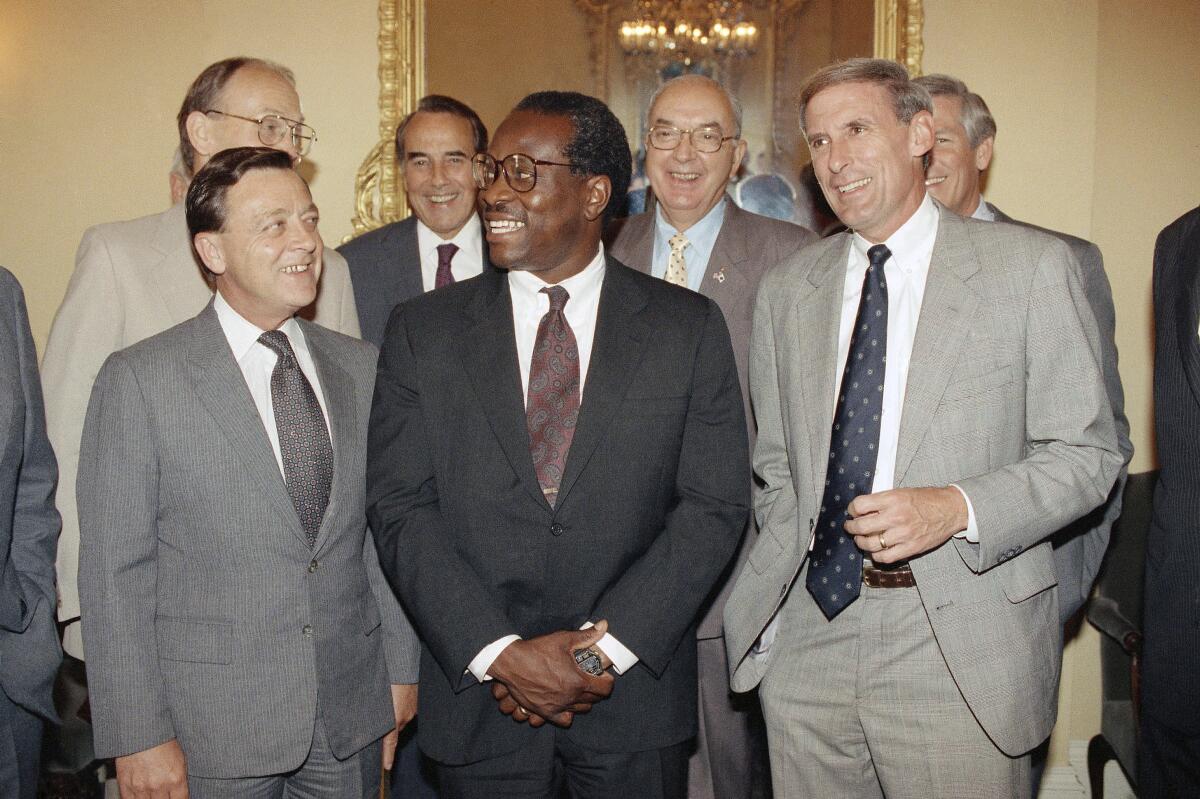
Supreme Court nominee Clarence Thomas, center, poses with senators on Capitol Hill in 1991. With Thomas, from left to right, are Sens. John Seymour (R-Calif.), Larry Craig (R-Idaho), Bob Dole (R-Kan.), Jesse Helms (R-N.C.), Connie Mack (R-Fla.) and Dan Coats (R-Ind.), right front.
(John Duricka / Associated Press)
“If somewhere in a footnote, history should record my public service, I would hope that they record me as one who cared more for people than for policy, one who was a no-nonsense guy who worked hard for those in need of help, but who wasn’t hesitant to knock heads of bureaucrats in order to get things done,” he told supporters at the kickoff to his Senate campaign in 1992.
Born in Chicago, Seymour settled in Southern California in the 1960s after a stint in the Marine Corps. The UCLA graduate started a real estate business in Orange County as the region transformed from farmland to suburbia. After four years on the Anaheim City Council, he became mayor in 1978.
He quickly established the pragmatic persona that would enable his rise in California politics.
Months after Seymour’s mayoral win, Anaheim police officers stormed a Latino neighborhood and beat up dozens of people in what became known as the Little People’s Park riots. At community meetings, Seymour admitted his shock at learning about the poor relations between the police and many residents.
The mayor described his approach as: “Don’t sweep it under the rug; don’t look the other way. Admit that we have a problem.”
At the same time, Seymour was negotiating with the Los Angeles Rams to move from the Coliseum to Orange County. While other O.C. officials proposed a new stadium, he convinced the Anaheim City Council to convert Angel Stadium into a multipurpose venue that he argued would create “the greatest opportunity for Anaheim since Disneyland and the California Angels.”
The Rams moved to the city in 1980. Two years later, Seymour was off to Sacramento as a state senator.
He became head of the Republican Senate caucus in his first year and bucked the stereotype of an Orange County GOP firebrand by largely eschewing culture war issues in favor of matters like higher pay for teachers and government support for poor parents that sometimes aligned him with Democrats. That made him few friends in his own party, with many finding his personal ambition grating — he once wrote a letter to then-Gov. George Deukmejian asking that he be appointed state treasurer — and a distraction from getting more of their own elected to Sacramento.
Seymour made no apologies for selling himself as a public servant while simultaneously seeking more power.
“I like to do things,” Seymour told The Times in 1987. “I’ve been a doer all my life. I don’t like to sit around sucking my thumb. I like to resolve problems.”
That year, conservative opponents deposed him as caucus chair. They snickered two years later when he announced that while he personally opposed abortion, he now supported a woman’s right to choose.

Sen. John Seymour in 1991.
(Don Boomer / For The Times)
The impetus was a U.S. Supreme Court decision that gave states more leeway to regulate abortion. Since California had legalized the procedure decades earlier, Seymour reasoned that he should respect women’s choices. He spoke with people who were for and against abortion, and with his own family, before going public with his change of heart.
Naysayers accused the state senator of trying to pick up female voters as he was campaigning for the Republican nomination for lieutenant governor against fellow Orange County legislator Marian Bergeson, who opposed abortion. The charge was bogus, according to longtime Seymour campaign advisor Eileen Padberg.
“He didn’t get talked into it — he was an effing Marine,” she said. “He had to be convinced in anything before making a decision. In my career representing hundreds of candidates, John was one of very few who consistently would say about their stances, ‘This is going to kill me, but I gotta do it.’”
Seymour lost the primary to Bergeson. Six months later, he was once again one of the most powerful Republicans in the state when he took the Senate seat Wilson had just vacated to become governor.
Seymour’s son John recalled his father getting the call from Wilson while the family was vacationing in Shasta.
“Dad knew that it was a heavy, weighted responsibility, and that it would affect the family,” John said. “But we kids said, ‘You should do this, if it makes you happy.’”
Seymour became the second Anaheim Republican to serve in the position, after Thomas Kuchel in the 1950s and 1960s.
Wilson told The Times that he originally wanted to keep his friend in Sacramento to help push through his agenda. But the governor figured he needed a trusted voice in Washington even more.
“You’re looking for people who are not only friends but are capable and experienced and understand what’s necessary,” Wilson said. “And I don’t think I was doing him a great favor, because it was a tough time for the state.”
California was weathering its worst recession in decades and a punishing drought. The state’s vaunted defense industry was shedding tens of thousands of jobs with the closure of military bases after the end of the Cold War.
The daunting task didn’t faze Seymour.
“I mean, you gotta be good to succeed in the private sector,” he told The Times in 1992. “But if you’re gonna succeed in getting things done in the public sector, you gotta be better than that! That’s the challenge!”
Seymour spent most of his short time in the Senate in triage mode. He lobbied especially hard for California’s real estate industry, calling himself the “realtors’ senator.” But the diminutive man’s plainspoken demeanor failed to gain traction with California voters — a 1991 Times profile deemed him “the unknown senator.” And his one moment in the national spotlight became fodder for opponents.
In the spring of 1992, Los Angeles erupted in deadly riots after a jury acquitted four police officers who beat Rodney King. As he once did in Anaheim, Seymour went on a listening tour across affected neighborhoods, accompanying President George H.W. Bush.
This time, Seymour was accused of seeking photo opportunities a month before his primary election and being tone-deaf to the riot’s root causes by airing television ads stating, “We can’t be tough enough on lawbreakers.” White House aides ridiculed him in the press as the “Velcro senator.” His Republican opponent, Orange County Rep. William Dannemeyer, labeled him “Senator Flip Flop.”
Seymour easily beat Dannemeyer, then faced Democrat Dianne Feinstein, the former San Francisco mayor whose narrow loss to Wilson in the governor’s race had earned her widespread name recognition. He received only 38% of the vote as Feinstein rode a Democratic wave that swept Bill Clinton into the White House and a record number of women into the U.S. Senate, including Barbara Boxer in California.
California Department of Finance spokesperson H.D. Palmer worked for Seymour at the time and saw his “regular guy” boss give “one of the kindest and most gracious concession speeches I’ve ever heard.”
“Then he went down to O.C. to be with his supporters,” Palmer said. “He was true to his roots.”
Wilson soon appointed Seymour to head the California Housing Finance Agency, which helps first-time home buyers access low-rate loans. He stayed in that role for two years before becoming chief executive of the Southern California Housing Development Corp. The Inland Empire nonprofit, which managed and built affordable housing complexes, is now known as National Community Renaissance, or National CORE.
John, who is the nonprofit’s vice president of acquisitions, said his father had no regrets about leaving politics behind because “housing was his passion. He saw it as a platform for people to grow. He would say, ‘Once you’re housed, you have a big, beautiful horizon to do anything.’”
Seymour did lean on his past to urge skeptical cities and counties to allow affordable housing projects, challenging them to be like him: do the right thing regardless of political cost.
“If in fact you’re going to try to change an environment in which a mayor or city council will do what they know in their hearts is right, you need to offset the political blow,” he said at a housing conference in Cathedral City in 2002. “I challenge you to form a coalition.”
Seymour is survived by his wife of 54 years, Judy; children John, Shad, Jeffrey, Barrett, Lisa Houser and Sarena Talbert; nine grandchildren and eight great-grandchildren.