California deal on Paramount-Warner Bros. merger spurs frustration
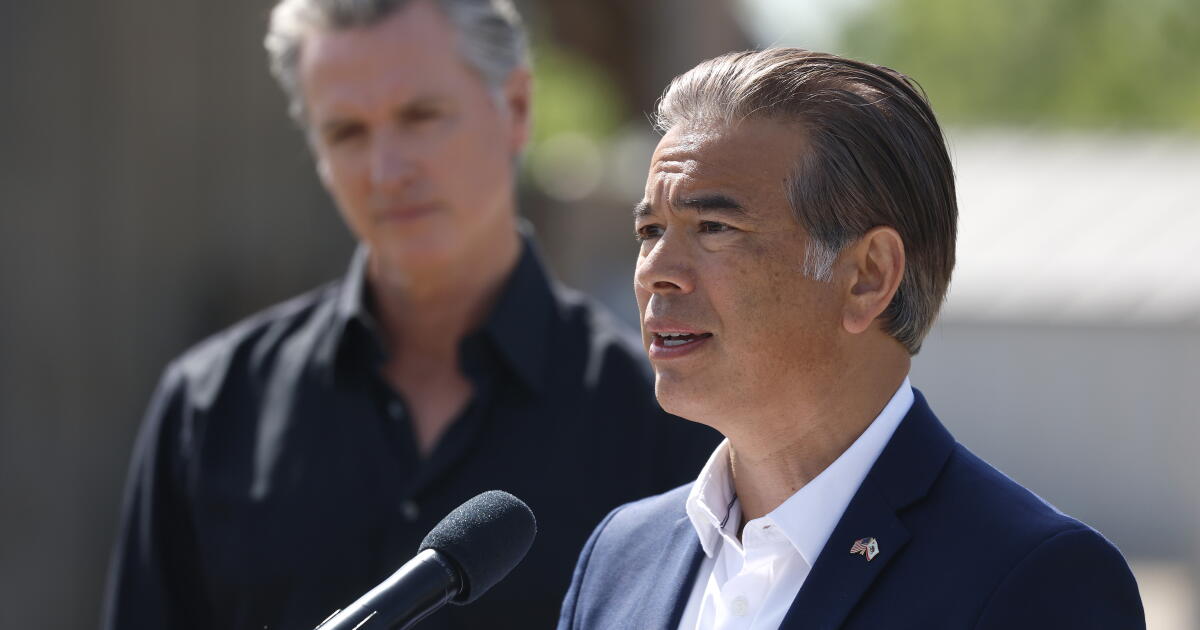
California Atty. Gen. Rob Bonta’s deal to allow the $111-billion Paramount-Warner Bros. merger to proceed was struck amid political pressure from state leaders and concern from some Democratic attorneys general that concessions from the studio fell short, according to multiple sources familiar with the negotiations.
As recently as this weekend, New York Atty. Gen. Letitia James and Connecticut Atty. Gen. William Tong — who had signed on to the lawsuit — had said they needed more concessions, according to three knowledgeable sources close to the negotiations.
In an interview with The Times on Tuesday, Tong said Bonta was “doing his very best in very difficult circumstances” to steer the coalition to a favorable outcome, but amid “a lot of political pressure” from others in California that “did not help.”
“I’m not going to sugarcoat it. This is ultimately not what I wanted,” Tong said.
Tong said one of his chief concerns — shared by others in the 12-member coalition of states — was with the merger’s consolidation of CNN and CBS News under Paramount Skydance Chief Executive David Ellison, the billionaire media mogul close to President Trump and son of Oracle co-founder and Republican mega-donor Larry Ellison.
Tong raised similar concerns after the announcement of the deal, when he said publicly that his state had “led the fight to the bitter end to protect the editorial independence of CNN and CBS News,” and that he was “deeply disappointed that we could not do more.”
Paramount declined to comment.
With its economy and global reputation heavily intertwined with Hollywood’s allure and ability to survive, California had more at stake in the negotiations.
In exchange for the states lifting their antitrust challenge, Bonta said Monday that the studio had agreed to either produce 30 or more films annually for the first five years of the combined company or divest the Miramax film studio; separately negotiate basic channel agreements for Paramount and Warner Bros. or divest from major cable channels; spend $300 million more each year on film production in the U.S.; maintain its Melrose Avenue and Burbank lots; and establish a board to ensure editorial independence at CNN and CBS News, which also fall under the merger.
Bonta said the deal has “real teeth,” and that he “will hold Paramount accountable” moving forward.
Since then, however, other Democrats have voiced less confidence, and some in the coalition believed they could have held out for better terms as the midterm elections approached.
Some also questioned whether Bonta and other California leaders were swayed by Ellison’s threat to move Paramount out of the state.
Gov. Gavin Newsom, Los Angeles Mayor Karen Bass and Xavier Becerra — the front-runner in the race to succeed Newsom as governor — had all urged Bonta to settle the case. In his initial statement on the deal, Ellison thanked the Democratic attorneys general for working through their differences, but also thanked Newsom for “his support throughout this process.”
Sen. Cory Booker (D-N.J.), the ranking Democrat on the Senate Judiciary Subcommittee on Antitrust, Competition Policy and Consumer Rights, said Bonta and the other state attorneys general “took on one of the most powerful media companies in the world, a company backed by the full weight of the White House,” and that Paramount had answered “with what amounted to extortion” by threatening to withdraw from California if the deal was blocked.
Booker claimed the merger remains illegal and questioned the independence of any editorial board picked by and reporting to Ellison — saying it would not stop him from making “sweeping changes at CNN” to please Trump.
“This is what happens when federal enforcers abandon their posts. States are left to carry the fight alone, and even the strongest state enforcers cannot outlast a company willing to say anything and spend anything,” Booker said. “That is not justice. That is a price tag.”
Dissent before the deal
The pace of the negotiations, which had been on-again, off-again for weeks, quickened last week, and Bonta’s office had reached a deal with Paramount by Friday, sources said.
But there was a last-minute hiccup: Some members of the coalition felt the deal fell considerably short of what they had been seeking.
Among other things, James was dismayed that the Writers Guild of America — which had separately sued to block the deal — hadn’t been brought into the negotiations. She pushed to include the WGA and to bolster Paramount’s commitment to the WGA’s health and pension fund.
Over the weekend, Paramount agreed to increase its health fund commitment from $10 million to $17.5 million. Still, the WGA had largely been shut out of the process, and said Monday that it continued to “believe the merger will cause damage to writers and the industry at large.”
One source familiar with the negotiations said the states had four separate votes against settling on Sunday, but the resistance eventually crumbled with word that the WGA was backing out of the fight. Two sources familiar with the matter said some in the coalition were caught off guard by the speed with which Bonta’s “tone” changed and the deal was reached. Some had felt Paramount may be more inclined to grant concessions once it had to start increasing its payout to Warner Bros. investors starting Oct. 1.
On Tuesday, Bonta told The Times that he would not comment on “what specifics led up to” the deal, except to note that all 12 state attorneys general in the coalition signed on to it.
“It was unanimous, and I’ll leave it at that,” he said.
Bonta said there was certainly “a lot of interest” in the case from other elected officials, some of whom made their positions clear, but that “none of it had any influence” on him.
“I need to look at the law and the facts,” he said. “If we’re able to get a solution to our antitrust concerns, we take it.”
Bonta said he could not comment on what effect Ellison’s threats to move Paramount out of California might have had on his decision and that his “focus was on the antitrust concerns” — which he believes the deal substantially addresses.
A source close to the governor’s office said Newsom communicated frequently with Bonta and Ellison, acted as an unofficial mediator and urged them to reach a resolution, but did not try to control the terms of the deal and respects Bonta’s role as the state’s independently elected law enforcement leader. Newsom appointed Bonta as California’s attorney general in 2021 after Becerra, who was serving in that post, accepted a position in President Biden’s cabinet. California voters elected Bonta as attorney general in 2022.
The source said Newsom wanted the two sides to settle the case because he was concerned that the state could face protracted litigation, ultimately lose in court and end up with nothing. Paramount leaving California for Nashville — a destination floated by Ellison — also would have been an economic blow to the state.
Newsom has tried to keep businesses headquartered in the state due to the economic and budgetary impacts of losing companies and their wealthy chief executives to other places, and recently signed legislation to create a new post-production tax credit for studios. Last year, he doubled the state’s existing film and television tax credit in an effort to support the industry.
Mixed reaction
Newsom and many of Bonta’s fellow attorneys general echoed his claims of victory.
James said the deal “will allow the film and television industry to continue to thrive with more movies produced in America and $1.5 billion of new investment in film production.” Oregon Atty. Gen. Dan Rayfield said it “keeps real competition in place, ensures that productions will continue, and ensures journalistic independence.” Arizona Atty. Gen. Kris Mayes said it would protect businesses, including local movie theaters. Colorado Atty. Gen. Phil Weiser said it would protect “moviegoers and producers.”
In a statement, Newsom thanked Bonta for his work to reach the deal, which he called “a practical path forward” that “protects California jobs while putting a safeguard in place to help preserve editorial independence for two of America’s most important news organizations.”
Still, it was clear that others viewed the deal as a partial win at best.
New Mexico Atty. Gen. Raúl Torrez called it a “great first step.” Massachusetts Atty. Gen. Andrea Joy Campbell said the states were “unable to secure every protection we fought for,” and that she “would have liked to see more.” Minnesota Atty. Gen. Keith Ellison stressed that the deal should not be seen as an endorsement of the merger.
“I believe mergers like this are never done with the best interests of consumers, workers and small businesses in mind and are instead designed to help a select few get richer,” he said.
Some outsiders were even more forthright with their skepticism. Rich Greenfield, a longtime media analyst, called the deal a “slam dunk win” for Paramount because it didn’t require the company to sell off any assets. Norm Eisen, co-founder of the Democracy Defenders Action group, said the “so-called independence board” to oversee CNN and CBS News “appears to be sorely lacking in independence.”
Bonta said the deal does set out structural divestment remedies if Paramount does not follow its other terms — including by requiring it to sell off Miramax if it doesn’t produce enough films, and to sell off BET, VH1, Comedy Central and other channels if it doesn’t negotiate cable agreements for Paramount and Warner Bros. separately.
He said that if the state had held out and gone to trial on its antitrust arguments, it would not have been able to negotiate any journalistic oversight for CNN and CBS, whereas the “creativity and flexibility of settlement” allowed them to establish the oversight panel.
“Does that transform our information ecosystem broadly, to make sure that there’s no more misinformation or disinformation? No. Does it make sure that all broadcast news and cable channel news organizations are only telling fair, fact-based, independent, objective news? No. Does it even ensure that happens every single time at CBS News or CNN? No,” Bonta said. “Does it improve the likelihood, vastly, significantly, that that outcome will occur? It does.”