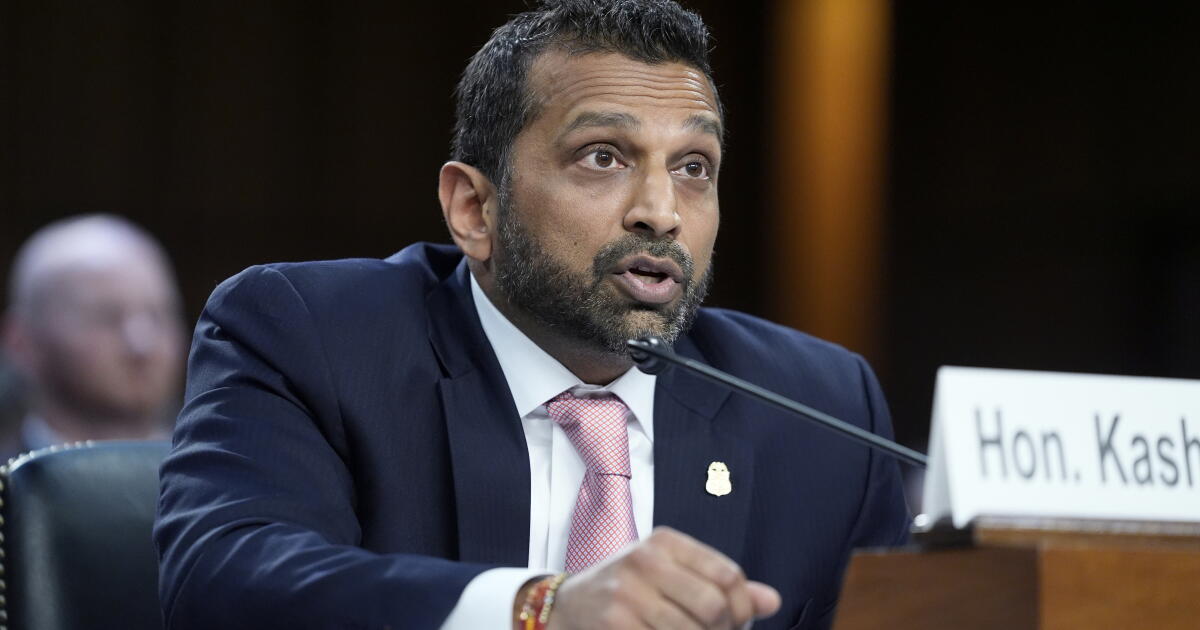
FBI chief Kash Patel defends hiring standards changes on prostitution, bestiality at fiery hearing
WASHINGTON — FBI Director Kash Patel on Tuesday defended the bureau’s loosening of hiring standards regarding an applicant’s past experience with prostitution and bestiality, insisting that the changes were meant to enable victims of those acts to be considered for employment without fear of automatic disqualification.
The subject arose during a contentious Senate Judiciary Committee hearing in which Patel clashed with Democrats over his firing of agents who participated in investigations of President Trump, a spate of media leak probes, and whether employees would be dispatched to the polls on Election Day in light of the bureau’s ongoing election-related investigations and Trump’s repeated and false claims about the existence of pervasive voter fraud.
The hearing featured the name-calling and bitingly personal exchanges that have come to define Patel’s appearances on Capitol Hill, with Democrats characterizing the Trump appointee as unqualified, criticizing him for politically charged investigations into Trump’s enemies and highlighting travel that has included a trip to the Winter Olympics in Italy during which he partied with U.S. hockey players and a snorkeling excursion at the Pearl Harbor memorial in Hawaii.
“He’s an incompetent lackey. He’s like an 18-year old-kid who wants to join a fraternity that he could never be a member of, doing keg stands and chugging with friends. He’s an embarrassment to the agency and wouldn’t qualify even to be an FBI agent,” said an exasperated Sen. Cory Booker (D-N.J.), his voice rising in anger.
Given a chance to respond, Patel replied: “I don’t have much to say. This guy called me a thug. It’s kind of ironic. He’s running for president of the United States. He just got his 20-second ad campaign.”
Booker ran for president in 2020. He has not announced a candidacy for 2028.
Patel was pressed on the FBI’s hiring standards
The FBI quietly issued guidance this spring lifting a categorical hiring ban on applicants who had previously engaged in prostitution. The bureau made a similar change with regard to past experience in bestiality as a child.
Under questioning, Patel denied that the changes reflected a lowering of employment standards and insisted they were designed to prevent victims who’d been forced to engage in that conduct from being automatically disqualified.
“We did not want to punish victims of bestiality, victims who were trafficked. We did not want to make it an automatic disqualification for the FBI to consider you if were a victim of these awful, heinous acts,” Patel said. “We are not going to target victims and prevent them from serving in their capacity to serve this country.”
The questioning spanned partisan lines, with Sen. John Kennedy (R-La.) grilling Patel about the rationale for a change that the FBI director said was proposed to him by subordinates.
“When you saw bestiality, I say this with respect: The person who recommended it, why didn’t you just say, ‘What planet did you parachute in from?’” Kennedy asked. Patel conceded that that was his initial reaction.
The Associated Press reported last month that the FBI still intends to disqualify some applicants who are revealed to have previously engaged in prostitution, including if they’ve done so within the last 10 years.
Patel faced questions about the FBI’s role on Election Day
The hearing unfolded two months before the midterm elections in November and at a time when the FBI has opened investigations related to the 2020 contest, including by seizing voter data in Fulton County, Ga.
Trump regularly makes false claims that elections are rigged and riddled with fraud, especially in the months before an election. But there is no widespread fraud in American elections. Local election officials have detailed processes for auditing the accuracy of the vote after ballots are tallied. Even as he disputed his loss in 2020, audits, reviews and recounts in the battleground states where he challenged the outcome all affirmed President Biden’s win.
Democrats repeatedly pressed Patel on whether the FBI would be dispatching agents to polls. The director said the FBI has an election coordinator in each of its 56 field offices to respond to issues at polling places, including alleged election interference. He did not rule out the idea that agents could be dispatched to the polls if problems arose.
“Do you pledge that you will not in any way interfere in the will of the America people when they go to the polls in November?” asked Sen. Peter Welch (D-Vt.) in one of the more combative exchanges.
“I pledge unequivocally that I will not participate in your charade of lies,” Patel said, later calling Welch a “total fraud.”
FBI firings were also a featured topic of the hearing
Patel repeatedly touted what he asserted was his record-breaking success at the FBI, proclaiming the “most prolific reduction in crime in U.S. history” even though murder rates in American cities had begun dropping even before Trump took office last year.
The Republican-led panel tried through its questioning to keep the focus on Patel’s crime-fighting efforts from his perch at the nation’s premier federal law enforcement agency. But Democrats seized on the tumult inside the FBI over the last year, including sweeping firings of agents who participated in investigations of Trump, the bureau’s aggressive efforts to investigate media leaks by serving subpoenas at reporters’ home and Patel’s travel schedule that has blended private leisure with professional responsibilities.
Sen. Richard Blumenthal (D-Conn.) pressed Patel on the firing of national security agents with expertise in Iran shortly before the U.S. launched attacks on the country last February. He noted that the agents had participated in an FBI investigation into Trump over his retention of classified documents at his Mar-a-Lago estate in Florida.
“Do you think firing the president’s political opponents is more important than retaining the decades of experience and expertise monitoring intelligence threats from Iran?” Blumenthal asked.
“I think what’s most important is to not have a weaponized FBI, and I will endeavor every single day to make sure we have no one there that is doing that,” Patel responded. He did not say why their participation in the Mar-a-Lago investigation represented “weaponized” law enforcement.
Patel later suggested that the firings had been overblown, saying many agents had retired on their own. And he defended his personal travels by pointing to numbers that he said showed that two recent predecessors, Chris Wray and James Comey, had traveled more.
Tucker writes for the Associated Press.