Ireland are due to play Israel in the Nations League in Hungary on Sunday, but boycott pressure mounts on and off-field.
Published On 26 Sep 202626 Sep 2026
The Ireland team’s news conference and training session the day before its first Nations League game against Israel have been delayed as pressure to boycott the matches grows.
Journalists in Debrecen, Hungary – where Israel’s “home” game is to be played Sunday – were left waiting Saturday after being told the news conference was being pushed back until after training. That was 15 minutes before it was supposed to begin.
Training was also significantly delayed, however, with Irish broadcaster RTE reporting the players were still in their hotel more than two hours after the training session was supposed to begin.
RTE reported that some players had decided they did not want to play the games.
“And if they stay to their stated ambition that they have to be all in it together, if one or more want to be out, maybe they will all be out,” reporter Tony O’Donoghue told RTE Radio 1.
The team has been coming under increasing pressure in Ireland, where affinity with Palestinians is strong, to boycott the two games – the first on Sunday and the second, Ireland’s “home” game, in Backa Topola, Serbia, on October 4.
Ireland midfielder Jason Knight said after Thursday’s 1-0 loss in Kosovo that the players were in a difficult situation and that he didn’t think the matches should be going ahead.
Ireland coach Heimir Hallgrimsson previously said “we’re not playing with genocide, we’re playing against genocide. We’re playing against Israel, we’re not playing with Israel” – drawing a furious reaction from the Israeli football federation, which accused the Icelandic coach of “stupidity, ignorance and hypocrisy”.
The Football Association of Ireland (FAI) had resisted calls to boycott the matches, arguing the team could be hit by punishing sanctions by UEFA. Ireland is cohosting the 2028 European Championship with England, Wales and Scotland.
More than 160 Irish sportspeople signed an open letter urging the FAI to reconsider its decision to go ahead with the fixtures.
There were protesters outside the team hotel in Dublin last week calling on the players to boycott the games. The SIPTU trade union displayed a huge poster in central Dublin beside the River Liffey asking the players to “Go with your conscience!” and “Don’t play with genocide” beside an image of a blood-splattered ball.
Former Ireland coach Brian Kerr said the FAI had “lost the respect of the Irish people” for going ahead with the games.
“The Irish people and the soccer-going public don’t want the games to be played,” Kerr said. “I think they’ve made their opinions clear over the last year. The FAI back in November actually went to UEFA and requested that Israel be put out of the tournament on principle. And yet they went against that principle.”
Abbotsford, British Columbia – Every second day, 28,000 litres of raw milk leave Casey Pruim’s farm in Abbotsford in western Canada, entering a distribution system built on the assumption that the milk and the products made from it will have somewhere to go.
While most is consumed in Canada, some had been sold across the border to the United States.
Those sales have largely come to a standstill since US President Donald Trump’s 50 percent tariff on $20bn in Canadian goods, including dairy products, came into effect on August 22.
Pruim, who is also chair of the British Columbia Dairy Association representing about 400 dairy farmers across the province, told Al Jazeera that Canadian farmers do not individually decide which products are exported.
Instead, producers such as Pruim – whose farm has 330 cows milked three times a day – sell into the provincial milk-marketing system, which distributes milk to processors according to demand, including for products exported to the US.
If a processor loses US demand, it may require less milk, with the impact then spread across the provincial pool.
Dylan Kruger, director of public affairs at BC Dairy, told Al Jazeera “there is still considerable uncertainty around the impact of the US tariffs”.
He said it was too early to know how the industry would be impacted or whether milk no longer sold to the US could be sold elsewhere, mitigating financial losses.
But the tariffs and wider trade tensions have already introduced uncertainty and instability for businesses.
Casey Pruim, owner of Prime Acres Ltd dairy farm in Abbotsford, British Columbia, heads the BC Milk Producers Association in Canada’s western province [File: Ali Mustafa/Al Jazeera]
“If the processor who’s exporting some of his product to the United States can no longer sell into that market because he’s now priced out of the market with a 50 percent tariff, that’s how it would impact the dairy farm,” Pruim said.
Pruim said if processor demand is squeezed, farmers would be forced to dump the milk. In the worst-case scenario, the herd has to be cut.
“Cows aren’t like a tap; you can’t just turn them on or off,” he said.
His warning captures dairy’s particular vulnerability in a tariff war: Milk is highly perishable, collected on a tight schedule and dependent on processors whose demand can change much faster than farmers can adjust production.
“These tariffs are completely unwarranted,” David Wiens, president of the Dairy Farmers of Canada, told Canada’s CBC News, adding that they would affect “the supply chain, not only in Canada but in the US as well”.
Supply-management system
Dairy trade between Canada and the US has largely operated under a free trade agreement between the US, Mexico and Canada, known as CUSMA in Canada.
Canada manages the supply of dairy, poultry and eggs through a national agricultural policy known as supply management. The system uses production quotas and import controls, including tariffs, to provide farmers with more stable and predictable prices while maintaining domestic supply.
Critics describe the system as protectionist and as a government-backed cartel.
Washington argues that Canada’s supply-management system restricts US dairy exports. Trump posted on Truth Social that “Canada had been ripping off the United States of America for years” and accused it of imposing “ridiculously high tariffs” that made life impossible for US farmers.
Canadian producers reject that argument, saying the existing trade agreement already gives US imports substantial tariff-free access that is not fully utilised.
Canada’s dairy trade deficit with the US has grown significantly since CUSMA came into force on July 1, 2020, according to the Dairy Processors Association of Canada.
In 2020, Canada exported 241.3 million Canadian dollars ($173m) in dairy products to the US and imported 647.4 million Canadian dollars ($462.7m) worth of dairy and dairy products. In 2025, Canadian dairy exports had risen to 308.7 million Canadian dollars ($220.7m) while dairy imports from the US had more than doubled to 1.355 billion Canadian dollars ($968.5m), accounting for 13.8 percent of total value of US dairy exports, according to the association.
Nearly 14,000 litres of milk are stored daily in the refrigeration unit at Casey Pruim’s farm in Abbotsford, British Columbia, at a temperature of 2.8’C [File: Ali Mustafa/Al Jazeera]
Bryan Yu, chief economist at Central 1 credit union, said the immediate shock of losing a major market could be difficult for Canadian producers to absorb because replacement buyers cannot be found quickly.
“There is going to be pain in the near term for a lot of our producers,” Yu told Al Jazeera.
“You really can’t quickly adjust to a 50 percent tariff, because it’s uncharted waters for a lot of industries … and ultimately it shuts [Canadian producers] out, because a lot of them don’t have the margins that they can play with,” he said.
Yu said Canadian consumers might absorb some of the additional supply while exporters search for new markets and higher-value products, but neither adjustment is instantaneous.
“There are global markets as well, especially when you talk about chilled, chilled beef, chilled products and really it’s a question of whether … other types of markets that could be available.”
Canada has also imposed retaliatory tariffs, which came into effect on September 8 and cover $20bn worth of US products.
Dairy products are among the targeted goods. The list includes a 50 percent tariff on milk, cream and whey products and a 25 percent tariff on many cheeses imported from the US.
Casey Pruim has a herd of 330 cows at his dairy farm in Abbotsford, British Columbia [File: Ali Mustafa/Al Jazeera]
Canadian Prime Minister Mark Carney has framed Ottawa’s response as both retaliation and an attempt to build greater economic resilience.
Announcing the collapse of the latest negotiations, he said Canada would match Washington’s new tariffs “dollar for dollar” to protect workers, farmers, families and businesses.
But retaliatory measures carry risks of their own.
“Canada’s new retaliatory tariffs will help some industries but hurt most and weaken economic growth across the country by raising costs for producers and consumers,” Oxford Economics said in a report.
For now, geography remains important for perishable goods like dairy products that once moved quickly across the US border and cannot be redirected overnight to a distant market without new buyers, logistics and regulatory approvals.
Ottawa’s Trade Commissioner Service is advising affected companies to check their CUSMA compliance, explore available relief and contact trade commissioners about potential new markets.
Yu predicted that the US and Canada could reach a tariff deal in the following months but said the interim period could bring “higher prices, weaker economic activity and deeper mistrust”.
For Pruim, the uncertainty is as destabilising as the tariff threat itself.
“I think, like [for] any Canadian, it’s disappointing to have these trade talks collapse again and just the uncertainty around it.”

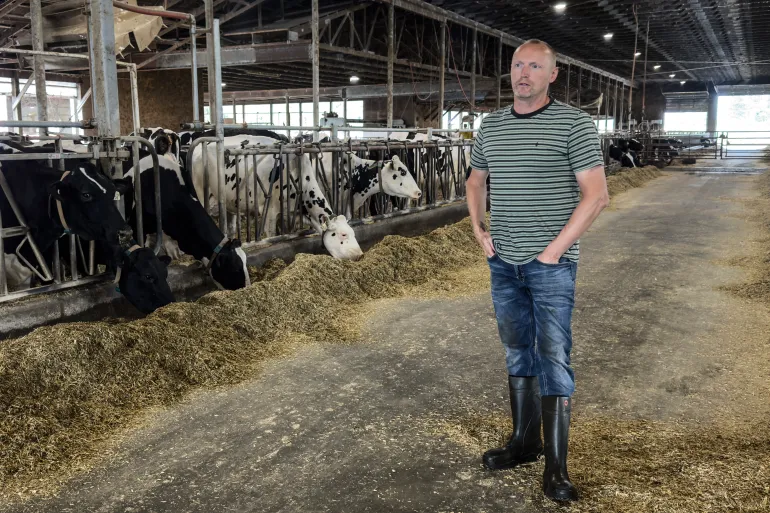
![Casey Pruim, owner of Prime Acres Ltd. dairy farm in Abbotsford, British Columbia heads the BC Milk Producers Association in Canada's western province [Ali Mustafa/Al Jazeera]](https://i0.wp.com/www.aljazeera.com/wp-content/uploads/2026/09/PRUIM7-1789051532.jpg?w=640&ssl=1)
![Each day almost 14,000 litres of milk produced by cows is stored in the refrigeration unit at Casey Pruim's Prime Acres Ltd. dairy farm in Abbotsford, British Columbia at a temperature of 2.8'C [Ali Mustafa/Al Jazeera]](https://i0.wp.com/www.aljazeera.com/wp-content/uploads/2026/09/DSLR_PRUIM25-1789051502.jpg?w=640&ssl=1)
![Casey Pruim, owner of Prime Acres Ltd. has a herd of 330 cows at his dairy farm in Abbotsford, British Columbia [Ali Mustafa/Al Jazeera]](https://i0.wp.com/www.aljazeera.com/wp-content/uploads/2026/09/DSC01443-1789051497.jpg?w=640&ssl=1)