staff member

Justices urged to block Trump’s new ballroom so Congress can decide

The Supreme Court was urged Tuesday to block construction of President Trump’s huge new ballroom until Congress weighs in. A decision, perhaps only temporary, is likely by Friday.

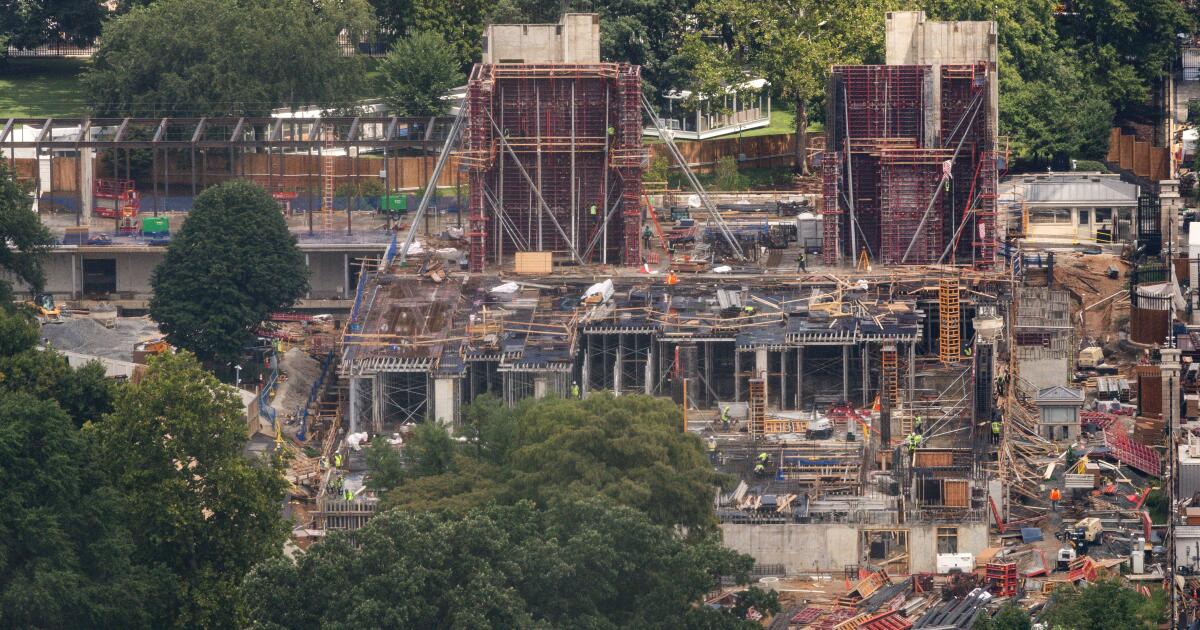
Acting on his own, Trump had the East Wing of the White House torn down in October and ordered work to start on a massive new building that would dwarf the old executive mansion and seat 1,000 guests for dinner.

But a federal judge in Washington ruled that Trump had overstepped his authority, and the U.S. Court of Appeals agreed in a 2-1 ruling on Aug. 7.

Those judges would stop the above-ground construction but put their decision on hold until this Friday. This gave the administration time to appeal to the Supreme Court.

The National Trust for Historic Preservation had sued, arguing that the president has no authority to erect new buildings on government property.

Federal law protects “historic buildings, parks, and places, including perhaps the most revered site in our nation: the White House and President’s Park,” the group told the court Tuesday. It is “more than the President’s residence” and “is owned by American people.”

The historic trust said Trump is moving quickly so as to bypass the law.

“Rather than obtain permission from Congress,” Trump and his appointees “have instead decided to try to outrun judicial review,” it said.

Meanwhile, Trump’s lawyers have taken to describing the ballroom as a national security project.

Last week, Solicitor Gen. D. John Sauer told the justices they should throw out the “extraordinary and unlawful injunction that will halt the ongoing construction of the integrated military complex” because “a totally secure ballroom space … is vitally required by national security.”

He also contended it is too late for judges to intervene.

“Today, the project is 65% complete in its entirety, and moving quickly toward total completion. A concrete-and-steel superstructure stretches five stories deep and 70 feet high, and occupies nearly 50,000 square feet, with construction on and above the second-story level above ground.”

While the plans have changed, the “work has followed a single coherent design,” he wrote. “By now, it has passed the point where major changes to [that] design are feasible.”

U.S. District Judge Richard Leon, a George W. Bush appointee who ruled on the lawsuits, agreed the White House may proceed with the underground work to create a safe and secure location for the president, his family and White House employees.

The solicitor general said a new and secure ballroom is also crucial for social gatherings and foreign dignitaries.

He said that if Leon’s ruling is “allowed to go into effect, the injunction would wrongfully install a single district judge as sole arbiter of what further construction is strictly necessary to protect the safety of the President, his family, staff members, and visitors to the White House, including foreign dignitaries, and presidents and prime ministers of other countries.”

Sauer also argued the lawsuit should be thrown out on the grounds that National Trust for Historic Preservation and its members have no standing to sue because they have not suffered a particular injury.

The D.C. Circuit judges split on that issue. Judges Patricia Millett, an Obama appointee, and Bradley Garcia, a Biden appointee, ruled the plaintiffs had standing to sue. Judge Neomi Rao, a Trump appointee, dissented and said the members of the historic trust did not have standing.
Source link

Probe finds reports of sexual misconduct at Epstein-supported school

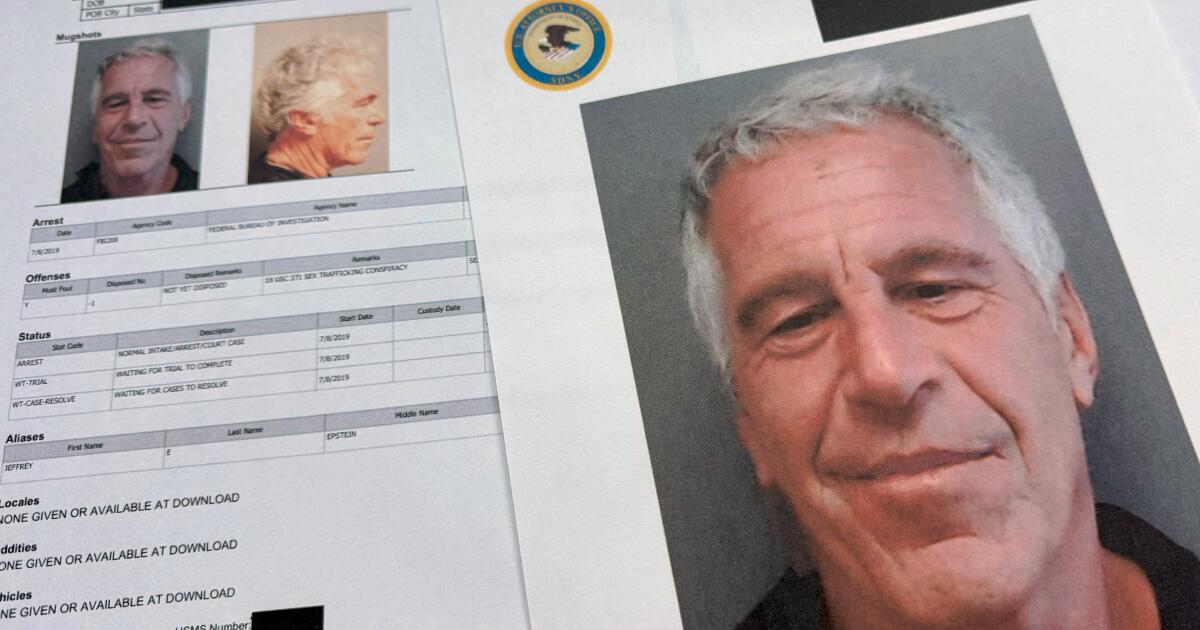
Two people who attended a prestigious Michigan fine arts school reported conduct of a sexual nature by Jeffrey Epstein, a major donor, according to an investigation that also uncovered dozens of allegations spanning decades against nearly 50 other people.

Interlochen Center for the Arts operates a summer camp and performing arts school that draws students from around the world. It hired a law firm in 2024 to investigate reports of sexual abuse by faculty and staff. Subsequently, it expanded the work to include information about Epstein, the 66-year-old financier who killed himself in jail in 2019.

Interlochen removed Epstein’s name from a lodge after he was convicted of sex offenses in Florida in 2008. The building, renamed the Green Lake Lodge, recently was demolished after the U.S. Justice Department released millions of pages about Epstein that had been compiled over the years.

Sanghavi Law Office says it collected 70 accounts from alumni alleging “physical conduct of a sexual nature” by 47 faculty and staff members affiliated with Interlochen from the 1950s through the 2010s, most before 2000.

“The information gathered during this investigation is, simply, devastating,” the 97-page report says, noting that alumni reported grooming, flirting, sexual touching and sex.

Interlochen said it provided names of people accused of misconduct to Grand Traverse County authorities in northern Michigan to determine what steps, if any, might be taken. None are employed at the school and more than a third are dead.

“We are deeply sorry for the harm experienced by members of our community and extend our apologies to those impacted by abuse at Interlochen,” president Trey Davey and board chair Barrett Rollins said in a letter to the community posted online.

“While the vast majority of the incidents described in the investigation took place decades ago, and reports of abuse at Interlochen have significantly decreased over the past 25 years, the passage of time does not diminish the experiences of our alumni,” they said. “Sexual abuse committed by an adult in a position of power or trust against a student is wrong, then and now.”

Interlochen today “is fundamentally different from the institution described in this report,” Davey and Rollins wrote, with comprehensive safety policies and a changed culture.

Epstein, who played the bassoon, was an Interlochen camper in 1967. He donated more than $400,000 to the school between 1990 and 2003.

Two women told investigators that Epstein engaged in conduct of a sexual nature with them, one of them at the Interlochen lodge that bore his name. He brushed against her body “over her clothes, in a manner in which he indicated was accidental,” according to the report.

Epstein also paid for her to visit him in New York while she was a student. She said “every time he was ‘handsy’ with her, she would freeze until he would stop,” the report states.

The other woman said she gave Epstein a massage at his home, according to the report, and he may have asked her to remove her top. She said she had no further contact with Epstein or his girlfriend, Ghislaine Maxwell.

Outside of the school investigation, at least two Interlochen alumnae made allegations of grooming and abuse against Epstein and Maxwell, according to federal records and media reports. Their identities were not made public.

One testified against Maxwell in 2021 when she was convicted of sex trafficking. It’s unclear whether those women spoke to the law firm hired for the Interlochen investigation.

White writes for the Associated Press.

Source link