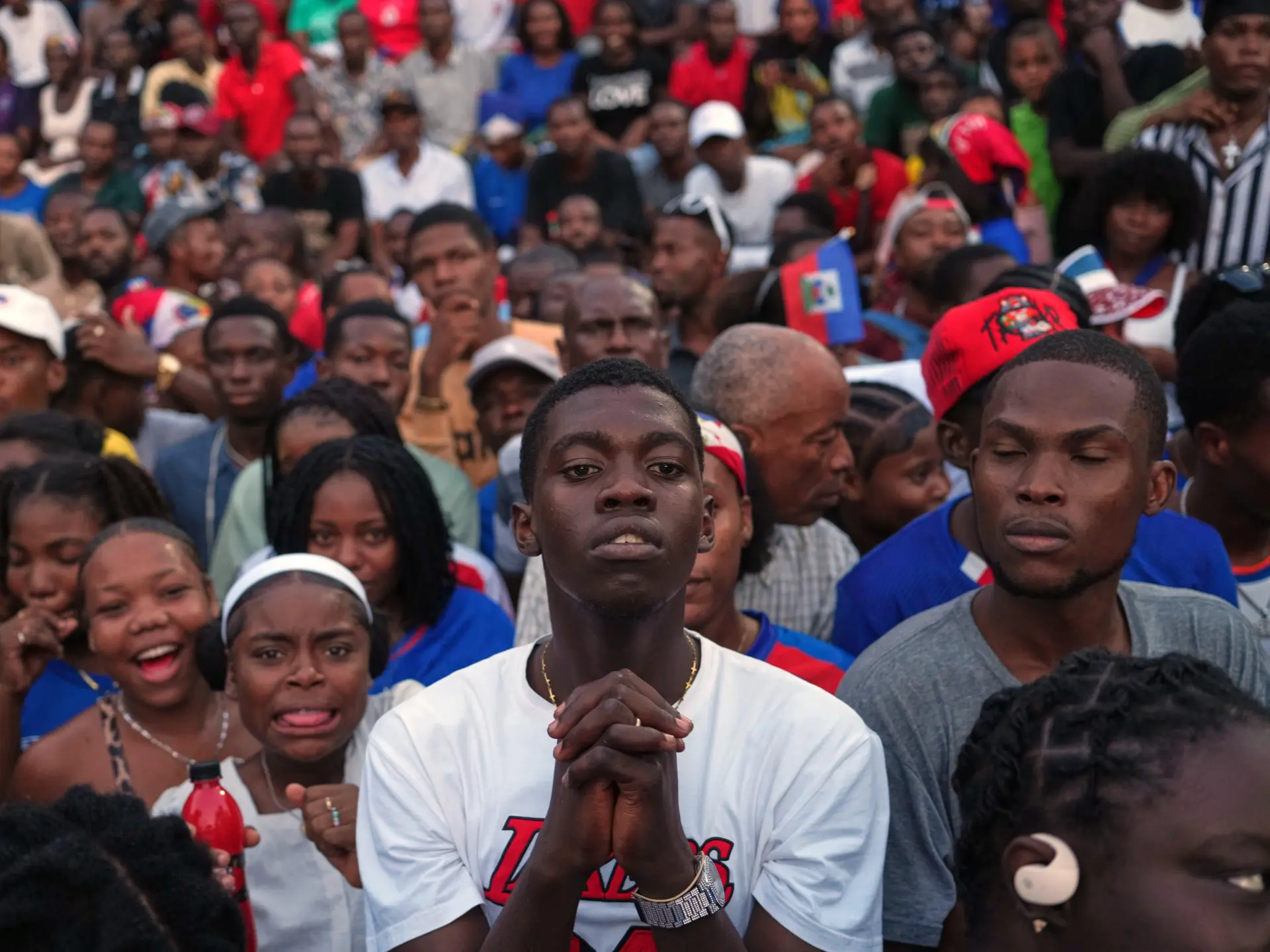
Groups of fans forced through entrances, damaging a gate at the teams’ CONCACAF Nations League match in Santo Domingo.
Published On 3 Oct 20263 Oct 2026
The Dominican Republic has banned Haiti’s national football team from playing at its sports venues after crowd trouble at a CONCACAF Nations League match between the two island neighbours.
Sports Minister Kelvin Cruz announced the ban after incidents before the match on Thursday night at the entrances to the Felix Sanchez Olympic Stadium in Santo Domingo.
Video posted on social media showed groups of fans forcing some entrances, with one gate damaged.
“What we saw yesterday with a gate at the Felix Sanchez, a sports facility that has cost millions and millions of pesos to make it shine, is unacceptable,” Cruz said, citing a zero-tolerance policy on indiscipline.
Dominican Republic President Luis Abinader backed the decision, saying: “The position of the Sports Minister is the position of the Government.”
Haiti’s embassy in Santo Domingo said the remarks, made “in the heat of competition and the intensity characteristic of sporting events”, did not reflect the position of the Haitian government and thanked Dominican authorities for the event.
“Sporting rivalries must not call into question relations of good neighborliness and mutual respect that must prevail between the two states,” the embassy said in a statement.
In a post on X after the match, the federation called it a “beautiful night for Haiti, beautiful night for the island we share”, adding: “On the field, competition; off the field, respect for the neighbor.”
Haiti won the match 4-1, with Sunderland striker Wilson Isidor scoring twice. The win gave Haiti nine points in Group A, while the Dominican Republic remained on six points. Haiti play Costa Rica in San Jose on Sunday.
Isidor was filmed saying: “Hispaniola is Haiti.” Hispaniola is the Caribbean island shared by the Dominican Republic and Haiti, which have long clashed over migration and border security.
Dominican Football Federation president Jose Deschamps called Isidor’s remark “a lack of respect for national sovereignty” and said the federation would file a complaint with FIFA and CONCACAF.
Abinader’s government has stepped up deportations of undocumented Haitians since October 2024, when it pledged to deport up to 10,000 people a week.
Sport has been drawn into the neighbours’ disputes before.
In 2023, after Abinader shut the border in a dispute over a Haitian canal on the shared Massacre River, Haiti’s sports ministry ordered its football federation to stop staging national team matches in the Dominican Republic.
Eckerlin was a professional footballer in Germany before transitioning to MMA, and says he taught Brighton players “wrestling, head control, hip control, and how to push back against opponents”.
Days before this interview with Eckerlin took place, the Seagulls moved up to third in the Premier League after beating champions and set-piece kings Arsenal 3-0.
Eckerlin is quick to play down the impact of his advice for the Brighton players, but admits his training “opened doors” for them.
“The Premier League is more physical, more aggressive, and they don’t know how to use their body,” Eckerlin told BBC Sport.
“Brighton sent me videos of how they defend, and they did nothing with their hips and arms.
“I taught them first in the weightlifting room, then the pitch, and it worked. This is what I did, I opened doors for them.”
Eckerlin was a professional footballer from 2005 to 2009, playing for SV Darmstadt in the third tier of German football at the peak of his career.
As a youngster, Eckerlin always wanted to play for the team he supports, Eintracht Frankfurt, but believed his dream was over when he left the sport.
Little did he know that MMA, and specifically European promotion Oktagon, would help make his dream of performing there come true.
In 2024, Eckerlin beat fellow German Christian Jungwirth at Frankfurt’s Deutsche Bank Park in front of nearly 60,000 fans in the most-attended MMA event of the year.
On Saturday, Eckerlin returns to the stadium also known as the Waldstadion for a second time to face the Czech Republic’s David Kozma at Oktagon 94 with nearly 60,000 expected once again.
“It was my first dream, when I was in the Waldstadion when I was six or seven with my uncle. It was the dream for me to play there but I thought the fire went out,” says Eckerlin.
“I cannot tell you in words what this means to me. The biggest thing in my career. And now for the second time… crazy.
“I’m at the end of my career, I’m 39, so this is maybe my last fight. There’s no better way to stop fighting in my backyard, you know.”
Tens of thousands of people walk in and out of Dodger Stadium on any given night, paying scant attention to the trees, plants, and other foliage surrounding it on all sides. Chaz Perea made his peace with that a long time ago.
“Getting to Dodger Stadium is not a small thing,” said Perea, 41, the stadium’s landscape manager. “You’ve got to park in this monster,” he said, motioning to the acres of asphalt around him, “and then go find your seat in that monster.”
1
2
3
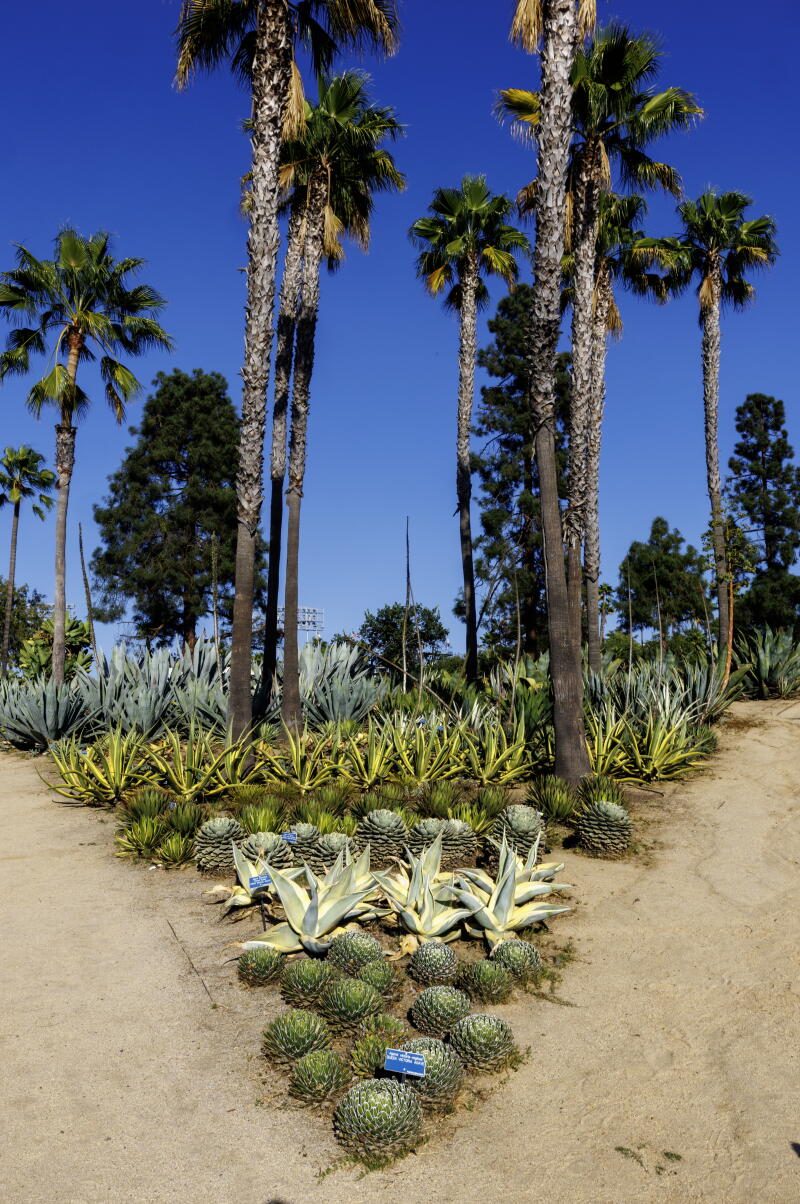
1.The agave garden sits outside Lot B at Dodger Stadium on Friday.(Gina Ferazzi/Los Angeles Times)2.Dodgers fans walk past vibrant plants behind photos of former Dodgerss outside center field at Dodger Stadium on Friday.(Gina Ferazzi/Los Angeles Times)3. A group visits agave island during a tour of Dodger Stadium’s botanic garden on Tuesday.(Christina House/Los Angeles Times)
For the past 17 years, Perea and his four-person crew have been responsible for every bit of stadium landscaping that isn’t the field itself. That’s roughly 300 acres, encompassing the parking lots, the hillsides meeting the 110 Freeway, and 149 concrete planters nicknamed “martinis” for their glass-like shape. The planters are original to the stadium’s 1962 construction, and many had crumbled badly enough over the decades to need painstaking repair.
The landscaping isn’t just about plants and planters. Behind a fence beyond the iconic orange 76 ball in the parking lot once sat a hidden garden. Its centerpiece was an eight-foot-tall stone lantern given to then-Dodgers owner Walter O’Malley by Japanese sports columnist Sotaro Suzuki and his wife, Toku, who had attended the stadium’s grand opening in 1962. Suzuki commissioned the 3,921-pound Kasuga-style lantern, which arrived in five pieces in late 1965 and became the centerpiece of a garden that also featured a small wooden bridge and a collection of rocks.
“For years, it was maintained by our gardener with great pride,” said former Dodgers owner Peter O’Malley, Walter’s son. “But it was remote, and fans couldn’t really get up there easily to see it or sit in the garden. And it got neglected for a few years. Some years later, I forget how many, we had to fence in the whole property.”
In 2024, shortly after the Dodgers signed two-way sensation Shohei Ohtani, the club moved the lantern to a place of prominence outside the top-deck gates, overlooking the downtown skyline. The move was an elaborate, delicate production. Bundled and boarded up, the lantern inched across the parking lot on the back of a flatbed truck that climbed a ring road steep enough to cause concern.
“It was like they were moving the Ark of the Covenant,” Perea said.
No one exhaled until the cargo was unloaded, unswaddled, and confirmed to be in one piece.
An 8-foot-tall stone Kasuga-style lantern is displayed at Dodger Stadium on Tuesday.
(Christina House/Los Angeles Times)
Perea’s crew works out of a large metal shed at the far end of a parking lot, a shop they affectionately call “the Oasis.” Much of what’s inside was retrieved from a dumpster, or scavenged before it landed in one. Perea, who describes himself as a bargain shopper, is passionate about repurposing whatever he can; many of the succulents at the stadium came from his own clippings.
“My general philosophy is I don’t treat the Dodgers like I’m salaried management,” he said. “I treat them like I’m a contractor that they don’t want to get rid of. So I manage the expenses and the labor as such.”
He doesn’t have much interaction with players and executives, though he’s occasionally been called to their homes to help with landscaping problems. One visit stands out.
“Vin Scully is the coolest one I’d stake a claim to,” he said of the legendary play-by-play man. “He was an unbelievable class act. He had a tree issue. He had us out, and was so attentive and appreciative, it was just stunning to me.”
1
2
3
4
1.Landscape manager Chaz Perea gives a tour of Dodger Stadium’s botanic garden.(Christina House/Los Angeles Times)2.A ceramic dog and monkey sit on a golf cart inside the Dodger Stadium landscape team’s shed on Tuesday.(Christina House/Los Angeles Times)3.A photo of Jim Lefebvre, Dodger player from 1965-1972, is surrounded by plants at Dodger Stadium on Tuesday.(Christina House/Los Angeles Times)4.Adolfo Hinojosa checks on the planters near center field at Dodger Stadium on Tuesday.(Christina House/Los Angeles Times)
On the hillside above the shop is an open-air lunch area, its seating made from wooden bleachers salvaged from the old right-field pavilion. Peek through the bushes and the stadium is visible in the distance. Inside the shop, the walls are lined with neatly organized shovels, pickaxes, and ladders. Above them hang paintings, art being another of Perea’s passions, most of them made by his friends.
Perea freely admits he’s an odd fit for the job. He’s not a baseball fan; he prefers beach volleyball and mixed martial arts. He had a rough upbringing in Arizona, dropped out of high school, and got by on $6.75 an hour doing golf-course maintenance, supplementing it with landscaping gigs he ran out of his pickup truck before eventually returning to school.
He came back to the classroom with a purpose, not only finishing high school but going on to earn multiple advanced degrees and, ultimately, a Ph.D. He’s now a professor of horticultural science and co-chair of agricultural science at Mt. San Antonio College.
But it’s his day job that draws clusters of Dodger fans willing to pay $52.25 each for his 90-minute botanic garden tour of the grounds. They explore “Agave Island” near the main entrance, a wedge of land planted with nine palm trees to match the number of players on a baseball field, and the planters outside the club-level entrance, where the crew grows chilies (jalapeños, serranos, habaneros), along with basil, mint, tomatoes, onions, and garlic. That garden spawned an annual salsa competition, in which club employees harvest their own ingredients from the planters, make salsa at home, and bring it back to be judged. Perea and his crew make handmade tortillas and quesadillas for the event.
Landscape manager Chaz Perea gives a tour of Dodger Stadium’s botanic gardens on Tuesday.
(Christina House/Los Angeles Times)
Two more planted islands are devoted entirely to tequila agave. It takes nearly a decade for the plant to mature, and about 110 pounds of its core to yield a single liter of tequila through processing. Perea and his crew hope to eventually try making some themselves, as an in-house project rather than a commercial one.
The landscape looked very different before Perea arrived. He describes the old look as Disneyland-esque: heavy on lawns and flowers, constantly in need of replacement, and thirsty for water. About two years into the job, he began swapping annual flower beds for drought-tolerant succulents. When one executive noticed and ordered the flowers put back in a particular spot, Perea complied there, then made the same swap a little farther down the hillside, out of view.
Turnover among executives and ownership gave him repeated openings to make wholesale changes, a shift that coincided with California’s drought crisis. Within a few years, he had planted 10,000 cuttings and stripped every flower bed from the property.
“A lot of people look at this as the last unpainted canvas in Los Angeles,” Perea said.
Chaz of Chavez Ravine, perpetually painting the corners.