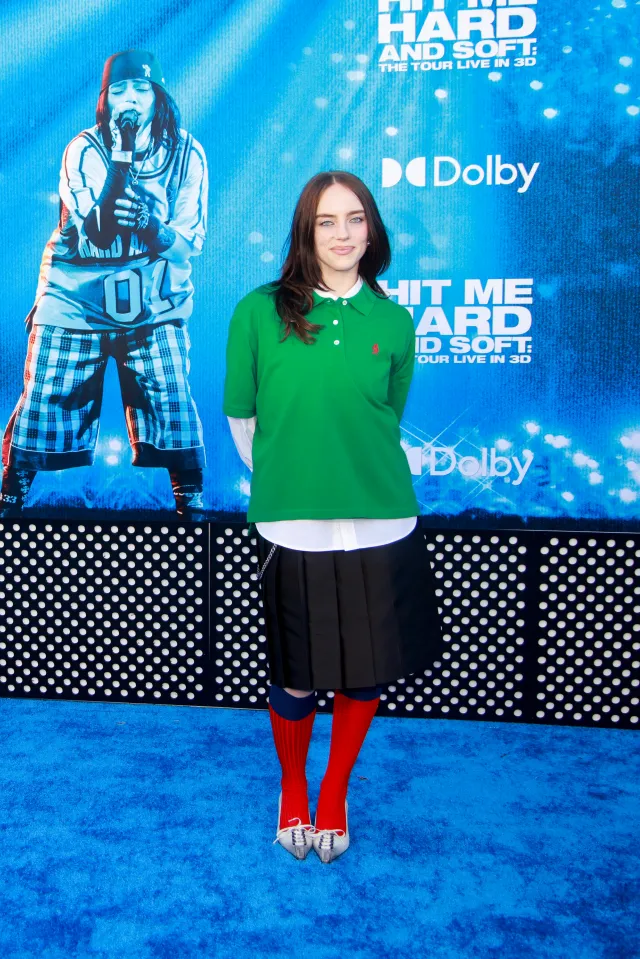
BILLIE EILISH is gearing up for a return in 2027 – and planning to perform on the biggest stages of her career so far.
I have been told the American singer has almost completed work on her fourth studio album, and a tour is also in the works to coincide with its release next year.
Billie Eilish is gearing up for a return in 2027 – and planning to perform on the biggest stages of her career so farCredit: GettyBillie has almost completed work on her fourth studio albumCredit: Getty
The last time Billie performed in the UK, she sold out six nights at London’s O2 Arena, four at Manchester’s Co-op Live, as well as two in Dublin’s 3Arena.
But now she is hoping to go even bigger, with her team in talks for major stadium concerts and festivals in 2027 and 2028.
Sign up for the Showbiz newsletter
Thank you!
My music insider explained: “Billie has been hard at work on her fourth album this year and her team are already putting a plan together for its rollout.
“She has grown and grown in popularity, and promoters are speaking to her team about putting on the biggest shows of her career.
“She has the popularity to be a stadium act now and sell out massive venues.
“On her first few tours, her team were conscious that she was very young and didn’t want to overwhelm her with venues which were too big, too early on.
“But Billie is in a really good place and she is raring to get out on the road again.”
Remarkably, next year will also mark ten years since her debut EP, Don’t Smile At Me, which was released when she was just 15.
Billie has had an incredible career so far, scoring three No1 albums.
She released her debut When We All Fall Asleep, Where Do We Go? in 2019, followed by 2021’s Happier Than Ever and 2024’s Hit Me Hard And Soft. Meanwhile, her 14 Top Ten singles include No Time To Die, What Was I Made For and Guess, with Charli XCX.
She has also won ten Grammys — including Song Of The Year three times since 2020 — as well as two Oscars and two Golden Globes.
In April, Billie commented on the progress on her fourth album, saying: “We’re more than halfway.”
She took time out over the summer to shoot a movie adaptation of The Bell Jar.
But from what I’ve been told, there isn’t too long to go before we get to hear a few more tunes from her.
It was so hot a team that averaged nearly 50,000 fans for often meaningless regular-season games beat the Atlanta Braves 5-3 in its first postseason game before thousands of empty seats — some of which were literally too hot to sit in.
It was so hot the Dodgers set up pallets of bottled water near the gates and anyone brave enough to enter the stadium was given a plastic 16-ounce Dasini bottle. Gatorade also set up a cooling tent under the right-field pavilion.
It was so hot Nicolas Gonzalez, a fan sitting in the shade of the reserved level, saw a stadium attendant, overcome by heat, stretchered before the game even started. She wasn’t the only one. By the later innings, other fans on the reserved level were reportedly seeking medical attention on the concourse.
The Dodgers declined comment.
So how hot was it?
The game started 45 minutes after the National Weather Service issued an extreme heat warning, cautioning against “extremely dangerous heat conditions” as the temperature reached 100 degrees at first pitch. By the third inning, the temperature reading atop the left-field scoreboard peaked at 103 degrees, matching the highest first-pitch temperature at 64-year-old Dodger Stadium.
“I’ve been coming to games my whole life and this is easily the hottest game I’ve ever been to,” said Gonzalez, 38, of Culver City. “Having a game in these conditions feels like we’re flying too close to the sun, both literally and figuratively.”
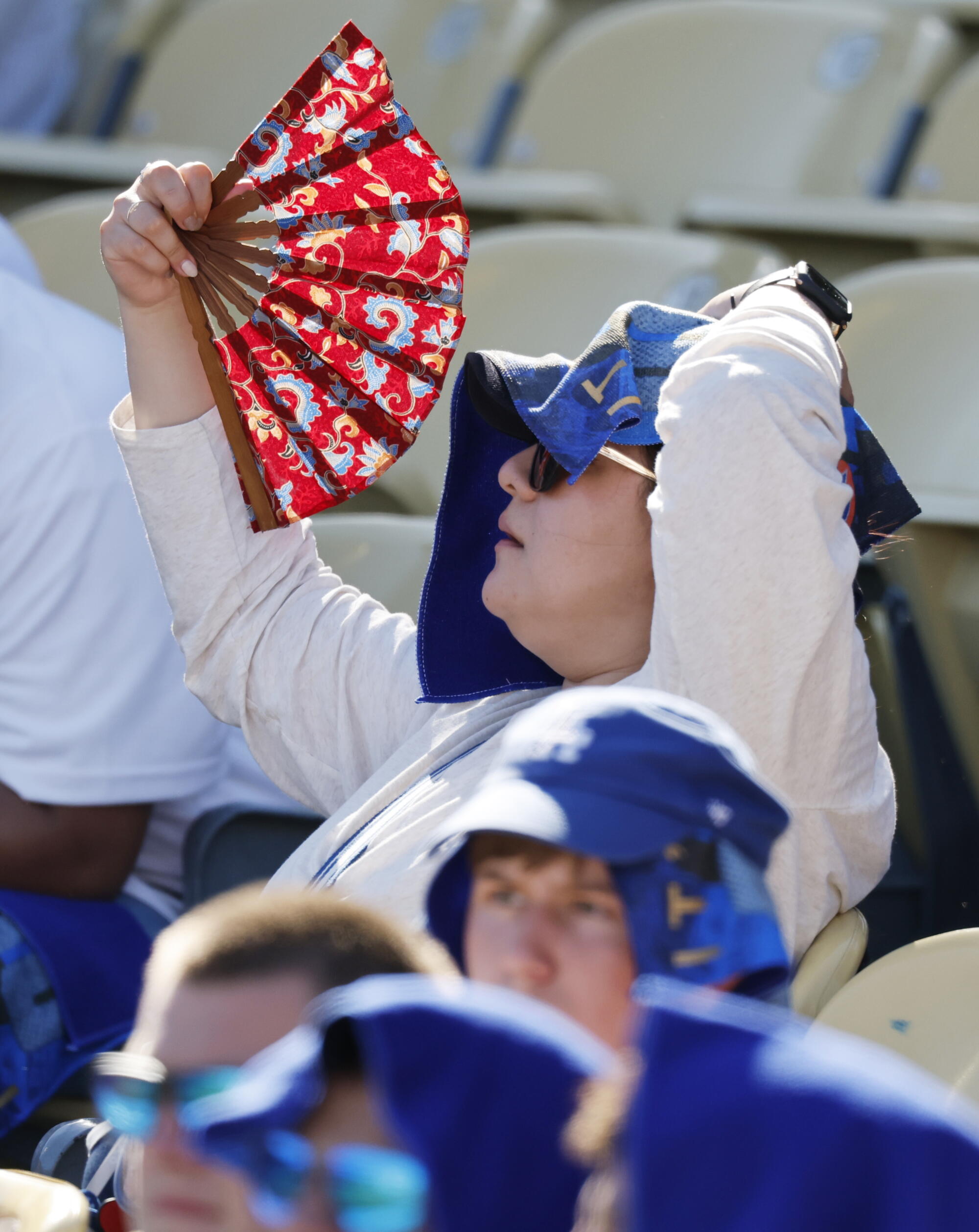
A fan tries to stay cool during Game 1 of the NLDS between the Dodgers and Atlanta Braves at Dodger Stadium on Saturday.
(Gina Ferazzi / Los Angeles Times)
Around him, fans tried to cool themselves by waving makeshift fans. It didn’t work.
But the weather didn’t just effect the way the game was watched. It effected the way it was played, too. The cloudless skies made every pop-up an adventure and the warm, dense air reduced drag, allowing batted balls to travel further. As a result, the teams combined for five homers, accounting for all eight runs.
“That’s probably one of the hottest games that we’ve ever had here. And so shout out to the Dodger fans; they were amazing,” said Max Muncy, who hit of those five homers.
“My feet were hot. Really hot.”
The Dodgers wound up with an early afternoon game in the middle of a historic heat wave because MLB and the TV networks — in this case Fox and TBS — set conditional start times for the four Division Series games before the teams and matchups were known. When the San Diego Padres eliminated the Chicago Cubs in the wild-card round, Saturday’s early NL game went to the Dodgers.
Left-hander Tarik Skubal, who gave up just a run on two hits in six innings to get the win in his Dodger postseason debut, said he didn’t really notice the heat until he came out of the game.
“I walked back into the dugout, and I asked — I forget who, I think it was [Blake] Snell — I was like, ‘has it been this hot all game?’ It’s amazing what your brain can do in certain circumstances and moments,” he said.
“I actually didn’t think it was horrible when I was pitching.”
But then Skubal pitched in much hotter conditions as a kid growing up in northern Arizona.
“I played a Little League game in 127 [degrees]. Lake Havasu,” he said. “[Saturday’s] up there with as hot a baseball game that you can play in.
“Every team’s playing in it, right? They’re playing in the same conditions we are. It shouldn’t really impact how you are mentally or how it’s going to impact how you pitch. Just go out there and play baseball and try to drink water. That’s really it.”
At least Skubal got to drink his water in the relative cool of the dugout between innings. Umpire Roberto Ortiz, wearing 10 pounds of protective gear and a black-and-gray uniform, got no such relief. He had to stand behind the plate for 2 hours 44 minutes and all 290 pitches, one of which smoked him in the seventh inning.
That’s why his five fellow umpires made a point of patting him on the back or shoulder before jogging to their positions for the first pitch.
“He stayed tough,” Dodger catcher Will Smith said of Ortiz. “I’m sure he’ll rehydrate and be ready for tomorrow.”
Speaking of tomorrow, the Dodgers, Braves and the umpires will all get some relief for Game 2. At first pitch Sunday afternoon the Weather Channel is forecasting a temperature of just 97 degrees.
“The dark silver lining,” Gonzalez, the heat-weary fan said in a nod to global warming, “is this might be the coolest October of the rest of our lives.”
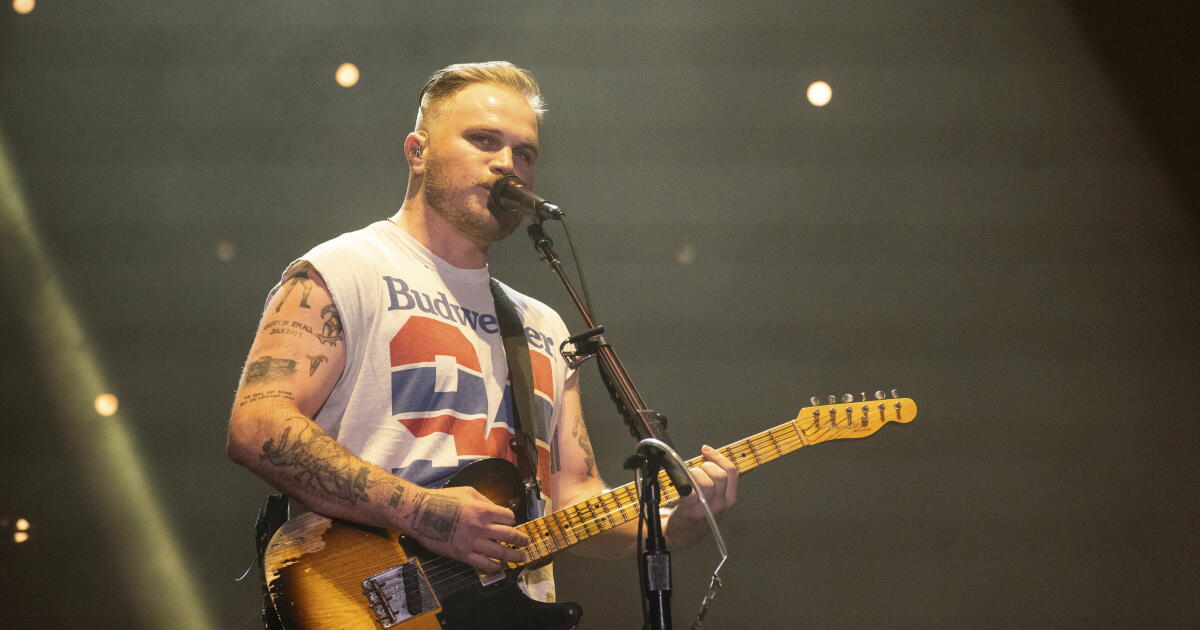
Country music star Zach Bryan signaled his support for Palestinians at the same stadium that recently banned rapper Macklemore over his efforts to do the same.
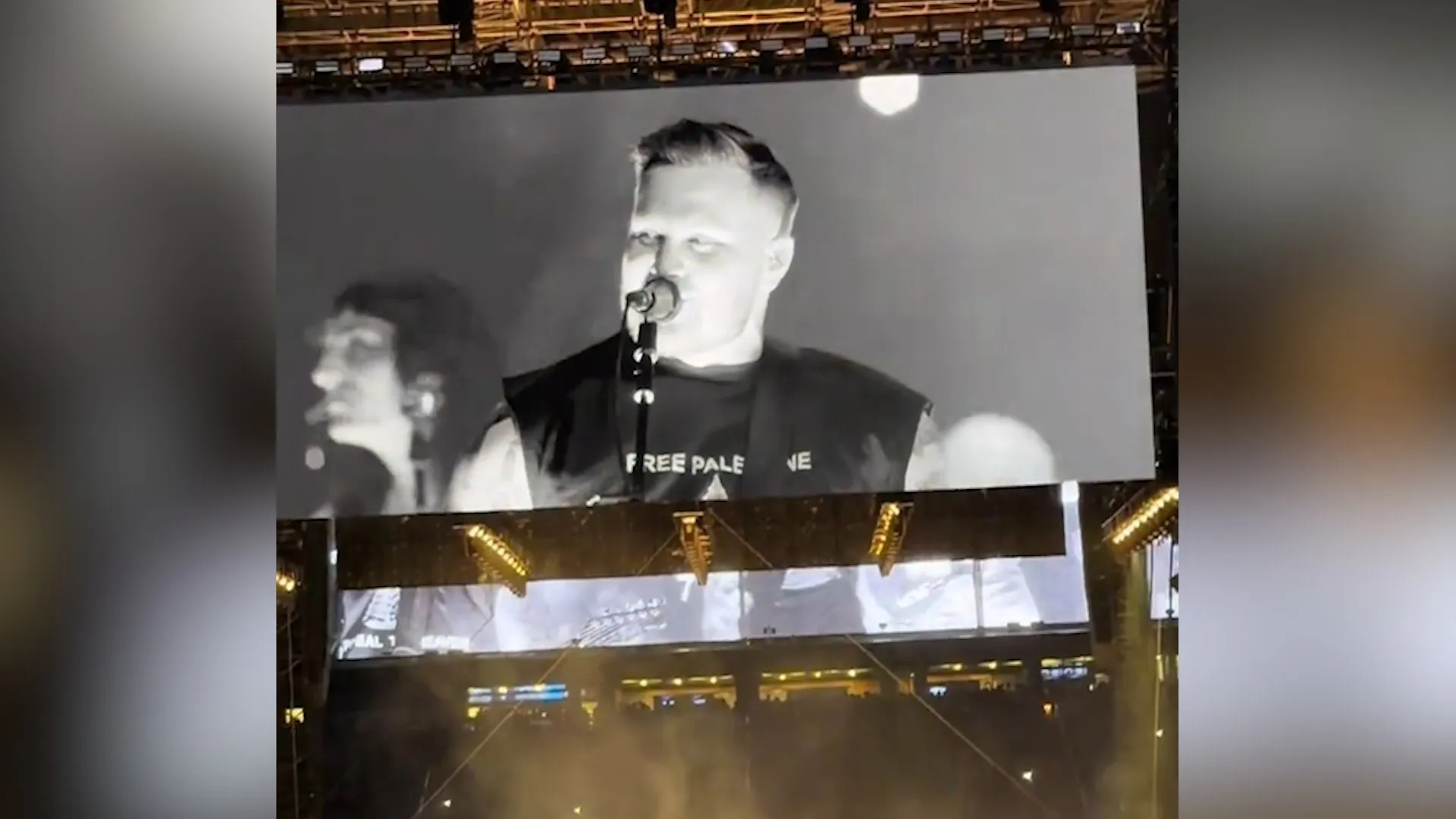
Grammy winner Bryan donned a black T-shirt emblazoned with the words “Free Palestine” and “Appeal to Heaven” during his Friday concert at Gillette Stadium in Foxborough, Mass., according to photos and videos shared on social media.
Members of his backing band also wore similar shirts, including drummer Nate Head, whose jersey paid homage to Hind Rajab, the 5-year-old girl killed alongside five members of her family in a 2024 attack by Israeli forces in Gaza.
Bryan’s Friday concert marked the first of two at Gillette Stadium, owned by billionaire Robert Kraft. The musician’s public display of support for Palestinians comes weeks after Kraft urged pop star Ed Sheeran to remove Macklemore from his tour, citing concerns over his pro-Palestinian messaging.
Last month, Sheeran and his touring team faced pressure to remove former opening act Macklemore from the rest of the tour. The Grammy-winning “Same Love” musician faced backlash from a number of Jewish advocacy groups over his performances at MetLife Stadium in New Jersey.
Days after the New Jersey shows, Messina Touring dismissed the rapper, who has been a vocal advocate for the Palestinian cause. “Shape of You” singer Sheeran denied playing a part in Macklemore’s departure, but confirmed in a statement that he spoke with Kraft, who was among the stadium owners expressing concern about Macklemore’s further involvement.
The remaining supporting acts for Sheeran’s tour, including Grammy winner Finneas (and brother of Billie Eilish) and folk band Beoga (Sheeran’s backing band), quit Sheeran’s Loop tour in solidarity. Sheeran carried on with his tour, but it hit another snag when his shows at Gillette Stadium last weekend were canceled “due to severe weather warnings” in the region.
Following the fallout, Macklemore announced his Free Palestine tour, which begins later this month with three shows in Dublin, Paris and London. Macklemore said he will be joined by artists “who have shown up and used their stages to stand in solidarity with the Palestinian people.”
The rapper announced on Wednesday that “all three shows sold out immediately.” He also said the full concert lineups and U.S. tour stops will come in a later announcement.
Macklemore, in his announcement, said all proceeds from the tour will go to a handful of charities supporting the Palestinians amid Israel’s war in Gaza. Macklemore previously said he would donate all $1 million of his earnings from his time on Sheeran’s tour to numerous pro-Palestinian charities.
Bryan’s With Heaven on Tour will return Saturday at Gillette Stadium. The “I Remember Everything” and “Pink Skies” singer will conclude his tour Oct. 10 at Jordan-Hare Stadium in Auburn, Ala.
The country star and U.S. Navy veteran, 30, is no stranger to channeling his political views in his music and performances. In 2025, Bryan released “Bad News,” a song critical of nationwide federal immigration enforcement operations.
Bryan’s pro-Palestinian stage gesture adds to a noticeable shift among mainstream artists speaking openly about their support for Palestinians amid Israel’s ongoing strikes on Gaza. Melissa Barrera, Rachel Zegler, Irish rap trio Kneecap and rap-punk group Bob Vylan have been among the entertainers who faced professional backlash for their criticism of Israel.
In April 2025, Cornell University also dismissed Kehlani from her headlining performance at the school after President Michael Kotlikoff accused the singer of espousing “antisemitic, anti-Israel sentiments in performances, videos, and on social media.”
In recent months, however, artists and entertainers, including Mark Ruffalo and the Israeli “NAZA” filmmakers Yuval Abraham and Rachel Szor (co-directors of Oscar winner “No Other Land”), continue to face backlash for criticizing Israel.
US country music star Zach Bryan wore a ‘Free Palestine’ shirt while performing at Gillette Stadium, owned by US businessman Robert Kraft. The pro-Israel billionaire recently prevented Macklemore performing there on a Ed Sheeran tour, over pro-Palestine remarks.
SACRAMENTO — Gov. Gavin Newsom signed a pair of bills this week designed to help a San Diego stadium and development project led by Los Angeles Rams owner Stan Kroenke sidestep environmental review hurdles.
Newsom signed Senate Bill 344 and Senate Bill 958, which were put forward by state Sen. Akilah Weber Pierson (D-La Mesa) to help the stadium project, known as Midway Rising. The project would replace the decades-old Pechanga Arena and include a new 16,000-seat facility, 4,254 homes, including up to 2,000 affordable units, and commercial and outdoor space. The site is south of Mission Bay.
Newsom cast the bills as part of a package to help speed up the construction of much-needed housing.
“Every Californian deserves a fair shot at a stable home — families shouldn’t have to wait years for housing to be approved and built in their communities,” he said in a written statement.
Senate Bill 344 deems Midway Rising in full compliance with the state’s landmark California Environmental Quality Act, known was CEQA.
The act, adopted in 1970, has been credited for protecting California’s natural resources and minimizing pollution. It also has been criticized for sometimes being weaponized by opponents of a project, including housing developments.
After the state Legislature’s vote last month, Weber Pierson said the project would provide “much-needed affordable housing, permanent jobs, community spaces, and health resources in a part of our city that is ready for investment.”
Former San Diego Assemblymember Lori Saldaña, a longtime critic of the proposal, called Senate Bill 344 “reckless and rushed” because it was introduced late in the session without public input. Saldaña said the site isn’t suitable for development because of sea-level rise that she said is causing street flooding in the area.
Senate Bill 958 states that a project’s increased building height, and any related noise, shadows, or impact on wildlife shall not be considered significant environmental impacts, if the project meets a host of conditions.
It would apply to any development in the state but was introduced to benefit Midway Rising, according to Weber Pierson.
Assemblymember Carl DeMaio (R-San Diego) was among those who voted against both bills.
The developers “don’t want to play by the rules, so they came here to Sacramento asking for a special exemption,” DeMaio said during a discussion on Senate Bill 958 last month.
“We’re talking about the coast. I think a big condo tower on the coast impeding the view is a significant environmental impact, and I think deep down in your heart of hearts, you know that,” DeMaio said.
Former Senate leader Darrell Steinberg (D-Sacramento) led his colleagues in passing a bill in 2013 that helped the Sacramento Kings arena by limiting environmental lawsuits. The new arena for the Golden State Warriors basketball team in San Francisco also benefited from CEQA reforms passed by state lawmakers in 2011.
The San Diego City Council still needs to approve the project.
Turns out Ed Sheeran, whose Loop tour became embroiled in controversy this month, won’t perform at billionaire Robert Kraft’s Gillette Stadium this weekend, either.
The “Shape of You” pop star’s Friday and Saturday shows at the Foxborough, Mass., venue have been canceled “due to severe weather warnings” in the region, Messina Touring, the Loop tour’s promoter, announced Friday in a statement shared on Instagram. The touring group said it made the “difficult decision” to cancel the upcoming shows after consulting with local officials. A powerful nor’easter is expected to bring strong winds, coastal flooding and heavy rain to much of the East Coast over the weekend, with wind gusts potentially reaching 50 to 55 mph around Boston and 35 to 40 mph farther inland, the Associated Press reported.
“The decision was made with the safety of fans, staff and everyone involved in the show as the top priority,” the statement continued, adding that fans can now receive refunds for their tickets.
Sheeran’s Loop tour hits its latest snag after weeks of turmoil. Earlier this month Sheeran and his touring team faced pressure to remove former opening act Macklemore from future shows. The Grammy-winning “Thrift Shop” rapper drew criticism from a handful of Jewish advocacy groups over his pro-Palestinian messaging during his opening sets at MetLife Stadium in New Jersey. Within days of the concerts, Messina Touring dismissed Macklemore from the shows. While Sheeran denied having a role in Macklemore’s departure, he confirmed that he spoke with Kraft, who was among the stadium owners expressing concern about Macklemore’s continued involvement in the tour.
Shortly after Macklemore’s dismissal, the remaining supporting acts for Sheeran’s tour, including Grammy winner Finneas and folk band Beoga (Sheeran’s backing band), quit the Loop tour in solidarity. Sheeran proceeded with his tour over the weekend.
News of Sheeran’s canceled shows also comes on the heels of Macklemore’s announcement of his Free Palestine tour. The rapper, who has been a vocal advocate for the Palestinian cause, revealed three concerts set to take place in late October in Dublin, Paris and London. Though additional details have yet to be revealed, Macklemore said he will be joined by artists “who have shown up and used their stages to stand in solidarity with the Palestinian people.”
Macklemore also announced that dates for U.S. tour stops will come in a later announcement and that the entirety of proceeds from his tour will go to a handful of charities supporting the Palestinians amid Israel’s war in Gaza. Macklemore announced last week he would donate all $1 million of his earnings from his time on Sheeran’s tour to numerous pro-Palestinian charities.
Sheeran is next expected to perform Oct. 3 at Mercedes-Benz Stadium in Atlanta.
You’ve probably never seen Michael Araujo, but if you’ve attended an Angels game since 2013, you’ve definitely heard him.
On Sunday, Araujo will work the final game of his 14th season as the Angels’ public address announcer. During that time he has started more home games than Mike Trout and finished hundreds more than any reliever to come out of the bullpen.
Yet for most fans, his voice has been little more than background noise, an acapella Muzak that only gets noticed when Araujo makes a mistake.
And mistakes just don’t happen, said Davin Maske, the Angels’ director of entertainment and production.
“I don’t remember any,” said Maske, Araujo’s boss. “There isn’t that one major mistake since I’ve been here that I could recall.”
Araujo, who is also the stadium voice for the Galaxy, has worked Gold Cup and Copa América soccer matches, eight World Cup games and the 2003 Women’s World Cup final. But the Angels’ gig is his dream job and he passed 1,000 games as the team’s PA announcer last month.
“He loves sports,” said his wife Kathryn Casey. “He really does enjoy being there and being part of it because he’s a huge fan. It’s not just a job.”
It is a job that comes with high expectations, though. Because if the broadcasts of the late Vin Scully were the soundtrack for baseball fans in Southern California, for people of a certain age, the booming baritone of John Ramsey will forever be the template for what a PA announcer should sound like.
Ramsey, who died in 1990, was the original PA voice of the Angels, as well as the Dodgers, Kings, Lakers and L.A. Raiders. He also did the Rams and USC football with a calm, articulate and authoritative delivery that was so powerful, it had its own echo.
“Would you all please rise (rise, rise, rise) and honor America in the singing of our national anthem (anthem, anthem, anthem).”
It was like being spoken to by God, an impression aided by the fact that Ramsey, hidden in a small booth near the press box, was heard but never seen.
“That’s not me, Araujo said. “So I try not to emulate that.”
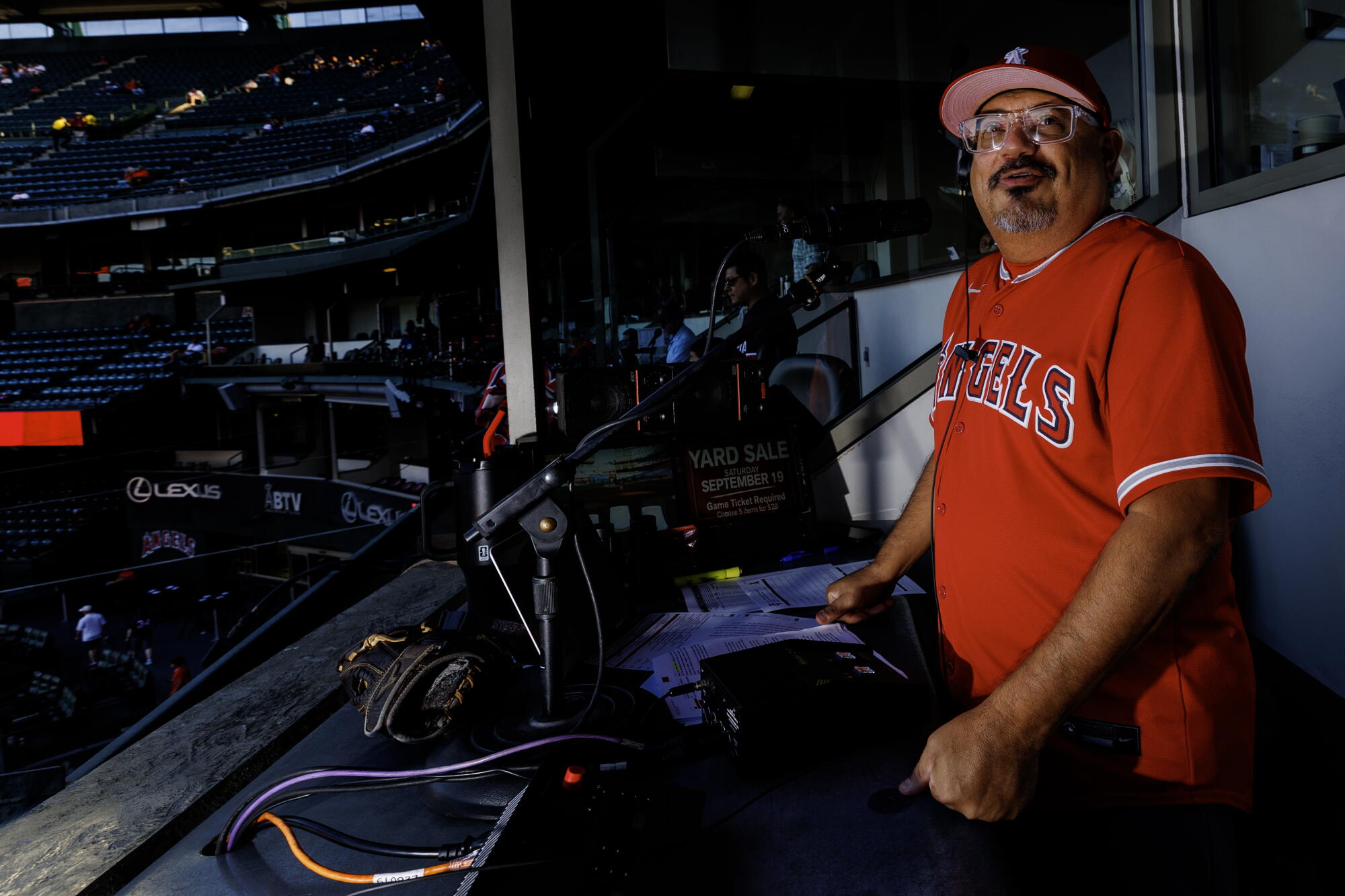
Angels public address announcer Michael Araujo overlooks the field in his booth before a game against the Minnesota Twins on September 17.
(Gina Ferazzi / Los Angeles Times)
Still, like Ramsey, Araujo’s gift is his voice. And though his delivery isn’t nearly as deep and commanding as Ramsey’s, it is unique in that it has a distinct, enthusiastic lilt, one he’s been able to maintain through what will likely be the Angels’ first 100-loss season.
“I try to bring the energy,” he said.
“It’s all about riding your vibes,” Maske added. That’s why Araujo’s perch on the club level behind home plate is exposed to the crowd rather than enclosed, like the booths to his right used by the radio and TV broadcasters. The idea is to feed off the fans, not lock them out.
“Baseball is gnarly. It’s repetitive. It’s a sport that’s inherently, at times, very boring,” Maske said. “So you’ve got to find those little moments to make it entertaining.
“It’s not NFL. It’s not the NBA. It’s baseball. Mike’s good at kind of finding that balance of excitement and traditionalism.”
And the excitement, even at the end of a blowout loss, is genuine, he said.
“The Angels were my team growing up, so the Angels was my dream job,” said Araujo, a former season-ticket holder. “I’ve been very fortunate.”
“I want to get paid to watch sports and that’s it,” he continued. “So whatever I’ve got to do to be invaluable so that I stay there, that’s kind of my mission.”
It’s not a mission that pays much, however, with most PA announcers across the majors earning between $100-$500 a game to announce each hitter as he comes to plate, read commercial copy between innings and, in Araujo’s case at least, to handle the play-by-play for the cartoon races that run on the scoreboard late in the game.
“It’s fun money,” said Casey who, like Araujo, is a teacher as well as the clock operator at Galaxy games, where she works alongside her husband. “We use it for travel.”
The job is one Araujo stumbled into. Despite a rich voice and a lifelong passion for sports, pairing the two was something that just happened, not something that was planned.
A teacher at an alternative-education high school in La Puente, Araujo, 54, has worked for the Galaxy since the MLS team’s second game in 1996, filling a number of roles from glorified errand boy to assistant game-day producer. That last job required him to stand behind the PA announcer and relay silent cues, and since he knew the gig, Araujo was handed a microphone and asked to fill in a few times during absences, sick days and other emergencies.
The biggest emergency came when Victor Villalba, the Galaxy’s regular announcer, left in the middle of a season to join the Dallas Cowboys radio team. Araujo was the natural choice to finish out the year and he’s been there ever since.
“That was 2002,” he said. “So I’m in my 25th season.”
It was similar desperation that led to his job with the Angels. When David Courtney, who had been with the team for nearly two decades, died at 56 two months after the 2012 season, the Angels began asking around for a replacement and Araujo’s name was the one they heard most frequently. So he was invited to spring training the following year to audition and he beat out two others to claim the job.
On game days Araujo gets to the ballpark about 2½ hours before first pitch, pausing in the parking lot to pull on an Angels cap and jersey with his name on the back. If the team wins, he’ll wear the same jersey the next day; if not, he’ll rotate through a closet of red, white, gray and City Connect jerseys.
Araujo’s only other tools are a microphone and a laptop, on which he’s installed an interactive software program he created that tracks the lineups of both teams. He can also call up pronunciation guides for players on all 30 major league teams, though he’s found the radio broadcasters for the visiting clubs are often more helpful.
Angels public address announcer Michael Araujo has worked more than 1,000 games at Angel Stadium and has been the Galaxy’s public address announcer since 2002.
(Gina Ferazzi / Los Angeles Times)
His cramped work space, about 90 feet from the field, has enough room for two green vinyl chairs, though Araujo prefers to stand when he’s working. And unlike many people whose vocal chords are their livelihood, Araujo says he has few ritualistic habits to protect his voice.
“In my bag I have a gazillion cough drops; a couple of different kinds, some with honey,” he said. “I definitely wouldn’t do anything carbonated before a game. Makes you burp and all that kind of stuff.”
Araujo is one of three Latino PA announcers in the majors, alongside Marysol Castro, who works for the New York Mets, and Frank Fernandez of the Miami Marlins. Given that 30% of big-league players are from Latin America, the fact that just 10% of the PA announcers are Latino is something Araujo said he thinks about during Hispanic Heritage Month.
“Did I grow up in Boyle Heights or anything like that? No, I’m no poster child or miracle story or anything like that,” said Araujo, who was raised middle class in La Verne, where his father, a sheriff’s deputy, and mother, a nurse, often spoke to one another in Spanish.
“We are here in 2026 and it’s not a little more prevalent. It can be an aspiration to any kid, even one of my students, that bigger things are possible.”
For a PA announcer, it turns out, there are times when it’s important to be heard and seen.
Allen barged into the endzone and found Joshua Palmer for a 43-yard touchdown, before Dawson Knox scored early in the second quarter.
The Lions replied with Jared Goff finding Jahmyr Gibbs, who became the NFL’s highest-paid running back in the off-season, for an 11-yard touchdown catch.
But Dalton Kincaid stretched Buffalo’s lead and the Bills remained comfortable throughout the second half.
Detroit, who beat the New Orleans Saints in overtime last week, cut the deficit with two touchdowns by Amon-Ra St Brown and another from Sam LaPorta.