Angels do right thing by going on franchise-shaking trading spree
No date will ever top Oct. 27, 2002, the date the Angels won their lone World Series.
We could talk about Sept. 30, 1984, the date Mike Witt threw the Angels’ lone perfect game. Or June 9, 2009, the date the Angels drafted the best player in franchise history, Mike Trout. Or July 29, 2018, the date Vladimir Guerrero became the first player to wear an Angels cap on a Hall of Fame plaque.
Or, if you care to look at it from a cynical angle, that fateful fall day in 1979 when then-general manager Buzzie Bavasi said he could replace Nolan Ryan, who had just gone 16-14 in his final year in Anaheim, with “two 8-7 pitchers.”
This isn’t about trivia. This is to say that Monday might well be remembered as one of those significant dates in Angels history.
In recent years, the Angels have deluded themselves and their fans with such beliefs as: they had assembled a young core that could win; Shohei Ohtani really wanted to stay; and the universally and consistently poor rankings of their minor-league system should be dismissed.
On Monday, John Mozeliak changed all that. The Angels’ interim general manager traded seven players off the major-league roster ahead of the trade deadline, including five within the final nine hours. Mozeliak imported nine prospects, only one of which will report to the major-league team.
It was one thing for owner Arte Moreno and new team president Molly Jolly to recruit Mozeliak six weeks ago and promise that he could embark on a desperately overdue rebuild.
To see it actually come to fruition? Maybe there really are Angels in the outfield.
“What’s really impressive for me is just the amount of trust I’ve been granted,” Mozeliak said.
The Angels finished in last place last year, and the year before that. They are on pace to lose 100 games this season, for the first time in franchise history. Their postseason drought is about to hit 12 years, the longest in baseball.
But now there is a plan, not just a bunch of ifs and hopes, even if the Angels might have to take another step back to take two steps forward.
“I would say we took a step forward today,” Mozeliak said on a videoconference after the trade deadline passed.
Prospects! Tell me more!

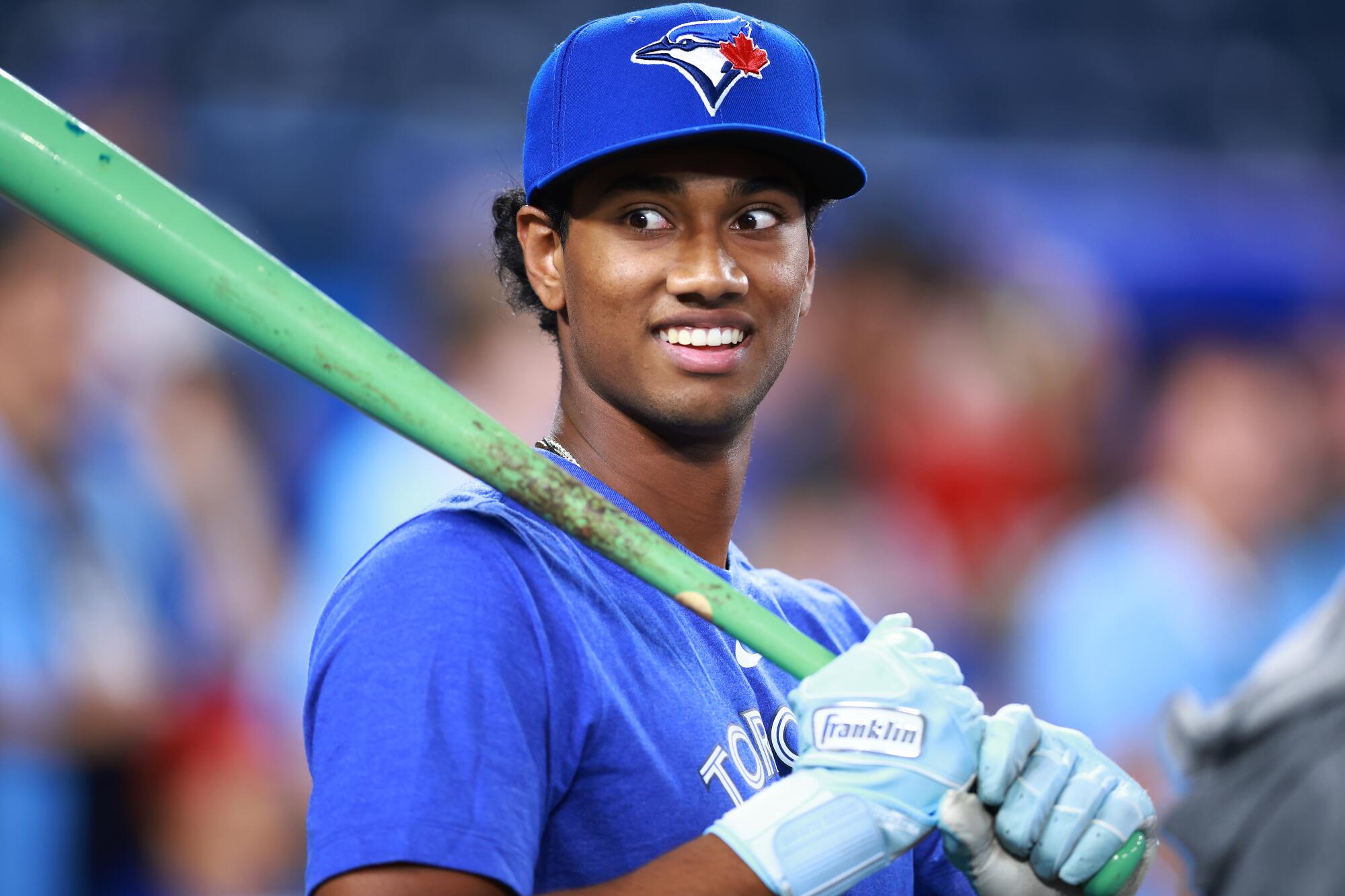
Arjun Nimmala takes part in batting practice for the Toronto Blue Jays on July 14, 2023.
(Vaughn Ridley / Getty Images)
The only top-50 prospect the Angels acquired: shortstop Arjun Nimmala, 20. The Toronto Blue Jays swapped him and two other minor leaguers for pitcher José Soriano. Mozeliak said Nimmala is about two years from the majors.
The only prospect coming to the majors: catcher/designated hitter Moises Ballesteros, whom Mozeliak said would DH in two of the next three games.
That means Jorge Soler won’t be the DH for the moment. Who was traded?
Soriano, outfielder Jo Adell, catcher Logan O’Hoppe and relievers Ryan Zeferjahn, Brent Suter, Kirby Yates and Chase Silseth. All but Suter and Yates were under the Angels’ control beyond this season.
And who was not traded?
In addition to Soler, pitcher Reid Detmers and shortstop Zach Neto (“We definitely listened to offers, but we were not comfortable with the offers we received”) and first baseman Nolan Schanuel (“He was asked about, but not to the level of others”).
Mozeliak had said last month that a Trout trade was “not happening.” He said Monday that he had invited Trout to observe the team’s war room ahead of the trade deadline.
“He’s the face of this franchise,” Mozeliak said. “From where I stand, from being around him, we want to get this better for him, and for others. Our fans want to see winning.”
Mozeliak had said the Angels should not need a total rebuild because the resources available to a major-market team should mitigate the need to tank and just play kids. Does he believe the Angels could be better next season?
Hear it from him: “We need to remain disciplined and patient to a process and not just try to rush some people to the big leagues. … If they’re not ready, and we’re not ready to compete with that group, that’s where we’re going to augment using more of the free-agent model.”
This is starting to sound like a long-term plan. Is Mozeliak here for the long-term, as most inside the industry believe he is?
Mozeliak insists he hasn’t decided if he wants to stay, and he hasn’t yet met with Moreno and Jolly to discuss the matter. But he said two things that stuck out to me.
One: “It’s fun being back in the game. I didn’t realize how much I missed it.”
Two: “We have made a difference. Change has been real.”