spell

How US Senate Russia sanctions could spell 100% tariffs for India, China | Russia-Ukraine war News

A sweeping package of new Russian sanctions has cleared its first hurdle in the United States Congress, and, if passed, could trigger huge tariffs for countries such as India and China which continue to buy oil from Moscow.

The bill, which was advanced in the US Senate this week, has been named for the late Lindsey Graham, whose funeral was attended by world leaders including Israeli Prime Minister Benjamin Netanyahu earlier in the week.

Recommended Stories

list of 4 itemsend of list

Here’s what we know:

What happened in the Senate?

The “Lindsey O Graham Sanctioning Russia Act of 2026” was advanced overwhelmingly by the Senate this week in a vote of 86 to 12, meaning it can now proceed to the House of Representatives for further deliberation.

Named for the late Senator Graham, a staunch Ukraine supporter who died unexpectedly this month, the bill moved forward with the support of Ukrainian President Volodymyr Zelenskyy, who was in Washington to attend Graham’s funeral and watched the proceedings from the gallery.

“It was an honour to be present as the votes were counted – 86 senators supported the bill,” he wrote on X afterwards. “This is the first step towards implementing Lindsey [Graham]’s plans, and certainly a step towards peace. It is important that this tool works.”

After clearing the Senate, there will be a delay before the bill can move forward to the House, which is now in summer recess.

On Wednesday this week, US President Donald Trump ordered lawmakers to amend the bill to include tariffs covering Iran as well. This will likely delay the bill further if it deters Democrats from supporting it, analysts said.

David Smith, an associate professor at the University of Sydney’s US Studies Centre, told Al Jazeera: “One of the things they’re worried about is how the tariff power in relation to Iran is going to be expanded. They’re going to be ok with tariff powers on Russia but they’re worried about tariff power on countries buying Iranian oil, which means China. I think there are going to be a lot of Democrats that are going to say these powers should be limited to sanctions and not tariffs.”

Without the Iran addition, he said he would have expected the bill to pass once the House resumes given strong Democratic support for Ukraine.

“Democrats have been genuinely worried about the Trump administration abandoning Ukraine. Something like this, which is ramping the pressure up on Russia so much, I just think there will be a large critical mass of Democrats who will vote for this,” he said.

What’s in the bill?

The bill makes use of sanctions and tariffs to target Russia and cut off the economic pipeline that has kept the Ukraine war going.

Major provisions include new sanctions on Russian President Vladimir Putin as well as on more than 20 top officials and companies which work with the Russian defence industry. It also targets Russia’s “shadow fleet” of oil tankers and the network it uses to evade international sanctions on its energy exports.

The bill gives the president authority to impose sanctions by invoking the International Emergency Economic Powers Act (IEEPA). Under it, he would be able to apply tariffs of up to 100 percent on exports to the US from the top five purchasers of Russian energy, military equipment or countries facilitating Russian sanctions evasion.

Tariffs of up to 500 percent can also be applied to Russian imports directly into the US. The US imported $3.8bn in goods from Russia in 2025.

Which countries are likely to be targeted?

China, India and Türkiye are potential targets of the bill, as they are among the largest buyers of Russian energy, according to data compiled by the Centre for Research on Energy and Clean Air (CREA).

China has historically responded to Trump’s tariffs with tariffs of its own on US exports. Even Pay, a director at the Beijing-based consultancy Trivium China, told Al Jazeera that the US may wait to impose tariffs as Trump is due to meet Chinese President Xi Jinping later this year.

Trump would still welcome the option, she said, after the Supreme Court struck down many of his tariffs in February.

“If passed and signed into law [which is still a big if at this point], the legislation would give Trump something he’s wanted for a while, namely, the legislature’s permission to impose high tariffs on China, alongside the small handful of other countries that import Russian oil,” Pay told Al Jazeera.

India is in a tricky position as its attempts to diversify away from Russian energy were disrupted by the shutdown of the Strait of Hormuz, according to Maia Nikoladze, a deputy director of the Economic Statecraft Initiative at the Atlantic Council.

Due to the disruptions, it has also applied for and received US sanction waivers to continue buying Russian oil in the interim, Nikoladze wrote in a report this week, and it is expected to do the same in the future.

“India will face a trade-off between maintaining energy security and managing the risk of US tariffs, potentially prompting it to again seek waivers and exemptions,” Nikoladze said.

What do critics say about the bill?

Critics like Senator Maggie Hassan say the bill gives Trump too much power to impose tariffs while also potentially harming both the US taxpayer and allied countries.

Turkiye, for example, buys Russian energy but it is also a US ally and NATO member, while “major non-NATO ally” Brazil and “major security cooperation partner” Singapore both buy Russian oil products, according to CREA.

In a post on X, Hassan wrote that while she supports sanctioning Russia, she does “not think tariffs, which are paid for by American businesses and consumers, will help Ukraine win”.

The bill is also opposed by lobby groups such as the US Chamber of Commerce, which also says the true cost will be passed on to US businesses and consumers, as with past tariffs.

While many of Trump’s tariffs have already been struck down by the Supreme Court, the Russia tariffs could have more staying power because they would be imposed on a stronger legal basis, according to Smith.

That’s because it is new legislation which has been crafted using the powers of the IEEPA.

“Previously what Trump has done is to go back to old pieces of legislation and invoke from those his power to use tariffs in ways they haven’t been used before and in ways courts have subsequently found less lawful, whereas this looks like new legislation that is going to lawfully expand his tariff authority,” he told Al Jazeera.

Source link

India’s youth have broken Modi’s spell | Opinions

The recent uprising of the youth in India might seem to have subsided after forcing Dharmendra Pradhan, the education minister of India, to resign. Still, he was never the true target of this historic youth revolt. The slogans, the placards, the irreverent digital art and the collective anger of the young were directed at one man alone: Narendra Modi.

There exists a pervasive prejudice among the intelligentsia that young Indians today are politically indifferent, consumerist and unconcerned with politics or the erosion of democratic norms. The events at Jantar Mantar have laid bare the shallowness of this assumption. The young harboured no illusions about the nature of this regime. They understood with absolute clarity that in the present constitutional setup, no minister possesses independent agency.

The Indian state today has been reduced to a single face, a single voice and an unyielding hub of authority: Narendra Modi. To demand the resignation of a minister, therefore, was not an administrative plea; it was a deliberate act to compel the supreme leader himself to yield.

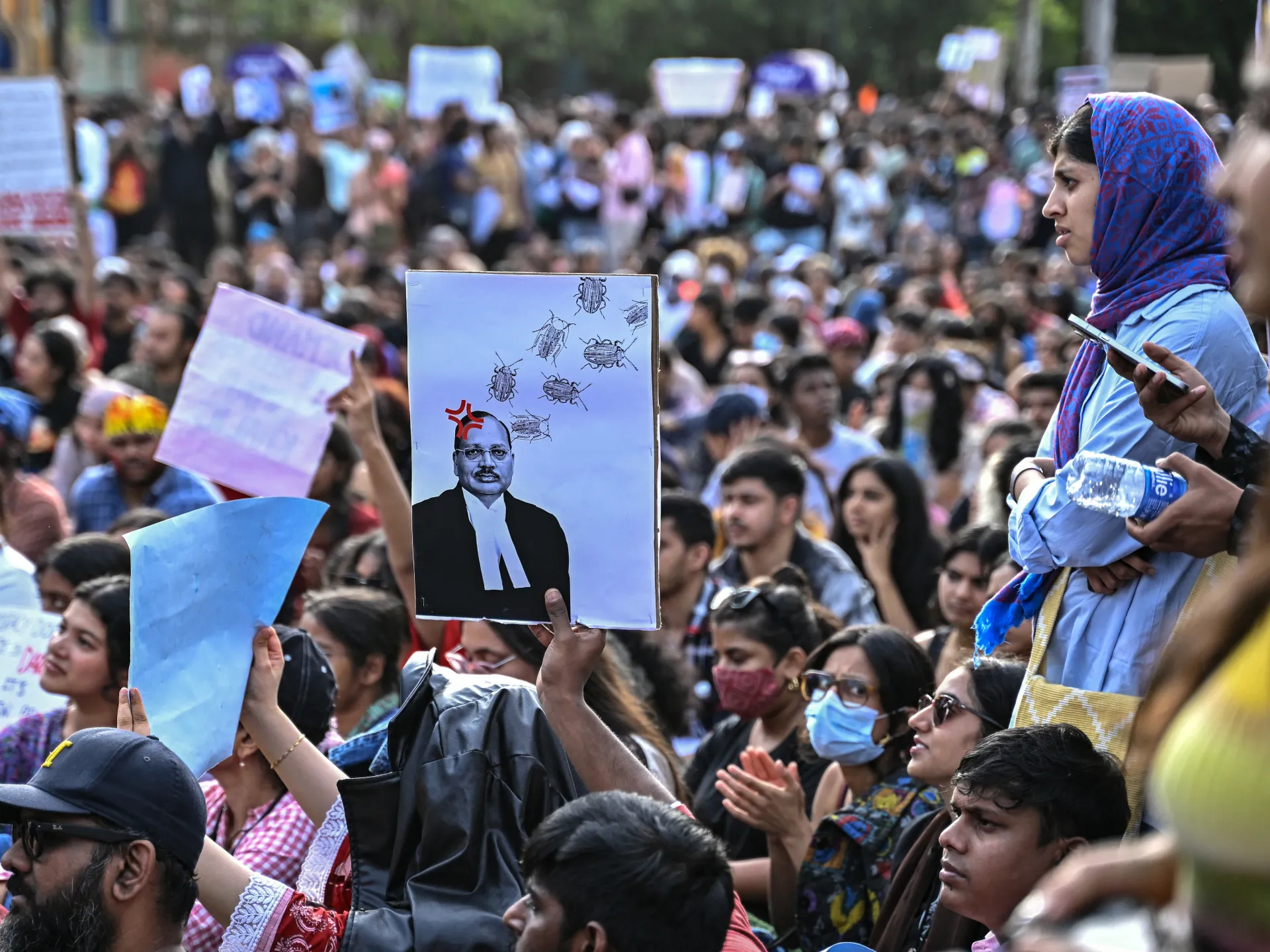
Walking through Jantar Mantar, the protest site in central Delhi, occupied by thousands of young people for weeks, one could not escape this truth. What these young people achieved was nothing short of the iconoclasm of our times: the systematic demolition of the carefully curated, mythic public persona that this regime has spent a decade building as the sole visage of the nation.

What was most remarkable about this uprising was its radical decentralisation.

There were no high-budget, professionally printed banners. There was no vanguard organisation dictating the visual language of the protest or distributing uniform slogans for the benefit of television cameras. Scraps of cardboard, discarded paper and cheap marker pens sufficed. Each placard bore the unmistakable, authentic imprint of individual moral agency.

Yet, beneath this extraordinary heterogeneity, there remained an unwavering thematic unity.

Everything revolved around Modi.

The prime minister was mocked, caricatured and systematically stripped of the sacral aura that had been constructed around him for more than 10 years. In a matter of weeks, this generation transformed an imposing figure of state authority into a subject of collective laughter.

The young were outraged, above all, by the sheer, unbridled arrogance of power.

This uprising did not spring from material grievances alone; it arose from a profound sense of humiliation. The immediate symbolic spark was the deeply insensitive remark made by the chief justice of India, who publicly compared unemployed young people to “cockroaches”.

Coming after years in which the higher judiciary has increasingly appeared less like an independent guardian of the Constitution and more like an extension of executive power, the remark was understood as an articulation of the regime’s own contempt for its youth.

The formation of the “Cockroach Janta Party” (CJP) was an act of counter-humour born of deep injury. The already unfolding scandal over irregularities in the NEET examinations provided the movement with a concrete institutional focal point. The scandal became the occasion to demand accountability not just for a single test, but for an entire culture of governance.

The regime, meanwhile, suffered from its own hubris. It had persuaded itself that Indian society was thoroughly managed. Preoccupied with engineering electoral outcomes through the manipulation of rolls, managing parliamentary majorities through party defections, and consolidating its hold over state institutions, it failed to notice the quiet, gathering storm beneath the surface.

Those who possessed platforms, prestige and the power to shape public discourse were engrossed in celebrating the grand narrative of national glory. Television studios debated the nation’s civilisational destiny and its global standing. The mainstream press sang panegyrics to a “New India”. Scarcely anyone looked towards the young who found every avenue of mobility blocked. Their anxieties were rendered invisible because the state and its allied media did not consider them worthy of serious democratic attention.

Deprived of traditional spaces, they constructed their own. Their smartphones became their public square; social media platforms became their political assemblies; and satire became their primary democratic vocabulary.

The ruling ideology had convinced itself that the project of cultural hegemonisation was complete: once the majority was mobilised around a politics of religious identity and grievance against minorities, material realities would cease to matter. The aspirations, anxieties and dignity of an entire generation simply did not figure in this political imagination.

It was against this backdrop of institutional indifference that Sonam Wangchuk began his fast at Jantar Mantar. The government’s initial response was its standard weapon: calculated silence. As Wangchuk’s health deteriorated, the refusal to even acknowledge his presence generated profound moral outrage. Then came the fateful decision to forcibly remove him.

It proved to be a fatal miscalculation. The young perceived the treatment of Wangchuk as an insult to their own citizenship. What was done to him could be done to anyone who dared to stand up. His humiliation became their collective provocation. The response was immediate: Jantar Mantar was flooded by thousands of young bodies.

When the young marched towards parliament on July 20, the state relied on its familiar playbook: barricades, prohibitory orders and violent suppression. It had deployed these very methods against the anti-CAA protesters and the farmers’ movement. But this time, the internal mechanics of fear failed to operate. The blows they received did not shatter their spirit; they deepened their moral clarity.

Their struggle was not merely about securing a policy change or extracting a routine administrative concession. They set out to breach that institutional arrogance. When the Delhi police rained blows on the protesters on July 20, beating young citizens with a ferocity typically reserved for enemy combatants, the protesters did not view those batons as the instruments of an indifferent police force. They recognised them as the direct expression of Narendra Modi’s political will.

Yet, fear failed to perform its intended historic function. Many returned to Jantar Mantar carrying their wounds like badges of honour. Some returned barefoot. Their injuries became symbols of moral persistence rather than reasons for retreat. Their resolve was remarkably simple: they would force Modi to sacrifice one of his own.

Crucially, the protesters refused to yield to the temptation of violence. Their weapons remained language, images and satire. Armed with their phones, they launched an unrelenting assault on the prime minister’s public image, the very asset he has guarded most fiercely throughout his political life. For the first time, Modi was drawn onto a battleground where he could not dictate the rules.

When the prime minister attempted to intervene directly on social media, addressing the youth as “friends”, the rebuttal was instant and devastating:

“We are not your friends.”

It was more than a clever slogan; it marked the psychological collapse of a carefully cultivated paternalistic relationship. For years, Modi had sought to speak directly to the populace, bypassing mediating institutions and independent media. The young rejected that calculated intimacy in a single sentence. The authority of the patriarch dissolved into the irreverence that a free people reserve for their elected officials. The spell of fear was broken.

The assault on Modi’s public image appears to have shaken the regime far more deeply than any routine electoral setback ever could. For more than a decade, his authority has rested not merely on the coercive power of the state, but on the illusion of invulnerability: an image of a leader who never retreats, never admits error and never compromises.

The movement had to be contained before the satire hardened into permanent collective memory and the laughter of the young became the common language of the republic.

Pradhan’s resignation must be read precisely in this light. It is not the sacrifice of a minister; it is a desperate attempt to construct a firewall around the prime minister himself. The government will undoubtedly frame this as evidence of its responsiveness and democratic sensitivity. But the young understand it differently. For them, the resignation is a political concession extracted from an authority that had run out of options.

Before arriving at this point, the state had exhausted its standard repertoire of delegitimisation. It ignored the movement, questioned its motives, accused the youth of being proxies for opposition parties and deployed its media networks to allege foreign plots. When these slurs failed to stick, it resorted to force. Having endured all of this, the young do not view the minister’s exit as an act of state benevolence; they see it as the reluctant admission of a defeat that could no longer be disguised.

Ordinarily, the vocabulary of victory and defeat should not dominate a constitutional democracy. A government is expected to listen to its citizens, not view them as adversaries to be crushed. Dissent is not treason. But when a state consistently treats criticism as hostility and peaceful protesters as enemies of the state, it transforms democratic dialogue into a confrontation. When that happens, it cannot complain if citizens celebrate its retreat as a democratic victory.

The ultimate significance of this movement lies in its moral and creative form. The young answered state coercion with speech, wit, art and an extraordinary mastery of contemporary cultural forms. Their elders have often lamented that a generation raised on short-form content lacks political depth and endurance. Jantar Mantar has demolished that patronising assumption.

The meme was elevated to a potent instrument of political resistance. Laughter accomplished what solemn political rhetoric often fails to do: it punctured fear, dismantled false authority and deprived power of the uncritical reverence upon which authoritarian politics depends.

Authoritarianism requires not just obedience, but awe. It survives as long as people believe the ruler is beyond challenge, beyond satire and beyond defeat. The young at Jantar Mantar refused to grant Narendra Modi that sacral status. They restored him to the position he must occupy in a constitutional republic: an ordinary, accountable political leader, subject to the scrutiny, criticism and satire of the citizenry.

The protest site at Jantar Mantar may now be empty. The barricades have been moved aside and the crowds have returned to their hostels, campuses and homes. But movements of this nature do not end when the physical space is vacated. The critique inaugurated on the streets will continue in countless quiet spaces: university libraries, rented rooms, bus rides and millions of illuminated screens. The language that has been discovered cannot easily be unlearned.

If this youth uprising leaves behind an enduring lesson for the republic, it is a simple, fundamental truth: democracy begins the moment a people recover confidence in their own voice.

The views expressed in this article are the author’s own and do not necessarily reflect Al Jazeera’s editorial stance.

Source link

West Indies v Pakistan: Justin Greaves takes five wickets for none in incredible spell

First Test, Tarouba (day three of five)

West Indies 311 (Hope 92; Ali 4-50) & 126-7 (Chanderpaul 35, Abbas 3-14)

Pakistan 282 (Masood 109; Greaves 5-27)

West Indies lead by 155 runs

Scorecard

West Indies all-rounder Justin Greaves took five wickets without conceding a run in an incredible spell of bowling on day three of the first Test against Pakistan.

Greaves, who is playing in his 17th Test, claimed his maiden Test five-wicket haul to help dismiss Pakistan for 282 in response to West Indies’ first-innings total of 311.

The 32-year-old Barbadian’s spell – five consecutive wicket maidens – was all the more remarkable given he had bowled six overs earlier in the day for 27 runs without taking a wicket.

“When I came on captain Roston Chase just said ‘continue to be disciplined in what you are doing’ and to see if I can get some wickets for the team,” Greaves said.

“The ball nipped around and I got some reward. Anytime I get the ball in hand the team looks to me to be that solid player for them [and] try to dig us out of situations.

“To get five wickets for the first time in Test cricket, I’m really happy, but there’s still a lot of work to do in the game.”

Pakistan captain Shan Masood was Greaves’ first wicket at the Brian Lara Cricket Academy in Trinidad when he was bowled for 109 in the 64th over following a superb set-up.

Greaves had pushed the ball wide to the left-hander from over the wicket before he tailed a delivery back into Masood who played down the wrong line and inside edged on to his stumps.

Aamer Jamal had his middle stump uprooted in Greaves’ next over as the seamer speared one through his defences.

Greaves then trapped Ali Usman lbw before he had Mohammed Rizwan and Mohammad Abbas both caught behind as Pakistan lost their last seven wickets for just 38 runs.

West Indies reached stumps on day three on 126-7 in their second innings – a lead of 155 runs – to leave the match finely poised.

Source link

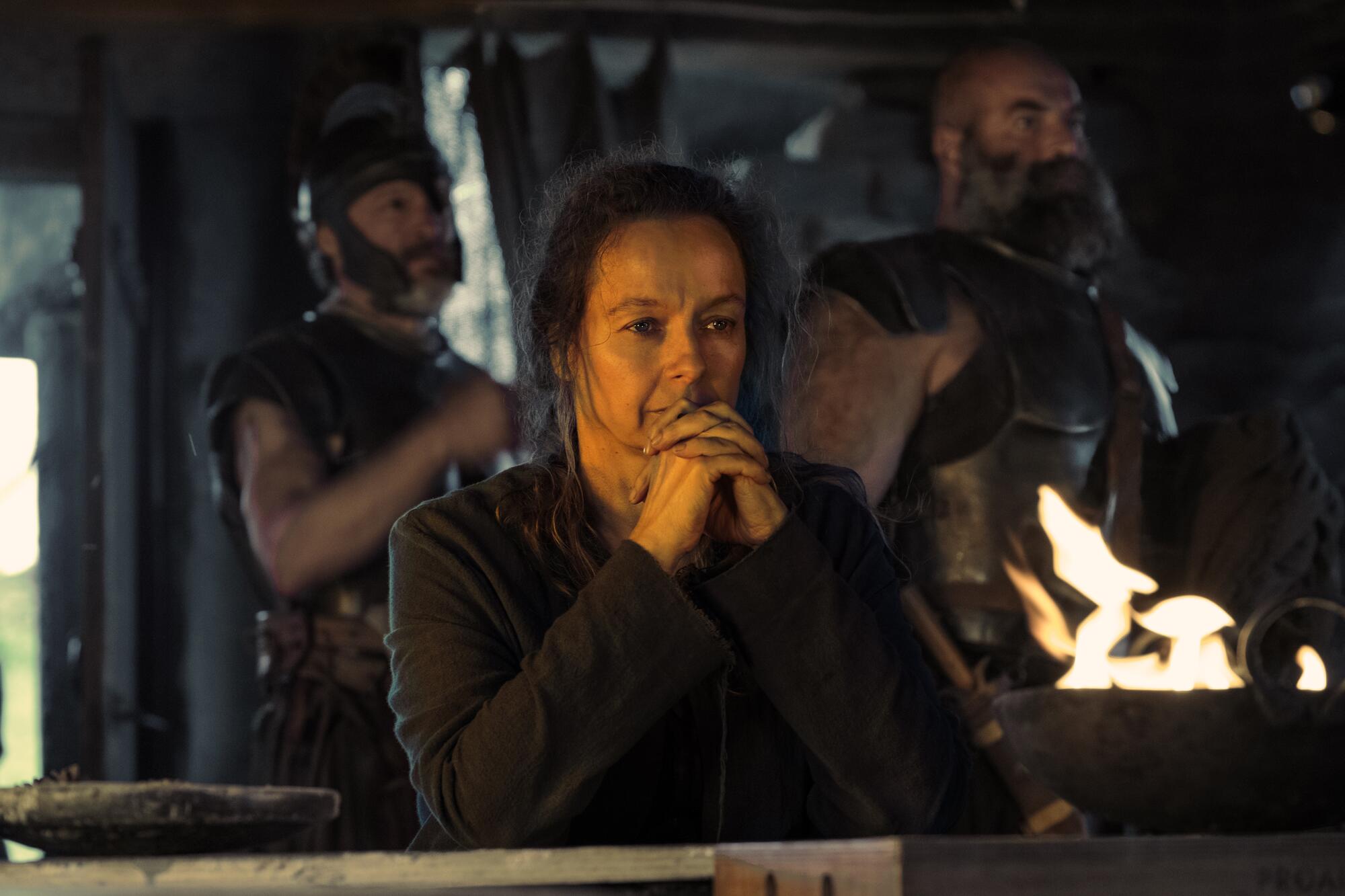
Samantha Morton on how she cast a spell over ‘The Odyssey’

Samantha Morton didn’t mean to start humming during that scene in “The Odyssey,” the scene everyone is talking about, when, as the sorceress Circe, she turns Odysseus’ men into pigs, literally molding them into their true savage selves.

It wasn’t in the script. It just happened. And when Morton was done, she looked over to director Christopher Nolan, waiting for him to say something like, “Maybe try it without the humming, Samantha.”

But Nolan didn’t say anything, so Morton did it again and the music that was swirling inside her head, which she remembers now as a symphony of glass harmoniums and theremin, kept coming out as Circe went about her witchy business, altering her gluttonous guests, who are busy slurping and gulping down her stew.

“These are sounds that can make you go mad, apparently,” Morton, 49, tells me, reclining on her bed at the Hotel Chelsea in New York. “So to transform the men, the magic came not just from my hands but from my sounds.”

A woman sits in concentration by a fire.

Samantha Morton as Circe in “The Odyssey,” directed by Christopher Nolan.

(Melinda Sue Gordon / Universal Pictures)

Morton unabashedly believes in magic. How else, she asks, can you explain how a girl who was shuttled between children’s homes and a dozen foster families, only to be living on the streets of Nottingham, England, at the age of 14 with a criminal record, be here talking with me now, sipping green tea at the Chelsea?

“That’s got to be guardian angels and love — and not that I suddenly became good at acting and got a job,” says Morton, a veteran who’s been at it for 35 years, dazzling audiences and stealing scenes for the likes of Steven Spielberg, Jim Sheridan and, now, Nolan. “I’ve always believed that anything is possible and there’s no doubt in here,” and she pats her heart, “because I’ve always felt this immense love for me from another entity.”

When Morton heard that Nolan wanted to meet her for “The Odyssey,” she says she wept. If that sounds dramatic, she makes no apologies. She likens it to being an athlete who qualifies to represent their country at the Olympics. She’d spent decades honing her craft for that phone call. When it came, she flew to Los Angeles in January 2025 during the wildfires, embarking on what would become the best job interview of her life.

I ask her what she remembers about that meeting.

“I think it went really well,” Morton answers, laughing.

Morton told Nolan she hadn’t read “The Odyssey,” which, when you quit school at the age of 12, makes sense. Flying back home to England — she and her husband live in East Sussex with their children, 18-year-old daughter Edie and 12-year-old son Teddy — she recalled that, yes, she knew a bit of “The Odyssey” from having seen it parodied on an episode of “The Simpsons.” (“We’re ‘Simpsons’ mad in our house,” she says. “Like, mad.”)

But Morton doesn’t believe in bogging herself down in research, not since starring in a British TV production of “Jane Eyre” when she was 19 and carried around a heavily highlighted copy of the Charlotte Brontë book, despairing whenever the adaptation deviated from the novel. From that point on, she stuck to the script and her own imagination.

A woman looks out a city window on a gloomy day.

“That’s got to be guardian angels and love — and not that I suddenly became good at acting and got a job,” says Morton of her career. “I’ve always believed that anything is possible.”

(Ebru Yildiz / For The Times)

Thinking about Circe, Morton recalled going to the library with her dad (“We had nothing and were beyond poor, but he always had a library card,” she says) and finding the Howard Pyle fairy-tale book “King Stork.” She remembers being mesmerized by the story’s wicked witch. She recalls other witches from folk tales like Baba Yaga, frightening characters but also, she says, “women possessing an innocence that had been eroded over the years by the harshness of life.”

Morton does a playful verbal evasion when discussing the nuts-and-bolts aspects of shooting the scene where Circe transforms Odysseus’ men, saying that back in the day when behind-the-scenes features were prevalent on DVDs, she routinely declined to participate.

“I didn’t mean to be tricky, but it was like: This is my private moment. This is for me,” she says. “I do like the idea of a little mystery.”

But then a beat later, she laughs it off and dives in, remembering that her husband showed her an Instagram post from Nolan’s set revealing how the movie’s Cyclops was, in fact, a puppet.

“Oh my gosh — I love puppets!” Morton raves, and off she goes, telling me how much she adores Jim Henson and how “The Dark Crystal” is one of her all-time favorite films.

What she will say about her “Odyssey” scene is that there were no digital effects. Everything was real and “in camera” and that she was so in the zone that she barely remembers any of it, only flashes.

“That’s not CGI,” Morton says. “That’s human brilliance and a connectivity of me as a performer, almost dancing and feeling one. And not to say that it was sexual, but I wanted it to be very sensual when she’s with the men and the animals, just like, you know, that she’s almost one with them.”

“What was lovely about that,” Morton begins and then stops, wondering if she should draw back the curtain on the creative process. She goes ahead. “There was a day on set when Chris was like, ‘OK,’ and he put his hand in because I was a little scared. It’s like that scene in ‘Raiders of the Lost Ark’ where he puts his hand in the thing, and you’re like, ‘Oh no!’ I was a little nervous, but Chris did it first. I think he actually cut his finger.” She giggles. “You know, he’s going to go in first, like getting into the cold water in the sea. I felt protected and supported in that whole process.”

When Odysseus’ men arrive at Circe’s home, hungry, asking to be fed, Circe seems frightened — understandably so. She’s alone, and these soldiers have a history of pillaging and taking what they want. And yet, she’s a powerful sorceress. Is Circe really scared or tricking them to lure them in?

“I played that like she was genuinely frightened because she was caught off-guard,” Morton says. “I also wanted to play somebody that was all ages, so I played her like a 16-year-old girl in that scene. And then in other scenes, I’m playing her as a 90-year-old woman or a 49-year-old woman or a sister or a mother, a grandmother. I just wanted her to be ageless.”

Morton, looking out for Circe, stresses that transforming Odysseus’ men was not purely vengeful.

“It’s not just hate,” she says. “It’s not just harm. It’s not just anger. It’s almost like a Zen master within the goddess role of the teaching as well. ‘Be careful what you wish for,’ gluttony, greed, all of these things.”

There’s a righteous feminist rage underneath the scene as well, a modernization that brings “The Odyssey” fiercely and disturbingly up to date. It’s another reason why people leave are leaving the theater talking about Morton.

A woman in a blazer stands by a mirror in a hotel room.

“In some weird way, the film lived or died over that character,” says director Nolan of Morton’s Circe, a creation of pure acting and no digital sorcery. “She was the fulcrum.”

(Ebru Yildiz / For The Times)

Nolan thinks “The Odyssey,” in some weird way, “lived or died over that character — she was the fulcrum.” He told The Times that “after one of her takes, the crew gave her a great round of applause.” Emma Thomas, Nolan’s producing partner and wife, later recalled that the last time that had happened was with Heath Ledger on “The Dark Knight.”

Morton makes a point of telling me how much Ledger meant to her, having been cast opposite him (and Odysseus himself, Matt Damon) more than 20 years ago in Terry Gilliam‘s 2005 fantasy adventure “The Brothers Grimm.” Miramax chief Harvey Weinstein overruled Gilliam, dropping Morton from the film because, in his eyes, she wasn’t attractive enough.

“And Heath fought for me with such kindness and compassion,” Morton says. “He’s up there with Philip Seymour Hoffman for me. There’s something otherworldly personal about what they gave, such sincerity and vulnerability and an absolute dedication to craft. They leave a mark on your heart.”

It’s not the first time Morton has invoked the heart in our conversation. She brought her son, Teddy, to New York for the premiere of “The Odyssey” because she wanted to show him the place where her creative spirit was born. Morton first came to New York as a teen to do press for “Emma,” returned a year later to promote “Jane Eyre” and then couldn’t bring herself to leave, “sofa-surfing” at friends’ apartments so she could immerse herself in the city.

“New York stole my heart,” Morton says. It’s where she first got into literature, devouring Charles Bukowski, roaming the aisles at the St. Mark’s Bookshop, checking out movies from Kim’s Video and gobbling hash browns and eggs over easy at the Waverly Diner.

Not long after, Morton scored the role that would land her the first of two Oscar nominations (for now, at least), playing the mute laundress in Woody Allen’s “Sweet and Lowdown.” The production put her up in a Greenwich Village apartment and when it ended, she moved to the East Village.

Only the diner remains but Morton still plans on touring the Village with Teddy, showing off all of mom’s old haunts and, yes, having a cup of soup at the Waverly.

“Life is good right now,” Morton says, smiling. “Who knows? Maybe I’ll indulge in some hash browns.”

Source link

Lionel Richie, 77, ‘taken to hospital by ambulance’ over dizzy spell as he ends concert early

LIONEL Richie has been reportedly taken to hospital after he took a funny turn on stage and was forced to end the concert.

The 77-year-old was performing at the Grand Casino Arena in Minnesota when his ill spell happened and had to take a moment to sit down.

Lionel is touring his Sing A Song All Night Long show throughout the summer (pictured in May) Credit: Getty
The Commodores frontman was performing in Minnesota when he had to cut the gig early due to a dizzy spell (pictured back in April) Credit: Getty

TMZ reports that the star halted his gig and was attended to paramedics backstage where he was subsequently sent packing to hospital.

Sources told the publication that the hospital trip was part of a precautionary measure.

The Sun has contacted representatives for Richie for comment.

In a video from the gig shared online, the music icon is seen attempting to finish performing his hit Dancing On The Ceiling while sat on the steps leading up to the live band.

GARBAGE!

American Idol fans livid after Katy, Lionel and Luke eliminate ‘Garbage Man’ Doug


FRENCH FANCY

Samir Nasri snapped out and about again with Lionel Ritchie’s teenage daughter Sofia in Hollywood

Lionel had to sit down while singing hit song Dancing on the Ceiling Credit: Getty
The 77-year-old was subsequently taken to hospital in an ambulance after the funny turn Credit: Getty

While he got back to his feet to carry on, he was forced to sit down again amid a second dizzy spell.

He is seen in the footage catching his breath, perched on the edge of the stage, while trying to continue with the song.

As explained in the post shared to X, Lionel managed to perform one more song, sat at the piano.

After departing the stage, Lionel’s saxophonist Dino Soldo told the crowd that the hitmaker wasn’t feeling well and wouldn’t be returning to the stage, ending the show.

Lionel was appearing with Earth, Wind & Fire as part of their joint tour hitting 26 venues across the States.

The Easy musician is next expected to appear for a gig in Chicago on Friday night.

Source link

The GOP’s YOLO caucus is small but growing. That may spell trouble for Trump’s congressional agenda

The YOLO caucus is in session.

In a Republican-led Congress defined by deference to President Trump, there’s a small but steadily growing cohort who have found themselves more willing to break with the White House. Although the president maintains a firm grip on Republican voters, the expanding club could hinder his agenda on everything from the Iran war to immigration funding at a moment when his party holds a tenuous majority on Capitol Hill.

Sen. Bill Cassidy of Louisiana is the newest member of the club. Just days after losing his primary to a Trump-backed challenger, Cassidy on Tuesday reversed himself on legislation involving the war in Iran and voted with Democrats to rein in U.S. military action.

“The way our Constitution is set up, Congress should hold the executive branch accountable,” he told reporters the day before.

Sen. John Cornyn of Texas could be next after Trump endorsed Ken Paxton, Cornyn’s rival for the Republican nomination in next week’s runoff.

Rep. Thomas Massie of Kentucky is perhaps a founding member of the YOLO caucus — slang for “you only live once,” used to punctuate unbothered or even foolhardy behavior. He frustrated Trump since the president’s first term, and his status was solidified after losing his primary on Tuesday to a Trump-backed challenger. Massie has enraged Trump by voting against his signature tax and spending bill and by pushing for the release of the Jeffrey Epstein files.

He hinted there’s more to come before he leaves office.

“I got seven months left in Congress,” Massie said with a grin during his concession speech as the crowd erupted.

More Republicans feel free to shrug off Trump

Other similarly situated Republicans include Sen. Thom Tillis, who was a fierce critic of former Homeland Security Secretary Kristi Noem and has more recently turned his attention to Defense Secretary Pete Hegseth. There’s also Sen. Lisa Murkowski of Alaska, who joined Democrats last week in a bid to curb Trump’s war powers in Iran. Sens. Susan Collins of Maine and Mitch McConnell of Kentucky have voted against some of Trump’s Cabinet picks. And in the House, Rep. Don Bacon of Nebraska has pushed to reclaim congressional power over tariffs.

“If the legislative branch always votes with the president, we do have a king,” Massie said in his concession speech Tuesday.

This hardly amounts to a revival of the Never Trump movement that some Republicans unsuccessfully hoped would curb the president’s excesses during his first term or block him from returning to office. Many in the party, including Trump’s occasional detractors, have either stood by or been unable to block the president as he launched the war in Iran and presided over an aggressive immigration enforcement operation and the dismantling of the federal workforce.

Today’s unencumbered Republicans don’t fit into an ideological box. But they are united by a sense of emboldening that can only be attained in a few ways in Trump’s Washington.

Many, like Tillis, McConnell and Bacon, have decided to retire and can cast votes knowing they’ll never again have to face Republican primary voters. Others like Collins and Murkowski have more leeway because they represent states that tend to reward political independence. And some like Massie banked on the idea that voters could support both Trump and someone who occasionally crossed him.

It’s a paradox for Trump. As he demands total loyalty and pushes out Republican dissenters, he’s left with a growing cohort who, for one reason or another, owe Trump nothing.

Democrats look to capitalize

That could be a problem for Senate Majority Leader John Thune and House Speaker Mike Johnson, who are already governing with threadbare majorities. Shifting loyalties of even a few Republican lawmakers could dramatically complicate the ability for either chamber to pass substantial legislation ahead of the November midterm elections.

Thune called Cornyn a “principled conservative” and “very effective senator” on Tuesday.

“None of us control what the president does,” he said.

The next tests could come later this week as Thune pushes a funding package for Immigration and Customs Enforcement and Customs and Border Protection designed to pass on a party line basis.

Democrats are eager to pounce.

Speaking at an event in Washington on Tuesday sponsored by the Center for American Progress, House Democratic leader Hakeem Jeffries said he would aim to drive a wedge between Republicans by using a so-called discharge petition to bring issues directly to the floor for a vote.

That tactic has been successful in securing House passage on issues including the Epstein files and temporary protection of Haitian immigrants.

“When we’re disciplined and when we’re focused and when we put pressure in particular on the so-called swing seat Republicans, they have been breaking with us,” Jeffries said.

California Gov. Gavin Newsom told reporters on Tuesday that Trump’s endorsement of Cornyn’s rival was a sign that his political power lies within the Republican base — not the American public at large.

“He’s showed the only influence he has, and that’s an outsize influence within the base of the party,” the potential 2028 Democratic presidential contender said. “Otherwise he’s shown little to no influence with the American people.”

Counting the votes

That leaves Republicans gaming out how they might cobble together the votes needed to pass legislation.

Sen. John Hoeven of North Dakota called Cassidy a “good friend” and said the loss was “tough for him.” He said Cassidy “will always vote in line with what he thinks is best” but doubted he will become a less reliable Republican vote.

His fellow Louisianan, Sen. John Kennedy, said Cassidy deploys power “rationally and maturely” and “will continue to do the same thing.”

Cassidy repeatedly rejected the notion that he will spend his final months in Washington as a troublemaker for Trump, saying he’s going to do “what’s good for my country and my state.”

Yet the independent streak that ended his political career quickly resurfaced. A week after Trump visited China, Cassidy spoke of a Western alliance that’s “totally falling apart” and will be unable to “push back on the threat China represents.” He seemed stunned that the administration would create a nearly $1.8-billion fund to compensate Trump allies who they believe have been unjustly investigated and prosecuted.

“I just came off the campaign trail,” he said. “People are concerned about making their own ends meet, not about putting a slush fund together without a legal precedent.”

Sloan and Cappelletti write for the Associated Press. AP writer Stephen Groves in Washington contributed to this report.

Source link