spell

The GOP’s YOLO caucus is small but growing. That may spell trouble for Trump’s congressional agenda

The YOLO caucus is in session.

In a Republican-led Congress defined by deference to President Trump, there’s a small but steadily growing cohort who have found themselves more willing to break with the White House. Although the president maintains a firm grip on Republican voters, the expanding club could hinder his agenda on everything from the Iran war to immigration funding at a moment when his party holds a tenuous majority on Capitol Hill.

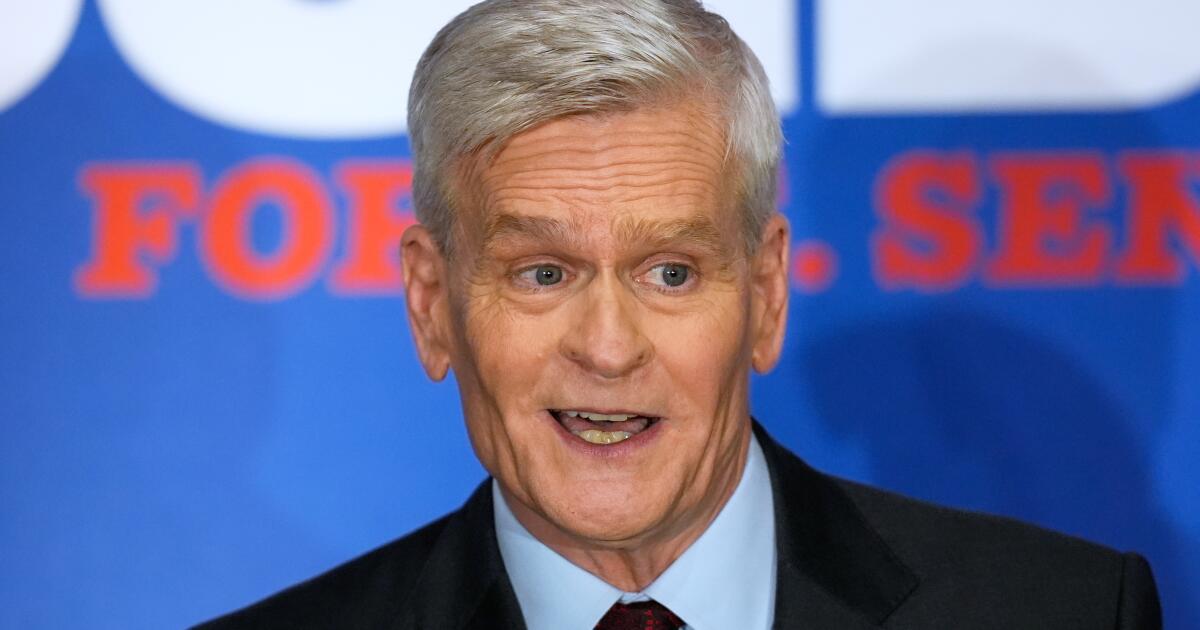
Sen. Bill Cassidy of Louisiana is the newest member of the club. Just days after losing his primary to a Trump-backed challenger, Cassidy on Tuesday reversed himself on legislation involving the war in Iran and voted with Democrats to rein in U.S. military action.

“The way our Constitution is set up, Congress should hold the executive branch accountable,” he told reporters the day before.

Sen. John Cornyn of Texas could be next after Trump endorsed Ken Paxton, Cornyn’s rival for the Republican nomination in next week’s runoff.

Rep. Thomas Massie of Kentucky is perhaps a founding member of the YOLO caucus — slang for “you only live once,” used to punctuate unbothered or even foolhardy behavior. He frustrated Trump since the president’s first term, and his status was solidified after losing his primary on Tuesday to a Trump-backed challenger. Massie has enraged Trump by voting against his signature tax and spending bill and by pushing for the release of the Jeffrey Epstein files.

He hinted there’s more to come before he leaves office.

“I got seven months left in Congress,” Massie said with a grin during his concession speech as the crowd erupted.

More Republicans feel free to shrug off Trump

Other similarly situated Republicans include Sen. Thom Tillis, who was a fierce critic of former Homeland Security Secretary Kristi Noem and has more recently turned his attention to Defense Secretary Pete Hegseth. There’s also Sen. Lisa Murkowski of Alaska, who joined Democrats last week in a bid to curb Trump’s war powers in Iran. Sens. Susan Collins of Maine and Mitch McConnell of Kentucky have voted against some of Trump’s Cabinet picks. And in the House, Rep. Don Bacon of Nebraska has pushed to reclaim congressional power over tariffs.

“If the legislative branch always votes with the president, we do have a king,” Massie said in his concession speech Tuesday.

This hardly amounts to a revival of the Never Trump movement that some Republicans unsuccessfully hoped would curb the president’s excesses during his first term or block him from returning to office. Many in the party, including Trump’s occasional detractors, have either stood by or been unable to block the president as he launched the war in Iran and presided over an aggressive immigration enforcement operation and the dismantling of the federal workforce.

Today’s unencumbered Republicans don’t fit into an ideological box. But they are united by a sense of emboldening that can only be attained in a few ways in Trump’s Washington.

Many, like Tillis, McConnell and Bacon, have decided to retire and can cast votes knowing they’ll never again have to face Republican primary voters. Others like Collins and Murkowski have more leeway because they represent states that tend to reward political independence. And some like Massie banked on the idea that voters could support both Trump and someone who occasionally crossed him.

It’s a paradox for Trump. As he demands total loyalty and pushes out Republican dissenters, he’s left with a growing cohort who, for one reason or another, owe Trump nothing.

Democrats look to capitalize

That could be a problem for Senate Majority Leader John Thune and House Speaker Mike Johnson, who are already governing with threadbare majorities. Shifting loyalties of even a few Republican lawmakers could dramatically complicate the ability for either chamber to pass substantial legislation ahead of the November midterm elections.

Thune called Cornyn a “principled conservative” and “very effective senator” on Tuesday.

“None of us control what the president does,” he said.

The next tests could come later this week as Thune pushes a funding package for Immigration and Customs Enforcement and Customs and Border Protection designed to pass on a party line basis.

Democrats are eager to pounce.

Speaking at an event in Washington on Tuesday sponsored by the Center for American Progress, House Democratic leader Hakeem Jeffries said he would aim to drive a wedge between Republicans by using a so-called discharge petition to bring issues directly to the floor for a vote.

That tactic has been successful in securing House passage on issues including the Epstein files and temporary protection of Haitian immigrants.

“When we’re disciplined and when we’re focused and when we put pressure in particular on the so-called swing seat Republicans, they have been breaking with us,” Jeffries said.

California Gov. Gavin Newsom told reporters on Tuesday that Trump’s endorsement of Cornyn’s rival was a sign that his political power lies within the Republican base — not the American public at large.

“He’s showed the only influence he has, and that’s an outsize influence within the base of the party,” the potential 2028 Democratic presidential contender said. “Otherwise he’s shown little to no influence with the American people.”

Counting the votes

That leaves Republicans gaming out how they might cobble together the votes needed to pass legislation.

Sen. John Hoeven of North Dakota called Cassidy a “good friend” and said the loss was “tough for him.” He said Cassidy “will always vote in line with what he thinks is best” but doubted he will become a less reliable Republican vote.

His fellow Louisianan, Sen. John Kennedy, said Cassidy deploys power “rationally and maturely” and “will continue to do the same thing.”

Cassidy repeatedly rejected the notion that he will spend his final months in Washington as a troublemaker for Trump, saying he’s going to do “what’s good for my country and my state.”

Yet the independent streak that ended his political career quickly resurfaced. A week after Trump visited China, Cassidy spoke of a Western alliance that’s “totally falling apart” and will be unable to “push back on the threat China represents.” He seemed stunned that the administration would create a nearly $1.8-billion fund to compensate Trump allies who they believe have been unjustly investigated and prosecuted.

“I just came off the campaign trail,” he said. “People are concerned about making their own ends meet, not about putting a slush fund together without a legal precedent.”

Sloan and Cappelletti write for the Associated Press. AP writer Stephen Groves in Washington contributed to this report.

Source link

David Attenborough worrying prediction for 2030 could spell disaster for the world

As he reaches 100, broadcaster and naturalist Sir David Attenborough has spoken of the changes he has seen in his lifetime – and the horrifying consequences of climate change in the years to come

Legendary broadcaster Sir David Attenborough made a worrying prediction for 2030 – and predicted the state of the planet is likely to get worse after that. The iconic naturalist celebrates his 100th birthday on Friday (May 8) and he has long been heralded as the natural world’s biggest champion.

He has also been vocal about the threats facing the Earth. In 2020, as the world was in lockdown as a precaution against Covid-19, Sir David made what he called a “personal witness statement” about the threat of climate change. Many of the dire predictions he made about the world are beginning to come true.

Back in 2020 he warned that 10 years from that date, with much of the Amazon rainforest becoming a dry desert and the polar icecaps shrinking, the effects of climate change will become truly irreversible – and threaten the extinction of humanity.

As he released his Netflix documentary, A Life on Our Planet, Sir David made a personal appeal to world leaders. He said: “There are short-term problems and long-term problems. Politicians are tempted to deal with short-term problems all the time and neglect long-term problems.

“{Climate change] is not only a long-term problem, it is the biggest problem humanity has ever faced. Please examine it, and please respond.”

The prognosis for the rest of the century looks pretty bleak if Sir David’s predictions are to be believed. He said that if he had been born in 2020, instead of 1926, he would be witness to the full range of climate collapse: “In the 2030s, The Amazon Rainforest, cut down until it can no longer produce enough moisture, degrades into a dry savannah, bringing catastrophic species loss… and altering the global water cycle.

“At the same time, the Arctic becomes ice-free in the summer. Without the white ice cap, less of the sun’s energy is reflected back out to space. And the speed of global warming increases.”

By the 2040s, just 14 years from today, Sir David predicts: “Throughout the north, frozen soils thaw, releasing methane, a greenhouse gas many times more potent than carbon dioxide, accelerating the rate of climate change dramatically.”

Through the 2050s, as today’s schoolchildren reach middle age, the world’s seas will become a sterile desert: “As the ocean continues to heat and becomes more acidic, coral reefs around the world die. Fish populations crash.”

Into the 2080s, mankind truly becomes an endangered species: “Global food production enters a crisis as soils become exhausted by overuse. Pollinating insects disappear… and the weather is more and more unpredictable.”

The stable climate that has endured longer than human civilisation will be lost forever by 2100, Sir David says.

“Our planet becomes four degrees Celsius warmer,” he adds, “Large parts of the earth are uninhabitable. Millions of people rendered homeless. A sixth mass extinction event… is well underway.”

He describes these various tipping-points as “a series of one-way doors,” with each bringing irreversible change.”

As he muses on his long life, Sir David warren that someone born today who lives as long as he has will see almost unimaginable change: “Within the span of the next lifetime, the security and stability of the Holocene, our Garden of Eden… will be lost.”

Average global temperatures have risen by more than 1C since the 1850s. Since 2015, every successive year has brought record high temperatures – causing heatwaves, floods, droughts, and fires as well as irrevocable habitat loss for many species.

Sir David thinks that humanity is the species most under threat. He said: “I used to think this was about saving the planet, and now I realise it’s not …nature will always look after itself. It’s about saving us.”

He was one of the first to sound the alarm about humanity’s impact on the environment. In 1937, the total human population was around 2.3billion. Carbon in the atmosphere was measured at 280 parts per million, and 66% of the planet remained unspoiled wilderness: “Everywhere you’d go, there was wilderness. Sparkling coastal seas. Vast forests. Immense grasslands. You could fly for hours over the untouched wilderness,” Sir David said.

Sir David was one of the first to sound the alarm about humanity’s impact on the environment. In 1937, the total human population was around 2.3billion. Carbon in the atmosphere was measured at 280 parts per million, and 66% of the planet remained unspoiled wilderness: “Everywhere you’d go, there was wilderness. Sparkling coastal seas. Vast forests. Immense grasslands. You could fly for hours over the untouched wilderness,” Sir David said.

By 1960, less than 30 years later, the change was already measurable. The global population was now three billion, atmospheric carbon was measured at 315 parts per million, and the remaining wilderness had shrunk to 62%.

Fast forward to 1997, the population had more than doubled to almost six billion, carbon in the atmosphere had increased to 360 parts per million, and much more wilderness had been lost – now down to 46%.

“The global air temperature had been relatively stable till the ’90s,” Sir David said. “But it now appeared this was only because the ocean was absorbing much of the excess heat, masking our impact. It was the first indication to me that the earth was beginning to lose its balance.”

Unsustainable logging, overfishing, and above all the reckless use of fossil fuels was pushing the planet to a tipping point, he warned: “The average global temperature today is one degree Celsius warmer than it was when I was born,” he said in A Life on Our Planet,” speed of change that exceeds any in the last 10,000 years. Summer sea ice in the Arctic has reduced by 40% in 40 years.”

The wildlife that has been Sir David’s lifelong interest has been pushed to the margins: “Half of the fertile land on earth is now farmland. 70% of the mass of birds on this planet are domestic birds. The vast majority, chickens.

“We account for over one-third of the weight of mammals on earth. A further 60% are the animals we raise to eat. The rest, from mice to whales, make up just 4%.”

Despite the bleak outlook, Sir David says all hope is not lost. One is to stabilise population growth and another is to switch to renewable energy.

Source link