speed

Brenen Thompson could help push Chargers’ offense into overdrive

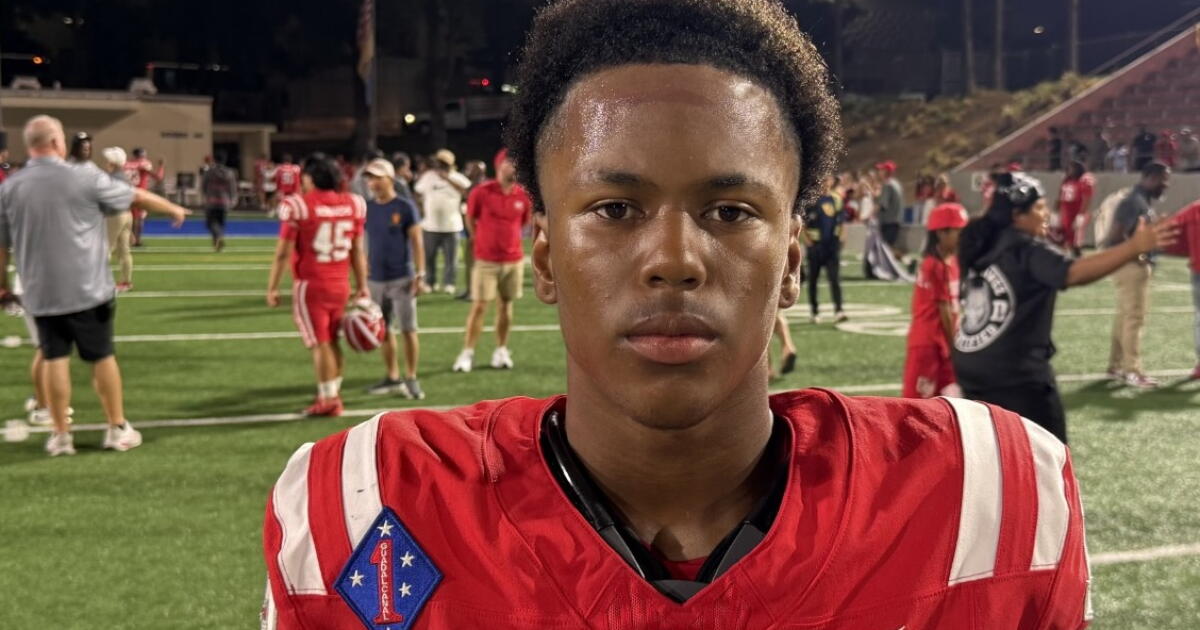
Chargers rookie wide receiver Brenen Thompson said he doesn’t love zipping around.

“To be fair, I really hate running,” Thompson, a former track star, said. “But I’m really good at it.”

Thompson has proven that so far in Chargers training camp, sprinting around defenders and maximizing his 5-foot-9, 170-pound frame in passing drills.

His speed and do-it-all attitude have made him one of Justin Herbert’s favorite targets, including on deeper routes, over the last two weeks.

“He’s going to be very good,” Herbert said of Thompson. “We saw it early on that he was going to be. He’s skilled. He’s fast. He’s going to make a lot of plays for us. So, I’m really excited about him.”

Added Thompson: “I know my speed is pretty much unmatched when I step on the field, and that’s something I take strong confidence in.”

Thompson was clearly the fastest player going into the 2026 NFL draft after he posted a time of 4.26 seconds in the 40-yard dash, the third-best time ever, at the scouting combine.

And after leading the Southeastern Conference with 1,054 receiving yards as a senior at Mississippi State, Thompson impressed the Chargers enough to be their fourth-round pick.

He’s thrived ever since — as a wideout and as a returner.

“I agree with Justin,” added coach Jim Harbaugh. “We’re all seeing the same thing. Much like Akheem [Mesidor], so far, so good — really good.”

Special teams coordinator Ryan Ficken has been impressed with Thompson’s work ethic, saying “he’s willing to go ahead and put in the work.”

The Chargers have good reason to be excited about Thompson’s budding role.

New offensive coordinator Mike McDaniel’s scheme is largely focused on getting the ball to playmakers in space quickly. With Herbert being tasked this season with getting rid of the ball quicker, receivers are being tasked with finding ways of getting open sooner.

“We’re doing a lot more motions, a lot more shifts, a lot more stuff like that. “[McDaniel’s] whole philosophy is speed and moving fast,” wideout Quentin Johnston said. “Just different formations … variations of the same route … I mean, shoot, that just shows how good a coach Coach Mike is — got us in different positions to be successful.”

Thompson acknowledged he struggled to adapt to the NFL’s “20-word” play calls early on after coming from no-huddle communication rules in college.

McDaniel, however, acknowledged the progress and dedication he has seen from the rookie over the last few months.

Chargers wide receiver Brenen Thompson runs a drill during rookie minicamp in May.

Chargers wide receiver Brenen Thompson runs a drill during rookie minicamp in May.

(William Liang / Associated Press)

“I think he’s captured the attention of the quarterback room by his attack and ownership of the offense,” McDaniel said. “Typically, it’s a very difficult transition … there’s not pictures on the sidelines that you memorize. … The most impressive part has been his professional attack and ownership of assignment, which is not easy.

“Now, the next challenge is that you have all these stacked installs — can you still execute everything while these new plays are being shoveled to you, much like in a season where you have a new game plan every week?”

It helps Thompson to have veteran receivers such as Johnston and Ladd McConkey, who are willing to work with him.

“I pick their brains a lot,” Johnson said. “Whether it’s a certain route or certain play, how do they see these things? … I think the world of those two guys, along with everyone else in the room.”

McConkey and Johnston have enjoyed working with him too.

“He’s flying around across the field,” McConkey said. “He didn’t run 4.2 by accident. … He’s going to be able to help us a lot this year, for sure.”

Added Johnston: “Man, that’s my dawg. He came in with one thing on his mind: speed. Shoot, you’ve seen his [40-yard dash] time … he brought that to the league — to this team — which I appreciate a lot. He’s a very smart dude in the classroom. … He’s been a fun guy to be around.”

The Chargers’ offense will undoubtedly be different under McDaniel — Herbert’s new shotgun stance is proof of that. Speed and spacing will be key. And those who find ways to learn and contribute quickly, like Thompson, will earn playing time.

“I came here to contribute [and] to make this team better, and so whether that’s blocking, running, special teams — whatever that is — I’m going to put my best foot forward,” Thompson said. “I’m nowhere near where I want to be right now.”

Source link

The Times’ preseason top 25 high school football rankings

The Times’ preseason top 25 high school football rankings for 2026:

1. ST. JOHN BOSCO: Braves have few weaknesses but must prove they can win in the rain after last season’s first-round playoff debacle to Orange Lutheran.

2. CORONA CENTENNIAL: The offense is going to be balanced and explosive with quarterback Jaden Jefferson the trigger man and Quentin Hale his partner in battle.

3. SIERRA CANYON: Trailblazers have the offensive linemen and running back to run the ball and the defensive linemen to attack quarterbacks.

4. SANTA MARGARITA: Eagles won’t be ready to start the season dominating with too many young players but beware by season’s end.

5. ORANGE LUTHERAN: There’s already signs the Ray Fenton coaching formula is working with lots of talent on both sides of the ball.

6. MISSION VIEJO: Diablos have their best offensive line in years, giving coach Chad Johnson lots of options.

7. MATER DEI: Depth is gone but there’s enough talent to be very good on their best day.

8. SAN CLEMENTE: Just trust Jaxson Rex to do anything and everything for improved Tritons.

9. CHAPARRAL: There’s a crazy amount of offensive firepower ready to be unleashed.

10. RANCHO CUCAMONGA: They play tough, hard-nosed football.

11. EDISON: Quarterback Sam Thomson’s fourth year as starter sets the stage for big Chargers season.

12. CREAN LUTHERAN: If the Saints’ many transfers get eligible, quarterback Caden Jones should flourish.

13. GARDENA SERRA: With five starters back on the offensive line and the arrival of RB AJ McBean, Cavaliers are ready to play smashmouth football.

14. CHAMINADE: There’s speed and size surrounding sophomore quarterback Jeremy Mellalieu.

15. SERVITE: New coach Rick Garretson has a history of building top teams with speed, which Friars have plenty.

16. JSERRA: Lions will be competitive in nonleague games but Trinity League remains formidable challenge.

17. DAMIEN: USC commit Gavin Williams is the definition of the word elite on defense and offense.

18. PALOS VERDES: Ryan Rakowski is back for fourth year as starting quarterback and is a proven winner.

19. OXNARD PACIFICA: Quarterback Taylor Lee is back with lots of skill-position players.

20. LOYOLA: If Cubs can get production at the quarterback position, they can surprise teams.

21. BISHOP AMAT: Still one of the toughest teams to beat on their home field.

22. WESTLAKE: The scoreboard operator will deserve extra pay trying to keep up with Warriors’ scoring barrages.

23. CARSON: Best in the City Section looking to beat some Southern Section teams with improved line play.

24. CORONA DEL MAR: Should have excellent passing attack if the line can provide protection.

25. TUSTIN: Lots of individual talent but can they get breakthrough win against a top opponent?

Source link

Woodbridge High senior wins gold medal in speed climbing

When it comes to fear of heights, Maddi Haferling was born with the opposite gene — loving heights.

The Woodbridge High senior started climbing a door at home at age 4 trying to reach a pull-up bar. By 10, she was signed up for a climbing academy. At 17, she won a gold medal in speed climbing last week at the USU19 National Championship in Salt Lake City.

On Thursday, she leaves for Arco, Italy, to compete at the Youth World Championships.

“It’s pretty cool,” she said.

At 5 feet tall, her challenge is climbing a standardized 15-meter wall course and finishing with the fastest time going against an opponent climbing an identical course. She’s attached to a safety rope in case there’s a fall.

Maddi Haferling of Woodbridge won a gold medal in speed climbing.

Maddi Haferling of Woodbridge won a gold medal in speed climbing.

(Haferling family)

Being a climber, I have a lot of strength that oust don’t have,” Haferling said. “I can do 25 pull-ups that can impress you.”

So what happens if a Woodbridge football player challenges her to a pull-up contest?

“I think they know they’d lose,” she said.

She trains five days a week, three hours a day at a Santa Ana climbing facility lifting weights and practicing speed climbing techniques with other team members.

“It’s nice I can push myself in a sport and commit to something,” she said. “Being on a team is amazing.”

Source link

California leaders cheer Supreme Court ballot ruling while eyeing other ways to speed count

California officials cheered a U.S. Supreme Court ruling Monday that allows states to continue counting mail ballots postmarked by election day but received in the days after — calling it a win for voter participation and access, including in the upcoming November midterm.

They also acknowledged delays in recent vote counting have spurred frustration, and promised to speed the process through other solutions — including by investing millions into new election infrastructure and vote processing capabilities.

Gov. Gavin Newsom — who called the court ruling a “win for voters, plain and simple” — has previously said the state should be able to count ballots faster, and his latest budget includes $29 million for “increased staffing, technology and equipment upgrades and purchases for counties,” $10 million for voter education and outreach at the state and county levels and $750,000 for combating election misinformation.

The court decision, a loss for President Trump and other critics who contend such policies contribute to unacceptable delays in vote counting, specifically upheld a Mississippi policy to accept mail ballots received within five business days of an election.

But it also lets stand similar policies in other states — including California, which counts ballots postmarked by and received within seven days of an election.

California Secretary of State Shirley Weber, who has long prioritized voter participation over a speedy count, called the high court’s ruling a “win for voters, for the rule of law, and for the future of our democracy.”

She said that she will “keep working to ensure every eligible Californian has the opportunity to be heard, because our democracy is strongest when every voice and vote count.”

Dean Logan, head of the Los Angeles County registrar-recorder/county clerk’s office, said in a statement to The Times that the ruling “affirms what Los Angeles County voters deserve: the assurance that a ballot cast by Election Day will be counted if received within the legal timeframe established in State Law.”

“Our office will continue to provide voter education, multilingual outreach, and leverage available resources to ensure voting access for our 5.8 million registered voters,” Logan said.

Many voting rights experts agree California’s vote counting should and could be faster, but disagree with the Trump administration’s efforts to step in with policies such as election day deadlines.

In 2024, California counted more than 406,000 late-arriving mail ballots, but they represented only about 2.5% of the statewide total. Experts say California’s delayed results have far more to do with the massive influx of mail ballots that are placed in ballot drop boxes or arrive at processing facilities on or just before election day.

Rick Hasen, an election law expert and director of the Safeguarding Democracy Project at UCLA Law, said the court’s decision was a “symbolic loss” for Trump, in that the court rejected his preferred policy on mail ballots, but “doesn’t appreciably change how long it takes to count ballots” because late-arriving ballots were never the problem.

In a report published Thursday, the California Voter Foundation recommended statewide adoption of “sign, scan, and go” programs that allow elections officials to immediately process mail ballots that voters submit in person at polling centers or drop boxes.

The foundation recommended ballot curing programs that speed up the process by utilizing a secure text platform when double checking whether a ballot is legitimate when a voter’s signature doesn’t match state records.

It also urged the state to invest $35 million in a voter education campaign to encourage early ballot returns, and more than $55 million in improving counting capacity and efficiency in county elections facilities.

Trump and other conservatives had called for an end to state policies allowing late-arriving mail ballots to be counted as an overdue fix to a voting system that often can’t produce election results in close races for days after polls close, as was the case in California’s recent primary races for governor and L.A. mayor.

Trump has pointed to California’s time-consuming count as proof of widespread fraud to undermine Republican candidates, though he has never produced evidence to support that claim and Democrats have fiercely denied it.

On Monday, Trump called the high court’s decision to uphold such state policies a “tremendous loss,” and more reason to pass the Save America Act — a bill he has backed that would enforce new voter ID and proof of citizenship requirements and ban mail ballots except for military personnel, individuals suffering from illness, disability, and in other rare circumstances.

He said politicians have “no excuse” other than “CHEATING!” to oppose such measures, especially at “a time when there is a powerful Communist Movement taking place in our Country, one more dangerous than World War I, World War II, Pearl Harbor, or September 11th.”

But California leaders rejected that — saying the criticisms of mail ballots are baseless and an attempt by Trump and his allies to undermine elections in which they are poised to lose, particularly in big blue states such as California, by attempting to wrest control over voting processes that have always been the purview of states, not the federal government.

California Atty. Gen. Rob Bonta said Monday that states have been “primarily responsible for regulating elections” since the nation’s founding, and his office was “pleased that the U.S. Supreme Court has respected that authority.”

“Today’s decision recognizes a basic reality: Mail delays happen. When people vote by election day, their ballots should not be discarded because of those delays,” he said.

Sen. Alex Padilla (D-Calif.), the ranking Democrat on the Senate Rules and Administration Committee, which has oversight over federal elections, praised the high court Monday for acknowledging that nothing in federal law precludes states from counting mail ballots in the days after an election.

“Today’s decision is a victory for voting rights and a rejection of Trump’s attacks on mail and absentee voters,” Padilla said.

Liberal groups and many voting rights experts also hailed the ruling as a win for voters.

Moving up deadlines for mail ballots is just one effort in a much broader political war over voting and the rules that govern it. The U.S. Constitution generally gives states the authority to run their own elections, but the Trump administration has been trying to assert greater federal control — especially around mail ballots.

Earlier this year, Trump signed an executive order directing the U.S. Postal Service to assert control over mail balloting by designing new envelopes with special bar codes that would allow the federal government to ensure ballots only go to and get returned by eligible voters. The order prompted the Postal Service to propose new rules requiring states to hand over their voter mailing lists so it could implement Trump’s directive.

In a letter to U.S. Postmaster ‌General David Steiner on Wednesday, Democratic senators denounced the proposed rule as an “unconstitutional and illegal attempt to transform [USPS] into an election administration agency controlled by the White House and President Trump.”

In a Senate hearing the same day, Steiner said that under the new rule, the USPS would not mail the ballots of a state that refused to turn over its voter lists, but also that his agency would adhere to any court orders curtailing its implementation.

On Thursday, just such an order came down in a federal case in which California and other Democrat-led states challenged Trump’s executive order. U.S. District Judge Indira Talwani ruled that the Constitution does not grant the president “any specific powers over elections,” and blocked his order as unlawful.

Nevada Secretary of State Cisco Aguilar, who is chair of the Democratic Assn. of Secretaries of State, said states such as California were right to focus on increasing investment in their own election infrastructure rather than accepting the Trump administration’s “bad policy ideas” for speeding things up.

Newsom’s office on Monday said that is exactly what California has been doing. It pointed to laws passed by the state Legislature last year that allow election officials to begin processing mail ballots earlier and require them to finish counting ballots sooner.

Source link