Iran’s government spars with state TV as mediators push talks with US | US-Israel war on Iran News
Tehran, Iran – A public rift has emerged between Iran’s government and state television over how to portray the state of war and negotiations with the United States, as mediators try to nudge both countries towards diplomacy.
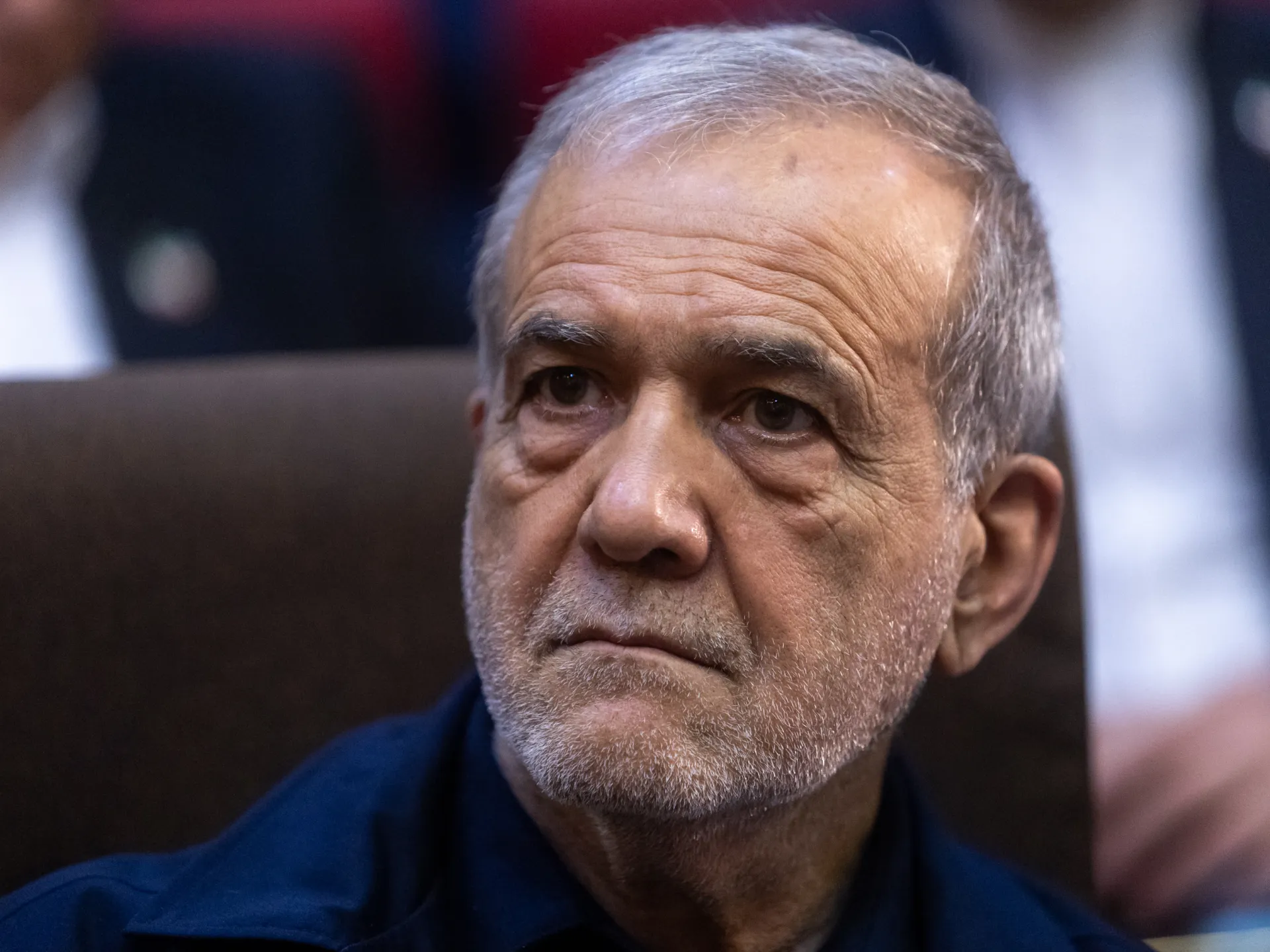
The Government Information Council on Friday accused state broadcaster IRIB of “censorship” after parts of a speech by President Masoud Pezeshkian earlier in the week were not shown to the public.
The broadcaster, whose head is appointed by the supreme leader, issued a response on Saturday rejecting the government’s “accusations and improper attributions”, and emphasised that it has a duty to prevent “an incorrect and unreal suggestion of duality in the country’s leadership pillars”.
In his speech, Pezeshkian had pointed out that after last year’s 12-day war with Israel, former Supreme Leader Ayatollah Ali Khamenei publicly said there would be no negotiations with Washington – but privately had given his approval.
“We went to the dear leader, explained the situation, and asked him what to do since he had said the ‘no war, no peace’ conditions are bad for the country,” the president said. “He ordered us to go negotiate. We started the talks based on his order.”
The government said in its statement the move to cut that section of the speech was part of a series of “unusual actions” taken by state television concerning recent comments made by the heads of the government, parliament and judiciary.
It pointed out that earlier this month, a part of the parliament speaker and chief negotiator Mohammad Bagher Ghalibaf’s interview with state television dealing with negotiations had also been cut. The government council added that a part of a speech earlier this week by judiciary head Gholam-Hossein Mohseni-Ejei was not aired either, in which he expressed backing for the president.
Foreign Minister Abbas Araghchi has also separately criticised IRIB, saying during an interview with a state-linked outlet released on Saturday that he “fought with a sword” in wartime interviews with US media such as Fox, CNN and others. The chief diplomat said he expected state television to show how Iran’s case was being strongly presented to US audiences and policymakers, but only one or two subtitles from the interviews ended up going on air.
Araghchi also rejected a notion raised by hardliners that the now-suspended memorandum of understanding signed with the US last month was “imposed” on new Supreme Leader Mojtaba Khamenei, as some hardliners have claimed. He characterised it as the best possible agreement under the circumstances.
In its own statement, the government blamed the actions on “a political faction within” state television, in an apparent reference to the Paydari Front of ultrahardliners, and said their actions could serve to undermine national security and social cohesion.
IRIB, in a statement published by its public relations department, countered that broadcasting the president’s segment would have propagated an appearance of division.
Both sides accused each other of undermining the decree issued last week by Mojtaba Khamenei to reach a “sacred unity” in face of military, economic and diplomatic pressure by the US.
Mohammad Mirzaei, a member of parliament and spokesperson of a committee tasked with exerting oversight on IRIB, said on Saturday that directors of the state broadcaster have been warned about the necessity to display different viewpoints and to act as a “sign of national unity”.
Conservative journalist Mohammad Mohajeri told local media that the broadcaster is now at its most expensive and least effective. Reformist activist Mohammad-Sadegh Javadi-Hesar described the deeper problem as “one government being installed and another government called IRIB operating against it”.
Reformist Entekhab news outlet reported, citing an unnamed source, that Pezeshkian sharply reprimanded IRIB chief Peyman Jebeli at a cabinet meeting after the row over the negotiations. Jebeli, who was appointed by Ali Khamenei in 2021, was media deputy at the Supreme National Security Council when Saeed Jalili, the only council member said to have voted against an interim deal with the US last month, was its secretary.
Hardline lawmaker Meysam Zohourian said the president has threatened to cut state television’s budget, but the administration has not confirmed this.
As the public sparring unfolded, mediators from Oman were in Tehran on Friday to discuss the management of the Strait of Hormuz, a vital waterway whose control has become a central point of contention between the US and Iran.
US President Donald Trump argued on Friday the war was going “extremely well” and that Israeli Prime Minister Benjamin Netanyahu will visit Washington in the coming days.
He said the two sides continued to talk through mediators, but that he did not expect any agreement soon.
The US president also refused to answer whether realising his threat of systematically attacking power plants and bridges in Iran in case of a war escalation would constitute war crimes.
Mohammad Bagher Zolghadr, the secretary of Iran’s Supreme National Security Council, on Saturday responded by saying missile and drone launches across the region will continue “until the full surrender of the enemy” and avenging the blood of civilians killed during the war.