SpaceX

SpaceX Dragon delivers new crew to International Space Station

Crew-12 joins Expedition 74 aboard the International Space Station on Feb. 14, replacing Crew-11, which returned to Earth early in mid-January due to one of the astronauts having a medical emergency. Photo courtesy NASA/X

Feb. 15 (UPI) — The International Space Station is once again fully staffed with the arrival of astronauts from NASA, the European Space Agency and Roscosmos on Saturday afternoon.

A SpaceX Dragon carried the four Crew-12 members docked to the Harmony module on the ISS at 3:15 p.m. EST and, after leak checks and pressurization between the craft and the station, the hatch was opened about two hours later.

NASA astronauts Jessica Meir and Jack Hathaway, ESA astronaut Sophie Adenot and Roscosmos cosmonaut Andrey Fedyaev entered the ISS at 5:14 p.m. EST Saturday afternoon, joining NASA astronaut Chris Williams and Roscosmos cosmonauts Sergey Kud-Sverchkov and Sergei Mikaev who are already about the orbiting outpost.

“We say welcome to Crew-12 today and we are happy they all arrived safe and sound, Kud-Sverchkov, ISS Expedition 74 commander, said during an arrival event after the hatch opening. “We have been waiting for this moment for a very long time. So we are very happy and proud to work as a team here.”

Meir said she was excited to be back on ISS and that the crew is “excited to be here and get to work with Expedition 74.”

Adenot, who is a first time crew member on the ISS, said that seeing the Earth was space was “mind-blowing,” calling it “a very big moment.”

Crew-12 launched from Kennedy Space Center’s Space Launch Complex 40 in Cape Canaveral, Fla., on Feb. 13 for the 34 hour ride to reach ISS and bring the station back to full staffing levels.

Crew-11 returned to Earth early on Jan. 15 because of an undisclosed medical issue with one of the astronauts in the first-ever evacuation of a space crew from the ISS.

During Crew-12’s eight-month-long mission on ISS, the crew will conduct studies on how penumonia-causing bacteria can lead to long-term heart damage, improve on-demand IV fluid generation to verify a system that uses potable water to make saline and will investigate automated plant health monitoring to help develop methods to grow food during space missions, according to NASA.

The crew also has several spacewalks planned during their mission, the agency said.

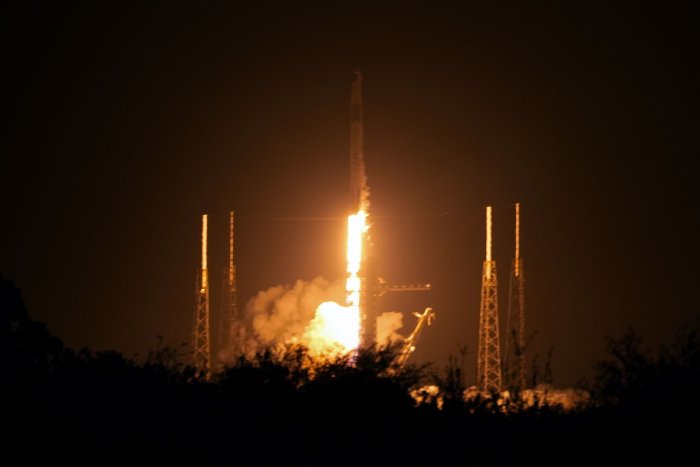
SpaceX’s Falcon 9 rocket with NASA’s Crew-12 aboard lifts off from Launch Complex 40 at Cape Canaveral in Florida on February 13, 2026. Photo by Kate Benic/UPI | License Photo

Source link

Brazil gives X five days to stop Grok from producing sexual content

Brazilian authorities have ordered that Elon Musk’s platform, X, must implement measures to prevent its artificial intelligence tool, Grok, from generating sexualized content involving minors and involving adults without consent. File Photo by Fazry Ismail/EPA

Feb. 13 (UPI) — Brazilian authorities have ordered that Elon Musk’s platform, X, must implement measures to prevent its artificial intelligence tool, Grok, from generating sexualized content involving minors and involving adults without consent.

The case is being reviewed by Brazil’s National Data Protection Authority, the Federal Public Prosecutor’s Office and the National Consumer Secretariat. The agencies contend that, despite prior warnings, the social network failed to show effective action to curb these practices.

“X must immediately implement appropriate measures to prevent the production, through Grok, of sexualized or eroticized content involving children and adolescents, as well as adults who have not expressed their consent,” Brazilian authorities said in a joint statement.

The agencies gave the platform five days to comply with the determination, under penalty of fines and legal action.

On Jan. 20, the agencies recommended that X establish, within up to 30 days, technical and operational procedures to identify, review and remove sexualized content generated by Grok that remained available on the social network. That deadline co-existed with the requirement to adopt immediate actions to prevent new posts.

The company said at the time that it had removed thousands of posts and suspended hundreds of accounts for violating its policies.

However, Brazilian authorities said the information provided “was not accompanied by concrete evidence, technical reports or monitoring mechanisms that would allow its effectiveness to be assessed.”

Tests conducted by technical teams indicated that the platform still allows the generation and sharing of sexualized or eroticized images of minors and adults without authorization.

Since late last year, thousands of complaints in several countries have alleged that Grok responds to requests to alter photographs posted by women on social media, making them appear nude or in bikinis. At least two Brazilian women have reported being victims of these deepfakes.

The Federal Public Prosecutor’s Office ordered X to submit monthly reports on the actions taken to prevent the production of these images and pointed to a lack of transparency in the company’s response.

The National Data Protection Authority also required the platform to detail the measures implemented and provide evidence that can be verified by authorities.

The new five-business-day deadline requires the company to explain what specific actions it will take to prevent Grok from creating this type of content. The official document does not specify when clock began.

If the order is not met, the company could face fines and other administrative sanctions. Those responsible could also be prosecuted for disobedience.

The Federal Public Prosecutor’s Office said it could open broader investigations that may lead to legal action to seek damages for harm caused by the creation and dissemination of these images.

The case adds to investigations in Europe. On Feb. 3, the Paris Prosecutor’s Office searched Grok’s offices as part of a preliminary investigation into the alleged dissemination of child pornography and deepfakes. Authorities in the United Kingdom and the European Union are also examining Grok’s use to manipulate images.

Grok is developed by xAI, Musk’s artificial intelligence company, which also controls X. Earlier this month, the entrepreneur announced the merger of xAI with SpaceX, his aerospace company. SpaceX is expected to debut on the New York Stock Exchange later this year.

Source link

SpaceX IPO Would Set Record As First Trillion‑Dollar Offering As More Giants Line Up

Home News SpaceX IPO Would Set Record As First Trillion‑Dollar Offering As More Giants Line Up

OpenAI, Anthropic, and Databricks lead a new class of super-sized private companies eyeing public markets.

The US IPO market has never seen a trillion-dollar debut. That may soon change as a wave of mega-valued private companies considers tapping public markets, which are eager for fresh stock.

Behind the headlines about the potential Elon Musk IPO from the newly merged SpaceX and xAI is a class of potential mega-sized deals currently valued in the hundreds of billions, supported by a thriving ecosystem for funding big companies in private markets.

SpaceX’s private market valuation is estimated at $1.25 trillion, placing it ninth in the S&P 500. That’s just below Tesla’s $1.5 trillion valuation and ahead of Warren Buffett’s Berkshire Hathaway ($1.1 trillion) and Walmart ($1.05 trillion).

If Musk succeeds in taking SpaceX public this year, it will likely sell about 10% of its equity in the IPO, raising $125 billion. That figure would handily exceed Saudi Aramco’s IPO proceeds of $29.4 billion, the largest global IPO ever, and Alibaba’s IPO proceeds of $21.8 billion, still the largest ever in the US since its 2014 debut.

“There is no precedent for an IPO this large,” Morningstar passive strategies analyst Zachary Evens said in an email to Global Finance. “I am interested to see if index providers make exceptions for mega IPOs since they will instantly reshape the market.”

Nasdaq is considering a special “fast entry” rule that would allow a company to join its flagship index after its first 15 trading days, he said.

Meanwhile, OpenAI is currently valued at about $500 billion. That’s roughly double Alibaba’s $236 billion enterprise value, the current record holder for a US IPO, when it went public in 2014.

Anthropic, the company behind the Claude AI service, is valued at about $374 billion — also bigger than Alibaba — and business software specialist Databricks tips the scales at $134 billion.

These companies also dwarf the $81 billion valuation of Facebook at its 2012 IPO or the $75.5 billion market cap of Uber Technologies at its 2019 IPO.

To be sure, it’s possible that the sky-high valuations of these private companies could take a big hit amid uncertainty on Wall Street about whether unprecedented spending on AI will pay off. The window to take companies public slammed shut in April of last year after the launch of the US’s Liberation Day tariff regime. And it could do so again if the recent tech selloff driven by AI jitters continues.

While the companies are part of an ecosystem that developed and grew in the years following the Financial Crisis, they’ve never experienced a severe recession or a bubble burst, such as the dot-com meltdown of 2000-2001.

Still, after a sluggish IPO market in recent years and the dwindling number of listed companies due to take-private and other merger deals in the marketplace, brokers remain hungry for more public stock, said Mark Lehmann, vice chair of the commercial bank at Citizens Financial Group.

“There’s a whole host of people who will want exposure to these companies,” he said, including institutions, wealthy individuals, and retail investors.

Kaush Amin, managing director and head of private market investing at US Bank, said that valuations of some AI companies assume widespread use of their products within five to ten years. That’s much faster than the 70 years it took for the Industrial Revolution to diffuse across the U.K. and the 25 years it took for the internet to take hold across the economy.

Some pockets of the tech sector are very overvalued because the numbers may not reflect the infrastructure support AI needs and how long it may take to build and be adopted across the economy. There’s a need for capex funding, data centers, chip purchases, and power purchases. This all takes time and money.

Other than Nvidia or other large strategic players – maybe Softbank, for example – there aren’t many players out there that can write big enough checks, Amin said.

While the debate continues over how these and other unicorns will fare after going public, the private capital ecosystem continues to grow.

Morgan Stanley acquired EquityZen, a private markets brokerage, and folded the business into its investment portfolio for its wealthy clients. The deal will also enable the bank to help sell private stock earned as part of a client’s compensation package. Charles Schwab has similar plans with its acquisition of Forge Global.

David Shapiro, co-founder and CEO of OpenVC, which helped create the NYSE OPEN Venture Capital Unicorn Index, said investors are eager to secure stakes in companies before they go public – but they should be aware that fees may be much higher in some cases and that once an IPO debuts, it may fall flat.

“Sometimes, by the time these companies go public, all the juice has already been squeezed for investors,” said Shapiro. This is a reason to invest in companies before they go public — to realize bigger gains. The companies in the index alone add up to an addressable market of about $2 trillion or more, at last check. 

“People are hungry for these assets,” he said.
Source link

Musk merges SpaceX and xAI firms, plans for space-based AI data centres | Elon Musk News

Musk says solar powered and space-based data centres are the only way to meet AI’s burgeoning energy demands.

Elon Musk’s SpaceX has acquired his AI company xAI as part of an ambitious scheme to build space-based data centres to power the future of artificial intelligence.

The billionaire, who is also the CEO of Tesla, announced the merger in a statement on Tuesday on the SpaceX website.

Recommended Stories

list of 4 itemsend of list

Musk said the merger will help to address the emerging question of how to meet the power-hungry demands of artificial intelligence.

AI demand will require “immense amounts of power and cooling” that are not sustainable on Earth without “imposing hardship on communities and the environment,” he said.

Space-based data centres that harness the power of the Sun are the only long-term solution, according to Musk.

“In the long term, space-based AI is obviously the only way to scale. To harness even a millionth of our Sun’s energy would require over a million times more energy than our civilisation currently uses!” he wrote.

“The only logical solution therefore is to transport these resource-intensive efforts to a location with vast power and space,” he continued, predicting that within the next “2 to 3 years, the lowest cost way to generate AI compute will be in space”.

The merger of SpaceX and xAI will bring several of Musk’s space, artificial intelligence, internet, and social media projects under one roof.

SpaceX operates the Falcon and Starship rocket programmes, while xAI is best known for developing the AI-powered Grok chatbot. Last year, xAI also acquired X, the social media platform known as Twitter, until it was bought by Musk in late 2022.

Both companies have major contracts with US government agencies such as NASA and the Department of Defense .

SpaceX’s Starshield unit specifically collaborates with government entities, including military and intelligence agencies.

Musk is not the only tech CEO looking to space as a solution to AI’s energy quandary.

Jeff Bezos’s Blue Origin and Google’s Project Suncatcher are both working on solar-powered space-based data centres.

“In the history of spaceflight, there has never been a vehicle capable of launching the megatons of mass that space-based data centres or permanent bases on the Moon and cities on Mars require,” Musk wrote.

Musk also said his long-term plan for SpaceX is to launch a million satellites.

To achieve this aim, SpaceX’s Starship rocket programme aims to one day launch one flight per hour with a 200-tonne payload, he said.

Musk said Starlink, a subsidiary of SpaceX that offers satellite-based internet service, will soon get a major boost with the launch of SpaceX’s next generation of V3 satellites.

They will each add “more than 20 times the capacity to the constellation as the current Falcon launches of the V2 Starlink satellites”, he wrote.

Source link