Sarina Hosseiny said she had never heard of Qassem Suleimani, an Iranian general assassinated by the U.S. in 2020.
That is, not until this year, when threatening comments cropped up on social media claiming that she and her mother were relatives of Suleimani and were terrorists who should be deported.
The 25-year-old, who studies fashion at Los Angeles Trade Technical College, now sits in an immigration detention facility in Texas, alongside her 47-year-old mother. And other L.A. Iranian Americans helped put her there.
Sarina Hosseiny, 25, shown in an undated photo, is a student at Los Angeles Trade Technical College now held at an immigration detention facility in Texas, alongside her 47-year-old mother.
(Courtesy of Hosseiny family)
“They were sending me death threats. Literally saying like, they were gonna find me and kill me and my mom and all this stuff,” Hosseiny said in a phone interview from the facility last week. “All I’ve ever posted is that I was against war and just innocent people dying.”
In recent weeks, as the war in Iran continues, the U.S. State Department has detained five L.A. area-based Iranian nationals, including Hosseiny and her mother — all of whom are green card holders — and moved to strip them of their residency.
The arrests have exposed a rift in the Iranian American community, which has grown increasingly polarized in recent years, leading to online smear campaigns and at times violence.
In L.A., home to the largest concentration of people of Iranian descent outside Iran, a vocal segment has joined forces with Trump-aligned far-right conservatives, including Laura Loomer, to wage campaigns against other Iranians they believe should not be allowed to live here.
Many in the local community fled Iran after the Islamic Revolution in 1979 and cheered the recent U.S. military attacks on their native country. Some have turned on Iranian Americans who have expressed antiwar opinions, interpreting that stance as support for the current government.
A poster in support of Iran’s former crown prince, Reza Pahlavi, hangs in a window of the Gallery Eshgh, which sells artwork and clothing reflecting Iranian culture on Westwood Boulevard in Los Angeles in April 2026.
(Kayla Bartkowski / Los Angeles Times)
The tensions are interpersonal, with arguments at family gatherings and friendships strained or shattered. But much of the conflict also takes place online, as when a San Diego-based “mommy influencer” — who normally posts images of herself and her three young children in a luscious backyard shucking nuts, arranging tulips and peeling pomegranates — urged her Instagram followers to contact Loomer so that “the deportation of [the Islamic Republic’s] lackeys can be arranged.”
Anger at the Iranian government has been channeled toward family members of current or former officials, with online petitions describing them as living luxuriously in the States even as ordinary Iranians face repression from a brutal government back home.
Agoura Hills residents Seyed Eissa Hashemi and Maryam Tahmasebi, both psychology professors, were detained by immigration authorities in early April — as was their son, Seyed Mobin Hashemi. The elder Hashemi, the State Department said, is the son of Masoumeh Ebtekar, who gained fame as a spokeswoman for militants who stormed the U.S. Embassy in Tehran in 1979 and became a reformist politician pushing for environmental protections and women’s rights.
The petition that led to the family’s detention amassed more than 140,000 signatures, with many identifying themselves as members of the Iranian diaspora in the U.S., Australia or elsewhere. The creator of the petition on Change.org, a user who also published petitions targeting five other families, did not respond to a request for comment.
The Times was not able to reach Hashemi or the family’s attorney. U.S. Secretary of State Marco Rubio said on social media when announcing their detentions that the Obama administration had granted visas to the family members, who have been lawful permanent residents since June 2016.
The Department of Homeland Security declined to respond to questions about Hosseiny and her mother’s case. White House spokesperson Abigail Jackson also declined to comment. The State Department and Loomer did not respond to requests for comment.
Jamal Abdi, president of the National Iranian American Council, said that some of the sentiment comes from real grievances about corruption in Iran, such as the banker who embezzled millions before fleeing to Canada. But he said that rumors have been weaponized to muffle voices opposing U.S. and Israeli military aggression in Iran and exploited by the Trump administration to exercise a show of strength at home during a flailing war.
The flags of pre-revolution Iran are prominently displayed in the Jordan Market, a purveyor of Persian groceries on L.A.’s Westwood Boulevard, in April 2026.
(Kayla Bartkowski / Los Angeles Times)
“This witch hunt has become really pervasive, and it’s not new,” Abdi said. “What seems to be new is there’s an administration who is willing and eager to entertain this McCarthyism and actually punish people based on what the mob is calling for.”
In the section of Westwood known as “Tehrangeles,” support for Reza Pahlavi, the exiled crown prince and son of the late shah, is apparent. A campaign to install him as Iran’s leader intensified in January, as protests ripped through the country. Supreme Leader Ayatollah Ali Khamenei was killed in a U.S.-Israeli attack in February.
“Make Iran Great Again” signs and posters of a stern-faced Pahlavi are plastered on nearly every window. Iran’s flag before the 1979 revolution — green, white and red with a lion and a rising sun — flutters from many overhangs.
In early March, as the U.S. widened its assault on Iran, crowds from the diaspora rallied in the neighborhood, dancing and celebrating even as the death toll in Iran grew and reports said a missile strike had killed more than 100 schoolchildren.
In Westwood these days, many are more tepid in their support for the war than at the outset and are hesitant to speak openly, whether because of potential backlash here in the U.S. or repercussions for relatives in Iran.
Iranians who don’t back a return to a monarchy under Pahlavi or American and Israeli intervention have gotten “a hell of a lot of backlash,” said Narges Bajoghli, an associate professor of Middle East studies at John Hopkins University. Bajoghli cited a groupthink dynamic stoked by popular Persian-language media such as Iran International, as well as U.S.-funded counter-propaganda programs during Trump’s first term.
After Aida Ashouri, a human rights lawyer who is running for L.A. city attorney, posted a video explaining why she opposes the U.S. war in Iran, the comments came rolling in.
“Please deport this woman,” one user wrote, tagging Rubio and Immigration and Customs Enforcement. “She is constantly spreading suspicious anti war propaganda.”
Aida Ashouri, who is running for L.A. city attorney, poses for a picture at Astralab on April 24, 2026.
(Etienne Laurent / For The Times)
Ashouri, a U.S. citizen, spent her childhood frequenting businesses in Westwood, but she no longer feels comfortable there, fearing some sort of altercation. Some businesses removed her campaign posters from their windows after the war began, she said.
“It’s 100% impacting my campaign. It’s hard to connect with the Iranian community now, even though I’m Iranian,” she said.
The State Department has said it revoked the green cards of Iranians it targeted in recent weeks, including Hosseiny and her mother. Immigration experts said it’s not so simple, as a legal process has to play out, during which the green cards remain valid.
Even so, Muzaffar Chishti of the Migration Policy Institute said that the executive branch has vast discretion in immigration law, particularly when invoking national security justifications, and defense attorneys may face an uphill battle.
Aaron Reichlin-Melnick, a senior fellow at the American Immigration Council, said he is “personally troubled by the idea that we need to deport someone because of who their grandparent is.”
“The government doesn’t usually outsource its investigatory processes to external people,” he said, referring to Loomer and others. “There’s still a lot of questions about how these people are being found and targeted.”
After Hosseiny and her mother, Hamideh Soleimani Afshar, were arrested by U.S. Immigration and Customs Enforcement agents on April 3, the State Department asserted that they were the Iranian general’s grand-niece and niece. Afshar had denounced America as the “Great Satan” and shown “unflinching support for the Islamic Revolutionary Guard Corps” while “enjoying a lavish lifestyle in Los Angeles,” the State Department said.
Social media posts, showing Soleimani Afshar posing for glamour shots and photos of Hosseiny in a similar vein, were published by numerous news outlets.
Loomer took credit on April 4 for the two women’s arrests, writing on X that over several months she had “quietly been documenting” their social media activity and shared the information with the Department of Homeland Security and the State Department.
Within hours, however, Hosseiny and her mother’s connection to the slain general was disputed, with his daughter writing on social media that they had “no relation whatsoever” to her family. A review of family documents, as first reported by Dropsite News, shows that Afshar’s father had no brothers and that the general is from a different province than Afshar’s family.
Hosseiny said her mother has been sharply critical of the U.S. and Israel’s military assault in Iran. But Hosseiny “always thought that in America, people have freedom.”
She said that her mother’s health has deteriorated as she battles severe autoimmune-related anemia and that her mother’s home and car were broken into, amid the stream of online hate.
After four weeks in detention, Hosseiny said, she is “still in disbelief.” Her friends have been raising funds for her legal defense.
Times staff writer Cierra Morgan contributed to this report.
WASHINGTON — President Trump says the United States is winning the war with Iran, even as thousands of additional American troops deploy to the Middle East.
He has pilloried other countries for not helping the U.S., only to say later he does not need their assistance. He has twice delayed deadlines for Iran to reopen the Strait of Hormuz. He has threatened to “obliterate” Iran’s energy plants if the vital waterway remains largely shut down and said the U.S. was “not affected” by the closure.
At one point this month, Trump claimed that one of his predecessors — who, he strongly suggested, was a Democrat — privately told him he wished he had taken similar action against Iran. Representatives for every living former president denied that any such conversation happened.
As the war entered its second month over the weekend, Trump’s penchant for embellishments, exaggerations and falsehoods is being tested in an environment where the stakes are much higher than a domestic political fight.
A president who has long embraced bluster and salesmanship to shape narratives and focus attention is confronting the unpredictability of war.
Leon Panetta, who served Democratic presidents as Defense secretary, CIA director and White House chief of staff, said he has “seen enough wars where truth becomes the first casualty.”
“It’s not the first administration that has not told the truth about war,” he said. “But the president has made it kind of a very standard approach to almost any question to in one way or another kind of lie about what’s really happening and basically describe everything as fine and that we’re winning the war.”
Michael Rubin, a historian at the American Enterprise Institute who worked as a staff advisor on Iran and Iraq at the Pentagon from 2002 to 2004, said Trump is “the first president of any party in recent history that hasn’t self-constrained to live within rhetorical boundaries.”
“So of course it creates a great deal of confusion,” he said.
The zigs and zags are the point
To his critics, Trump’s style is a sign that doesn’t have a coherent long-term strategy. But for Trump, the zigs and zags seem like the point, a method that keeps his opponents — and pretty much everyone else — always on their heels.
The approach was clear last week in the hours before he announced the second delay of the deadline for Iran to reopen the strait. Asked what he would do about the deadline, Trump said that he did not know and that he had a day before he had to decide.
“In Trump time, a day, you know what it is, that’s an eternity,” Trump said to laughter from members of his Cabinet.
But investors are unimpressed, with U.S. stocks closing out their worst week since the war began. To some on Capitol Hill, the freewheeling is more frustrating than amusing.
Rep. Gregory Meeks of New York, the top Democrat on the House Foreign Affairs Committee, lamented that Trump is “going back and forth and constantly contradicting himself.”
“The administration is winging it,” he said. “So how can you trust what the president says?”
Republicans were not willing to go that far, but their concern was apparent heading into a two-week break from Washington. Sen. John Kennedy of Louisiana said his constituents “support what the president has done.”
“But most of my people are also equally or even more so concerned about cost of living,” he said.
Republican Rep. Chip Roy of Texas, who sits on the House Budget Committee and is a member of the hard-right House Freedom Caucus, said his constituents were on board with “blowing some crap up.” Nonetheless, he expressed reservations about the prospect of ground troops and said the administration has not provided enough details in briefings for lawmakers. Such sessions, he said, only reveal information you “read in the papers.”
“Taking out bad guys, taking out conventional [weapons], taking out or at least working to take out nuclear capability, pressing to keep the straits open, all those are good things and I’ve been supportive and will continue to be supportive,” Roy said. “But we’ve got to have a serious conversation about how long this is going to go, boots on the ground, all those things, press for further briefings and understanding of where it’s all headed.”
Political risks ahead
While Trump has maintained deep support among Republicans, a poll last week from the Associated Press-NORC Center for Public Affairs Research indicates that the president risks further frustrating his voters if the U.S. gets involved in the kind of prolonged war in the Middle East that he promised to avoid. He campaigned against starting new foreign wars altogether, and his reversal on that already has irked some of his longtime supporters.
Although 63% of Republicans back airstrikes against Iranian military targets, the survey found, only 20% back deploying American ground troops.
That reflects the political challenges ahead for Trump, who did not prepare the country for such an extensive overseas conflict. If the war drags on or escalates, pressure on Republicans could build before the November elections, when their majorities in Congress are at risk. Some in the party have said sending in ground troops would be a red line that Trump should not cross.
The administration also will probably need congressional support for an additional $200 billion he seeks to support the war. That amount of money, which Trump has said would be “nice to have,” even as he said the war was “winding down,” would be a tough vote at any time. But it poses particular risks for Republicans in an election year.
White House spokesperson Anna Kelly said in a statement that Trump is “right to highlight the vast success of Operation Epic Fury,” the military name for the war in Iran.
“Iran desperately wants to make a deal because of how badly they are being decimated, but the President reserves all options, military or not, at all times,” she said.
Some see ‘logic’ to Trump’s approach
Rubin, the former Iran and Iraq advisor at the Pentagon, said there could be some “logic” to the president’s ever-evolving rhetorical approach to the war. He said Trump’s initial comments about ongoing negotiations, which Iran denied, could “spread suspicion and fear within the regime circles.”
“Perhaps Donald Trump or those advising him simply want the Iranians to grow so paranoid they refuse to cooperate with each other or perhaps they even turn on each other,” he said. “But then again, there’s always a danger with Donald Trump of assuming that his rhetoric is anything more than shooting from the hip.”
Rep. Adam Smith of Washington state, the top Democrat on the House Armed Services Committee, said Trump is not going to be able to fully achieve his objectives, even those that have been clearly articulated — including the complete elimination of Iran’s nuclear program — “in the current trajectory.”
And if that is the case, Smith said, the president has the option to rely on his rhetorical skills to simply say the U.S. won — and end the war.
“As I’ve jokingly said, nobody I have ever met or heard of in human history is better at exaggerating his own accomplishments than Donald Trump,” Smith said. “So go knock yourself out and claim this was some great success.”
Arrests of several L.A. Iranian families sow confusion in a polarized community
Sarina Hosseiny said she had never heard of Qassem Suleimani, an Iranian general assassinated by the U.S. in 2020.
That is, not until this year, when threatening comments cropped up on social media claiming that she and her mother were relatives of Suleimani and were terrorists who should be deported.
The 25-year-old, who studies fashion at Los Angeles Trade Technical College, now sits in an immigration detention facility in Texas, alongside her 47-year-old mother. And other L.A. Iranian Americans helped put her there.
Sarina Hosseiny, 25, shown in an undated photo, is a student at Los Angeles Trade Technical College now held at an immigration detention facility in Texas, alongside her 47-year-old mother.
(Courtesy of Hosseiny family)
“They were sending me death threats. Literally saying like, they were gonna find me and kill me and my mom and all this stuff,” Hosseiny said in a phone interview from the facility last week. “All I’ve ever posted is that I was against war and just innocent people dying.”
In recent weeks, as the war in Iran continues, the U.S. State Department has detained five L.A. area-based Iranian nationals, including Hosseiny and her mother — all of whom are green card holders — and moved to strip them of their residency.
The arrests have exposed a rift in the Iranian American community, which has grown increasingly polarized in recent years, leading to online smear campaigns and at times violence.
In L.A., home to the largest concentration of people of Iranian descent outside Iran, a vocal segment has joined forces with Trump-aligned far-right conservatives, including Laura Loomer, to wage campaigns against other Iranians they believe should not be allowed to live here.
Many in the local community fled Iran after the Islamic Revolution in 1979 and cheered the recent U.S. military attacks on their native country. Some have turned on Iranian Americans who have expressed antiwar opinions, interpreting that stance as support for the current government.
A poster in support of Iran’s former crown prince, Reza Pahlavi, hangs in a window of the Gallery Eshgh, which sells artwork and clothing reflecting Iranian culture on Westwood Boulevard in Los Angeles in April 2026.
(Kayla Bartkowski / Los Angeles Times)
The tensions are interpersonal, with arguments at family gatherings and friendships strained or shattered. But much of the conflict also takes place online, as when a San Diego-based “mommy influencer” — who normally posts images of herself and her three young children in a luscious backyard shucking nuts, arranging tulips and peeling pomegranates — urged her Instagram followers to contact Loomer so that “the deportation of [the Islamic Republic’s] lackeys can be arranged.”
Anger at the Iranian government has been channeled toward family members of current or former officials, with online petitions describing them as living luxuriously in the States even as ordinary Iranians face repression from a brutal government back home.
Agoura Hills residents Seyed Eissa Hashemi and Maryam Tahmasebi, both psychology professors, were detained by immigration authorities in early April — as was their son, Seyed Mobin Hashemi. The elder Hashemi, the State Department said, is the son of Masoumeh Ebtekar, who gained fame as a spokeswoman for militants who stormed the U.S. Embassy in Tehran in 1979 and became a reformist politician pushing for environmental protections and women’s rights.
The petition that led to the family’s detention amassed more than 140,000 signatures, with many identifying themselves as members of the Iranian diaspora in the U.S., Australia or elsewhere. The creator of the petition on Change.org, a user who also published petitions targeting five other families, did not respond to a request for comment.
The Times was not able to reach Hashemi or the family’s attorney. U.S. Secretary of State Marco Rubio said on social media when announcing their detentions that the Obama administration had granted visas to the family members, who have been lawful permanent residents since June 2016.
The Department of Homeland Security declined to respond to questions about Hosseiny and her mother’s case. White House spokesperson Abigail Jackson also declined to comment. The State Department and Loomer did not respond to requests for comment.
Jamal Abdi, president of the National Iranian American Council, said that some of the sentiment comes from real grievances about corruption in Iran, such as the banker who embezzled millions before fleeing to Canada. But he said that rumors have been weaponized to muffle voices opposing U.S. and Israeli military aggression in Iran and exploited by the Trump administration to exercise a show of strength at home during a flailing war.
The flags of pre-revolution Iran are prominently displayed in the Jordan Market, a purveyor of Persian groceries on L.A.’s Westwood Boulevard, in April 2026.
(Kayla Bartkowski / Los Angeles Times)
“This witch hunt has become really pervasive, and it’s not new,” Abdi said. “What seems to be new is there’s an administration who is willing and eager to entertain this McCarthyism and actually punish people based on what the mob is calling for.”
In the section of Westwood known as “Tehrangeles,” support for Reza Pahlavi, the exiled crown prince and son of the late shah, is apparent. A campaign to install him as Iran’s leader intensified in January, as protests ripped through the country. Supreme Leader Ayatollah Ali Khamenei was killed in a U.S.-Israeli attack in February.
“Make Iran Great Again” signs and posters of a stern-faced Pahlavi are plastered on nearly every window. Iran’s flag before the 1979 revolution — green, white and red with a lion and a rising sun — flutters from many overhangs.
In early March, as the U.S. widened its assault on Iran, crowds from the diaspora rallied in the neighborhood, dancing and celebrating even as the death toll in Iran grew and reports said a missile strike had killed more than 100 schoolchildren.
In Westwood these days, many are more tepid in their support for the war than at the outset and are hesitant to speak openly, whether because of potential backlash here in the U.S. or repercussions for relatives in Iran.
Iranians who don’t back a return to a monarchy under Pahlavi or American and Israeli intervention have gotten “a hell of a lot of backlash,” said Narges Bajoghli, an associate professor of Middle East studies at John Hopkins University. Bajoghli cited a groupthink dynamic stoked by popular Persian-language media such as Iran International, as well as U.S.-funded counter-propaganda programs during Trump’s first term.
After Aida Ashouri, a human rights lawyer who is running for L.A. city attorney, posted a video explaining why she opposes the U.S. war in Iran, the comments came rolling in.
“Please deport this woman,” one user wrote, tagging Rubio and Immigration and Customs Enforcement. “She is constantly spreading suspicious anti war propaganda.”
Aida Ashouri, who is running for L.A. city attorney, poses for a picture at Astralab on April 24, 2026.
(Etienne Laurent / For The Times)
Ashouri, a U.S. citizen, spent her childhood frequenting businesses in Westwood, but she no longer feels comfortable there, fearing some sort of altercation. Some businesses removed her campaign posters from their windows after the war began, she said.
“It’s 100% impacting my campaign. It’s hard to connect with the Iranian community now, even though I’m Iranian,” she said.
The State Department has said it revoked the green cards of Iranians it targeted in recent weeks, including Hosseiny and her mother. Immigration experts said it’s not so simple, as a legal process has to play out, during which the green cards remain valid.
Even so, Muzaffar Chishti of the Migration Policy Institute said that the executive branch has vast discretion in immigration law, particularly when invoking national security justifications, and defense attorneys may face an uphill battle.
Aaron Reichlin-Melnick, a senior fellow at the American Immigration Council, said he is “personally troubled by the idea that we need to deport someone because of who their grandparent is.”
“The government doesn’t usually outsource its investigatory processes to external people,” he said, referring to Loomer and others. “There’s still a lot of questions about how these people are being found and targeted.”
After Hosseiny and her mother, Hamideh Soleimani Afshar, were arrested by U.S. Immigration and Customs Enforcement agents on April 3, the State Department asserted that they were the Iranian general’s grand-niece and niece. Afshar had denounced America as the “Great Satan” and shown “unflinching support for the Islamic Revolutionary Guard Corps” while “enjoying a lavish lifestyle in Los Angeles,” the State Department said.
Social media posts, showing Soleimani Afshar posing for glamour shots and photos of Hosseiny in a similar vein, were published by numerous news outlets.
Loomer took credit on April 4 for the two women’s arrests, writing on X that over several months she had “quietly been documenting” their social media activity and shared the information with the Department of Homeland Security and the State Department.
Within hours, however, Hosseiny and her mother’s connection to the slain general was disputed, with his daughter writing on social media that they had “no relation whatsoever” to her family. A review of family documents, as first reported by Dropsite News, shows that Afshar’s father had no brothers and that the general is from a different province than Afshar’s family.
Hosseiny said her mother has been sharply critical of the U.S. and Israel’s military assault in Iran. But Hosseiny “always thought that in America, people have freedom.”
She said that her mother’s health has deteriorated as she battles severe autoimmune-related anemia and that her mother’s home and car were broken into, amid the stream of online hate.
After four weeks in detention, Hosseiny said, she is “still in disbelief.” Her friends have been raising funds for her legal defense.
Times staff writer Cierra Morgan contributed to this report.
Source link
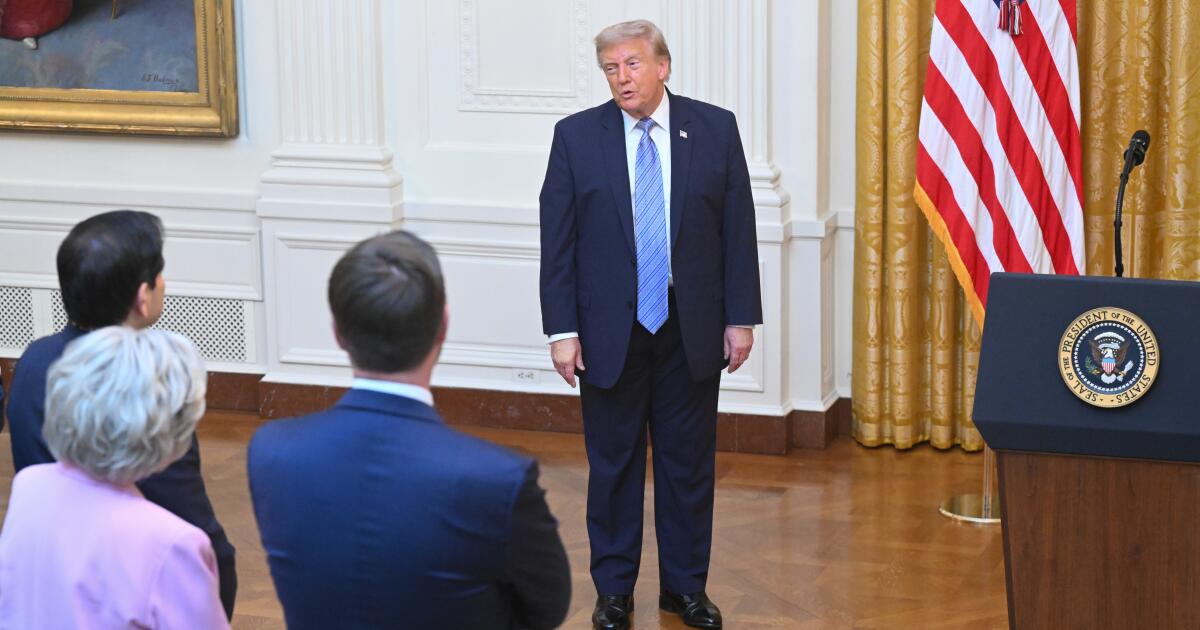
Trump’s conflicting messages sow confusion over the Iran war
WASHINGTON — President Trump says the United States is winning the war with Iran, even as thousands of additional American troops deploy to the Middle East.
He has pilloried other countries for not helping the U.S., only to say later he does not need their assistance. He has twice delayed deadlines for Iran to reopen the Strait of Hormuz. He has threatened to “obliterate” Iran’s energy plants if the vital waterway remains largely shut down and said the U.S. was “not affected” by the closure.
At one point this month, Trump claimed that one of his predecessors — who, he strongly suggested, was a Democrat — privately told him he wished he had taken similar action against Iran. Representatives for every living former president denied that any such conversation happened.
As the war entered its second month over the weekend, Trump’s penchant for embellishments, exaggerations and falsehoods is being tested in an environment where the stakes are much higher than a domestic political fight.
A president who has long embraced bluster and salesmanship to shape narratives and focus attention is confronting the unpredictability of war.
Leon Panetta, who served Democratic presidents as Defense secretary, CIA director and White House chief of staff, said he has “seen enough wars where truth becomes the first casualty.”
“It’s not the first administration that has not told the truth about war,” he said. “But the president has made it kind of a very standard approach to almost any question to in one way or another kind of lie about what’s really happening and basically describe everything as fine and that we’re winning the war.”
Michael Rubin, a historian at the American Enterprise Institute who worked as a staff advisor on Iran and Iraq at the Pentagon from 2002 to 2004, said Trump is “the first president of any party in recent history that hasn’t self-constrained to live within rhetorical boundaries.”
“So of course it creates a great deal of confusion,” he said.
The zigs and zags are the point
To his critics, Trump’s style is a sign that doesn’t have a coherent long-term strategy. But for Trump, the zigs and zags seem like the point, a method that keeps his opponents — and pretty much everyone else — always on their heels.
The approach was clear last week in the hours before he announced the second delay of the deadline for Iran to reopen the strait. Asked what he would do about the deadline, Trump said that he did not know and that he had a day before he had to decide.
“In Trump time, a day, you know what it is, that’s an eternity,” Trump said to laughter from members of his Cabinet.
But investors are unimpressed, with U.S. stocks closing out their worst week since the war began. To some on Capitol Hill, the freewheeling is more frustrating than amusing.
Rep. Gregory Meeks of New York, the top Democrat on the House Foreign Affairs Committee, lamented that Trump is “going back and forth and constantly contradicting himself.”
“The administration is winging it,” he said. “So how can you trust what the president says?”
Republicans were not willing to go that far, but their concern was apparent heading into a two-week break from Washington. Sen. John Kennedy of Louisiana said his constituents “support what the president has done.”
“But most of my people are also equally or even more so concerned about cost of living,” he said.
Republican Rep. Chip Roy of Texas, who sits on the House Budget Committee and is a member of the hard-right House Freedom Caucus, said his constituents were on board with “blowing some crap up.” Nonetheless, he expressed reservations about the prospect of ground troops and said the administration has not provided enough details in briefings for lawmakers. Such sessions, he said, only reveal information you “read in the papers.”
“Taking out bad guys, taking out conventional [weapons], taking out or at least working to take out nuclear capability, pressing to keep the straits open, all those are good things and I’ve been supportive and will continue to be supportive,” Roy said. “But we’ve got to have a serious conversation about how long this is going to go, boots on the ground, all those things, press for further briefings and understanding of where it’s all headed.”
Political risks ahead
While Trump has maintained deep support among Republicans, a poll last week from the Associated Press-NORC Center for Public Affairs Research indicates that the president risks further frustrating his voters if the U.S. gets involved in the kind of prolonged war in the Middle East that he promised to avoid. He campaigned against starting new foreign wars altogether, and his reversal on that already has irked some of his longtime supporters.
Although 63% of Republicans back airstrikes against Iranian military targets, the survey found, only 20% back deploying American ground troops.
That reflects the political challenges ahead for Trump, who did not prepare the country for such an extensive overseas conflict. If the war drags on or escalates, pressure on Republicans could build before the November elections, when their majorities in Congress are at risk. Some in the party have said sending in ground troops would be a red line that Trump should not cross.
The administration also will probably need congressional support for an additional $200 billion he seeks to support the war. That amount of money, which Trump has said would be “nice to have,” even as he said the war was “winding down,” would be a tough vote at any time. But it poses particular risks for Republicans in an election year.
White House spokesperson Anna Kelly said in a statement that Trump is “right to highlight the vast success of Operation Epic Fury,” the military name for the war in Iran.
“Iran desperately wants to make a deal because of how badly they are being decimated, but the President reserves all options, military or not, at all times,” she said.
Some see ‘logic’ to Trump’s approach
Rubin, the former Iran and Iraq advisor at the Pentagon, said there could be some “logic” to the president’s ever-evolving rhetorical approach to the war. He said Trump’s initial comments about ongoing negotiations, which Iran denied, could “spread suspicion and fear within the regime circles.”
“Perhaps Donald Trump or those advising him simply want the Iranians to grow so paranoid they refuse to cooperate with each other or perhaps they even turn on each other,” he said. “But then again, there’s always a danger with Donald Trump of assuming that his rhetoric is anything more than shooting from the hip.”
Rep. Adam Smith of Washington state, the top Democrat on the House Armed Services Committee, said Trump is not going to be able to fully achieve his objectives, even those that have been clearly articulated — including the complete elimination of Iran’s nuclear program — “in the current trajectory.”
And if that is the case, Smith said, the president has the option to rely on his rhetorical skills to simply say the U.S. won — and end the war.
“As I’ve jokingly said, nobody I have ever met or heard of in human history is better at exaggerating his own accomplishments than Donald Trump,” Smith said. “So go knock yourself out and claim this was some great success.”
Sloan writes for the Associated Press.
Source link