The waxy scent that drifts up the escalators at the Los Angeles Central Library is immediately familiar to anyone who remembers the Mold-A-Rama.
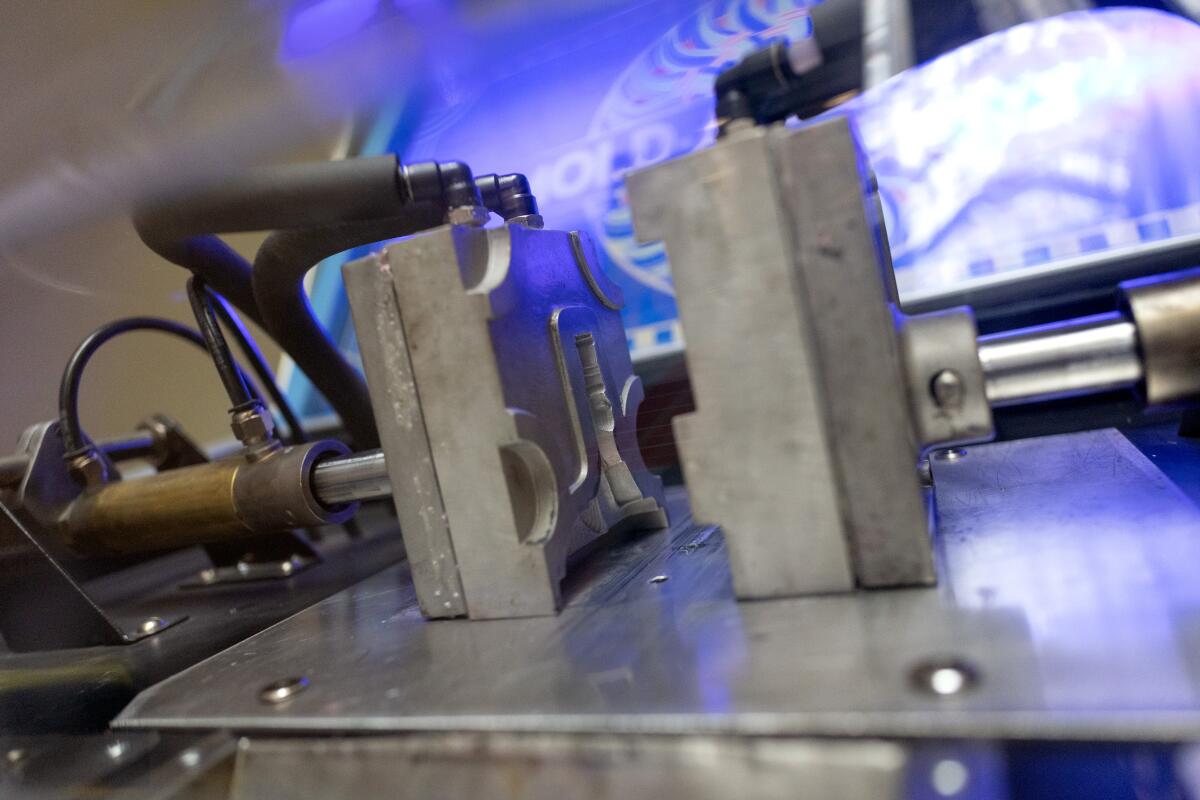
The novelty vending machines mold souvenir sculptures — a train car, a gorilla, a bust of Abraham Lincoln — in under a minute, filling a two-sided mold with hot plastic, then hollowing it out with compressed air.
Christina Rice, the senior librarian who oversees the Los Angeles Public Library’s photo collection, made it her personal quest to find and install one in the Central Library after a patron asked for pictures of machines at sites across the city, which disappeared in 2006 after their operator exited the market and sold them to private collectors.
The Mold-a-Central fills a two-sided mold with hot plastic, which is then filled with compressed air, to make a sphinx souvenir.
(Eric Thayer/Los Angeles Times)
At first, Rice wasn’t sure what he was talking about, but when it clicked, “it was such a strong visceral response,” she said. “I loved these machines when we would go to the zoo. It was a must-have every time.”
In fact, the last mold she purchased was a black panther from the Los Angeles Zoo, shortly after she graduated high school. Other L.A. souvenirs included a replica bandshell from the Hollywood Bowl and a tiny pagoda from the Chinese Theatre.
Rice saw an opportunity in the retro tech to get new people into the library or encourage existing patrons to explore other departments or collections.
It was a hunch that took her six years to see to fruition, but the library’s very own “Mold-a-Central” now sits in the alcove of the lower fourth floor. Visitors can trade $5 for a small black sphinx, a replica of sculptor Lee Lawrie’s Belgian black marble and bronze sphinxes that flank the north staircase on the library’s second floor. Pittsburgh sculptor Brian McGuire custom designed the mold and is also working on a replica of the 1926 Central Library building.
It’s been a hit. Visitors who’ve been drawn by nostalgia or curiosity to see it — and smell it — for themselves have molded over 3,000 sphinxes so far. During the library’s Centennial Festival in July, the machine had a consistent wait, churning out 255 figures in a single day. J.H. “Tike” Miller, the Illinois inventor of the Mold-A-Rama, was inspired by a broken figurine in his nativity scene. Department stores only sold them in sets, so he and his wife Shirley began making individual figures for sale in the late 1930s.
The Mold-a-Central makes sphinx souvenirs modeled after the black marble and bronze sphinxes that flank the north staircase on the library’s second floor.
(Eric Thayer/Los Angeles Times)
Olivia Gill, left, Ryan Gill and Thomas Gill use the Mold-A-Central. The souvenirs cost $5.
(Eric Thayer/Los Angeles Times)
In the 1950s, Miller began making figurines — often of dinosaurs and space aliens — using plastic injection molding. When his company went bankrupt in 1959, Miller licensed the technology to Aramark, then known as Automatic Retailers of America Inc. It spun off a separate division for the venture and worked with Miller to produce the first Mold-A-Rama machines.
The concept debuted at the 1962 Seattle World’s Fair, with figures including the Space Needle and Alweg Monorail, then rolled out in several test markets, including Southern California. The Los Angeles Times described Mold-A-Ramas as “a diabolical cross between a jukebox and a pinball machine” that cost $3,600 apiece, or about $39,500 today.
After a bigger splash at the New York World’s Fair in 1964, Mold-A-Ramas proliferated across the U.S., popping up in zoos, museums and anywhere tourists might exchange a coin for a toy.
Though Mold-A-Rama President Ben A. O’Dorisio predicted a future in which they’d eventually sell household goods and even apparel, high maintenance costs led Aramark to dissolve its Mold-A-Rama division and sell its machines just a few years later.
Today, most operational machines are concentrated in the Midwest and the South, split between two companies that have amicably divided their territories: Illinois-based Mold-A-Rama Inc. and Unique Souvenirs Inc. in Florida, which operates machines branded Mold-a-Matic.
Unique Souvenirs owner Tim Striggow bought the family business from his grandfather, Eldin Irwin, who purchased several machines from Aramark and other operators starting in the late ‘60s and traveled with them to fairs and carnivals. It was Striggow’s uncle who operated — and removed — L.A.’s machines.
The Mold-a-Central has been popular, with more than 3,000 sphinxes made.
(Eric Thayer/Los Angeles Times)
Striggow sold Jack White two machines for his Third Man Records stores in Nashville and Detroit, and supplied the library with its machine. It cost $32,000 and is expected to pay itself through souvenir revenues within a couple years. As Mold-A-Rama and Mold-a-Matic are both trademarks, the library’s machine is called Mold-a-Central for the Central Library and features new graphics by Studios Number One, Shepard and Amanda Fairey’s design studio.
Though new to the library, the Mold-a-Central is still a vintage machine, and Rice knew that before she could persuade the library to invest in one she’d have to find someone who could service it. She asked Gary Hall, general manager of Angels Flight, L.A.’s 124-year-old funicular, who suggested one of its mechanics, Hirschel Riley.
“Hirschel agreed immediately, and I think it’s safe to say he has fallen in love with our Mold-a-Central machine,” Rice said. “When we first got the machine and opened it up, my head nearly exploded and I wondered if I had bitten off more than I could chew, but for Hirschel, it’s been a piece of cake compared to [Angels Flight].”
Though the library offers 3D printing — a far more modern sculpting method — at its Octavia Lab, Rice finds even teenagers are interested in slide projectors and older technology during her photo collection tours, proving there’s still space for the analog in today’s digital world. She hopes Mold-a-Central will inspire a “whole slew” of similar vintage machines to return to L.A.
They are out there. Quentin Tarantino told Variety he had a production designer track one down for an opening shot of “Once Upon a Time… in Hollywood” at the Chinese Theatre before he rewrote the script. After changing course, he stored it in his garage.
People holidaying in France might bring this keepsake home without thinking twice
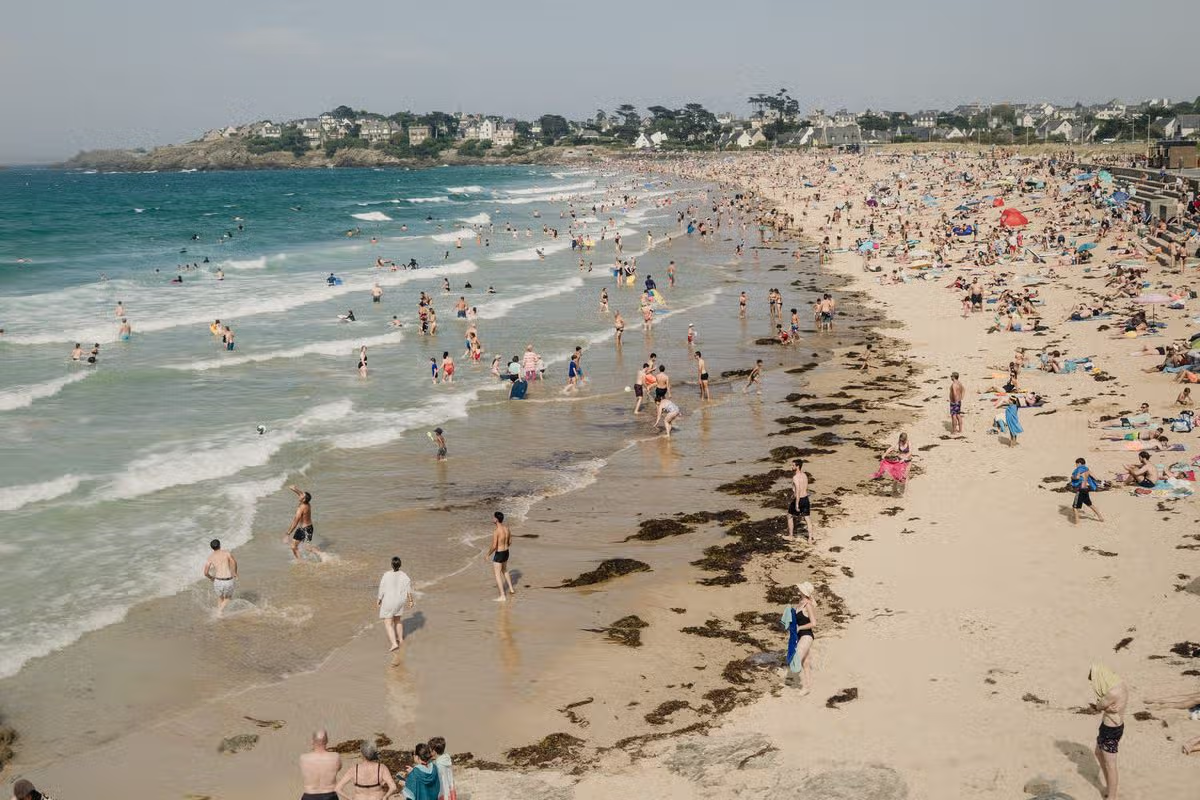
The beach of Longchamp situated between the towns of Saint Lunaire and Saint Briac sur Mer in France(Image: Bastien Ohier / Hans Lucas)
It may seem like a harmless memento to slip into your suitcase before heading home, but one common holiday habit could end up proving very expensive. Beach holidays are hugely popular, and while many travellers like to collect natural souvenirs as keepsakes or gifts, doing so in France could land them with a fine of up to €1,500 – which is around £1,300.
The little-known rule applies to natural materials including sea shells, pebbles and sand collected from French beaches. While many holidaymakers think nothing of taking home a small reminder of their trip, doing so is prohibited under French environmental laws designed to protect the country’s coastline.
Authorities say taking such items from beaches contributes to coastal erosion and can damage fragile ecosystems. Shells provide shelter for small marine creatures, while pebbles and sand play an important role in maintaining the stability of beaches.
France is home to more than 5,500 kilometres of mainland coastline and thousands of beaches stretching from the English Channel and Atlantic Ocean to the Mediterranean Sea. According to Atout France, the country’s official tourism development agency, its coastline attracts millions of visitors every year, making conservation efforts increasingly important.
The restrictions form part of France’s Environmental Code (Code de l’environnement), which protects the country’s natural coastal heritage. Anyone caught removing these materials without authorisation can face fines of up to €1,500, depending on the circumstances.
Environmental experts say the impact of individual tourists taking just a handful of sand or shells can quickly add up when millions of people visit beaches each year. According to the European Environment Agency, coastal erosion is already affecting many parts of Europe’s shoreline because of a combination of natural processes and human activity.
France remains one of the world’s most popular holiday destinations, welcoming millions of international visitors every year. Many head to coastal hotspots along the French Riviera, Normandy and the Atlantic coast, where authorities encourage people to leave beaches exactly as they found them.
The UK Foreign, Commonwealth and Development Office advises travellers to familiarise themselves with local laws before visiting overseas destinations. Even seemingly harmless actions can carry penalties if they breach environmental regulations.
Holidaymakers planning a trip to France are therefore encouraged to resist the temptation to pocket shells, pebbles or sand as souvenirs. Taking photographs instead is a simple way to preserve memories without risking an expensive fine or harming the environment.