Culver City protesters demand Sony, Amazon help defend democracy
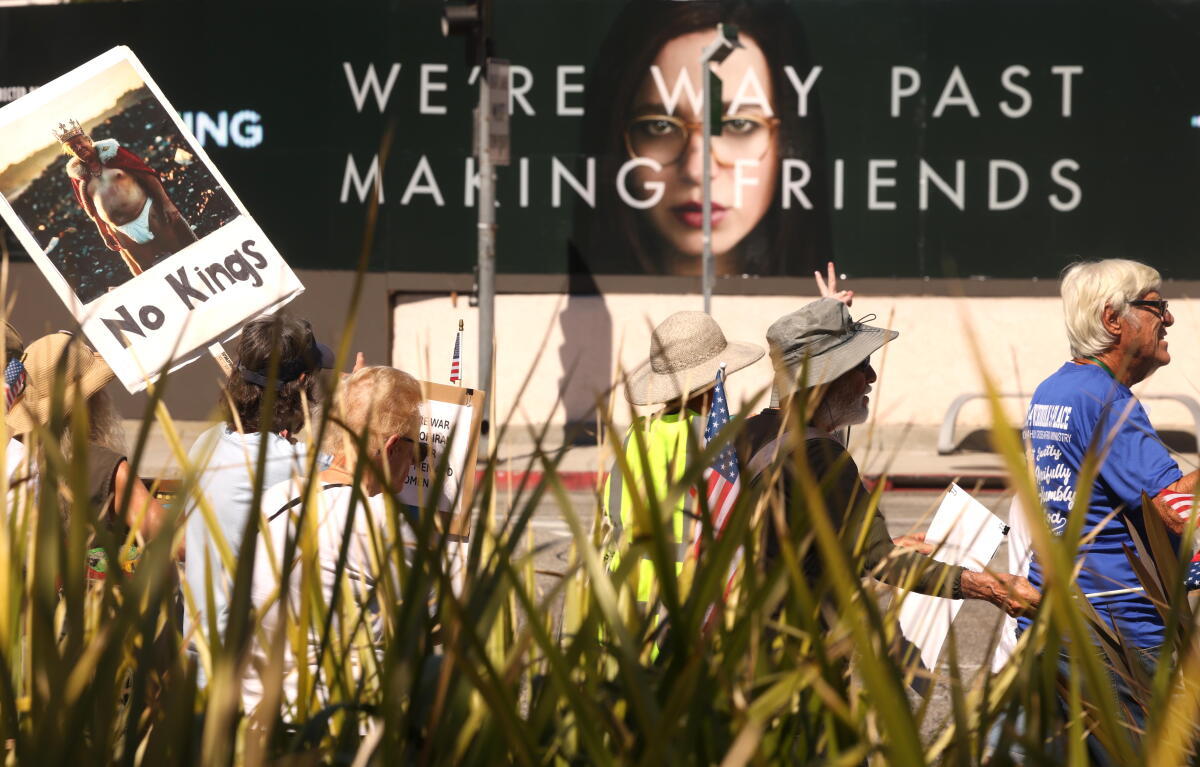
On a sweltering Saturday, around 100 people gathered in Culver City for a rally and march to deliver a message to several major media companies: Help us protect our democracy.
Spotlighting Sony Pictures Studios, Apple, Pinterest and Amazon MGM Studios, all with local offices, protesters demanded that the companies sign on to the “Business for Democracy Pledge” ahead of the elections in November.
After hearing from a few speakers outside Culver City’s City Hall, the band of demonstrators marched a few blocks to the offices of Sony Pictures Studios. From there — walking by posters for the upcoming Sony release “The Social Reckoning” — they made their way back across downtown Culver City to stop outside the historic Culver Studios, now owned by Amazon MGM.
Local groups Culver City and Friends Rising and Keep Showing Up led the protests. This week, they sent letters to the chief executives of all four corporations asking them to sign the pledge. No response has been received. (Messages from The Times to spokespeople for all four companies also were not returned.)
“Businesses and particularly large corporations like Sony, Apple, Pinterest and Amazon, who are our focus today, have a particular role to play in defending democracy,” Phil Ansell, leader of Culver City and Friends Rising, said before the rally. “They have weight, and this administration cares what business says.”
He added, “We’ve seen internationally that in situations where democracy has been under threat, that when the business community stands up for democracy, it can make a huge difference in preventing a full-on shift to authoritarianism.”
Bryan “Bubba” Fish, Vice-Mayor of Culver City, was on hand as a featured speaker and noted how Culver City, a relatively small community that is home to offices for multiple international media companies, is uniquely positioned to help ensure residents’ voices are heard.
“The message of this event is that these major corporations, that are the largest and richest corporations in the history of the planet, benefit from our civilized society,” Fish said before the rally. “…The only reason they’ve been able to grow to the size that they are is because we have stable, legitimate governance, and the bare minimum should be that they commit to defending and speaking out when our elections and our democracy is at risk. That should be the floor.”
Fish added, “We’re here saying you’re a part of our community, stand for free and fair elections and defend democracy alongside us.”

Demonstrators march to the offices of Sony Pictures Studios and past posters for the upcoming Sony release “The Social Reckoning.”
(Genaro Molina/Los Angeles Times)
Reverend Dr. Frances Wattman Rosenau, pastor at Culver City Presbyterian Church, spoke outside of both Sony and Amazon MGM.
“Democracy is one of our core values as a country, and me as a person of faith, I care deeply about giving voice to the voiceless and making sure that no one is marginalized,” Rosenau said while walking from one location to the other. “And calling our business partners to come alongside us is an act of partnership. It’s time for everybody to be in the boat and rowing, affirming what we stand for as a people for the common good.”
The Culver City event is one of a series around the country this week in collaboration with the group May Day Strong. Representatives of other local activist groups, including PowerSwitch Action, National Nurses United and Singing Resistance Santa Monica, were also in attendance on Saturday.
Amy Schur, campaign director with Alliance of Californians for Community Empowerment (ACCE), is involved with coordinating the national campaign for the “Business for Democracy” pledge.
“We’re in a unique moment where people are rising up all across the country of their own accord,” Schur said. “People are seeing what’s at stake. So they’re ready to march, they’re ready to speak out.”
Schur noted that much work remains to harness that energy and turn it into real change.
“The critical question is, can we do it in ways that are strategic and have the impact that we need in this moment?” she said. “Just marches are not enough because it’s kind of easy to ignore those. But when it’s a march with a purpose and calling out big corporations, it has more impact.”

The march in Culver City was one of several nationwide actions this week.
(Genaro Molina/Los Angeles Times)
Ansell noted that companies such as Apple and Amazon spoke out after the insurrection of Jan. 6, 2021 and hopes they will continue in that same spirit.
“We’re here today to say don’t wait for the equivalent of January 6 to happen again,” Ansell said. “Commit yourself now publicly to opposing any efforts to undermine this election. And our view is that to the extent that many large corporations across this country take that public stance, it will significantly reduce the risk of a major effort to subvert this election.”
Organizers see Saturday’s protest as part of an ongoing effort and hope more people will feel empowered to participate.
“People are not alone,” Ansell said. “No one should feel like they have to stay home alone and despair. There are many opportunities for action, and we have to be prepared. Today’s action is one of many to defend this election.”