
solved

We solved the fire crisis 100 years ago, by the way

When I cracked open retired firefighter Bruce Hensler’s 15-year-old book, Crucible of Fire, I felt I had found an oracle.

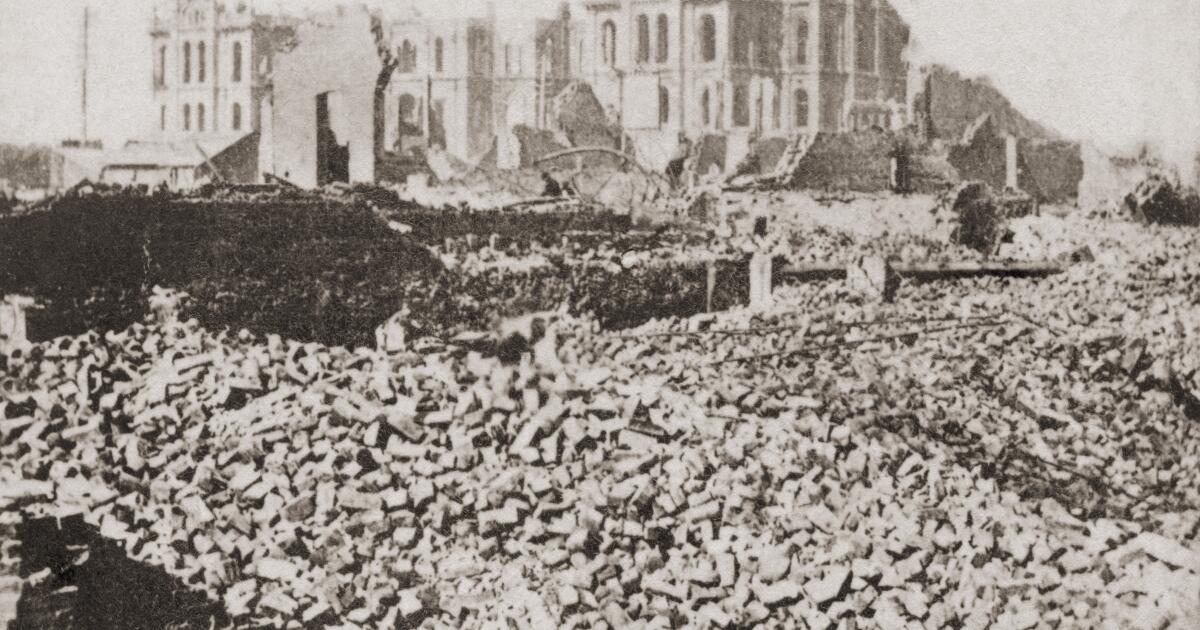
Before 15 out of California’s 20 most destructive fires on record, Hensler described large chunks of cities burning to the ground, insurance companies jacking up premiums after realizing they wildly underestimated the risk and politicians failing to enforce the few fire safety rules on the books.

He even describes the fire chief of a decimated city criticizing city its politicians for failing to properly prepare for such a disaster, resulting in the city ousting the chief. (Sound familiar, Palisadians?)

Yet Hensler wasn’t trying to predict what would unfold in California’s wildland-urban interface in the 21st century. He was simply telling the story of the late 1800s and early 1900s in the Eastern U.S.’ downtowns of dense, wooden buildings.

Spoiler: Firefighters, policymakers, local advocates and, notably, insurance professionals figured out how to stop it from happening. Here’s how they did it.

You’re reading Boiling Point

The L.A. Times climate team gets you up to speed on climate change, energy and the environment. Sign up to get it in your inbox every week.

The Industrial Revolution, supercharged by the Civil War, transformed Northeastern cities into denser and denser wooden tinderboxes filled with tons of humans more than capable of accidentally generating sparks.

Fire departments, inspired by the war, were already reorganizing under a new paramilitary structure to more quickly and aggressively respond to blazes although most were still primarily volunteer-based. And beyond a few ad hoc fire safety laws that were scarcely enforced, cities’ building codes and water infrastructure naively lagged far behind the threat cities were creating.

So, cities started burning.

In 1866, a Fourth of July firecracker burned down much of Portland, Maine.

The destruction — more than $240 million in damage in today’s dollars — seriously spooked insurance companies focused on downtown industrial properties. Within days, they joined together to form the National Board of Fire Underwriters to try to stabilize their industry and promote fire-safety measures.

It wasn’t enough. A barn fire burned down Chicago in 1871 — more than $4 billion in damage in today’s dollars. A warehouse fire burned down Boston the next year — causing more than $1 billion in damage.

After the Boston fire, the board raised rates by 50% in large cities and began hurling ham-fisted threats to pull coverage altogether if cities didn’t get their act together and address their tinderbox problems quickly.

Over the next few decades, the board slowly got its own act together: It began collecting data on what caused cities to burn and funded a lab to run experiments. After Baltimore burned in 1904, the board released its own national fire-safety building codes based on that knowledge and created a grading scale to identify the risk of different cities based on their fire departments and water utilities as well as how closely their building practices aligned with the board’s building and electrical codes.

For politicians who dragged their feet because bolstering a water system or fire department is costly and designing a fire-safe building is, quite frankly, more cumbersome, the grading system made maintaining the status quo no longer viable — try explaining to your constituents that insurance rates in town are through the roof simply because the city won’t adopt the board’s new codes.

At some point, cities no longer burned down, only blocks or buildings did. As fire departments and cities continued to adopt new tech (with some pushing from the insurance industry) — motorized fire engines to replace horse-drawn ones, and later, smoke detectors and indoor sprinklers, then air tanks that allowed firefighters to enter buildings — fires didn’t often spread past a single floor or room.

These reforms, targeted mainly at commercial and industrial buildings in dense downtowns, largely missed the looming crisis in suburban residential areas that were slowly building themselves into a different kind of tinderbox that burned from the outside in.

In those areas, we’ve already seen many of the same dynamics play out: first the insurance rate hikes, then the cancellations. Now, some conversations and many heated debates — often driven by the insurance industry — are taking place around what we ought to do to protect our urban-wildland interface areas and how we can make them insurable again.

Organizations such as the Institute for Business & Home Safety play the role of the National Board of Fire Underwriters. Insurance wildfire models are starting to play the role of the grading scale, and policies such as Zone Zero, the national building codes.

As Hensler wrote in 2011, we now “accept building fires as commonplace but no longer expect them to consume adjacent buildings or blocks.”

It reminds me of a text Keegan Gibbs, who leads the Community Brigade program with the Los Angeles County Fire Department, sent me when I asked what he hopes to see in 10 years’ time: “neighborhoods where wildfire can move through the landscape without becoming a community-level disaster.”

More recent wildfire news

State Farm reached a deal with California last month to keep a 17% rate hike that took effect after the 2025 L.A. County fires, my colleague Paige St. John reports. The state initially rejected State Farm’s 22% rate hike request but eventually offered a temporary approval of the 17% hike last year. State Farm — which said it paid $6.2 billion in claims last year, largely from the L.A. County fires — said the increase enables the company to continue serving Californians.

A monthlong heat dome over the American West, fueled by climate change, has melted mountain snowpacks significantly this year, writes fellow Boiling Point host Ian James. With more time for vegetation to dry out, the early melting brings an increased risk of wildfire across the region this year.

In fact, acreage burned this year is nearly triple the 10-year average, reports Tim Casperson of newsletter the Hotshot Wake Up. The uptick has been fueled by a series of fires in Nebraska that has stunned many of the state’s ranchers as it decimated the hay that cattle rely on and stressed pregnant cows, reports Anila Yoganathan at the Flatwater Free Press.

A few last things in climate news

The U.S. Forest Service announced a major reorganization effort Tuesday that will move its headquarters from Washington to Salt Lake City, close research and development facilities in more than 30 states and shift management from broader regional offices to more localized state offices, reports Christine Peterson for High Country News. Former Forest Service employees and tribal leaders expressed concern that the move would uproot thousands of employees, scattering specialized regional knowledge. The chief of the Forest Service said the plan is intended to make the agency more “nimble, efficient, effective and closer to the forests and communities it serves.”

Gas prices in Los Angeles surged to $6 per gallon this week after the U.S. and Israel’s and the U.S.’s attack on Iran prompted the nation to close the Strait of Hormuz. However, California’s petroleum market watchdog is warning that some of the inflated price may be due to price gouging, my colleague Blanca Begert reports. In January, refineries were making 49 cents on the gallon, the watchdog group said; now, it’s closer to $1.25.

Honda is scrapping plans to build and sell three new electric-vehicle models in the U.S. after the Trump administration abandoned Biden-era policy goals to increase EV manufacturing and adoption, Dan Gearino reports for Inside Climate News. It comes after similar moves by Ford and Ram.

Finally, Heatmap News, in collaboration with MIT, has launched a new tool tracking electricity prices across the country on a month-to-month basis all the way down to the Zip Code level. You can check it out here.

This is the latest edition of Boiling Point, a newsletter about climate change and the environment in the American West. Sign up here to get it in your inbox. And listen to our Boiling Point podcast here.

For more wildfire news, follow @nohaggerty on X and @nohaggerty.bsky.social on Bluesky.

Source link

Inside the Tour Guide murder and how a TikTok post solved the case

The TikTok Killer is currently streaming on Netflix and tells the shocking case of the murder of Esther Estepa, 42, and how the social media platform helped piece the tragedy together

Netflix’s chilling true crime documentary The TikTok Killer tells the horrifying story of 42-year-old Esther Estepa, whose final days were pieced together through TikTok videos, messages, and digital clues. It’s the kind of nightmare ripped straight from a thriller film – but Netflix ’s chilling true-crime documentary The TikTok Killer tells a story that is horrifyingly real.

The two-part series explores the murder of 42-year-old Esther Estepa – and the suspect at the centre of it, convicted killer-turned-TikTok influencer José Jurado Montilla. What unfolds is a disturbing case of deception, digital footprints and a man who appeared to be hiding in plain sight.

At the heart of the story is Esther – a free spirit with a love of travel. Raised in Seville, she left her hometown in 2013 to “spread her wings,” living a nomadic lifestyle across Spain while remaining incredibly close to her family – especially her mother, Josefa “Pepa” Pérez. They spoke every single day.

READ MORE: ‘I intervened in a London mugging and was praised in parliament but one thing must change’READ MORE: The Mean Girl Murders: Inside the terrifying murder of schoolgirl Skylar Neese by her friends

By 2022, Esther was trying to rebuild her life after leaving an allegedly abusive relationship. For a time, she stayed in women’s shelters across Spain, determined to start again. In August 2023, Esther met Montilla.

According to his account, the pair met at a hostel in Alicante and bonded over their shared nomadic lifestyle. They travelled together along Spain’s east coast, hiking for days and eventually reaching Gandía, near Valencia, around August 20.

He claimed their hiking journey ended when Esther became unwell, suffering from a swollen leg and severe headache, and that he accompanied her to a health centre before she left to meet friends. He insisted that was the last time he saw her.

Ensure our latest headlines always appear at the top of your Google Search by making us a Preferred Source. Click here to activate or add us as your Preferred Source in your Google search settings.

On August 23, 2023, Esther’s mother received a string of bizarre WhatsApp messages. The texts claimed Esther was broke, living on the streets in Argentina and planning a new life in Buenos Aires. But Pepa immediately sensed something was wrong.

“She didn’t have any friends there,” she says in the documentary. “It made me doubt that it was her writing it.” When she tried to call, Esther’s phone went straight to voicemail.

Even more chillingly, Esther had left behind her beloved dogs – something her family insist she would never have done voluntarily. Suspicious and frightened, Pepa demanded a voice note; otherwise, she would go to the police. None came.

After that, contact stopped completely. On August 26, Esther was officially reported missing. Then came the phone call that would change everything. Out of the blue, Montilla contacted Esther’s family, claiming he last saw her on August 21 when she left to meet friends for a job in Castellón.

But instead of stepping back, he did something deeply unsettling. He kept calling. Asking about the investigation. And, most bizarrely of all, he began retracing their journey – posting videos about it on TikTok.

To Esther’s family, alarm bells rang. What ultimately began to shift the case was something distinctly modern. Investigators began analysing Esther’s digital footprint, alongside Montilla’s own online activity. TikTok videos, messages and geolocation data allowed police to reconstruct her final movements in remarkable detail.

Crucially, his own posts placed him with Esther – effectively documenting key moments himself. Director Héctor Muniente describes becoming transfixed by the footage, noting Montilla’s ability to switch emotions instantly – from warm and engaging to cold and detached.

“It feels like watching psychopathy unfold in real time,” he suggests. For months, the case appeared to go cold. Then came a grim breakthrough.

Partial human remains – including a skull – were first discovered in a remote area near Gandía, close to Bairén Castle and a canal junction in February 2024. At the time, their identity was unknown.

It wasn’t until June 21, 2024, when further remains were found in the same location, that the full horror became clear. DNA testing later confirmed they belonged to Esther Estepa. Medical experts concluded she had died from blunt force trauma to the head.

As suspicion grew, a far darker picture of Montilla emerged. The man who had presented himself as a reflective travel influencer had, in fact, spent decades behind bars for a string of brutal killings in the 1980s in the Málaga region.

Between 1985 and 1987, he carried out four murders. For these crimes, he was sentenced to 123 years in prison. However, he was released in December 2013 after serving 28 years, following a European Court of Human Rights ruling on Spain’s “Parot Doctrine,” which changed how sentencing reductions were applied.

By the time Esther’s remains were identified, Montilla was already in custody. He had been arrested in connection with the murder of a 21-year-old student in Málaga, who was found shot in the back and neck on a family farm. DNA found on the victim’s backpack ultimately linked back to his family tree.

Prosecutors now allege that evidence recovered from his phone connects him to Esther’s assault and murder, including chilling photos and videos of a woman’s body hidden inside a sleeping bag in a remote field.

Despite this, he denies any involvement. Investigators also relied heavily on digital evidence throughout the case – not just Esther’s data, but Montilla’s own social media activity, which helped place him with her.

As of March 2026, José Jurado Montilla remains behind bars in Spain, awaiting trial for the murders of Esther Estepa and a 21-year-old man in Málaga — allegations he continues to deny.

It is a case study in manipulation — and a chilling warning about trusting online personas. A man who appeared calm, reflective and charismatic on screen, while allegedly committing acts of extreme violence, and someone who built a false, carefully curated online identity.

Perhaps the most unsettling aspect of The TikTok Killer is how ordinary everything appeared on the surface. He wasn’t hiding. He was posting videos. Gaining followers. Telling stories. All the while, investigators allege, concealing a far darker reality.

For Esther’s loved ones, this is more than a documentary. It’s a fight for answers. They became investigators themselves – analysing footage, tracking movements and refusing to let her story disappear.

But questions remain. What really happened in those final hours? And could there be more victims? Because while José Jurado Montilla documented his journey online, Esther Estepa was unknowingly living out her final days.

And for her family, the truth that followed was more devastating than they could ever have imagined.

The TikTok killer is available to stream on Netflix now.

Like this story? For more of the latest showbiz news and gossip, follow Mirror Celebs on TikTok , Snapchat , Instagram , Twitter , Facebook , YouTube and Threads .


Source link