solar

Qcells targets U.S. AI power demand with solar project

Atlas Energy Park, a solar and energy storage complex Qcells is building in Arizona. Photo courtesy of Qcells

July 10 (Asia Today) — Qcells is accelerating its push into the North American renewable energy market as investment in power infrastructure grows rapidly amid the expansion of artificial intelligence data centers in the United States.

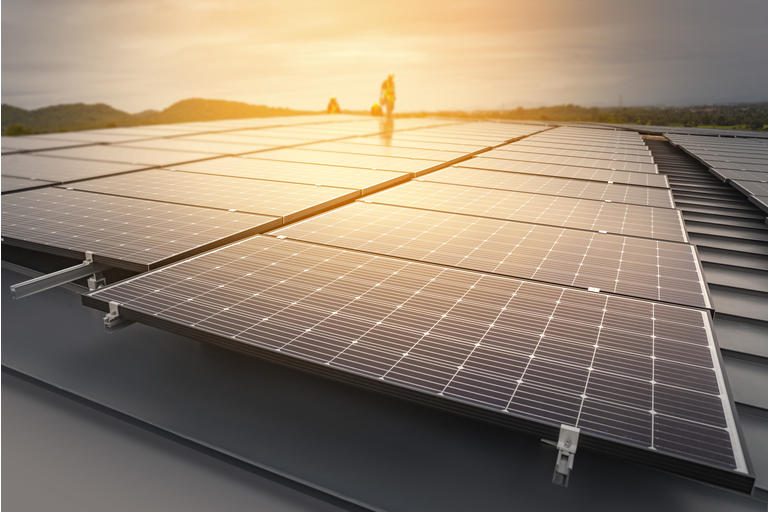
The Hanwha unit said Friday it will handle engineering, procurement and construction for Atlas Energy Park, one of the largest solar and energy storage complexes in the United States. The project will be built in La Paz County, Ariz.

Atlas Energy Park will include 2.8 gigawatts of solar generation capacity and 5.7 gigawatt-hours of energy storage capacity by 2028. The complex will consist of 14 solar and energy storage projects and cover an area about 22 times the size of Yeouido, Seoul’s main financial district.

Qcells will handle engineering, procurement and construction for all projects in the complex and supply all solar modules.

The company completed the sale in May of two solar power plants with a combined capacity of 357 megawatts after carrying out their early-stage development and construction. The deal is seen as evidence that Qcells has expanded beyond equipment supply into project development, construction and asset sales.

The company’s competitiveness is backed by its U.S. supply chain. Qcells operates Solar Hub, a solar manufacturing complex in Georgia, giving it module supply capacity. It has also built a supply chain for energy storage equipment.

Industry analysts say companies with U.S. production bases are gaining a stronger advantage as Washington expands policies favoring domestically made equipment.

Analysts also expect Qcells’ expansion in North America to help improve earnings. Hana Securities projected Hanwha Solutions’ second-quarter operating profit this year at 230.7 billion won, about $153 million, roughly 29% above market consensus.

“The oversupply of solar modules in the United States is easing, and prices are continuing to rise, while the expansion of local production capacity in the United States will drive earnings improvement,” said Yoon Jae-sung, an analyst at Hana Securities.

Analysts say AI will further accelerate growth in renewable energy demand.

“Power demand is structurally increasing because of AI data centers, electrification and manufacturing reshoring, making solar power and energy storage key pillars of global power infrastructure,” said Han Byung-hwa, an analyst at Eugene Investment & Securities. “In particular, rising power consumption by AI data centers will continue to increase demand for large-scale projects combining solar power and energy storage.”

Qcells has completed or is pursuing more than 11 gigawatts of solar and more than 6 gigawatt-hours of energy storage projects in North America, expanding its local business base.

“Atlas Energy Park is a symbolic project that once again demonstrates Qcells’ EPC capability, U.S. supply chain and comprehensive business capacity from development to construction and asset sales,” said Chris Hodrick, head of Qcells’ EPC business division.

“We will lead the growth of the North American renewable energy market by increasing customer value and business competitiveness through integrated solutions that combine solar power and energy storage,” Hodrick said.

— Reported by Asia Today; translated by UPI

© Asia Today. Unauthorized reproduction or redistribution prohibited.

Original Korean report: https://www.asiatoday.co.kr/kn/view.php?key=20260710010003926

Source link

South Korea’s Shinan turns solar profits into resident pensions

Solar panels stand at the Anjwa Solar City power plant in Shinan County, South Jeolla Province, on Friday. The county distributes part of the project’s profits to residents through local cooperatives under its Sunlight Pension program. Photo by Asia Today

June 15 (Asia Today) — Salt-damaged farmland once unsuitable for either agriculture or aquaculture has become a source of pension income for residents of islands in southwestern South Korea.

Shinan County in South Jeolla Province operates what it calls a “Sunlight Pension,” sharing part of the profits from solar power projects with local residents. The program is regarded as a social economy model that connects large-scale renewable energy infrastructure with household income and local spending.

The county began distributing the pension on Anjwa and Jara islands in 2021 under a renewable energy profit-sharing program. It has since expanded the program to Jido, Saokdo, Imjado and Bigeumdo.

Under the program, part of the profits generated by solar power projects is distributed to residents through local cooperatives.

South Korea’s Ministry of the Interior and Safety regards the Shinan program as a social economy model that converts local resources into resident income while keeping spending within the community. The program brings residents, local government and private businesses together to ensure that some profits from power generation remain in the region.

The model is also consistent with the national government’s initiative to create “Sunlight Income Villages,” where communities receive income from renewable energy projects.

Shinan County enacted an ordinance in 2018 establishing a system to share profits from renewable energy development with residents. Residents do not directly pay the cost of building the power plants. Instead, resident cooperatives participate in the projects and receive dividends from the resulting revenue.

The dividends are paid through local gift certificates, encouraging recipients to spend the money within Shinan County.

“Existing residents are guaranteed dividend benefits, while benefits for new residents vary according to age to encourage younger people to move here,” a county official said. “New residents age 40 or younger are eligible immediately, without a waiting period.”

The program has produced measurable results.

Renewable energy development dividends generated cumulative revenue of 24.71 billion won, or about $16.1 million, between April 2021 and April 2025. Of that amount, 22.32 billion won, or about $14.6 million, was distributed through the Sunlight Pension.

An additional 2.39 billion won, or about $1.6 million, was distributed as a Sunlight Child Allowance for residents younger than 18.

Of Shinan County’s 16,483 residents, 13,284 are members of participating cooperatives, representing a participation rate of 81%.

The Anjwa Solar City power plant serves as the foundation of Shinan’s Sunlight Pension model.

The facility has a combined generating capacity of 288 megawatts, consisting of a 96-megawatt first phase and a 192-megawatt second phase. The first phase began commercial operations in November 2020, followed by the second phase in January 2023.

Plant officials said the project cost about 560 billion won, or approximately $366 million. It generates annual revenue of between 80 billion won and 85 billion won, or roughly $52.3 million to $55.6 million.

The history of the site is also significant.

The land was originally used for farming but became unsuitable for both agriculture and aquaculture because of salt damage and years of use as fish farms. A 2019 revision to South Korea’s Farmland Act allowed salt-damaged farmland to be used temporarily for other purposes, clearing the way for the solar project.

The land is scheduled to be restored to farmland after the solar facilities cease operations.

Anjwa Solar City is considered a leading example of South Korea’s resident-participation renewable energy profit-sharing system. Large solar projects can generate local opposition when residents receive few tangible benefits, making the profit-sharing structure a central element in securing community acceptance.

The Shinan model, however, may be difficult to reproduce in every region. Large renewable energy projects require several conditions, including government approval, resident consent and access to transmission infrastructure.

Project profitability and local acceptance must also be considered to maintain a stable dividend system.

“The Sunlight Pension was designed to ensure that development profits remain with residents and circulate within the community,” the county official said. “We plan to expand the profit-sharing program beyond solar power to offshore wind and other renewable energy projects.”

— Reported by Asia Today; translated by UPI

© Asia Today. Unauthorized reproduction or redistribution prohibited.

Original Korean report: https://www.asiatoday.co.kr/kn/view.php?key=20260615010005065

Source link