slows

China injects over €45 billion into state banks and insurers as growth slows

Beijing has reached for its chequebook.


ADVERTISEMENT


ADVERTISEMENT

The Chinese finance ministry is advancing a 360 billion yuan (€46.1bn) package to businesses, announced on Sunday through statements from the companies involved and reported by state news agency Xinhua, making it one of the larger interventions in China’s financial system this year as growth slows.

The Chinese banks take the bulk of it, roughly 290 billion yuan (€37.2bn), intended to preserve their capacity to keep lending as Beijing presses them to increase support for economic activity.

Xinhua reported the injection would strengthen the institutions’ “sound operating capabilities, risk resistance capabilities and ability to serve the real economy.”

The Agricultural Bank of China is pursuing a private placement of A-shares worth up to 160 billion yuan (€20.5bn) and the Industrial and Commercial Bank of China up to 100 billion yuan (€12.8bn), with the finance ministry among the investors.

Unusually, so is the China National Tobacco Corporation, which operates the state tobacco monopoly and the Export-Import Bank of China which will receive 30 billion yuan (€3.85bn).

Insurers account for the remaining 70 billion yuan (€9bn).

China Life Insurance Group, the country’s largest life insurer, gets 35 billion yuan (€4.5bn) and China Taiping Insurance Group 7 billion yuan (€900mn).

The People’s Insurance Company of China plans to raise up to 15 billion yuan (€1.9bn) through a private placement to the ministry, China Export and Credit Insurance Corporation receives 10 billion yuan (€1.28bn), and China Reinsurance Group is raising 3 billion yuan (€385mn).

Insurers have been squeezed from two directions as years of low interest rates have eroded investment returns, while the government has directed them to put money into Chinese equities.

The currency has been moving in the same direction.

The Chinese yuan reached its strongest level against the US dollar since January 2023 on Monday, trading at around $0.149, a firmer exchange rate that also happens to blunt a long-standing American complaint about Chinese currency management, weeks before talks in Washington.

Beijing’s busy month

The capital injection is not the only move Beijing is making this month.

Chinese President Xi Jinping is reportedly preparing to bring a large delegation of business executives to his Washington visit on 24 September, according to sources cited by news agencies.

It would be a notable departure from customary practice.

Xi rarely travels with corporate leaders, many of whom lost standing after the regulatory crackdowns on technology, education and property that began in 2020, and the last comparable delegation accompanied him to the US more than a decade ago, in 2015.

Washington’s response has also been curious.

“The White House is not tracking a Chinese CEO delegation,” a US official said, without explaining what tracking meant in this context, leaving the statement short of either confirmation or denial.

The gesture would be reciprocal in any case.

When US President Donald Trump visited Beijing in May, he brought a roster of American CEOs including Elon Musk, Tim Cook and Jensen Huang. Bringing Chinese counterparts to Washington would signal a willingness to invest and trade with the US, while handing the White House potential economic wins before November’s midterm elections.

Expectations for the summit itself remain modest, with the two sides still divided over which products should count as non-sensitive under trade arrangements.

US Treasury Secretary Scott Bessent, US Trade Representative Jamieson Greer and Chinese Vice Premier He Lifeng are due to meet in early September to work on deliverables.

Source link

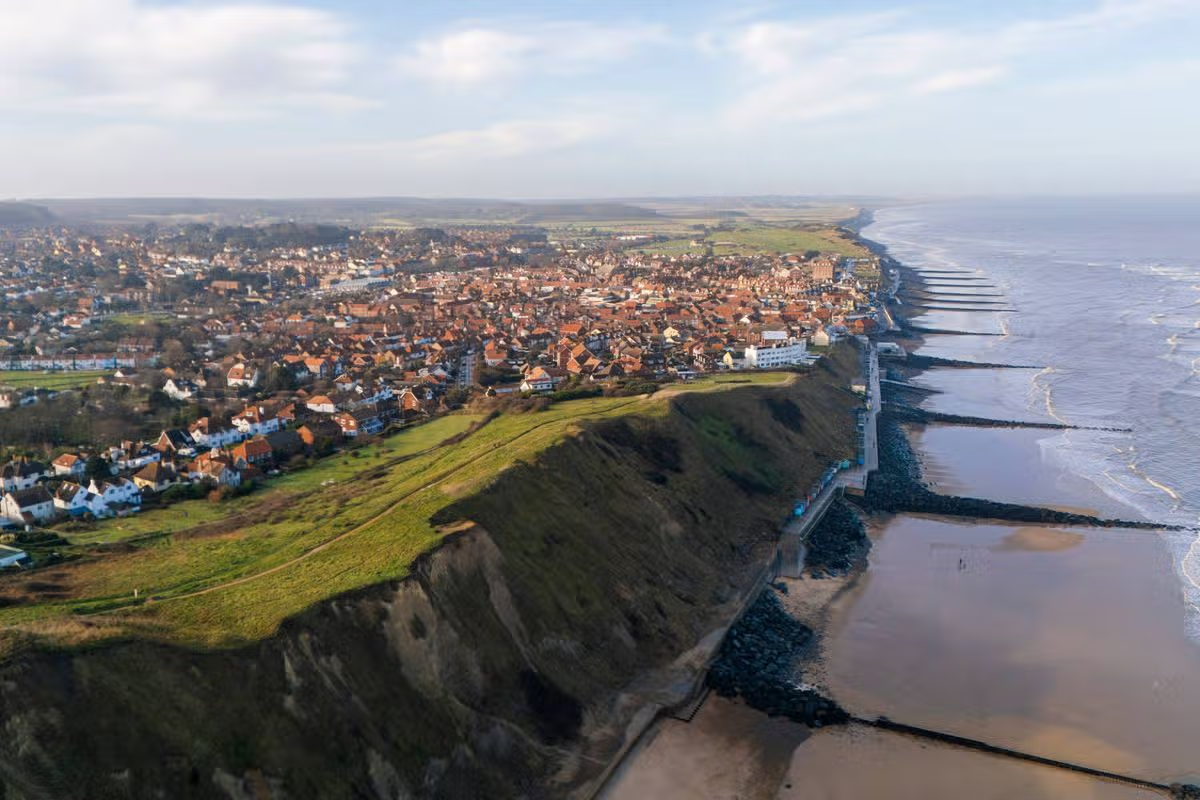
‘Cosy’ UK seaside town where ‘time slows down’ with longest chalk reef in the world

A woman has shared a video of her trip to a charming seaside town, where she said ‘time slowed down’ and visitors feel like they’ve stepped back in time

One Norfolk spot is one of those classic British seaside towns that has managed to hold on to its old-school charm. Set on the North Norfolk coast, it offers far more than just a day at the beach, with historic attractions, independent shops, local food and plenty of scenic walks.

A surprising attraction in Sheringham is hidden beneath the waves. The Cromer Shoal Chalk Reef, which runs along the coast just offshore, is described by North Norfolk tourism authorities as the longest chalk reef in the world, stretching for around 20 miles.

Sheringham sits along the coastline, just an hour’s drive north of Norwich.

At first glance, it might seem fairly ordinary, with a population of just 7,100 residents, according to the 2021 census. But most visitors quickly change their minds, with countless tourists claiming they feel as though they’ve stepped back in time upon arriving in this delightful town.

There’s no shortage of things to do, with an award-winning beach, breathtaking nature and parks to explore, as well as local and military museums to visit, reports the Express.

A traditional seaside beach

Sheringham’s Blue Flag beach is a big draw, with a long promenade, colourful beach huts and plenty of space to enjoy the coastline.

At low tide, patches of sand appear between the pebbles, while the rocky shoreline is ideal for rock pooling. The town has a much more traditional seaside feel than some of Britain’s busier resorts, with fishing boats, cafés and independent shops lining the streets rather than rows of large amusement attractions.

Ride a steam train

One of Sheringham’s best-known attractions is the North Norfolk Railway, also known as the Poppy Line.

The heritage railway runs between Sheringham and Holt, taking passengers through the Norfolk countryside on restored historic trains. With its old-fashioned stations and steam locomotives, it’s a particularly appealing way to see the surrounding area and adds to the town’s nostalgic charm.

A fishing town at heart

Sheringham’s roots can be traced back to its days as a fishing village, and that heritage is still visible today. Small fishing boats continue to operate from the town’s slopes, with crab and lobster among the catches associated with the area.

For anyone wanting to find out more about the town’s past, Sheringham Museum is well worth a visit. Its collections explore everything from fishing and farming to local life and the lifeboat service, alongside fossils and prehistoric discoveries from the surrounding coastline.

Taking to TikTok, one woman decided to share her experience of visiting the charming coastal town, describing it as a place ‘where time slowed down’.

“Sheringham – a cosy seaside town where time slows down. Colourful cottages, fresh sea breeze, and the sound of waves – it’s the kind of place that makes you want to stay a little longer,” she wrote in the caption of the video.

She went on to post her clip, which opened with a woman, dressed in a blue dress and wearing a sunhat, strolling along the platform at the train station. The footage was filmed from inside a vintage train, which immediately created the sensation of having stepped back in time.

The TikTok creator went on to share brief clips from their visit to Sheringham, highlighting the delightful high street decorated with colourful bunting strung above, before capturing a procession of older women dancing and parading through the town centre.

They then shifted their focus to the beach, where visitors were enjoying the scenery and taking part in various activities in the blue waters, despite the grey skies above.

Viewers were quick to rush to the comments section to share their thoughts, with many expressing their joy at how peaceful and beautiful the Norfolk town looked.

“I love Britain one of my favourite countries,” one person wrote.

Another viewer said: “This is not just a video. It’s like opening up to a brand new dimension of extraordinary power!”

Source link

Walmart shares fall as comparable sales growth slows

Customers at a Walmart on Nov. 28, 2013 in Alexandria, Va. Shares of Walmart fell more than 9% after the retailer reported the lowest quarterly comparable sales growth since 2020. File Photo by Michael Reynolds/EPA-EFE

Aug. 20 (UPI) — Walmart on Thursday reported sales grew at their slowest pace in the retailer’s latest fiscal quarter in six years, sending its shares down more than 9%.

In the second quarter ended July 31, comparable sales in the US, including stores and digital channels open for at least a year, were 2.6%, the smallest advance since 2020, Walmart said.

“Customers tell us they’re still feeling some pressure,” Walmart CEO John Furner said on an earnings call with analysts.

Walmart blamed the disappointing sales growth partly on new federal rules on drug pricing that cut the prices of several costly medications for those enrolled in Medicare.

The company is also anticipating at least $2 billion in extra costs this year from higher gasoline prices due to rising oil prices due to the U.S.-Israeli war with Iran.

As the national average for a gallon of regular gasoline has risen to $4.10 from $2.98 and inflation spiked to 3.4% from 2.4% before the conflict, Walmart said consumers are making adjustments.

“As you go through month by month in the last quarter, you can tell when fuel prices increased and got above $4, and perhaps there’s a psychological impact to that, that there are choices that consumers are making,” Walmart finance chief John David Rainey told analysts. “It’s why we have leaned so heavily into lower prices.”

Meanwhile, Walmart said it has seen gains as more affluent customers trade down as their budgets tighten.

For the full year, Walmart expects net sales to rise 4% to 5%, up from 3.5$ to 4.5% previously. Operating income is expected to rise 7.5% to 8.5%, up from an earlier view for 6% to 8%.

Rainey told CNBC that Walmart is eligible for tariff refunds of around $2.9 billion, and it has yet to receive nearly $100 million of that. He said the funds would be used to lower prices.

Source link

Japan’s economy slows, missing growth forecasts | Business and Economy

GDP rises 0.3 percent in the second quarter as consumption and capital spending sag.

Japan’s economy has slowed in the second quarter of the year amid moribund consumption and capital spending, according to official figures.

Gross domestic product (GDP) grew 0.3 percent in the April-June period from the first quarter, data released by Japan’s Cabinet Office on Monday showed. It was the third consecutive expansion but was down from 0.5 percent growth in the previous quarter and missed the 0.5 percent growth analysts had forecast.

Recommended Stories

list of 4 itemsend of list

On an annualised basis, the world’s fourth-largest economy expanded 1.1 percent.

A survey of 37 economists conducted by the Japan Center for Economic Research, a think tank, had forecast an annualised expansion of 1.67 percent.

Private consumption was flat in real terms while capital expenditures fell 1.2 percent, or 4.6 percent on an annualised basis, offsetting strong exports, according to the data.

Broken down by component, net exports contributed 0.5 percentage points to GDP growth while domestic demand accounted for negative 0.2 percent.

Norihiro Yamaguchi, lead economist for Japan at Oxford Economics, said he expected growth to be sluggish in the second half of 2026 as companies pass rising energy costs on to consumers.

“Although AI-related goods exports will continue to stay robust in the near term, sluggish non-AI-related global economic activities will limit overall export gains,” Yamaguchi said in a note to clients.

Japan imports almost all of its crude oil needs, leaving it exposed to elevated energy costs stemming from the fallout of the United States-Israel war on Iran.

Cost pressures on Japan’s consumers have been exacerbated by the weakness of the Japanese yen, which last month hit a 40-year low against the US dollar.

The weaker-than-expected growth figures could complicate the Bank of Japan’s (BOJ’s) upcoming decision on interest rates in September amid its push to normalise monetary policy after decades of ultra-low and negative borrowing costs.

The BOJ in June raised its benchmark interest rate to 1 percent, its highest in more than three decades.

The central bank began to move away from an ultra-loose policy in 2024 when it announced its first rate hike since the 2008 global financial crisis.

Japan’s stock market rose on Monday with the benchmark Nikkei 225 up 0.3 percent as of 05:15 GMT.

South Korea and Hong Kong’s markets also made gains with the KOSPI up 2.4 percent and the Hang Seng Index 1.6 percent higher.

Source link