The top trending travel destinations for 2027 according to Expedia – and one UK location features among the top holiday spots
14:23, 14 Oct 2026Updated 14:25, 14 Oct 2026
Discover the top bucket list destinations for 2027(Image: Getty Images)
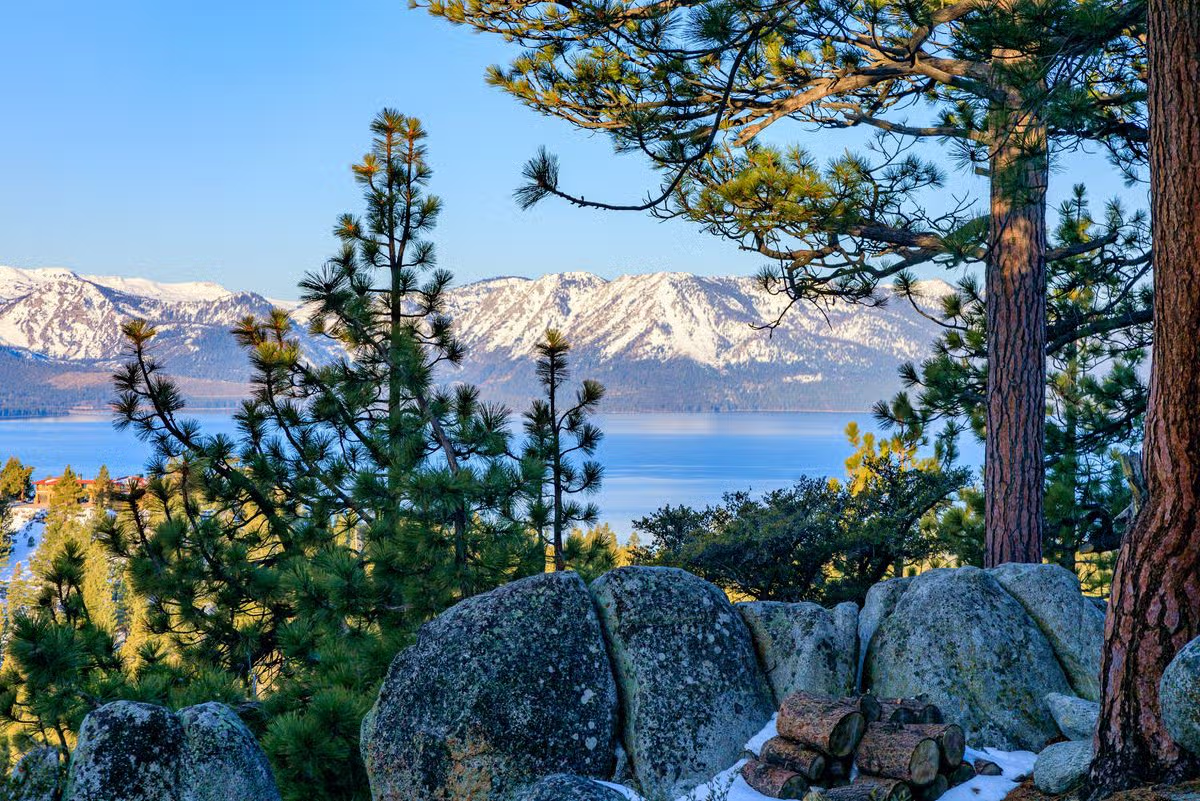
The hottest holiday destinations for 2027 include South Lake Tahoe in California, Hyogo in Japan and Punta del Este in Uruguay, according to Expedia Group.
The global marketplace has analysed flight and accommodation search data to pinpoint where traveller interest is soaring. Between 1 September 2025 and 27 July 2026, compared to 1 September 2024 to 27 July 2025, searches for “South Lake Tahoe” in California, USA, jumped by 195%.
The resort city nestled in the Sierra Nevada mountains is described as ideal for adventure seekers and outdoor enthusiasts, offering everything from skiing to picturesque hiking trails. Coming in second place is Hyogo in Japan, with searches climbing 95%, while Punta del Este, Uruguay secured third spot, with searches rising 65%.
The destinations form part of Expedia and Hotels.com’s “Unpack’27: The Trends in Travel” report, which details the destinations and travel behaviours expected to shape the year ahead.
Other locations making the top 10 include Sedona, Arizona, USA (up 55%), Busan, South Korea (up 50%) and Holbox, Mexico (up 45%). Perugia, Italy (up 35%), The Tweed, New South Wales, Australia (up 35%), Niagara-on-the-Lake, Canada (up 35%) and Chichester, UK (up 30%) also made the list.
CEO of Expedia Group Ariane Gorin said: “Travel is about creating memories, and Unpack ’27 uncovers the destinations and experiences shaping those moments.
“In 2027, travellers are being more intentional in choosing their next adventure, seeking experiences that are more personal and purposeful to them.”
The report from the global marketplace also surveyed 26,000 respondents worldwide, including 2,000 from the UK, all of whom have previously been on holiday and plan to do so within the next three years.
Adults from 16 countries took part – including the UK, USA, New Zealand, Singapore, Australia, Brazil, Canada, Germany, Denmark, France, Hong Kong, Japan, South Korea, Mexico, Norway and Sweden.
Both the research and search data were used to determine 2027 travel trends, including the ‘2027 Destinations of the Year’, ‘Un-Adulting’, ‘Trip Snacking’, ‘Gothic Getaways’ and ‘The 2027 Set-Jetting Forecast’.
‘Un-Adulting’ emerged as a standout trend, with 57% saying they are “likely” to book an over 18s trip to an amusement park next year, a figure that climbs to 71% amongst Gen Z and Millennials.
For UK travellers in particular, these trips are all about having fun and enjoying a carefree day out (74%) and spending quality time with their partner, friends or other loved ones (64%). Escaping the pressures of everyday responsibilities (60%) also plays a significant role.
The ‘Trip Snacking’ trend has come to light as searches on Hotels.com for one-night stays between Thursday and Sunday soared by nearly 10% over the past 12 months compared to the previous year . The poll revealed that 79% of travellers are planning to book a one-night stay in the coming year, with this figure climbing to 83% amongst Gen Z and Millennials.
The surge in popularity is driven by a desire to attend concerts, shows and sporting events (49%), to mark life milestones (42%) and to enjoy a break between ‘normal’ holidays (23%).
‘Gothic Getaways’ have also emerged as a major trend, with 65% of respondents expressing a specific interest in booking a Gothic-style hotel in 2027 – rising to 71% amongst Gen Z and Millennials. Some 56% have previously chosen hotels purely for their atmosphere or aesthetic.
Amongst the 54% of UK travellers keen on booking a Gothic-style hotel in 2027, 51% favour historic hotels, castles, or properties steeped in a rich past.
Furthermore, 41% are drawn to destinations associated with folklore, legends or the supernatural, while 40% find the dramatic architecture and striking visual atmosphere of Gothic-style hotels particularly appealing.
Finally, ‘The 2027 Set-Jetting Forecast’ comes as searches for Monaco soared by more than 120% in the 30 days after Emily in Paris season six was confirmed to be filming there.
It also emerged that 18% have booked a trip to a destination after seeing it featured on television or in films.
Meanwhile, 46% of those who watch TV or films have researched or booked trips to locations featured in yet-to-be-released shows and films – rising to 58% amongst Gen Z and Millennials. On average, UK respondents said they would splash out £600 to visit a set location – rising to £629 for those with children in tow.
Gorin added: “We’re making it easier to discover, plan, and book the right trip, so travellers can spend less time managing the details and more time enjoying the moments that matter.”
A DREAMY cottage in the highlands is a perfect destination to escape for a retreat.
It can also be a base for an action-packed family adventure break – with dolphin spotting among the highlights. Janice Hopper reveals all…
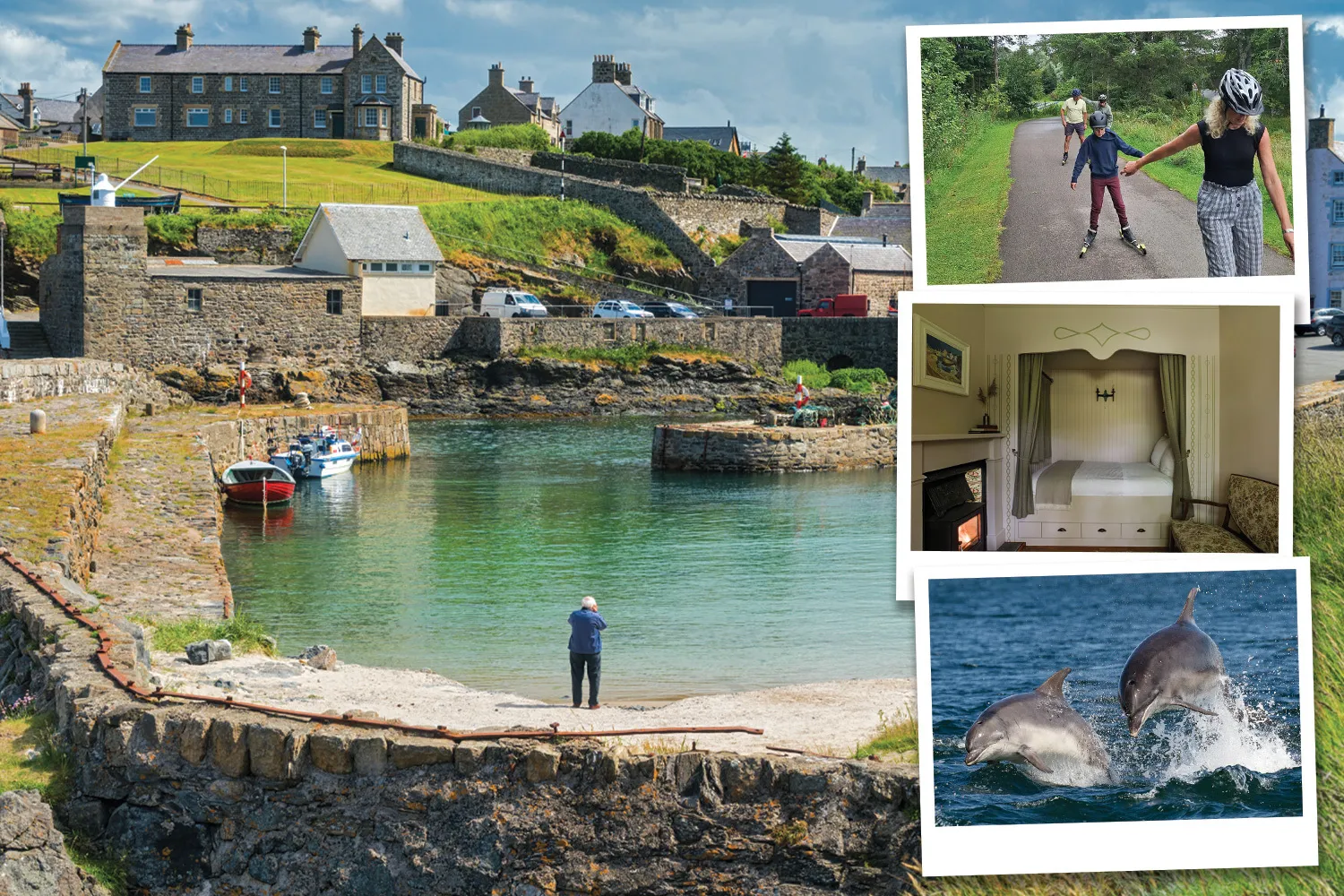
Janice and her family seen roller-skiingCredit: Supplied by Janice HopperPortsoy Harbour is a historic location famous for being rich in salmonCredit: Getty Images
With our feet strapped into boots atop skis with wheels, coach Logan advises us to glide just like him.
Our wobbly attempts at roller-skiing aren’t great, so we soon move on to cross-country skiing on the dry-slope matting instead, where my husband Eamon and our sons Samuel, 12, and Joseph, 11, and I do actually glide.
Sign up for the Travel newsletter
Thank you!
We’ve booked a family session at Huntly Nordic And Outdoor Centre, which ends with us all flinging ourselves, whooping and screaming, down a slope on rubber rings.
It’s a fun way to experience the Scottish hills. Three-hour activity sessions cost £18.15 per adult, £12.15 per child (Livelifeaberdeenshire.org.uk).
After all the exhilaration, it’s time to check into our two-bedroom cottage on the elegant Mayen Estate.
With a classy colour palette, the cosiest stove and a beautiful ”box bed” in the master, plus a fire pit and hot tub in the garden, Butlers Cottage is a gorgeous hideaway.
We task the boys with rolling out dough and sprinkling on the cheese and salami from our pre-ordered pizza kit, from £21, before popping it in the outdoor pizza oven as the sun starts to wane.
The next morning, we wake to the sound of Highland cows nearby, before taking a peaceful riverside stroll along the Deveron and exploring Mayen’s stunning two-acre Walled Gardens, open exclusively to holiday guests for £20 per cottage.
Our two-bed cottage is located on the elegant Mayen Estate, with it’s stunning two-acre Walled GardenCredit: Garden at Mayen Estate – Supplied by PRTry to spot the bay’s resident 200 bottlenose dolphins and the chance to listen to recordings of their callsCredit: Getty Images
It’s August, so everything is in full bloom as we wander through walkways of lavender, white lilies and glorious glasshouses.
Huntly is also home to a cinema, castle, shortbread factory and swimming pool, but we head to scenic Greenmyres Lochan for Canadian canoeing and standup paddleboarding, £28 per person for an hour and a half.
After peeling off our wetsuits, we reward ourselves with a Sunday roast at The Bank Cafe & Restaurant.
Here, choose your carvery meat and three sides, such as sticky red cabbage and macaroni cheese, for just £15, or seven sides for £21 (Thebankrestauranthuntly.com).
Buttery orange biscuits from Dean’s Shortbread, £2.49 (Deans.co.uk) and Irn Bru ice cream, £3 a scoop, from long-standing Rizza’s wrap up our day nicely (Rizzas.co.uk).
While Butlers Cottage is set amid rolling hills, the golden sands of Banff Bay are only half an hour away.
After wandering along the shoreline, we warm up with hot chocolate, £4.50, and a dainty Victoria sponge tower, £3.40, at Annie’s Cakery (Facebook.com/anniescakery7).
Butlers Cottage is a gorgeous hideaway and a perfect hub for a lazy or action-packed retreatCredit: Clare LouA beautiful ‘box bed’ in the cottage’s master bedroomCredit: Supplied by PR
Housed in the town’s former railway station, AKA The Platform, there’s a lovely homeware and fashion shop, too (Theplatform-macduff.co.uk).
Also close by is Portsoy, famous for its salmon. After learning more about the local catch at the free Salmon Bothy museum (Salmonbothy.org), we buy flavoursome smoked fillets, £4 each, from Messrs J Smith at the historic harbour to cook later, before hitting Spey Bay’s free Scottish Dolphin Centre, half an hour away (Dolphincentre.whales.org).
There are binoculars for trying to spot the bay’s resident 200 bottlenose dolphins and the chance to listen to recordings of their calls.
The local dolphins are considered the world’s “chubbiest”, thanks to their extra layers for keeping warm in the chilly waters.
We’re alright though, we have a hot tub to return to. . .
The stove is a feature of the cosy cottage – adding character to the holiday letCredit: Supplied by PR
AS someone with a fear of heights, dangling by a thin rope from a cable several hundred metres above a deep mountain valley is not on my bucket list.
But here I am, suspended 2,000ft up with nothing between me and the valley below (a situation that could soon change as I feel the pastries I had for breakfast make their way back up).
The Sun’s Colin Robertson tests out the mountain gondolaCredit: SuppliedAerial view of the skiing area of Paradiski, La PlagneCredit: Getty
I have reluctantly agreed to take part in the so-called Aerolive experience, which is essentially a gondola without walls.
“Aerolive invites you to slow down, take a deep breath and appreciate the sheer scale and beauty of the mountains,” teases the bumpf.
Sign up for the Travel newsletter
Thank you!
Heavenly stuff, but no one has told my pulse, which is going like the clappers as I gingerly step nearer the edge.
I watch in awe as my fellow daredevils lean out into the abyss and decide on a half in/half out strategy, which would typically be described as “chicken”.
Because yes, Aerolive is exhilarating and yes, the view is magical but my God it is also bloody terrifying.
This mountain masochism is the latest thing to do in La Plagne — a French ski resort which has spent millions installing the superfast gondola from which I now teeter, to whisk visitors up to the top of its 3,080m-high Roche De Mio mountain.
Of course, you don’t have to — literally — put your life on the line to get up here. Normal, sealed cabins are available.
And while Roche De Mio is most definitely the highest, it is just one of numerous peaks in this vast Alpine resort, with its 77 lifts, 143 pistes and 225km of skiing.
The Aerolive experience, which is essentially a gondola without wallsCredit: en.la-plagne.com/Daredevils lean out into the abyss and decide on a half in/half out strategyCredit: en.la-plagne.com/
That nearly doubles when you add the runs and lifts in neighbouring resort Les Arcs, which offer a combined 425km of pistes — the third largest ski area in the world.
You could spend a week here and not cover half the terrain, even if you bomb down a few slopes after hours on a sledge, which local ski firm Oxygene offers for around 40 euros.
I gave their so-called Superluge Derby a go and wow, it’s probably the fastest — and most out of control — you can go on these mountains.
Helpfully La Plagne is HIGH, with 70 per cent of runs above the treeline between 2,000m and 3,000m, which is perfect for a late break (I went in late March and conditions were ideal).
From the top of the highest runs, the views across the bowls are spectacular and there are plenty of big, wide runs.
And when your legs get tired, you are spoilt for choice for places to stop, from cosy chalet-style joints serving all the Savoie usuals — such as tartiflette and fondue — to more modest snack bars pumping out croque monsieurs.
So you don’t blow a hundred euros every lunchtime, I’d suggest nipping over to Plagne Bellecote, where cheaper snack bars abound but the view is still cracking.
If you do fancy spending a few bob and you can’t visit the mountains without a blast of electronic dance music, there is a Folie Douce-style bar on the way down to Plagne Village called La Bergerie.
The Ski Beat package delivered service that was first class, with top quality food also laid onCredit: SuppliedColin on the pisteCredit: Supplied
It’s a straight rip-off of the Val d’Isere original Folie Douce and features DJs, half-naked dancers and, of course, some dude on a saxophone.
Getting a big round in here is only for the brave, though. I bought three pints and am still paying off the credit card bill.
But it’s a good laugh for a quick stop and hey, you’re on holiday.
I stayed just down the hill from Bellcote in a Ski Beat chalet in one of La Plagne’s smaller satellite villages, Plagne 1800.
It’s a charming little place with a few bars and restaurants but most importantly, it’s about a five minute totter from the lifts.
This is my second year on a Ski Beat package and again the service was first class and the food top quality.
While Plagne 1800 is a sleepy hamlet, there is enough to keep you entertained if you’re not quite ready to turn in at 9pm.
I spent a few nights in the rowdy La Mine Bar, themed on a “traditional English pub” and it has made a pretty good fist of it.
You can watch Premier League matches here and neck a few proper pints but, with its wooden beams and Gore-Tex-clad clientele, you still feel like you’re in the Alps.
Bomb down a few slopes after hours on a sledge, which local ski firm Oxygene offers for around 40 eurosCredit: oxiski.comFor those who prefer a slightly more conventional gondolaCredit: Alamy
Musical acts take to the stage most nights and, depending on how smashed you are when you ask them, they’ll play requests.
The only, er, downside is you have to walk back up the hill when you’ve reached capacity.
Where’s that windowless lift when you need it, eh?
GO: LA PLAGNE
GETTING/STAYING THERE: A week in a slopeside chalet in La Plagne costs from £731pp including flights from Gatwick or Manchester, transfers and a chalet host to cook breakfast, afternoon tea, and three-course evening meals with wine.
OUT & ABOUT: A La Plagne Lift Local Pass costs from £220 for six days. A Paradiski Unlimited Area Pass costs from £244 for six days. For details, see en.la-plagne.com.
Ski holidays have gathered a reputation for being some of the most expensive getaways, but how much will a weekend on the slopes really set you back? Oliver Radcliffe went to find out
The truth about how much a ski holiday can really cost – is it just for the elites?
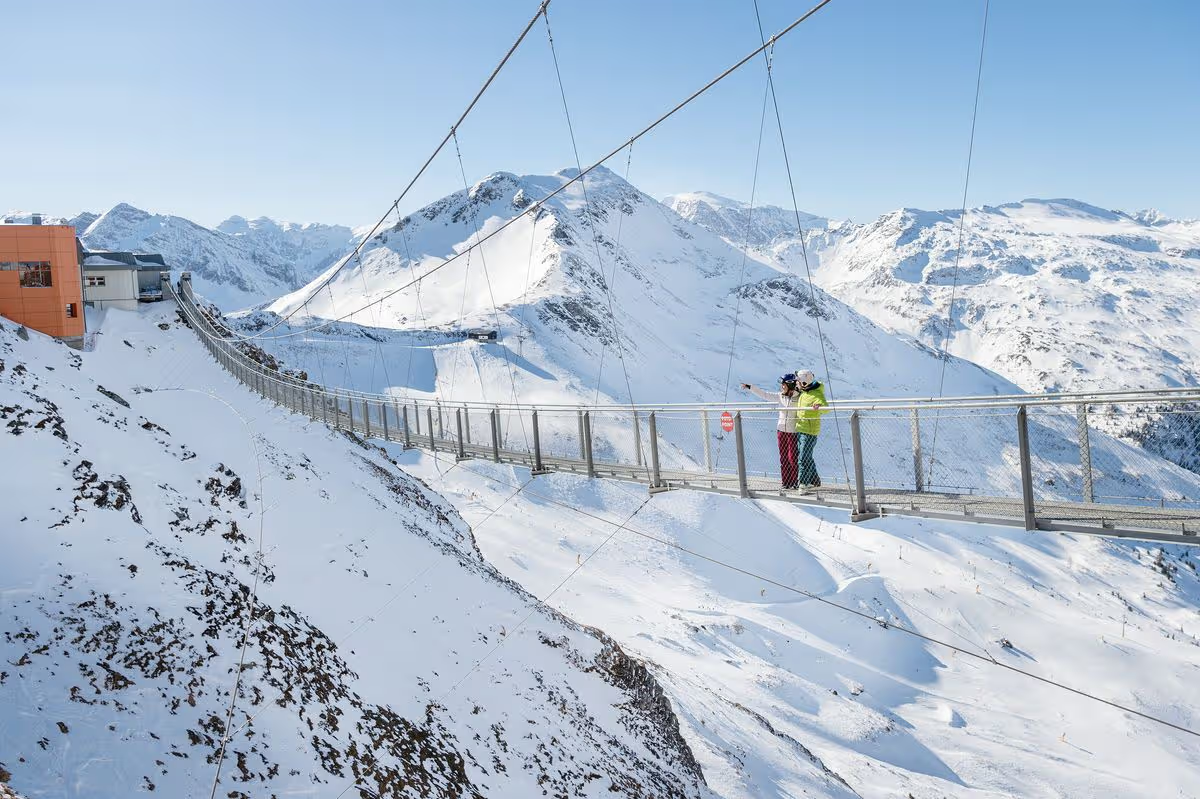
Ski holidays have a reputation for being on the pricey side. The very pricey side. Holidays to the Alps are increasingly thought of as a reserve for only the richest, as the Mirror’s trip to Megeve last year highlighted. But it doesn’t have to be. A day on the slopes in Austria’s Gastein Valley might not be as expensive as those new to the mountainside life may think (although it’s certainly all relative).
Spread across the trio of resorts of Bad Gastein, Bad Hofgastein, and Dorfgastein, the valley forms part of the region of SalzburgerLand, one of the lesser-known alpine destinations. Yet compared with some of Europe’s biggest-name resorts, the cost of skiing here remains reasonable.
While a local dry slope can offer a cost-effective start for beginners, nothing beats real snow for the authentic experience. A trip to the Angertal ski school could be the perfect place to build your skills and get you able to take on the slopes.
One really handy feature of the region is its Guest Mobility Ticket, which provides free public transport throughout the entire region.
So what does a realistic day on the mountains actually cost?
Do you have a travel story to tell? Email webtravel@reachplc.com
The lift pass
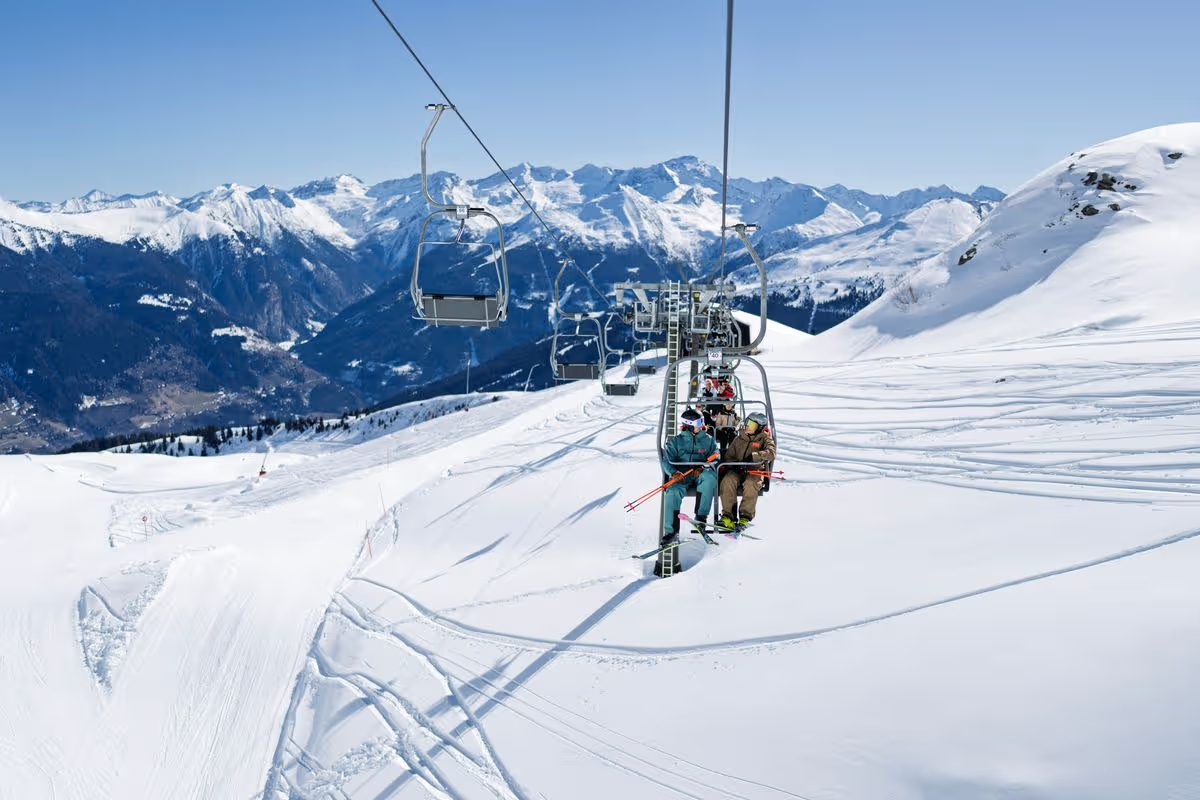
The biggest hidden expense for any skier is the lift pass. This is your ticket to the mountain’s ski lifts and gondolas, which transport you to the top of the slopes so you can ski down. Without a valid pass, you won’t be able to ride the lifts. Passes can range from single-day tickets to multi-day, weekly, or even season-long access, with prices varying widely.
In the Gastein ski area, a one-day adult ticket costs €69.50 (~£59). A six-day pass costs €344.50 (~£293), which works out at around €57.40 (~£49) per day, so staying for a few days noticeably reduces the daily cost.
The pass gives access to the main Schlossalm–Stubnerkogel ski area linking Bad Gastein and Bad Hofgastein, as well as the higher-altitude Sportgastein sector.
Ski hire
If you’re not travelling with your own equipment, rental is the next major cost. At the Angertal Skizentrum in Bad Hofgastein, a day’s rental starts from around €26 (£22) for skis and poles and €14 (£12) for boots.
For weekly rentals, expect to spend around €129 (£110) for skis and €65 (£55) for boots. Snowboard rental is priced similarly.
Ski lessons
For beginners, learning can also be the most expensive part. A three-day beginner’s course can set you back around €294 (£250), including 12 hours of lessons with a dedicated instructor.
Lunch on the mountain
Food prices in the mountains are slightly higher than at your local spot, but Austrian mountain huts are usually gentler on the wallet than some French mega-resorts.
A typical slope-side lunch might include €10–€15 (£8.50–£13) for dishes such as goulash soup or Tiroler gröstl, another €6 (£5) for a drink or coffee, and another €7 (£6) for a slice of strudel. Kaiserschmarrn, the sweetened shredded pancake, costs a little more at around €15 (£13)but it will keep you full well into the evening.
Altogether, €15–€25 (£13–£21) is a realistic spend for lunch and an espresso on the mountain.
One recommendation after a day on the slopes of Bad Hofgastein is the brand new Hirsch und Maus, perched at the mountain peak. A traditional Wiener Schnitzel costs the equivalent of €21 (£18). For those fed up with beige carbs, a Caesar salad is around €19 (£16).
Après ski
Après ski is a key part of the skiing experience, but it can be expensive. After a day on the nursery slopes, a half litre of the local Salzburg brew, Stiegl, costs the equivalent of €6 (£5.30) at the trendy Angertal 1180.
That overall figure can drop if you book lift tickets early, bring your own gear, or choose shorter passes such as half-day tickets. Skiing will never be a budget activity, but not every resort caters only to those on six figures, where single-day lift passes often exceed €80–€90 (~£68–£77).
After the lifts close, many skiers swap their boots for bathrobes and head to the valley’s famous thermal spas, soaking tired legs in steaming mineral waters surrounded by snow.
Accommodation
A classic double room at Hotel Zum Stern costs €294 (~£250) per room per night. Shared between two people, that’s about €147 (~£125) each per night.
Five-day holiday estimate (per person)
Based on the assumption that you’d buy a lift pass for each of the five days of a five-day ski holiday, hire skis and boots for the week, and each day have a mountain lunch, a Schnitzel-style dinner, and one beer Apres ski, this is how much you could expect to spend.
Lift pass, 5 days: €66–78.50 a day, €330–392 (£280–335) a week
Ski and boot hire, weekly: €194 (£165)
Lunch, 5 days: €15–25/day, €75–125 (£65–105) a week
Dinner, 5 days: £16–18/day, €94–106 (£80–90) a week
One beer a day, 5 days: €31 (£26.50)
Accommodation, 5 nights: €1,470 per room, halved to €735 (£625)
ANTIGUA, Florida and the Caribbean… what do they all have in common? Obviously they’re all beautiful, exotic destinations that typically cost thousands to visit.
They’re also some of the amazing locations currently being offered as prizes in some incredible competitions. We’ve rounded up all of the best ones to enter right now…
There are tonnes of competitions open at the moment where you could win a once-in-a-lifetime opportunityCredit: supplied
There’s something for everyone, from luxury staycations to five-star escapes abroad – plus all are free to enter.
So whatever your ideal holiday is, here are some of the best competitions currently taking entries offering a wide range of prizes…
Europe
Live like royalty on a family trip to Versailles
Le Shuttle is giving away a trip to Versailles for a family of four, with access to the Palace of Versailles, the Trianon Estate, Queen’s Hamlet and Gardens, plus a guided tour of the special Marie-Antoinette by Sofia Coppola exhibition.
You’d stay at the Le Louis Versailles Château MGallery and get a VIP shopping experience with One Nation Paris.
There are some competitions for trips to Europe as well including to VersaillesCredit: GettyAlternatively, you could enter to win a short break to Croatia and get a £250 Ellis Brigham voucher as wellCredit: Getty
Travel in style on aCroatia long weekend
Win a short break on the Dubrovnik Riviera in Croatia, plus an Osprey backpack and a £250 Ellis Brigham voucher.
The winner gets a four-night trip and can choose between either a men’s Farpoint 55 or women’s Fairview 55 pack.
Just answer the question ‘what is the capital city of Croatia?’ along with your details by December 15 – click to enter.
Live in luxury on a French Alps family ski trip
Family Ski is offering a seven-night family ski holiday for four to the French Alps.
Included in the prize is £500 of Roarsome Ski Wear for Kids, accommodation in a luxury catered chalet at either Ardent, Portes du Soleil or Reberty, Les Trois Vallées (depending on availability), childcare and airport transfers.
You’ll need to book your own travel from the UK to Geneva, plus lift passes, ski hire and travel insurance.
To enter, fill out the entry form and follow Roarsome and Family Ski Company on Instagram by October 31 – click to enter.
Take the family to the alternative Lapland
Win a family trip to Swedish Lapland worth £4,648.
On Instagram, Letsgofaraway is offering a round-trip (flights up to a maximum of £1,033.09) to Grand Lodge at Blueberry Lodge Lapland for up to eight people.
One activity at the lodge for all guests in included, plus a private session in the relaxation area, which has a sauna, Nordic hot tub and a homemade fika.
To enter, follow @letsgofaraway_, @hospitality.guide, @danieltravl and @blueberry_lodge_lapland on Instagram, then like the competition post, tag two friends and repost/share.
Ever heard of Swedish Lapland? Well, there’s a competition to win a trip thereCredit: AlamyOr you could explore Austria more with a trip to InnsbruckCredit: Getty
Snowy holiday to Innsbruck
Monster energy drinks is offering a snow trip for two people to Innsbruck in Austria.
If you don’t have a card, that’s fine, you can sign up for free.
There’s competitions with long-haul prizes as well such as a trip to AntiguaCredit: GettyOr you could be in with a chance of heading to Saint LuciaCredit: Getty
Luxury Saint Lucia holiday and Arsenal tickets
Windjammer Landing Resort & Residences is offering a seven-night round-trip to Saint Lucia from London.
You’ll also get two tickets to an Arsenal game hosted by the Saint Lucia Tourism Authority and two Arsenal t-shirts.
Answer the questions ‘what is the name of Saint Lucia’s famous national landmark?’ and ‘which Arsenal legend has just visited Saint Lucia?’ by December 15 – click to enter.
Fabulous, personalised holiday toOrlando
Tripadvisor and Visit Orlando are offering an eight-night holiday to Orlando, Florida for two people, plus a free holiday planning session.
Tripadvisor and Visit Orlando have also teamed up to give away an eight-night holiday to Orlando in FloridaCredit: GettyOr perhaps you’ll win a trip to Grand Cayman in the Cayman Islands…Credit: Getty
Cruise
14-night all-inclusive cruise to the Canaries
Saga is giving away a 14-night all-inclusive cruise to the Canaries and Casablanca.
You’d set sail from Portsmouth on January 6, 2027 in a Twin Standard Balcony cabin, stopping at La Palma, Tenerife, Madeira and Gran Canaria.
If you have always dreamt on going on a cruise, there are plenty of cruise competitions as wellCredit: AlamyIncluding ones sailing to the Canaries and to GreeceCredit: Supplied
14-night Caribbean cruise with food and drink included
Win a river cruise through Europe on the Danube or Rhine with Scenic worth £7,000.
The prize includes suite accommodation, excursions, five dining venues, premium drinks, butler service, return flights and transfers and complimentary e-bikes to explore the destinations you stop at.
Five star trip for two at Old Course Hotel, St Andrews
Old Course Hotel in Scotland is a five-star spot boasting views of the Fife coastline and a large golf course.
Win a one-night stay at the hotel for two people with a two-course dinner and a full Scottish breakfast – worth £700.
You’ll get a full day to spend at Kohler Waters Spa, with a spa pool, hydrotherapy suite with a thermal pool, steam room, sauna and plunge pool and the UK’s first Espuro Foam Steam Rooms.
Each guest will get a 50-minute treatment, from a custom massage, hot stone massage, classic prescription facial, reflexology session or a 25-minute facial and 25-minute massage combo.
You need to have a Muddy Stilettos account to enter (free to sign up) and click here to answer ‘what town is Old Course Hotel in?’ by October 14.
You could win a hotel stay and tickets to see Wicked on the West End in LondonCredit: PAOr you could win a stay at a Harbour Hotel and a Salcombe Gin experienceCredit: Alamy
West End show and a 4-star London hotel stay
The Royal Mint recently launched a coin dedicated to the musical Wicked to celebrate 20 years of the West End show.
To celebrate they are giving away a one-night stay at The Clermont Hotel, a silver Proof Colour edition of the Wicked UK coin and two tickets to the London show.
Five-star countryside retreat and year’s supply of popcorn
Popcorn brand Jo & Sephs are offering a luxury trip to Devon, to celebrate the release of the new Sense and Sensibility movie.
The prize includes a three-night stay in a five-star hotel, a private horse-drawn carriage ride and afternoon tea, plus a year’s supply of popcorn.
Click here to answer the question: ‘in Sense and Sensibility, what are the names of the two Dashwood sisters at the heart of the story?’ by November 30.
In another competition, you could be lucky enough to win a stay at Andy Murray’s hotel in ScotlandCredit: Verena SplettOr you could win a luxury trip to Devon with Jo & Sephs
A luxury stay at Andy Murray’s Scottish country house hotel
Discover Britain is running a competition to win a luxury stay at ‘Cromlix’ – Sir Andy Murray‘s country hotel in Scotland.
It includes dinner in the hotel’s new restaurant – The Garden Room.
While many may flock to the huge French resorts of Val D’isere or Chamonix, for a more intimate romantic ski getaway one hidden Austrian getaway scoops the title
09:00, 02 Oct 2026Updated 09:28, 02 Oct 2026
Is Austria’s Gastein valley one of Europe’s most romantic winter getaways(Image: Atelier Wolkersdorfer)
There are ski resorts built for thrill seekers, and there are ski resorts built for those searching for glamour. Then there is the Gastein Valley in Austria, a place that seems designed for something else entirely – romance.
Hidden deep within the Alps in the province of SalzburgerLand, the valley’s twin spa towns of Bad Gastein and Bad Hofgastein combine sweeping mountain scenery, healing thermal waters and classic wooden ski huts that ooze quintessential Austrian charm.
While German may not be known as a romantic language, the Austrian alpine culture all but makes up for it with its cosy wooden lodges with roaring fires, extremely good local wines (I promise it’s not just Riesling), and let’s not forget about the fondue. Something I indulged in for the first time on a recent trip, surrounded by a roaring fire in said cosy lodge, at Bellevue Alm Gastein. Washed down with a good quantity of schnapps, of course.
Do you have a travel story to share? Email webtravel@reachplc.com
With plenty of lodges to curl up in, it’s clear why the region has quietly gained a reputation as one of the Alps’ most romantic winter destinations. The resort of Bad Gastein itself is unusual. Rather than spreading gently across a valley floor like most Alpine resorts, it clings dramatically to the side of a steep gorge.
After a walk around the town during golden hours on a brisk February evening, looking at the mountain views and the marvels of architecture that surrounded me, it hit me – I’m in a Wes Anderson film. The streets were lined with grand pastel coloured hotels perched perilously onto the mountainside, just like in one of my personal favorite films, The Grand Budapest Hotel. I walked through the flakes, feeling as though I had just stumbled onto a film set with Ralph Fiennes and Bill Murray.
But this wasn’t just a figment of my imagination. The cult-classic director is said to have traveled to Bad Gastein, seeking alpine inspiration for the Oscar-nominated hit. Clearly, he found it. It is especially easy to spot when looking up at the façade of the Grand Hotel de l’Europe. The hotel looks out over a cliff, a gentle waterfall crashing below, with all but a bright pink 19th-century funicular distinguishing it from the film itself.
As I continued my wander, the noise of the waterfall offered its own theatrical backing track – and one that becomes even more magical in winter, when mist from the waterfall freezes into crystals and snow dusts the pastel-coloured buildings. This is a magic that has been enchanting people for centuries, with the town having inspired many Romantic composers.
Franz Schubert and Johann Strauss found musical inspiration from the valley, while it is said Mozart himself was born in Bad Gastein before his pregnant parents moved to the nearby city of Salzburg.
Today, that historic grandeur remains, giving the resort a slightly surreal atmosphere that feels part Hollywood and the perfect place for a day together on the slopes.