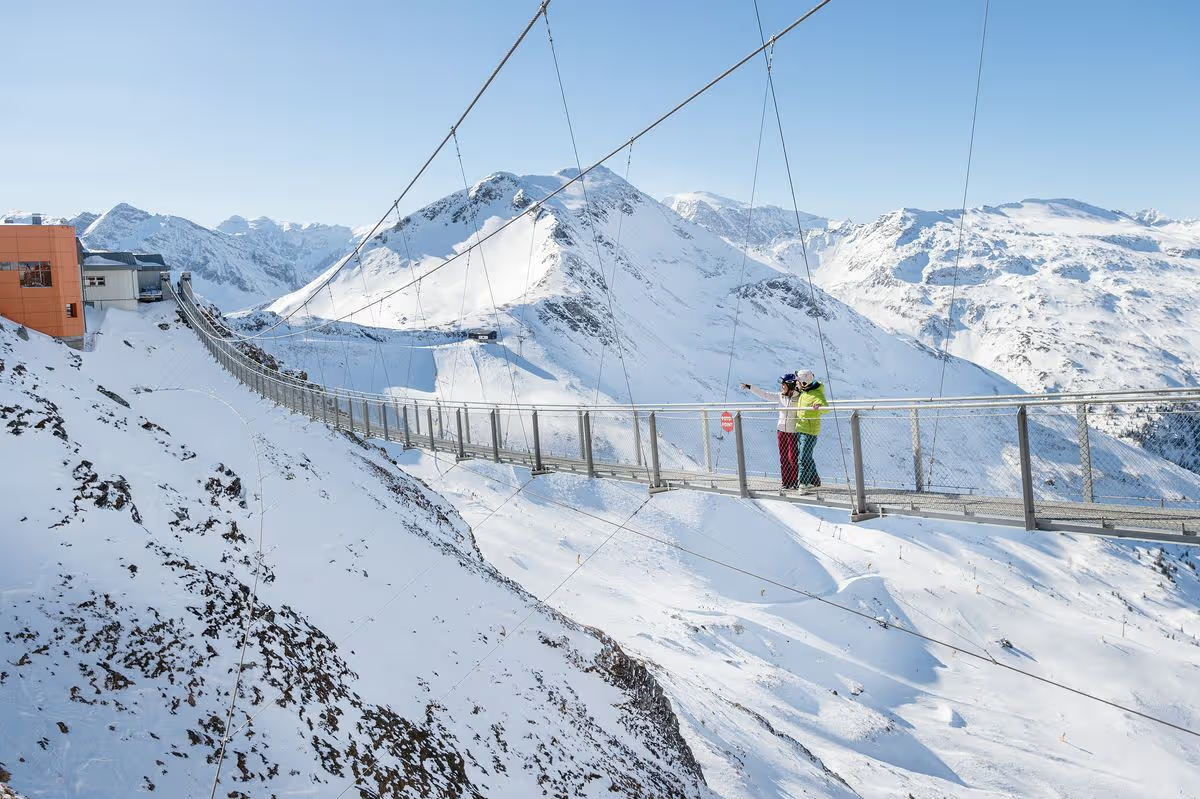
AS millions tune in to watch this year’s Winter Olympics in Milan, it is inspiring Brits to try out some of the sports for themselves.
Ski chalet specialist, Ski Beat, report a post-Games flurry with a spike in traffic during the global event.
Sign up for the Travel newsletter
Thank you!
Skiing holidays are seeing a boost thanks to the Winter OlympicsLaura Hazell shared some of her top tips
According to Ski Beat’s Laura Hazell: “100 years ago, the Chamonix Winter Olympics inspired Brits to try out skiing for the first time – in fact the origins of modern-day ski holidays can be traced back to those early days.
“The same effect is true today. Throughout the competition we see spikes in website traffic.
“There’s a real buzz, with many people who have never skied engaging in the sport, our phones are busier, and we this year we expect that what is already a good ski season will continue right into April.”
According to Inthesnow.com, the UK’s leading ski and snow sports website and magazine, spending in Europe’s winter sports destinations is up 14.3% year-on-year, with France, Italy and Austria among the strongest performers.
France remains the most popular destination for UK skiers, accounting for almost half of British ski trips.
Nearly seven in ten Brits say the Winter Olympics inspire them to try winter sports, and 45 per cent say their interest has increased over the past decade.
Around a third of UK adults booked a winter sports experience in the last year, with most choosing to travel abroad rather than stay in the UK.
The good news? There is no need to wait for next winter’s snow globe to settle as there’s still time to ski this season – and arguably the best weeks are just ahead.
Laura continued: “Spring skiing is the Alps’ best-kept secret. As the mercury softens, so do the prices, with late season deals on ski holidays making high-altitude getaways more attainable.
“The weather is kinder too: bluebird mornings, sunnier terraces, and longer daylight hours that stretch skiing well into the afternoon.
“With the half-term crowds gone, lifts hum more quietly and pistes feel wider, creating a relaxed rhythm that suits beginners finding their edges and families enjoying the snow together.
“Add in mountain restaurants serving lunch in shirtsleeves and you have a late season winter holiday that’s less about bracing for the cold and more about all about basking in the glow of it all.”
Skiing in February post the half term holidays means you can make the most of the tail end of the winter chill.
Wrap up well and go high altitude for the best snow where pistes and lifts are fully open.
April is still a great time for a last minute ski holiday
If you wan to go in March, days are lengthening, temperatures rising and layers and outerwear can be lighter.
Pistes will be busier over Easter, which is around March 28 , so don’t hang around if school holiday dates are important.
If not, plan in a week mid-month for optimum conditions and fewer crowds.
But skiing in April is just as fantastic. There is plenty of ski mileage to be had, aim high (above 2000m is ideal) and enjoy more daylight hours, long, lazy days, bluebird skiing, and lower ski holiday prices.
High factor sun cream and anti UV eye-protection are essential, pack a few t-shirts and lighter layers too, but be ready to layer up when the sun goes down.
Top tips for thrifty spring skiing:
For snow-sure spring skiing look for north facing slopes, and ski areas above 2000m
Beginners don’t need miles of skiing, well-groomed nursery slopes and blue runs will suffice, so save money and buy a local area lift pass.
Select accommodation that includes meals, dining out or shopping for self-catering can be expensive in the mountains.
Make sure the accommodation is close to the lifts, ski school, clomping around in ski boots, carrying skis, is an experience best limited.
Consider buying ski clothing from reseller sites like Vinted or Ebay.
There’s no need to buy skis or ski boots, hire in resort, most people do
Look out for late season offers, avoid the easter peak (28th March), and for the best prices all season consider a high altitude escape on 11th or 18th April.
Here are some of Ski Beat’s top last minute deals to sneak in one last ski holiday this year.
February 21: 7 nights La Plagne, £994pp (saving £304pp)
Includes a chalet host to prepare breakfast, afternoon tea and three course evening meals with wine, return Gatwick flights and transfers, based on two sharing a twin or double ensuite room at Ski Beat’s Chalet Sorbier.
February 28 : 7 nights skiing in French Alps, £1143pp (saving £136pp)
Includes return Gatwick flights, transfers and accommodation at high altitude Chalet Gentiane in Plan Peisey, with a chalet host to prepare breakfast, afternoon tea and three course evening meals with wine, based on two sharing a twin or double ensuite room.
March 21 : 7 nights in Three Valleys resort, £999pp (saving £98pp)
Incudes accommodation in Chalet Vallon Blanc in La Tania. Prices include a chalet host to prepare breakfast, afternoon tea and three course evening meals with wine, based on two sharing a twin or double ensuite room, return Gatwick flights and transfers.
Or fly on March 7 and March 14 for £1125pp, saving £100pp.
April 11: 7 nights in La Rosiere for £716pp (saving £307pp)
Ski Beat’s has 30 per cent off April 11 ski holiday departures.
Staying in Chalet Perdrix in high altitude La Rosiere on the French/Italian border, includes return Gatwick or Manchester flights, a chalet host to prepare breakfast, afternoon tea and three course evening meals with wine, based on two sharing a twin or double ensuite room.
However, be wary of booking any ski holidays that seem too good to be true for the price.
Laura warned: “With skiing it’s all about value, rather than price.
“Bargain ski holidays can result in an inferior lift infrastructure, a resort that’s in the valley and requires buses or lifts before the skiing even starts, or lower altitude skiing where the snow is less reliable, especially late season.”
Other top ski tips include:
Choose a high-altitude resort with reliable late-season cover
Look for resorts with north-facing pistes that retain the snow longer
Line up lessons in advance to build confidence from the first glide
Warm up before departure, with time in an indoor ski slope to acclimatise
Plan in a few visits to the gym, some power walks, or home exercise to get muscles in tone
Check out spring packages inclusive of flights, transfers, accommodation and meals.
Pack lighter layers and outerwear for sunnier slopes
Invest in UV-protective sunglasses and goggles to protect against sun and snow glare
Cover up with top-tier SPF defence to keep skin totally protected on bluebird days
Start early, linger late, make the most of firmer morning snow then ease into long lunches on sunny terraces once the slopes soften.
Book slopeside accommodation, a ski chalet close to ski schools, lifts and kindergartens is ideal, with a chalet host to point skiers in the right direction.
Weigh up the advantages of catered accommodation; save time, money and energy on shopping, and let someone else do the cooking, cleaning and catering.
Ski Beat’s Laura Hazell adds, “While the aspiration to fly like an Olympiad is still fresh in mind, make the medal-winning moments a cue, not just an inspiration.
“The mountains are still very much open for business right until the end of April, and there’s no better time to answer their call.”
Bargains can still be found – if you know where to look
Walking up a winding trail in the Dobratsch nature park in Carinthia, surrounded by picturesque snowy slopes dotted with pines, we hear shrieks coming from round the corner. The path is as wide as a one-way street but Birgit Pichorner, the park ranger I’m taking a tour with, motions for me to move to the side, where we watch a couple with wide grins glide past on a wooden toboggan.
We have seen families out hiking with young children and speed walkers pacing for the summit, while on a trail above us, four skiers are zigzagging up one of the nature park’s designated ski touring routes. For residents of Villach, the southern Austrian town at the foot of Dobratsch, this is very much their Hausberg, a much-loved “locals’ mountain”, says Birgit.
Until 2002, it was a ski resort – Birgit points out the slopes where she learned and later taught her kids to ski – but after successive bad winters at the turn of the century, the town faced the same choice as many ski resorts across the Alps today, as the climate crisis brings higher temperatures and reduced snowfall. Bring in the snow guns and supplement your natural snow offering with the fake stuff? Or chart a different path?
The environmental cost of Maschinenschnee, as the Austrians call artificial snow, is high – it’s energy- and water-intensive, with many resorts pumping water up from the valleys to service their slopes. It also negatively affects these fragile ecosystems by introducing potentially pathogenic and stress-tolerant bacteria to the snow, meltwater and soils, according to the hydrologist Prof Carmen de Jong.
At Dobratsch, residents were worried about the effects the Maschinenschnee would have on the cleanliness of their drinking water, which is funnelled through the mountain’s karst limestone system. They decided it wasn’t worth the risk, so closed the ski resort and instead developed a community-focused nature park.
Dobratsch, Villach’s community-focused nature park, in Carinthia. Photograph: Tom Klar/Getty Images
Along with providing affordable year-round outdoor recreation for local people and tourists – accessed by a €5 bus from Villach or by paying a slightly higher fee at one of the parking spots – the nature park designation protects the local flora and fauna. This includes mountain hares, chamois, ptarmigan and black grouse, with schoolchildren regularly taking part in educational classes on the mountain.
Visitors are encouraged to avoid specific “nature zones” and stick to the trails, which are prepared for them daily. There are three winter hiking routes, ranging from 30 minutes to two hours, depending on how hard you want to work; four ski touring routes, ranging from an-hour-and-a-half to three hours; plus a cross-country circuit and a toboggan slope.
We plan to hike a two-hour route to the summit (2,166m) via the Dobratsch Gipfelhaus, though we modify our route slightly when the fog comes in – depriving us of views of nearby Slovenia and Italy – and visit another hut near the summit instead, which used to house the old ski lift. It’s such a beautiful wintry landscape and a treat to be hiking on real snow. There isn’t enough to require snowshoes today – I’m in snowboard boots, though Birgit is fine in walking boots – but the snow still makes that lovely squeaking sound under my feet, making me feel nostalgic for winter holidays past.
A machine producing a cloud of artificial snow in St Anton, Austria. Photograph: David Hall/Alamy
The problem with fake snow, aside from its environmental and financial impact (the cost of producing it has forced many ski resorts to push up their prices), is that it’s not very nice to walk on, let alone ski or snowboard on; it’s more like ice and much harder and heavier than natural snow. Before I came to Carinthia, I spent a few days in St Anton in the west of the country, where the whirr of multiple snow cannons puffing out clouds of white mist like dragon’s breath was a constant, even at night.
I had the discombobulating experience of snowboarding down ribbons of white pistes surrounded by muted-green hills, and riding through the mist feels unlike any weather I’ve ever experienced; it’s lighter and less powerful than rain but grittier than real snow. When it lands on your jacket it has none of the intricate beauty of a snowflake and disappears almost instantly.
But it’s easy to see why ski stations are resorting to snow cannons to keep the lights on. St Anton had last seen proper snow in November yet was almost fully open for the New Year holiday crowds, which is no mean feat, and many local businesses will, of course, depend on that tourist spend.
I visit the small mountain village of Mallnitz, about 50 minutes on a scenic train from Villach, for a day’s snowboard touring with Klaus Alber, a mountain guide who also runs the Hotel Alber. The hotel has been in his family for four generations, and Klaus, who greets me in lederhosen despite the temperature hovering at -10C, has noticed the dramatic effects of the changing climate on the valley first-hand.
Pointing to the hotel windows, he tells me the snow used to pile up to halfway most winters, but in recent years it’s barely covered the pavement. “Now we get long periods of cold, dry weather with no snow,” he says. The village’s small ski resort Ankogel, which doesn’t yet have snow cannons, is closed due to a lack of snow.
The writer snow touring in Mallnitz, a 50-minute train ride from Villach
“Guests come because they want to ski, but we encourage them to be flexible and enjoy the nature as it is. If there’s no snow in December, we can hike to a summit, that’s still a very nice thing to do,” he says, adding that it forces him to be more creative and find new activities for guests, such as snow touring, where you hike up a mountain using adhesive “skins” for grip, then ski or snowboard down.
We set out in the Hohe Tauern national park, amid a wild, high mountain snowscape of extraordinary beauty. Klaus thinks we may find some good conditions for touring, as there was a recent dusting of snow, which has softened the snow that fell earlier in the season, and he’s right.
Climbing across a series of gentle spines, with sweeping views of a dramatic amphitheatre-like range to our left, it’s clear we have this entire glacial valley to ourselves – the polar opposite of factory farm skiing at a purpose-built ski resort. But it’s not just the setting; the true pleasure of the day comes from being in this landscape with wonderful natural snow all around. It looks so much brighter than its human-made equivalent, dazzlingly so under blue skies and sunshine.
After a couple of hours, we reach the Hagener hut at 2,446m, and Klaus points to an area of snow-covered wilderness that was nearly turned into a ski resort in the late 1960s, before the area became a national park – a resort that today would no doubt be debating the choice between snow cannons or closure.
After snacks and hot sweet tea, we begin our descent with no tracks in the snow ahead – Klaus thinks we’re the first people to do the route this winter. The snow will become bare and patchy lower down, but it feels amazing to be making swooping turns in this upper section, where it’s deep enough to spray in arcs across my face, a holy grail in snowboarding, but so rare these days if you only go to the mountains once a year.
It’s an experience you can only have with snow that’s fallen from the sky, and one that could never be approximated by a machine. The tears behind my goggles aren’t just from the cold.
This trip was provided by Visit Villach, National Park Region Hohe Tauern and Austria Tourism. A snowshoe hike at the Dobratsch nature park with a ranger costs €30 including snowshoe and pole rental, naturpark-dobratsch.at. A day’s ski or splitboard touring with Klaus Alber in the Hohe Tauern costs €240 a person (minimum two people, then €60 per extra person), tauernclimb.com
What was going on in the mind of the legendary 41-year-old ski racer, whose violent crash resulted in her being airlifted off the course and in surgery hours later Sunday with, at minimum, a fractured left leg?
Was it a calculated risk or stubborn foolishness?
“She’s so tough mentally that as long as physically she was OK, she was going to do it,” said Stacey Cook, a retired racer and Vonn’s former teammate on the U.S. Ski Team. “I think the harder part is wrapping your mind around putting yourself at risk again. And that’s never been an issue for her. She’s always been willing to, like, put it on the line… She was always the, like, extra fearless one.”
American Lindsey Vonn completed an alpine ski downhill training session in Cortina d’Ampezzo, Italy, without incident on Friday, two days before she crashed.
(Marco Trovati / Associated Press)
What’s more, Cook said, consider what was at stake.
“It isn’t common in everyday life to go another week with an ACL injury, putting yourself at risk,” Cook said. “It’s always common to take care of it right away. But there’s more on the line for the Olympics than that.”
Dr. Neal ElAttrache, who lives in Los Angeles and is a preeminent sports surgeon, doesn’t count Vonn among his current patients but he has scoped her knee twice to remove scar tissue. He’s also in contact with members of her medical team, as he trained Dr. Tom Hackett, a renowned orthopedic surgeon at the Steadman Clinic in Vail, Colo., who works with Vonn to manage her knee health.
“These aren’t amateur people who were helping her make this decision,” said ElAttrache, who specializes in sports medicine at Kerlan-Jobe Orthopaedic Clinic and is renowned for his treatment and research of knee, shoulder and elbow injuries.
ElAttrache said the typical risk-reward calculation was not in play.
“Everybody knew going into it that there was only one way that this was going to come out good, and that’s if she not only made it through the race, but performed well,” he said. “If she didn’t ski a Lindsey Vonn race and was at least competitive at the top of the leaderboard, it would be considered a failure. There wasn’t a lot of upside, except for Lindsey.”
This combination of images shows American Lindsey Vonn crashing during an alpine ski women’s downhill race at the Winter Olympics in Cortina d’Ampezzo, Italy, on Sunday.
(Jacquelyn Martin / Associated Press)
Vonn’s crash came near the top of the Olimpia delle Tofane course where she had won 12 World Cup races during her storied career, six in downhill and six in super-G. She was on the podium there a total of 20 times before these Olympics.
Cook said the first turn on the course, which Vonn was traversing when she got into trouble, is actually much steeper falling away from the skier than it looks on TV.
“It’s like dipping into a double-black-diamond and trying to come back out of it for a second,” Cook said. “What the racer sees in that section is way different than how it looks on TV. The way it feels is a lot different.”
The racer is traversing the hill perpendicular to the fall line, almost moving in an upward direction.
“It’s a very tough turn,” Cook said. “And the next gate, you can’t see it until you’re pretty much on top of it. You might as well put on a blindfold because you can’t see anything in front of you.”
She said you have to be there to truly understand the difficulty of negotiating the turn.
American Lindsey Vonn crashes during the alpine downhill during the Winter Olympics in Cortina d’Ampezzo, Italy, on Sunday.
(Handout / Getty Images)
“To the average fan, you would stand on top of it and just go, ‘Um, no. Not doing that.’ ”
ElAttrache has studied video of the crash and said there’s no obvious indication the knee in question caused Vonn to fall.
“It’s unclear that her fall was due to an instability event in her knee … and when you look at it, you don’t see that she was weight-bearing on that knee and that she had an instability event that led to the fall,” he said.
An executive from the International Ski and Snowboard Federation told reporters Monday that Vonn was simply “incredibly unlucky” in the crash.
“It was a one in a 1,000,” said Johan Eliasch, FIS president. “She got too close to the gate, and she got stuck when she was in the air in the gate and started rotating. No one can recover from that, unless you do a 360. … This is something which is part of ski racing. It’s a dangerous sport.”
Vonn had a chance to compete on one of her favorite courses and cap her career with a meaningful Olympic moment.
“This was not about proving anything to anyone,” said Dr. Armando Gonzalez, Vonn’s mental coach, in an interview with the Los Angeles Times two days before the fateful race. “It was more about defying the odds that were placed against her and being a competitor that always found a way, no matter what, no matter if it was pain, no matter if it was noise from the outside, she’d always find a way.”
ElAttrache made a comparison between Vonn and star NFL receiver Odell Beckham Jr., who was playing on a compromised ACL when the Rams won the Super Bowl in the 2021 season. Beckham understood the risks, but was somewhat at an advantage as a receiver because he knew the routes he would be running, as opposed to being a defensive back who has to react abruptly to what the player he’s covering is doing.
Often, ElAttrache said, an ultra-elite athlete will apply a different calculus when deciding whether to play with an injury such as a compromised ACL.
He said Vonn, having endured multiple injuries and surgeries to both knees, understood the risks to her own body the way few athletes do. And whereas most skiers would be hamstrung by a fear of injury that could endanger their career, Vonn is an established icon willing to accept risks others might not. In short, it might not make sense to many, but it made sense to the battle-tested Vonn, who has “earned the right” to make those types of decisions.
What’s more, she had performed well on the same course the day before.
“If you have somebody like her, who’s earned the right to try it, if that’s what she really wants to do, she was going into that race as one of the best skiers on the U.S. team,” ElAttrache said. “She was driving that ship.”
MILAN — One short week after Lindsey Vonn crashed in Crans-Montana, Switzerland, and tore her left anterior cruciate ligament, she was tearing down the hill in Cortina d’Ampezzo, Italy, a light knee brace warping the fabric of her racing suit the only obvious sign of anything amiss. When she finished the training run Friday, clocking the third-fastest time for a U.S. woman on the day, she casually fist bumped an American teammate at the finish line.
She made the feat look effortless. Sports medicine experts can say it’s anything but.
“It’s atypical to be able to compete without an ACL, at anything, but especially at a high level like Lindsey Vonn’s going to compete at,” said Clint Soppe, a board certified orthopedic surgeon and sports medicine specialist at Cedars-Sinai. “So this is very surprising news to me as well.”
The ACL, which connects the shin bone to the femur, is a main stabilizing force in the knee and protects the lower leg from sliding forward. Straight-line movement doesn’t stress the major knee ligament and some day-to-day tasks such as walking are easily accomplished without an ACL. But what Vonn is doing is far from normal.
“If you add cutting, pivoting, changing directions, in 95% of humans, you need an ACL to do that,” said Kevin Farmer, an orthopedic surgeon and professor at the University of Florida’s department of orthopedics and sports medicine. “She’s obviously fallen into that 5%.”
Farmer calls the rare group “copers.” They overcome the lack of an ACL by strengthening and engaging other muscles. It’s primarily the hamstrings and quadriceps, but everything, including the glutes, calves, hips and core, counts.
Vonn will have had just nine days between the Olympic downhill race and her injury when she stands at the start gate Sunday. But the 41-year-old has had her whole career to develop the type of strength and control necessary to carry her through the Games without an ACL. She’s already done it before.
Lindsey Vonn concentrates ahead of a downhill training run in Cortina d’Ampezzo on Friday.
(Marco Trovati / Associated Press)
Vonn skied on a torn right ACL for more than a month until withdrawing just before the 2014 Sochi Olympics. In 2019, she won a bronze medal at world championships without a lateral collateral ligament and three tibial fractures in her left knee. She said this week that the same knee feels better than it did during that bronze medal run.
“She’s dealt with knee injuries in this knee before, so she’s been able to develop mechanisms and strategies,” Farmer said. “She probably doesn’t even realize that, but just from years of practicing with a knee that’s not normal, her body has developed mechanisms of firing patterns that allow her knee to have some inherent stability that most people don’t have.”
For athletes who suffer major injuries for the first time, pain often prevents them from firing their muscles, said Jason Zaremski, a nonoperative musculoskeletal and sports medicine physician and clinical professor at the University of Florida’s department of physical medicine and rehabilitation. But Vonn, whose injury history is almost as long as her resume, looked calm during training, her coach Aksel Lund Svindal told reporters in Cortina on Saturday.
So even if she’s one ACL short, Vonn’s team knows she has more than enough of the intangibles to get her not only down the mountain, but into medal contention.
“Her mental strength,” Svindal told reporters in Cortina on Saturday. “I think that’s why she has won as much as she has.”
Vonn completed her second training run Saturday with the third-fastest time before training was suspended after 21 athletes. She was 0.37 second behind compatriot Breezy Johnson, who is intimately familiar with what Vonn is attempting.
Johnson, a medal contender for the United States who led the second training run at 1 minute and 37.91 seconds, attempted to ski in Cortina without an ACL in 2022. She had one successful training run, but crashed on the second one, sustaining further injuries that forced her to withdraw from the Beijing Olympics.
Johnson, like many, gasped when she saw Vonn’s knee buckle slightly on a jump during training Saturday. She said coming off jumps on this course are especially difficult.
“There are, I think, more athletes that ski without ACLs and with knee damage than maybe talk about it,” Johnson said at a news conference from Cortina. “… I think that people often are unwilling to talk about it because of judgment from the media and the outside.”
Critics say Vonn is taking a spot from a healthy teammate or that she simply refuses to give up the sport for good. But Vonn has already come to terms with the end of her career. She said she came out of retirement with a partially replaced right knee simply wanting an opportunity to put the perfect bow on her ski racing career at a course she especially loves.
The stage is different, but the sentiment is familiar to Zaremski. The doctor has worked with high school athletes who beg for a chance to play a final game after suffering a torn ACL. Through bracing, taping and treatment, sometimes there are temporary fixes for the biggest moments.
“If we’re trying to get a huge event like the Olympics, I would never put anything past [Vonn],” Zaremski said. “She’s an amazing, once-in-a-generation athlete.”
FEBRUARY in Britain is officially a washout – so now’s the perfect time to book your next holiday.
ClubMed has just launched a massive flash sale, slashing 20% off a bundle of luxury all-inclusive ski holidays.
Sign up for the Travel newsletter
Thank you!
ClubMed offers a huge range of all-inclusive ski holidays across the French and Italian Alps
Club Med: 20% off ski holidays
Whether you fancy skiing the French peaks or the Italian slopes, you can bag a serious bargain with the travel operator – but only for the next few days.
This promotion launched earlier today (3rd February) and runs until midnight on Friday (6th February).
Best of all, it covers holidays all the way from November 2026 to May 2027.
The discounts on offer are for a wide number of ClubMed resorts across the European Alps.
At Alpe d’Huez, you get ski-in, ski-out access to a massive 250km piste area.
When you aren’t carving up the snow, you can also try dog-sledding or hit the PAYOT spa.
You can even enjoy a legendary apres-ski session at the beautiful lobby bar.
If you want to go all out, Grand Massif offers contemporary chalet-apartments with private fireplaces.
Guests there even enjoy a daily glass of champagne from 6pm.
Meanwhile, Les Arcs Panorama is a family dream, featuring a Scandinavian enchanted forest design.
You can even soak those sore legs in an open-air jacuzzi while looking out over the Paradiski area.
Because it’s all-inclusive, your lift passes and lessons are usually sorted, meaning there are no nasty, hidden-cost surprises.
ClubMed ski holiday deals this February
The 20% discount is automatically applied to these price drops (per person, per week):
After an enormous storm dumped 3 feet of snow on Mammoth Mountain, rookie ski patroller Claire Murphy and a partner scrambled to help make the resort safe for guests ahead of a very busy — and very lucrative — Presidents Day weekend.
In howling wind and blowing snow, the patrollers labored to clear enormous piles of fresh, unstable powder from a steep, experts-only run, one of a group appropriately named the “Avalanche Chutes.”
Ski patrollers use hand-held explosives, and their own skis, to deliberately trigger small slides in the chutes before the resort opens, to prevent an avalanche from crashing down later in the day on thousands of paying customers gliding happily — and obliviously — along the much gentler slopes below.
Mammoth Mountain ski patrol members Claire Murphy, left, and Cole Murphy (no relation) both died while doing avalanche mitigation on the mountain.
(Courtesy of Lisa Apa; Tracy Murphy)
But something went horribly wrong that day. Instead of remaining safely above the sliding snow, Murphy and her partner got caught in it. He was buried up to his neck but survived. She was trapped beneath the collapsing wall of white and got crushed to death against a towering fir tree. She was 25 years old.
The avalanche that killed the young patroller on Feb. 14, 2025, stunned Mammoth’s tight-knit ski community. Her friends and colleagues were consumed with grief, but most regarded it as a freak accident, something that hadn’t happened before and was unlikely to be repeated.
But then, less than a year later, it happened again.
Share via
In late December — after a “Christmas miracle” storm dumped more than 5 feet of snow on the previously parched resort — 30-year-old ski patroller Cole Murphy (no relation to Claire) and his partner were hurrying to clear the same chutes before the busiest week of the year.
They, too, were caught in a deliberately triggered slide. Cole’s partner suffered a serious leg injury, but he survived.
Signs on top of Lincoln Mountain at Mammoth advise skiers that the runs are for experts only.
Cole was swept away and carried hundreds of feet down the mountain, where he suffocated beneath more than a meter of avalanche debris, according to two sources. Both were involved in the effort to save Cole, but asked not to be identified because they are not authorized to speak to the media.
With the sudden deaths of two young patrollers in such a short span, and in such distressingly similar circumstances — Claire and Cole came to rest within a few hundred yards of each other — questions began to swirl.
Were the resort’s managers pushing too hard to open the mountain after major storms? Had training standards slipped, pushing relatively inexperienced ski patrollers into dangerous situations? Are young ski patrollers afraid to speak up, even when they think they’ve been asked to take unreasonable risks?
Lisa Apa, Claire Murphy’s mother, said she begged mountain officials to take a hard look at their training and safety procedures after her daughter’s death — to figure out what went wrong and make sure it never happened again.
They blew her off, she said.
A small memorial remains at a tree, where an avalanche claimed the life of ski patrol member Claire Murphy.
When she heard about the second death, Apa said she immediately fired off a text to a senior ski patrol manager at Mammoth: “You killed another ski patroller … you’ve learned nothing!”
She told a Times reporter last week, “Claire would be f—ing furious if she knew this happened a second time.”
Mammoth Mountain officials have remained measured in their public response.
In a statement emailed to The Times, Mammoth Mountain President and Chief Operating Officer Eric Clark wrote that, after Claire Murphy’s death, the ski patrol had been empowered to “pursue a slower, phased opening of the mountain on storm days.”
After Cole Murphy’s death 10 months later, Clark wrote that resort managers “immediately instituted” measures to “de-pressurize storm mornings,” giving ski patrol more time to work and more latitude to keep chair lifts closed until the mountain is deemed safe.
In a follow-up interview, Clark insisted the pressure on Mammoth’s managers to open quickly after big storms comes from customers desperate to ski fresh powder, not from corporate executives chasing profits.
Chair 22 takes skiers to the top of Lincoln Mountain at Mammoth, where two ski patrollers have been killed by avalanches in the last year.
“Maybe 10 years ago that was different,” Clark said. But after the most recent accident, the message from the resort’s owners — Alterra Mountain Co., a privately held, multibillion-dollar conglomerate that owns 19 resorts across the U.S. and Canada — was to use caution.
“Make sure you’re taking your time,” Clark said they told him.
Apa, who sobbed talking about her daughter, gasped when she heard that.
Of course senior executives offer reassuring words after a tragedy, she said. But as a former business journalist, who once anchored a show called “Street Smart” on Bloomberg TV, Apa said she spent her career around top corporate officers. Anyone who believes profit motive doesn’t drive such decisions is naive, she said.
“Maybe you’re not getting a phone call, or an email, from the CEO saying, ‘get this mountain open today!’” she said. But any manager who develops a reputation as someone who’s afraid to open after a storm, on the busiest day of the year, “won’t be around very long,” she said.
No doubt, many skiers are desperate to hit the slopes after a storm brings fresh powder.
The sensation of floating down the hill with almost no resistance is dreamlike and addictive. No other conditions compare.
That’s why social media is full of influencers bragging about their epic “pow days,” and why hordes of paying customers start champing at the bit when the mountain is covered in a fresh blanket of white, but the ski patrol won’t let them at it.
A former Mammoth ski patroller recalled years of riding lifts with eager customers complaining that the steepest runs with the deepest powder were still closed for avalanche control.
Mammoth Mountain‘s summit is more than 11,000 feet high and averages nearly 400 inches of annual snowfall.
“I’d point to all of the mountains around Mammoth,” he said. There are dozens of beautiful, towering summits in the surrounding eastern Sierra with absolutely no rules and nobody to stop an adventurous soul from climbing up and skiing down.
But there are no chairlifts, so getting up those mountains is a physically exhausting test of will. And there’s no avalanche control, so you’re on your own when it comes to determining which slopes are safe, which are death traps.
“If you’re such an expert, why aren’t you over there,” the ski patroller said he’d ask, usually ending the conversation.
Within the boundaries of commercial ski resorts, avalanche control takes many forms.
At Mammoth, the steepest slopes near the 11,000-foot-high summit are controlled with a howitzer — an actual cannon. When the resort is closed, crews fire explosive shells across a valley up into the highest, heaviest and most threatening piles of fresh snow. Their aim has to be excellent, since stray shrapnel can do serious damage to ski lifts. But it’s a remarkably efficient way to get enormous quantities of snow sliding down the mountain without putting anyone at risk.
The ski patrol office at the top of Lincoln Mountain.
Another option is called a “Boom Whoosh,” which looks like an industrial chimney and is installed just above spots where dangerous piles of snow frequently accumulate. It works by remote control, igniting a mixture of hydrogen and oxygen — like lighting a gigantic camping stove — to create a shock wave that triggers an avalanche. Mammoth has one at the moment, near the summit above a run called Climax, and officials are hoping to install more.
Then there’s the old-fashioned technique: sending ski patrollers into the steepest, most technical terrain with backpacks full of explosives.
That’s what happens in the Avalanche Chutes — known locally as “the avis” — a handful of natural rock and snow slide paths carved by thousands of years of erosion into the side of a 10,000-foot sub-peak called Lincoln Mountain. Patrollers start early in the morning after a storm and ride a snowcat — like a school bus on tank treads — to a plateau just above the chutes.
Big red signs with black diamonds are everywhere on Lincoln Mountain, indicating its trails are for experts only. The chutes are the steepest trails of all, marked on maps with two black diamonds, the highest rating possible. Casual skiers go weak in the knees at the thought of making a wrong turn onto a vertigo-inducing “double-black.”
After hopping out of the snowcat, patrollers divide into pairs and work their way toward the chutes. Sometimes the wind is so strong it scours nearby boulders free of snow, so they have to take off their skis and climb over the bare rocks in their awkward, plastic boots to get to the edge.
Once in place, one of the patrollers tosses a hand-held explosive — it looks like a cartoon stick of dynamite — down the hill. The patrollers cover their ears, wait for the boom, and hope the explosion has loosened the big stuff and sent it sliding.
Then they ski down in carefully choreographed zigzags, sometimes hopping up as they go, to dislodge any remaining loose slabs beneath their feet.
A view of the Avalanche Chutes at Mammoth, where two ski patrollers have died in the last year.
The key to “ski cutting,” as it’s called, is to make sure your partner is anchored in a secure spot, usually off to the edge of the chute and out of the way of a potential slide, before you start moving.
In normal conditions, it’s just another day at the office. But after a massive “atmospheric river” storm, the risks increase.
This season’s Christmas storm was a monster, and it arrived with the biggest crowds of the year.
To keep the customers happy, Mammoth executives opened the lower part of the mountain on Christmas Day, the portion least exposed to avalanche risk. But there was so much fresh snow, patrollers spent the day digging out people who had simply gotten stuck in huge drifts, even on the relatively flat terrain.
And then, in the early afternoon, Raymond Albert, a 71-year-old regular known to fellow skiers as “every day Ray,” was spotted in a pocket of deep, fresh snow beside a well-traveled run near the bottom of Lincoln Mountain.
He had somehow popped out of his skis, which were behind him, and pitched forward, ending up with his head in the snow and his feet in the air, according to a written report of the incident provided to his family.
Looking down one of the Avalanche Chutes at Mammoth Mountain.
It’s unclear how long he was in that position before bystanders dug him out. When ski patrollers arrived he had no pulse. With so much fresh snow on the ground, the patrollers struggled to find a firm enough surface to lay him on his back and perform CPR. They finally used a bystander’s legs as a makeshift platform, according to the report, but could not revive him.
In a normal week, Albert’s death would have been big news, but it received almost no public attention because early the next morning, Cole Murphy and his colleagues headed up Lincoln Mountain to clear the chutes.
It’s still not publicly known what caused the slide that buried Murphy and his partner, but according to two people involved in the effort to save Murphy’s life, witnesses said that an avalanche triggered by an explosive in a neighboring chute might have “propagated” horizontally to where Murphy and his partner were working — taking them by surprise.
Resort officials declined to answer detailed questions about either Claire or Cole Murphy’s deaths, saying their lawyers advised them not to offer specifics during ongoing investigations by the California Division of Occupational Safety and Health.
As soon as Cole Murphy disappeared in that wall of white, the clock started ticking. More than 90% of avalanche victims survive if they can be freed within 15 minutes, according to the Utah Avalanche Center, but the odds drop “catastrophically” after that.
It took Cole’s desperate colleagues 18 minutes to locate him and dig him out, sources said. When they finally pulled him free, his skin was blue and he wasn’t breathing, the sources said.
He was airlifted to a hospital in Reno and pronounced dead days later.
Tracy Murphy, Cole’s mother, said her son loved Mammoth Lakes and the tight bonds he forged on that “little island” of outdoor enthusiasts, surrounded on all sides by hundreds of miles of mountains and desert.
After Claire’s accident, Tracy Murphy said her son was “shaken to the core.”
Cole’s roommate was the patroller in the chute with Claire that day, she said. Last month, the roommate was among the patrollers frantically trying to dig Cole free.
She’s waiting for OSHA’s report, but for now, Murphy said, “I believe that Mammoth would not have knowingly put any patroller in danger. I feel, in my heart, that this was just an extremely unlucky event.”
Her son had been on the job for a few years before his accident; Claire Murphy had been a ski patroller for only a couple of months before hers.
The wind was howling “like a jet engine” that day, according to accounts Apa received from ski patrollers who were there.
The witnesses told Apa that Claire’s partner triggered the fatal avalanche with his skis, and was quickly swallowed by it. But he survived, at least in part because he was about 6½ feet tall and his head remained above the debris.
It’s still a mystery why Claire was in the path of the slide, but the difficulty of hearing and seeing each other amid the wind and blowing snow probably played a part, Apa said.
Seconds after the slide began, it slammed Claire into the tree. When her colleagues dug her out, she was upright, with her back pinned against the trunk. She was facing uphill, Apa said, looking straight at the wall of snow bearing down on her.
Claire probably had no time to react, Apa said, pausing to steady herself before finishing the thought, but she hoped her daughter didn’t suffer. “It kills me to think of her trapped there, scared,” she said.
After hearing about the accident, Apa raced to Mammoth from the East Coast on a private jet provided by the mountain. She implored doctors to keep Claire’s heart beating until she arrived, she said. “I can’t come to a dead body, you have to keep her alive so I can hold her hand,” she begged.
Lisa Apa, left, with her daughter Claire Murphy.
(Lisa Apa)
Apa arrived in time to spend a few days in a Reno hospital with her unconscious daughter. She washed and braided her hair, read her letters from people wishing her well, and thought about what she wanted to say to the other young women on the ski patrol.
“Don’t get out of the snowcat if you’re scared,” she said she told them at Claire’s memorial service and in private conversations. “Go back down the mountain if you think what they’re doing is wrong. You have to say something, you have to.”
But that’s tough, Apa acknowledged, because there are only so many ski patrol jobs in the country, and most of those women had been dreaming about it since they were little girls.
Becoming persona non grata at either of the two big companies that dominate the U.S. ski industry — Alterra and Vail Resorts — could be a career killer, patrollers fear.
Apa said she is still haunted by the possibility that concern for their jobs prevents patrollers from pushing for safer working conditions, and that what happened to Claire and Cole will soon be forgotten.
On a cold, crisp day last week, beneath an almost impossibly peaceful cobalt sky, a reporter skied the Avalanche Chutes with a group of locals including a former patroller and a professional mountain guide who trains clients on avalanche safety.
There had been no significant fresh snow for weeks, so no one was worried about avalanches. Alone on the broad, steep face, the only sound came from the metal edges of skis biting into the hard surface.
The group pointed their skis toward a stand of tall fir trees hundreds of feet below. Some of them had been snapped in half by previous avalanches, one was still caked on its uphill side with thousands of pounds of snow.
And one, just below it, had a recent boot track around its base. A photographer trained his sharp eye on a faded strand of red cloth, light as gossamer, pinned to the trunk at eye level. Dried rose petals hung around it.
On the approach to Arosa in the Graubünden Alps, the road is lined with mountain chapels, their stark spires soaring heavenwards; a portent, perhaps, of the ominous route ahead. The sheer-sided valley is skirted with rugged farmhouses and the road twists, over ravines and round hairpin curves, to a holiday destination that feels like a well-kept secret.
On the village’s frozen lake, young families ice skate, hand in hand. A little farther along, on the snow-covered main street, children sled rapidly downhill, overtaking cars. The resort’s mascots are a happy gang of brown bears. And there are Narnia lamp-posts, which turn the falling snow almost gold every evening. Switzerland is replete with ski towns but none feel quite this innocent and childlike, like stepping into a fairytale.
I am here for a week in an apartment with my wife and two kids, as it’s a place my Swiss partner’s parents and grandparents have been returning to for more than a century. What first drew them here? All say the same thing: Arosa is the Swiss mountain village most Swiss don’t even think to visit; a low-key alternative to the box office of St Moritz, Verbier and Zermatt.
The village sits on a high, terraced plateau one hour south of Chur, Switzerland’s oldest city, and is surrounded by dense fir forests, above which rises an amphitheatre of saw-cut summits. The sense is that the out-of-sight village has been secretly occupied – the pretty-as-pie peaks standing sentry – as if the first farmers here back in the 14th century feared the Habsburgs might return at any moment to take back their territories.
This is also storybook Switzerland to a T. To the north is Heidiland, the farm holiday region where Johanna Spyri set her children’s novels. Also one hour away is Liechtenstein, the pipsqueak principality, which brings to my mind the land of Vulgaria in Chitty Chitty Bang Bang. Two hours to the north is Zurich where we arrived, before borrowing my in-laws’ car. If you fancy taking the train, there are options to do the trip from the UK to Zurich in as little as seven hours, with a change in Paris. Arosa can then be reached on the memorably scenic Rhaetian Railway, a journey with some of the Alps’ most glorious in-seat entertainment. Outside, all the drama is provided by a script of high-definition gorges and glaciers.
The Arosa Bear Sanctuary, at the middle station of the Weisshorn cable car, is a good place to start exploring. Even during the residents’ winter deep sleep, the 2.8 hectare den offers a walk-through education in animal welfare in an unlikely setting, and its wooden platforms offer memorable views of the snow-fuzzed summits and pistes that lead off in every direction like a spreadeagled skier.
The refuge is run in cooperation with global animal charity Four Paws and it provides four rescued European brown bears a species-appropriate home. Once held in appalling conditions, including a private mini zoo in Albania, the bears’ compound is now a place to readjust, to feel safe again. For the full Yogi and Boo-Boo experience, I’d suggest visiting in summer.
Rhaetian railway passing through snow in Arosa. Photograph: Alamy
It’s fair to say my six-year-old daughter fizzes with enthusiasm when the bears are mentioned, but also when we snowshoe later that week into pine forest along the resort’s themed Squirrel Trail. The trail is printed with fresh squirrel tracks and we add our own, feather-pressing our boots into the crisp snow. The flakes fall heavily, as if we’re inside an ornamental snow globe. Then, two red squirrels scurry past with dark-furred yet sparkling tails.
Most days we ski until lunch. All children enjoy one free half-day group lesson for each night’s stay in Arosa with ABC Snowsports School or the Swiss Ski and Snowboard School, but we prefer to explore the mountains as a family. Since 2014, the resort has been connected across the gaping Urden valley with the larger town of Lenzerheide, and like other popular Alpine ski areas, the combined piste map is now a profusion of primary colour squiggles.
But there the similarity ends. British accents are absent. The pistes are largely empty. Strict building regulations, upholding traditional timber aesthetics, mean the village is largely the same now as it was when my relatives first visited. It is Switzerland, but from a half-century ago. At the barn-like Tschuggenstübli, once a cheese dairy on the slopes, everyone crams on to tables to order bündnerfleisch (air-dried beef) and käseschnitte, an upgraded welsh rarebit with melted raclette cheese, pickles and onions.
Afterwards, it’s toboggan time. It strikes me there are almost as many traditional wooden sledges for hire in Arosa as there are pairs of skis, and, from the top of the Kulm Gondola, the only way is down. And at speed. My kids are barely ruffled by the tight, bobsleigh chicanes and, one afternoon, we all howl with laughter as my eight-year-old son hurtles off the track into a marshmallowy drift. He pops back up, grinning, but polar bear white. We repeat the sledge run another half-dozen times.
The Grand Arosa Pop-up Hotel uses a vacant resort hotel. Photograph: Studio Filipa Peixeiro/Le Terrier Studio
Another reason for visiting this winter is to stay at the Grand Arosa Pop-Up Hotel, a one-year experiment inside a vacant resort hotel which is open to the end of this season – the concept will continue next year, though details are yet to be confirmed (they also operate another pop-up hotel in Fribourg and a pop-up hostel in Zurich). Clues as to its aesthetic are in the name – this is not a ski hotel in the traditional sense, and certainly not a vintage chalet brimming with geranium window boxes and mounted antlers. More than that, it is probably the Alps’ largest ever pop-up hotel and its interiors are bathed in pastel pink. If you can find me cooler ski accommodation this year, I’m happy to wait.
With a tech-first approach, there is no reception, but self-check in instructions imposed on a poster of a purple bellboy. What might have once been a telephone operator’s room is reimagined as a walk-in guest book, its fan-print wallpaper covered with whimsical, hand-written comments. Velvet curtains drape two symmetrical elevators, then a cloaked red corridor suggests you are somehow walking backstage at a theatre, before revealing a piano observatory and a vintage design cinema. A Wes Anderson film set has been conjured before you. We only drop in for coffee, but I wish we’d stayed.
At the end of our week, my wife mentions to me how sad she is to be leaving. The kids aren’t too happy about it either. Neither am I. It crosses my mind that Arosa, with its sleepy bears, squirrels and surreal pop-up hotel, isn’t what most people come to Switzerland for. Rather, it’s what we’ve been looking for all along.