sitcom

‘The Peterson Show’ review: Janine Nabers’ new play goes awry

The shadow of Bill Cosby hangs over the “The Peterson Show,” a new play by Janine Nabers about the fallout of a disgraced TV dad on the grown-up cast members who played his children on the show.

Echo Theater Company, which is presenting the world premiere of this play in a production directed by Michelle Bossy, has reconfigured its Atwater Village Theatre space for the occasion. The refresh — in terms of the position of the stage and the audience and in the level of the design elements, including video monitors showing clips of Black sitcoms — promises a vital evening of theater.

Unfortunately, the production is hamstrung by fundamental problems in the writing, directing and acting, all pointing to a failure of control. Control of the story, control of the tone and control of the cast.

In my fall preview item for this show, I wrote that the “production is all but guaranteed to be more enlivening than an evening spent surfing Netflix.” Well, it’s certainly lively, but in a boisterous way that made me regret I had left my couch.

Not even Netflix would give “The Peterson Show” the greenlight. The story centers on the adult lives of the sitcom’s five child stars who are thrust once again into the spotlight after a reunion rumor goes viral and their TV mom, Valerie, kills herself.

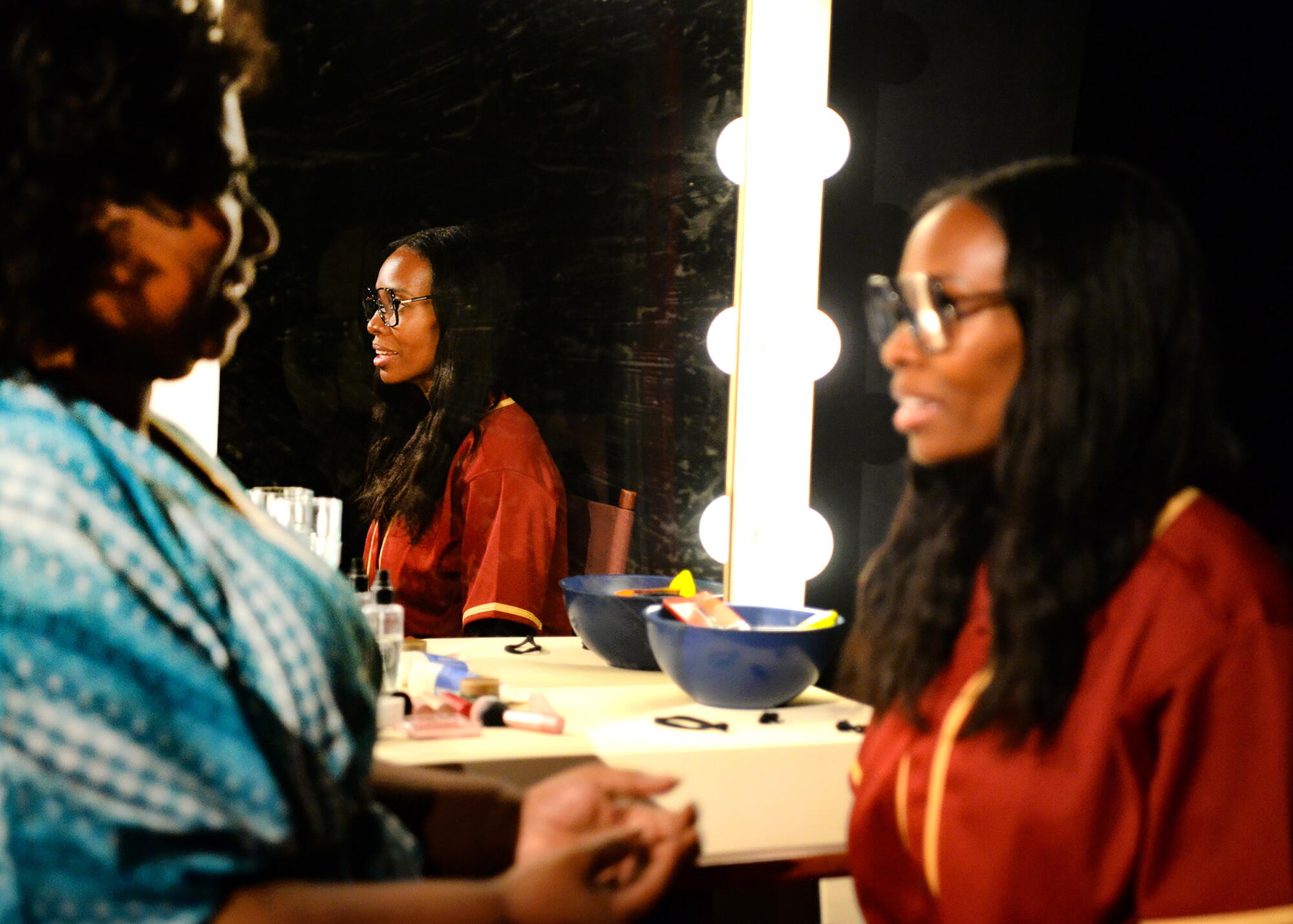
Deanna Reed-Foster, left, and Tamberla Perry in "The Peterson Show" at the Echo Theater Company.

Deanna Reed-Foster, left, and Tamberla Perry in “The Peterson Show” at the Echo Theater Company.

(Cooper Bates)

Ronika (Tamerla Perry), the troublemaker of the group, careens through life with faulty brakes. Zoe (Kristen Ariza), who has traded TV stardom for an academic career and motherhood, wants the normalcy that her former fame keeps threatening.

Dwight (Devere Rogers) is messy and loud as well as addicted to fame and other substances. Blair (Kelly McCreary), who pulled herself out of a miserable childhood, has made a successful career as an award-winning actor and isn’t going to let her flimsy talent or her TV siblings stand in her way. Elliot (John Clarence Stewart), who seems the best adjusted of this crew, left the business to become a lawyer and hasn’t looked back.

Haywood Peterson, the patriarch of the TV show who’s serving jail time for rape, doesn’t appear in “The Peterson Show.” But his voice tyrannically resounds with sadistic orders and conservative cultural commentary during the second-act flashback scene, in which a fateful day on the set of the show changes the lives of Ronika and Blair.

The unsettled first act, full of false starts, feels like an early draft of the play. Nabers, an Emmy-nominated TV writer and author of the play “Serial Black Face” (winner of the Yale Drama Series Prize), can’t figure out how to center the work.

Ronika is the protagonist, but her introduction is off-putting — not only to Zoe, whose home she has invaded, but to the audience, who isn’t given much reason to care about this abrasive, screechy and just-plain-annoying personality.

The cast members perform at a fever pitch of amateur sitcom acting. Ronika evolves as the scene shifts to Blair’s home (which confusingly has the same layout as Zoe’s house in Michael Kramer’s eye-catching scenic design) for the home funeral of their TV mom. But more thought is spent in reworking Ronika’s hairstyle and outfit than in developing her story.

Kristen Ariza, Devere Rogers, Kelly McCreary, John Clarence Stewart and Tamberla Perry.

Kristen Ariza, left, Devere Rogers, Kelly McCreary, John Clarence Stewart and Tamberla Perry in “The Peterson Show” at the Echo Theater Company.

(Cooper Bates)

Ronika’s resentment toward Blair, who has avoided condemning Haywood in public, seethes monotonously until her own backstory is finally unearthed. Ronika’s trauma plot, however, has to compete with Valerie’s related breakdown story, and neither is given its dramatic due.

In the meantime, there’s a lot of unwieldy comic commotion involving a missing corpse, a tweaking, naked Dwight and enough insipid TV sibling bickering to clog the airwaves for a decade.

“The Peterson Show” is exhausting. The play isn’t ready for prime time. Bossy’s direction raises the clamorous volume instead of sorting out the disordered structure or digging into the unexamined silences.

The actors are led completely astray. Echo has built its reputation on quirky plays idiosyncratically performed. The theatrical marching orders here seem to involve throwing spaghetti against the wall and laughing uproariously as it slides to the floor.

‘The Peterson Show’

Where: Echo Theater Company, Atwater Village Theatre, 3269 Casitas Ave., L.A.

When: 8 p.m. Fridays, Saturdays, Mondays, 4 p.m. Sundays. (Check for exceptions.) Ends Oct. 26.

Tickets: $15 – $50

Contact: EchoTheaterCompany.com or (747) 350-8066

Running time: 2 hours (including one 15-minute intermission)

Source link

‘Dang!’ review: Misfit siblings and Gen Z humor ground animated sitcom

“Dang!,” an amiably chaotic new adult animated comedy premiering Tuesday on Netflix, tells the story of the Dangs, three Chinese American siblings living in New York City. Eunice (Poppy Liu, “Hacks”) and older brother Andrew (Andrew Law) share a walk-up apartment in Chinatown; at 26, she’s still determinedly the baby, with little practical knowledge and dependent on him for the tiniest things. He’s the anxious middle child. (Therapist to Andrew: “I’m getting the sense that you’re an anxious people pleaser.” Andrew: “I’m cool with that if you are. Oh my God, are you?”) Somehow Andrew, who is gay, has a lot of casual sex, and only casual sex, despite being incredibly (and comically, obviously) awkward.

Both Andrew and Eunice, who makes money from a live stream in which “horny men and a few women with eating disorders pay me to step on bread,” are relationship averse. When it’s suggested she might like someone she’s been seeing, Eunice panics, “Am I catching feelings? Can it be stopped? Is there a vaccine? Damn whoever the president is.” There is little romance in this comedy.

Where Andrew and Eunice are aspirational slackers who spend off hours watching reality TV and taking whatever drug comes to hand, their older sister, Ruthie (Stephanie Hsu, “Everything Everywhere All at Once”), is a high-powered lawyer, more than comfortable defending evil corporations from the common people; she recoils at a community garden or free library, which she regards as socialism. (“I don’t even like fire departments.”) Though she’s seemingly the successful one, her life has taken an unexpected turn; she’s left her husband, Warren, a weedy Briton overeager to please her, and is pregnant by a colleague, a creep she idealizes. Her fall from perfection delights her brother and sister, who chant, “One of us!” She moves to New York and into the series.

Co-created by Law, who wrote for “Hacks,” “The Good Place” and “Late Night With Seth Meyers” and has acted a little, and Matt Murray (a smorgasbord of 21st century smart comedies are on his resume), the show was originally conceived as live-action. If anything like the present product, it would have to have been a very particular kind of comedy — something like “30 Rock,” whose beats were borrowed from cartoons in the first place. In any case, animation is the place it ought to be. The grotesqueness of Eunice’s boss, Jane, a product-damaged monster who is all face and very little body, if not unachievable in live-action — Katherine Helmond in “Brazil” comes to mind — isn’t really sustainable. You could not have a dead old man’s head come loose from his body and roll across a conference table with quite the same air of insouciance, or melt a rat walking across an overheated microwave oven, if actual people and rats were involved. On the other hand, the fact that Warren is so annoying reminds us that unreal people can elicit genuine repulsion. I ground my teeth at his every appearance; for Ruthie’s sake, I wanted him gone, and she isn’t real, either. It’s the magic of animation.

The show is generally amusing, sometimes very funny and easy to watch as an evolving story of family. (A visit to the Dang parents in Episode 8 is especially productive.) One’s mileage will vary depending on generation and experience. (“I was born in 1999,” says Eunice, who has never heard of Facebook. “Anything before ‘Skibidi Toilet’ is just cave paintings to me.” Of course, I had to look up “Skibidi Toilet,” and I don’t feel bad about admitting that.) There are sex jokes, fart jokes and pop culture jokes; there are jokes I don’t even want to describe. But there is a satisfying specificity to the humor, especially as involves Asian American culture, gay life, New York City and New York City gay Asian American life, which is not overexplained. The city itself is rendered with some light-handed detail — its delis, drug stores, coffee shops (why did I especially like the paper sleeves on the to-go cups?), Central Park on “Freaquinox,” “the first day that everyone decides it’s spring” when citizens turn into sex-crazed zombies. (Eunice: “Last year, I woke up next to an Uber Eats delivery robot.”)

As a situation comedy, its characters will spend their days and nights getting in and out of scrapes, enduring self-inflicted humiliations, experiencing minor triumphs; they are all a little stupid, and a little smart. And as a cartoon, its job is not just to tell you a story, but to give you something fresh to look at, something to set itself apart while offering easy access to its world and people. The character design, which borrows from anime, is elegant and a little odd — hands and feet are drawn tiny, which has the paradoxical effect of drawing your attention, making them more expressive.

Beyond the three stars and Noël Wells (as Greta, Jane’s cowed assistant), neither the producers nor the publicists nor the onscreen credits nor the usual websites have identified who played whom. But I copied down these names down from the screen: Al Roberts, Sungwon Cho, Jared Goldstein, John Michael Higgins, Adam Pally, Jaboukie Young-White and Mary Holland.

Source link