The Repair Shop’s expert craftsman Dominic Chinea has launched into yet another ambitious engineering project – leading to a somewhat chaotic video from his workshop
16:35, 02 Sep 2026Updated 16:41, 02 Sep 2026
Dominic Chinea with his Repair Shop co-stars(Image: BBC)
“The pressure really is on,” says The Repair Shop’s Dominic Chinea as he embarks on a tough engineering project: “We’re going to blitz this Land Rover and get it hopefully running, starting, possibly driving.”
In a new video, Dominic adds that, as he’s still missing a few components, it probably won’t be fully running for a little while yet. Nevertheless, he says, he’s determined to move as fast as he can with the project: “I do feel like this video needs to come with a little bit of a disclaimer or a warning that it’s quite hectic,” he joked, while giving his YouTube viewers an update.
Explaining that he has overstretched himself a little, Dominic says: “I’ve got multiple jobs all over the place and I am jumping around with no time. I filmed as much as possible and I’ve tried to assemble it into some kind of video to make some kind of sense.”
He stresses that the heat is on: “I have two days to get as much done as I possibly can.” But nevertheless, Dominic adds, he knows that rushing a job can lead to disaster.
“Patience is so important at moments like this.” He says, “I’m so tempted to just reach for the biggest hammer and try and persuade these things off of the shaft. But that is how you damage things.”
Dominic doesn’t need anything in his workshop to suffer any more damage. When Dominic and his wife Maria packed up their house in Kent last year and moved to Cornwall with their dog Wendy, he admitted that weatherproofing the newly converted workshop would be a “pressure.”
The dramatic storms that thrashed the county in January made Dominic’s prediction all too real. He was left struggling to make urgent repairs before he could get back to work, all while attempting to complete the renovations for his farmhouse kitchen.
He said at the time: “The storm has caused a lot of damage, the workshop roof, various tiles and bits and bobs. I’m doing my best to deal with those, I’ve ordered more roof sheets and I’ve lined up roofers to try and fix the roof, but I’m also juggling trying to finish this kitchen.”
A month later, another violent storm caused a section of his workshop roof to collapse, inflicting substantial damage to a nearly irreplaceable vehicle he’d been restoring underneath.
Then, in June, Dominic’s workshop was hit by yet another apocalyptic storm. Somehow, amid all this chaos he’s managed to fit in the filming of two TV series.
His decision to put his life on screen with his new series Dom Chinea’s Cornish Workshop was by no means an easy one. “It was definitely different to filming The Repair Shop, but that was part of the reason to try to do it, to experience something new.”
And of course he’s still working alongside the rest of The Repair Shop team. In tonight’s season opener for Beyond the Barn, electronics expert Mark Stuckey restores a homemade K-9 dog, and leather expert Suzie Fletcher repairs a bag belonging to Winston Churchill’s cook.
Meanwhile, milliner Jayesh Vaghela undertakes the delicate restoration, determined to bring this unique piece of rock ‘n’ roll history back to life while preserving its authentic character and remarkable connection to the rise of David Bowie and the 1970s glam rock movement.
EXCLUSIVE: A new book charts the extraordinary history of British Airways, inclduing its unusual first passenger flight, its unique link to Marmite, royal fans, and some questionable fashion
10:05, 07 Jun 2026Updated 10:06, 07 Jun 2026
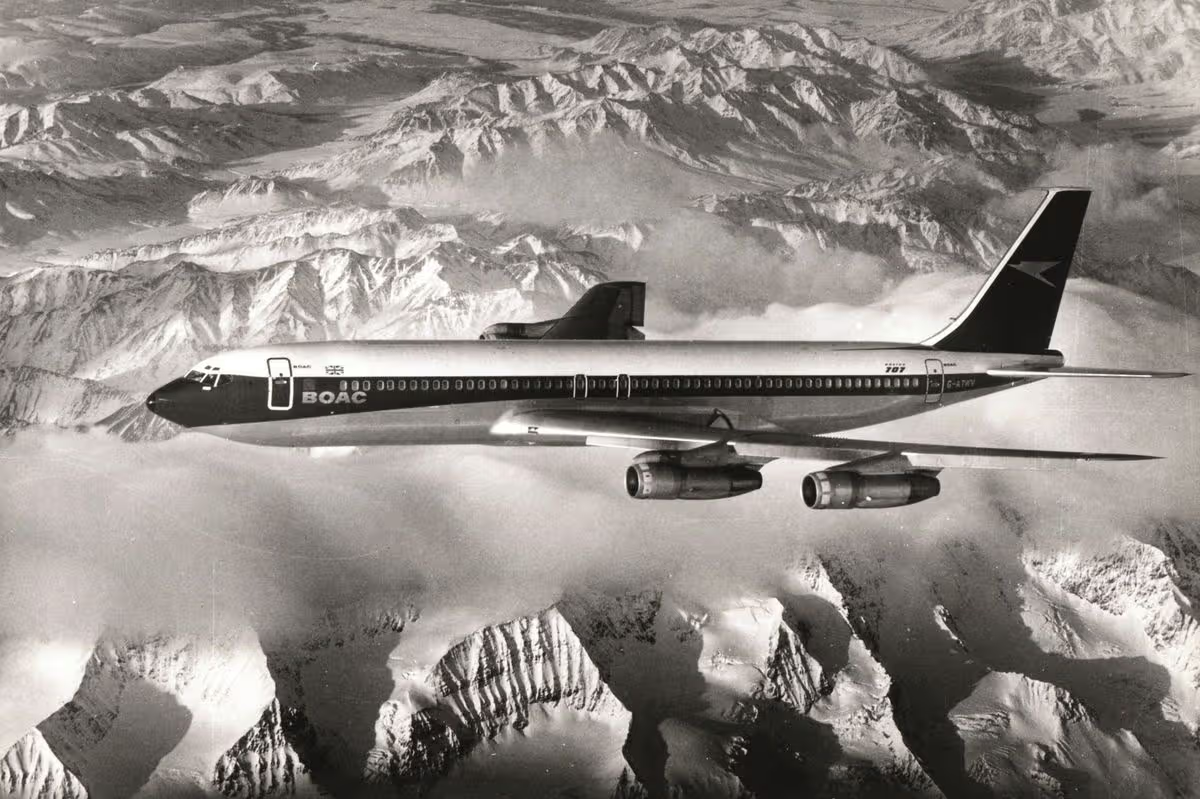
The Boeing 707 was a symbol of the iconic 60s and shrunk the world overnight(Image: Supplied)
British Airways has been flying for 107 years, connecting Britain to the world across more than a century of aviation history.
From a single biplane lifting off from a grass field in west London to a fleet serving destinations across the globe, the story of the world’s favourite airline is told in a new history by Captain Al Bridger – taking the story of BA in 100 objects, which encompass everything from Neville Chamberlain to Marmite.
British Airways traces its roots to 1919, when Aircraft Transport and Travel (AT&T) launched the world’s first international scheduled passenger service from Hounslow Heath to Paris.
This pioneering line later fed into Imperial Airways, which became BOAC in 1939 for long-haul routes, while BEA was formed in 1946 for European services; the two finally merged in 1974 to create modern British Airways.
But it began on August 25 1919 when a modest biplane was prepared on the grass at Hounslow Heath, a few miles from what is now Heathrow Airport. Captain Al said: “The world’s first international scheduled passenger was piloted by Lieutenant Bill Lawford.
“It carried one passenger, some newspapers, fresh grouse bound for the British Ambassador to France and Devonshire clotted cream. In challenging weather, Lawford skilfully completed the trip in 2 hours and 30 minutes.”
Five years later, in March 1924, the British government formed Imperial Airways, at the futuristic Croydon Airport. The art deco structure had a first-class restaurant, canteen for staff and a viewing gallery. The network expanded and flights could reach Delhi in seven-and-a-half days.
The Argosy aircraft, which first flew a passenger service on July 16 1926, gave early travellers a taste of luxury that would define the airline’s ambitions for decades to come. Captain Al said: “A white-coated steward served twenty passengers incredible four-course meals with drinks, providing true luxury for those lucky enough to afford it.
“The aircraft were also used for very popular weekend ‘Tea Flights’, offering afternoon tea while enjoying fabulous views over the capital.”
Among the collection’s most striking objects is a signed photograph of Prime Minister Neville Chamberlain, stepping from a British Airways Lockheed 10A after his famous Munich meetings and the declaration of “peace in our time”.
The 1950s brought a fresh start. “The Jet Age was officially launched with the introduction of the Comet in 1952, placing the UK at the very forefront of aviation,” said Captain Al, “The Rolls-Royce-powered Boeing 707 was a truly iconic symbol of the 1960s, and Sydney in Australia was now within reach in just 33 hours with four stops on the way. A true symbol of the iconic 1960s, the Boeing 707 was a triumph, shrinking the world overnight.”
The collection’s menu cards speak to a more glamorous age of flying. A BEA Silver Wing menu signed by Sir Winston Churchill on 26 April 1955 sits alongside one signed by Muhammad Ali on 10 May 1979
The 1960s brought experimentation of a more flamboyant kind. BOAC introduced cabin crew uniforms that became one of aviation’s most memorable fashion footnotes.
“While famously described as paper dresses, they were in fact sensibly made of a fireproof fabric that resembled paper and could be cut to the required length,” said Captain Al. “Incredibly, they were discarded after each flight.” They lasted a year.
The airline was also reaching out to its youngest passengers. On 26 March 1957, BOAC launched the Junior Jet Club, and Captain Al said: “The club was a huge success and had over 2 million members in its twenty-seven years of existence. Cabin crew would hand young travellers an envelope containing a registration form, a logbook and a Junior Jet Club badge.”
No history of British Airways would be complete without Concorde. The aircraft first flew on 2 March 1969 and entered service with British Airways on 21 January 1976. Captain Al said: “Concorde was to become the flagship of the fleet, bringing supersonic travel to everyone for the first time. Able to carry 100 customers in total luxury at speeds in excess of Mach 2 (more than 1,300 mph) the aircraft could cross the Atlantic in under 3 hours, with the record set on 7 February 1996 at 2 hours and 52 minutes.” The aircraft operated its last service on 24 October 2003.
While Concorde was redefining long-haul travel, the airline was also transforming life on board for ordinary passengers. A BOAC packing checklist pamphlet from the 1960s shows the formality of travel at the time. “For gentlemen, the list mentions the necessity of a dinner jacket, shirt collars and hair tonic,” said Captain Al. “For ladies, a bed jacket, hat and stole were essentials when travelling abroad.”
A photograph of the Beatles from the same era shows the Fab Four carrying BEA travel bags. Captain Al said: “Note how the Beatles are carrying BEA(TLES) travel bags, much like the more common BOAC bags. Clearly the band were travelling light.”
The 1980s brought fresh challenges and fresh ambition. In 1995, as part of a £500 million investment, the airline introduced the world’s first fully flat bed seat in First Class. Captain Al said: “Scientifically proven to give a much better night of sleep, it represented a huge leap forward in airline comfort.”
The airline’s inflight magazine, High Life, had been charting the journey since 1973. Captain Al said: “It truly is BA’s wingman. Through the years there have been some amazing contributors, from Jilly Cooper to Morecambe and Wise.”
Smoking had been part of airline life since the very beginning, but by March 1998 it was over. “When BEA was formed in 1946 over half of the British public smoked, with two-thirds of adult males recorded as smokers,” said Captain Al. “It wasn’t until 1998 that British Airways introduced a complete smoking ban on all flights.”
The modern era brought its own landmark moments. On 18 May 2012, a gold-liveried Airbus A319 named Firefly carried the Olympic flame into Culdrose Naval Airbase in Cornwall. Captain Al said: “Safely contained in four miner’s lamps, the flame was taken from the aircraft by Anne, the Princess Royal, accompanied by Lord Coe, the chairman of the London Olympics Organising Committee and football superstar David Beckham.”
The airline’s centenary in 2019 produced one of the collection’s most unlikely objects. “To celebrate the airline’s centenary, British Airways and Marmite teamed up and created a limited-edition jar that could be purchased on board,” said Captain Al.
“Apparently Marmite is the most confiscated brand at airport security, so the centenary jar was made to be just 70 grams, conveniently sized to fit within the liquid allowance to get it safely through airport security.”
Few objects in the collection carry more weight than the Royal Flights book, its pages bearing the signatures of those who have trusted the airline across the decades. The first entry dates from November 1983.
Captain Al said: “The book was beautifully inscribed with superb calligraphy and the signatures of Her Late Majesty Queen Elizabeth II and His Late Royal Highness The Duke of Edinburgh. Fittingly, the final signature is again that of Her Late Majesty after her visit to the British Airways Headquarters on 23 May 2019 to celebrate the airline’s centenary year.”
From a grass field in Hounslow to the signature of a queen, British Airways has carried the nation and the world for 107 years.
As Captain Al writes of the airline he has served and loves: “It has seen great highs and led the world through some very challenging times, and I know it will continue to give the best it can in the coming years, generating many more wonderful objects along the way.”
British Airways in 100 Objects by Al Bridger is published by Amberley, £17.99
BA in numbers
46.3 million passengers carried in 2025.
Fleet of 254 aircraft serving 215 destinations across six continents.