single-payer healthcare

Top takeaways from final governor’s debate: Knives out for Becerra

As Californians cast ballots in the most unsettled governor’s race in recent history, former U.S. Health and Human Services Secretary Xavier Becerra, a Democrat surging in the polls, once again took most of the heat during a contentious debate among the top candidates for California governor.

Becerra’s rapid rise as the top Democrat in the race was greeted on stage by a fusillade of political attacks from rival Democrats and Republicans, notably regarding his former campaign manager’s guilty plea to federal corruption charges hours before the clash.

Then came accusations that he wavered on support for single-payer healthcare, and failed to stem healthcare and unemployment fraud while serving as California’s attorney general.

“This is what happens when you take the lead in the polls and you’re ahead of everyone else. They all come at you,” Becerra said. “I get it. So they have to try to beat you down. This is a great Trump tactic that’s used. I didn’t expect it to come from fellow Democrats.”

“With friends like that, who needs enemies?” Becerra later said.

The face-off took place at a critical moment before the June 2 primary. Republican voters appear to be consolidating behind Hilton, who was endorsed by President Trump, while Becerra and billionaire hedge fund founder Tom Steyer are favored most by Democrats.

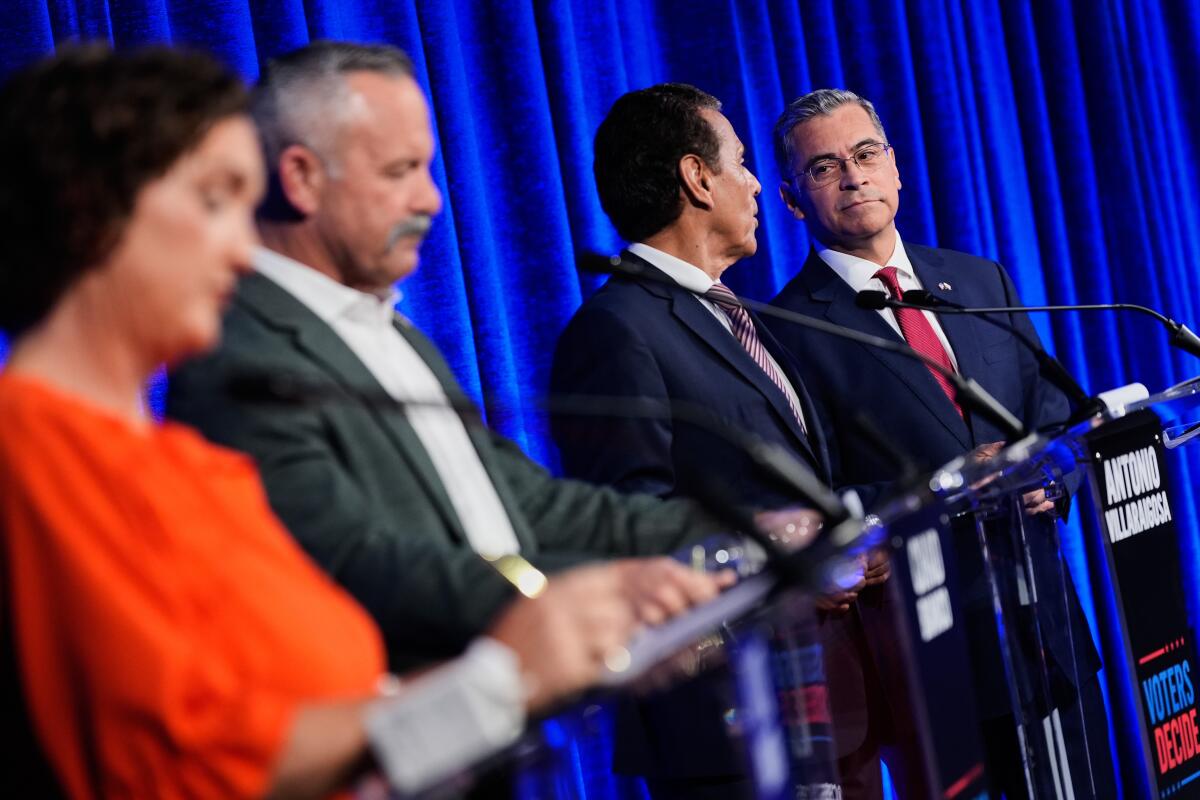
Xavier Becerra, right, listens to Antonio Villaraigosa, second from right, during a break

From left, Katie Porter, Chad Bianco, Antonio Villaraigosa and Xavier Becerra at Thursday’s debate.

(Godofredo A. Vásquez / Pool via Associated Press)

Up for grabs

As ballots land in mailboxes, California voters are finally tuning in to the race to lead the nation’s most populous state and fourth-largest economy in the world. Thursday’s 90-minute CBS debate may have been the final opportunity for candidates to directly address large numbers of voters.

Until now, scandal drew the most attention to the contest, as former U.S. Rep. Eric Swalwell (D-Dublin), once an establishment favorite and nominal front-runner, dropped out in April amid allegations of sexual assault and misconduct

Five Democrats — Becerra, Steyer, San José Mayor Matt Mahan, former Orange County Rep. Katie Porter and former Los Angeles Mayor Antonio Villaraigosa — and two Republicans — Riverside County Sheriff Chad Bianco and former conservative commentator Steve Hilton — clashed about affordability, housing, public safety, climate, education and healthcare. State Supt. of Public Instruction Tony Thurmond, a Democrat, failed to reach the polling threshold to qualify for the debate.

CBS News Bay Area reporter Ryan Yamamoto, CBS News Los Angeles reporter Tom Wait, and San Francisco Examiner Editor-in-Chief Schuyler Hudak Prionas moderated the face-off in front of nearly 200 people at the historic Julia Morgan Ballroom in San Francisco’s Financial District, with sweeping views of the city.

The opulent Beaux-Arts venue contrasted with the tense confrontations among the candidates that underscored Becerra’s swift rise among Democrats in the field after Swalwell dropped out of the race. Even before the face-off, his Democratic rivals began ramping up their focus on Becerra.

Becerra under attack

The candidate faced a barrage of attacks over a string of unfavorable publicity this week, including a widely circulated exchange with a KTLA reporter in which the Democratic candidate asked, “This is a profile piece, this is not a gotcha piece, right?”

Earlier Thursday, his former campaign manager Dana Williamson, who also spent time as Newsom’s chief of staff, pleaded guilty to federal corruption charges alleging she and Becerra’s former top advisor were among those who illegally siphoned $225,000 from Becerra’s campaign accounts.

Although Becerra has not been accused of wrongdoing, that did not temper criticism from his political rivals during Thursday’s debate. They questioned his judgment and said Becerra should have noticed where his money was going.

Hilton said Becerra should be preparing his own criminal defense, rather than running for governor. Porter warned that damning evidence against Becerra could come out later — which, if he finishes as the top Democrat in the primary election, could undercut his campaign and lead to a Republican being elected California’s next governor.

Becerra defended himself, pointing out that federal prosecutors never accused him of being involved and stated that none of the candidates for governor were implicated in scandal.

Democrats also painted Becerra as a leader who allowed fraud and mismanagement to fester under his watch.

“He wasn’t minding the shop” as state attorney general, Mahan said, pointing to fraudulent unemployment and hospice claims early in the COVID-19 pandemic. “I mean, the Biden administration had to sideline him during COVID. This is not good leadership.”

Matt Mahan, left, is polling in the single digits and made a last-ditch effort to leave an imprint during Thursday's debate.

Matt Mahan, left, is polling in the single digits and made a last-ditch effort to leave an imprint during Thursday’s debate.

(Godofredo A. Vásquez / Godofredo A. Vásquez/pool Ap Via Ap)

Major focus on kitchen table issues, a critical concern among voters

Affordability was a major theme in the debate, which included an introductory video of a single mother struggling to fill her gas tank and buy groceries.

Steyer said he would reduce costs by taking on special interests and bringing about structural change and breaking up monopolies.

“I am the person who will tax the billionaires like me, and the big corporations so we can afford to make the changes” to pay for healthcare and great education, he said.

Mahan said the answer was to “put more money in people’s pockets by bringing down costs,” and that that would not occur under either Steyer or Hilton.

“Tom Steyer’s structural change sounds to me more like socialism. His plans literally would double the size of state government,” Mahan said. “That’s not going to drive affordability. Steve Hilton is touting his Donald Trump endorsements. You’ve got tariffs and wars driving up costs.”

Hilton returned fire: “I love the way Matt talks about how he’s going to lower costs when his city was recently rated the most expensive, the least affordable for housing, in the world.”

Daylight between Republicans about climate change

The Republican candidates avoided attacking each other during the debates, offering compliments instead. But the two split when asked about whether climate change was having a real-world impact.

Bianco said California is destroying itself with its environmental policies.

“Of course we can say that temperatures are increasing,” he said, but he also said he was not “naive” enough to think that humans can affect or control the climate, which has been changing since he was a child, and that California has to stop all the environmental regulations that are “activist related” and destroying the state’s economy.

Tom Steyer spoke Thursday of affordability, a hot-button issue: "I am the person who will tax the billionaires like me."

Tom Steyer spoke Thursday of affordability, a hot-button issue: “I am the person who will tax the billionaires like me.”

(Godofredo A. Vásquez / Pool via Associated Press)

Hilton said he believes in climate change but that California needs to have “common sense” on the issue rather than ideological responses. He said it is “of course” right to want clean water and air but that policies in California are not working — as has been made clear by the recent “mega-fires” in the state.

The Democrats on stage were closely aligned on the need to respond to the climate crisis and ensure that environmental protections are not dismantled by the Trump administration.

Last-ditch efforts by struggling candidates

Candidates in the crowded field who have struggled to break through — centrist Democrats Mahan and Villaraigosa, who have languished in the single digits in the polls — made a last-ditch effort to leave an imprint during Thursday’s gathering.

Mahan went after nearly every candidate on the stage in the opening moments of the debate.

“The change we need is rooted in accountability for results,” Mahan said. “It’s not the change billionaire Tom Steyer’s offering, which is higher taxes and bigger government. It’s not the change Fox News talking head Steve Hilton’s offering — fear, division and more Donald Trump. And let’s be honest, Xavier Becerra is not offering change; he’s the embodiment of the status quo.”

Villaraigosa leaned heavily into his experiences leading Los Angeles and in the state Assembly to argue that he was most qualified to lead the state while castigating his fellow Democrats’ policies.

“This is a state with big challenges, the challenge of affordability, the challenge of healthcare, homelessness, and dirty streets and crime-filled streets,” Villaraigosa said. “The fact is, I’m the only candidate on this stage who, in addition to hitting Donald Trump, which I do, have challenged us, challenged this party, and said, ‘Hold it, a lot of the problems that we face have come from Sacramento policies.’ We need someone with the courage to take on Donald Trump, but also take on our friends when they’re wrong. I’ve had a record of doing that.”

Mehta reported from Los Angeles and Nixon from San Francisco.
Source link

In California governor race, single-payer healthcare is a litmus test. There’s still no way to pay for it

When Gavin Newsom ran for California governor in 2018, his support for a state-run single-payer healthcare system was considered a risky move and earned him hefty labor endorsements.

Today, leading Democrats in the wide-open race to succeed Newsom have embraced single-payer healthcare as a political necessity, an answer to voters fed up with rising premiums and other spiraling healthcare costs.

But with no clear front-runner, they are sparring among themselves in debates and political ads over who is most committed to a government-run model. No candidate has outlined how California would fund comprehensive health coverage for its 40 million residents, leaving voters unable to discern which candidate has a concrete plan for the nation’s most populous state.

Healthcare and political experts said the concept of single-payer has shifted from progressive pipe dream a decade ago to today’s mainstream talking points in a state where Democrats outnumber Republicans nearly 2 to 1. Democrats have pledged the model as the best way to lower costs in an attempt to woo voters worried about affordability as ballots arrive for the June 2 primary. The top two Republicans, meanwhile, have dismissed government-run healthcare as a “disaster” and “socialism.”

“In many ways, single-payer healthcare has become a progressive litmus test,” said Larry Levitt, a former White House policy advisor and a healthcare expert at KFF, a health information nonprofit that includes KFF Health News.

Few voters fully understand the term single-payer, let alone expect the next governor to achieve it, Levitt said. Rather, he added, the term has become more of a signal to voters about a candidate’s approach to healthcare reform.

Xavier Becerra, the former U.S. Health and Human Services secretary, who for decades backed single-payer healthcare in Congress, has come under criticism from opponents for a nuanced but clear shift away from single-payer. It came after Becerra secured an endorsement from the California Medical Assn., a powerful group representing doctors and a longtime opponent of single-payer healthcare bills in California.

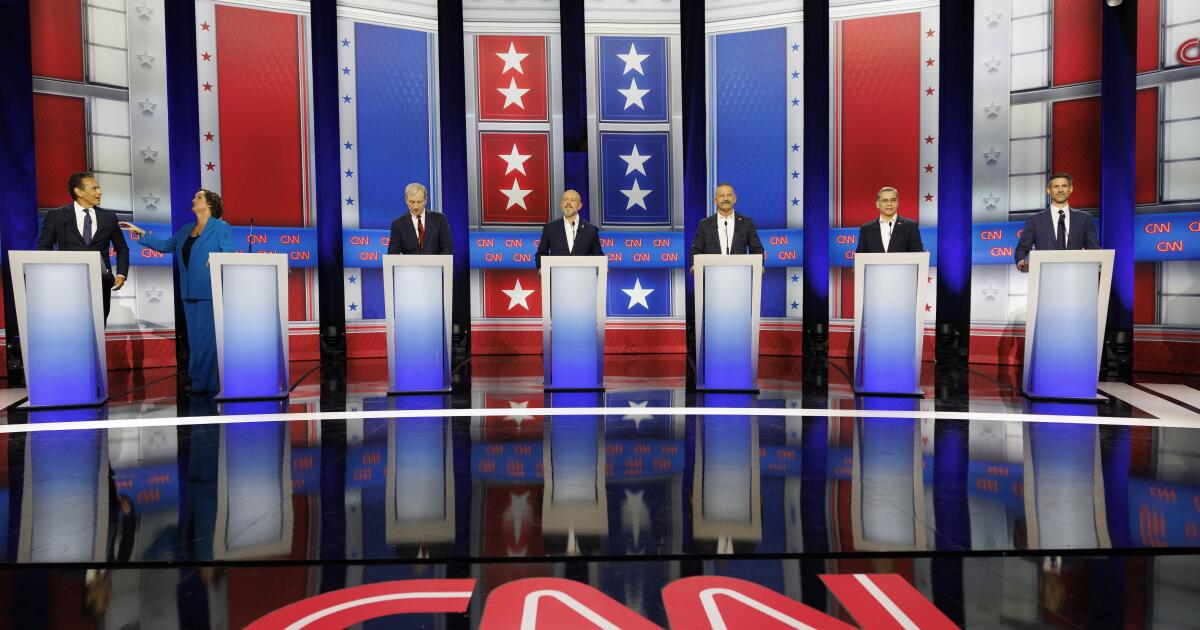
At a May 5 debate put on by CNN, Becerra declared his support for “Medicare for All,” a proposal for a federally run system that’s been stalled for years, but he declined to say whether he’d pursue a California-led effort. He said his immediate focus would be on mitigating the drastic federal cuts expected to hit low-income and disabled enrollees in Medi-Cal, the state’s Medicaid program, which covers more than a third of residents.

Becerra is counting on voters not to distinguish between the often-confused terms single-payer, Medicare for All, and universal coverage, noting during the debate that “Californians don’t care what you call it, so long as they have affordable healthcare.”

“A lot of people aren’t clear what single-payer is, and they need a metaphor to understand it,” said Celinda Lake, a Democratic strategist and one of the lead pollsters for former President Biden’s 2020 campaign.

Billionaire activist Tom Steyer, who’s touted his self-funding as a signal he can’t be bought, has emerged as the race’s most vocal advocate of single-payer after opposing it during a short-lived 2020 presidential bid. As governor, Steyer has said, he would pass legislation backed by the California Nurses Assn. that has failed to come to fruition under Newsom’s tenure. Pressed on how he would cover the estimated $731.4-billion cost, Steyer told KFF Health News that “God is going to be in the details.”

At a forum last year, former U.S. Rep. Katie Porter said she didn’t believe achieving such a system was realistic in the near term, but the Orange County Democrat later told party delegates that she would “deliver single-payer.” Former Los Angeles Mayor Antonio Villaraigosa and San Jose Mayor Matt Mahan, Democrats who are trailing their competitors in the polls, don’t support single-payer. The top two vote-getters — regardless of party — advance to the November general election.

Some of the most seasoned politicians have failed to deliver single-payer. Newsom, who campaigned on the promise of being a “healthcare governor,” dialed back his ambitions upon taking office, choosing instead to pursue “universal access” to health coverage under a series of Medi-Cal expansions and efforts to contain healthcare spending.

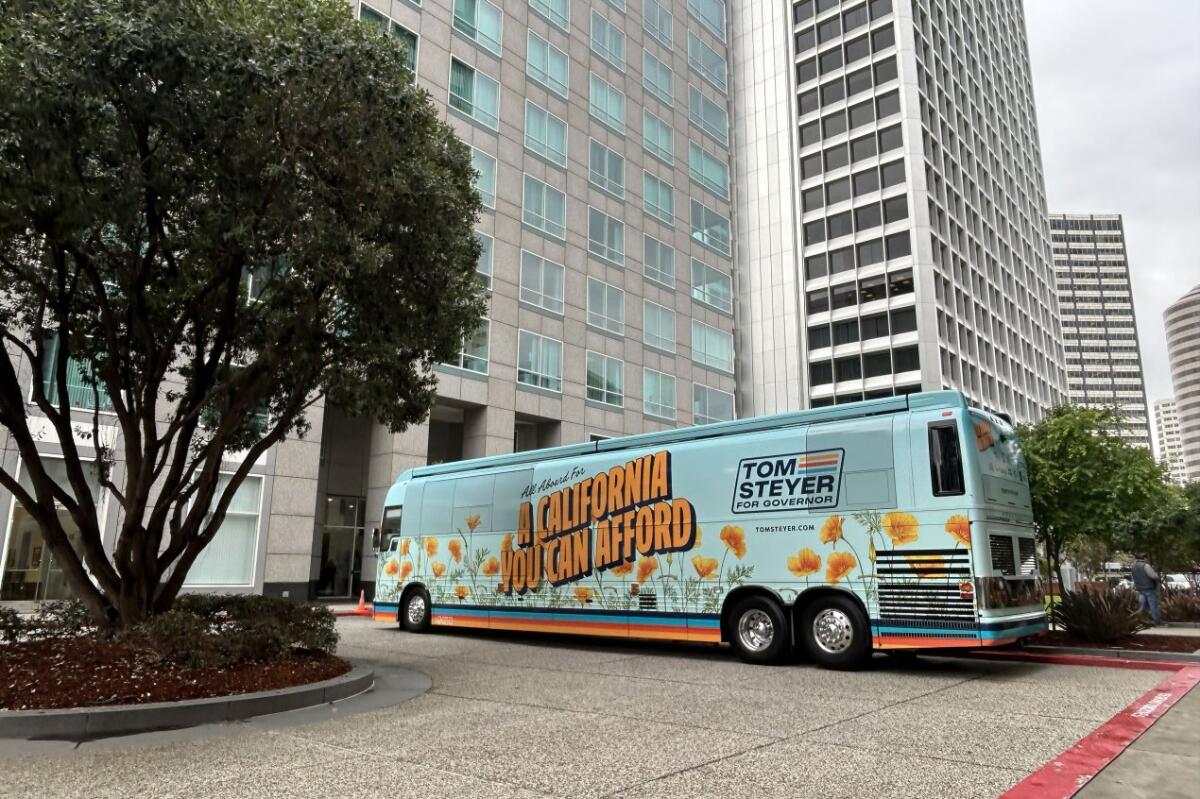
A bus with the message "All Aboard For A California You Can Afford" and "Tom Steyer for Governor" on its side is parked.

The campaign bus for billionaire activist Tom Steyer, who has made single-payer healthcare a central pillar of his run for governor, in downtown Oakland.

(Christine Mai-Duc/KFF Health News)

Vermont, which remains the only state to pass a single-payer healthcare law, reversed course when leaders there couldn’t identify a funding source.

To enact single-payer, California would need permission from the federal government to redirect billions of dollars from Medicaid, Medicare and other funding that currently flows to the system — approval not likely to come from the Trump administration.

More than half of adults nationally say healthcare costs will have a major impact on whom they vote for in November, according an April KFF poll.

Danielle Cendejas, a Los Angeles-based Democratic consultant who works with state legislative candidates, said single-payer healthcare increasingly appears on candidate questionnaires from small-business advocates as well as hyperlocal Democratic clubs, in state legislative races and national union endorsements. What most California voters want to hear, Cendejas said, is how candidates plan to give them more immediate relief from higher premiums, expensive drug costs and long waits to access care.

The high price tag doesn’t faze Jennifer Easton, a 63-year-old Democrat from Oakland, who said other countries with similar models have proved they can lower costs. She said she supports a single-payer health system because it’s clear to her that Americans have reached the limits of working within the existing system. But she isn’t expecting any of the current candidates to succeed in implementing one, and she hasn’t decided whom to support.

“No one can in four years,” she said. Seeing a candidate enthusiastically support the concept gives her a good idea of their philosophy. “It is, if we’re lucky, a 20-year, 25-year plan.”

Rob Stutzman, a Republican political consultant who advised former Gov. Arnold Schwarzenegger, said while Americans may be supportive of single-payer in polls, focus groups suggest that approval drops quickly when voters realize it could mean losing their current doctor or insurance plan.

At the CNN debate, Steve Hilton, the Republican candidate President Trump has endorsed, said Californians would end up with subpar patient care and “taxes sky high to pay for it,” like in his native United Kingdom. Instead, Hilton suggested the state stop providing “free healthcare for illegal immigrants who shouldn’t even be in the country in the first place.”

Mai-Duc writes for KFF Health News, a national newsroom that produces in-depth journalism about health issues and is one of the core operating programs at KFF—an independent source of health policy research, polling, and journalism.

Source link

Top takeaways from fiery, at times ugly, California governor debate

Democrat Xavier Becerra’s rapid rise in California’s race for governor made him a ripe and constant target during a combative nationally televised debate Tuesday evening, his first real test in a high-stakes election that remains highly volatile.

Becerra was ripped throughout the two-hour CNN debate, primarily by his Democratic rivals, who accused him of dodging questions about his stance on single-payer healthcare, falling short as a Biden Cabinet secretary and pocketing a campaign donation from Chevron.

“I think everyone’s invoking my name. It’s nice to hear my name quite a bit,” said Becerra, who served as the U.S. secretary of Health and Human Services during the Biden administration. “I will tell you this: Distorting the facts in your quest to be governor is never good, but using Trump lies to try to damage your opponents is worse, and that’s what we see happening.”

As ballots land in California voters’ mailboxes, the state’s seven top gubernatorial candidates clashed over immigration, President Trump, tax policy, political temperament and a hodgepodge of scandals, mudslinging and other unsavory actions that have risen to the forefront of the hotly contested race.

The snarky, sometimes petulant exchanges reflect how unsettled the race to replace termed-out Gov. Gavin Newsom is, as well as California’s outsize economic and political gravitas on the national and international stage.

Shortly after the debate began, former Orange County Rep. Katie Porter chastised her fellow candidates for their unceasing attacks.

“I can’t believe [the] interrupting and bickering and name calling and shouting and disrespect for everyone up here who’s stepping into public service that anyone wants to talk about my temperament,” said the former Democratic Congress member from Irvine.

Here are the top takeaways from a two-hour debate that somehow seemed even longer:

Becerra takes his lumps

Beccera, who has surged in the weeks before the June 2 primary, faced a barrage of attacks from his Republican and Democratic rivals about his oversight of unaccompanied immigrant minors during his tenure at the Health and Human Services Department and his relationship with a longtime adviser who, along with other consultants, skimmed about $225,000 from one of Becerra’s dormant campaign accounts.

Becerra is not accused of wrongdoing and has been painted as a victim in the prosecutor’s court filings. Still, conservative commentator Steve Hilton, a Republican, suggested Becerra knew about the scheme, and former Los Angeles Mayor Antonio Villaraigosa, a Democrat, questioned why Becerra paid an unusually high fee to one of the consultants named in the indictment.

“It doesn’t pass the smell test,” Villaraigosa said.

Becerra also was accused of changing his position on single-payer healthcare, a top priority of liberal voters that aims to create a healthcare system run and funded by the federal government.

Though Becerra has long supported single-payer healthcare, he recently assured members of the California Medical Assn. — one of the most influential medical lobbyinggroups in California, which has endorsed him — that he would not support it as governor, according to a KQED report.

When asked directly about this, Becerra said “those reports were inaccurate. I continue to be for Medicare for all.”

Becerra sidestepped repeated questions from Porter about whether he supported a state-sponsored single-payer healthcare system in California, saying that he wants to cover “everyone with something like Medicare for all.”

“Covering everyone with something is not single-payer. It’s not even federal Medicare for all. But you won’t say whether you support California having its own state-run single-payer system,” Porter said.

Single-payer healthcare is a telling issue

Democratic billionaire Tom Steyer also has taken heat for changing his position on the issue. The hedge fund founder turned environmental warrior opposed single-payer healthcare during his 2020 presidential bid and now supports a statewide single-payer system called CalCare. He is endorsed by the California Nurses Assn., one of CalCare’s biggest supporters.

A recent analysis by UC researchers estimates CalCare would cost $731 billion to implement in 2027 — a price tag that’s $14 billion larger than all anticipated healthcare spending in California next year.

Villaraigosa said creating a state-sponsored single-payer healthcare system — with a price tag larger than the entire state budget — is a “pie in the sky” proposal. He said he considers healthcare a human right but said a system such as CalCare would require approval from the Trump administration — and that’s not going to happen.

As a former British citizen, Hilton said he is the only candidate who has experienced government-run healthcare.

“As a patient, it nearly killed me,” he said. “That’s another story we don’t have time for. As a policymaker, you end up with the worst patient satisfaction, costs that you can’t afford, taxes, sky-high to pay for it. It is a total disaster.”

Race remains a toss-up

The 2026 gubernatorial contest has been an undulating, unpredictable whirlwind. Unlike every governor’s race for more than a quarter of a century, there is no clear frontrunner, leading to a sprawling field of candidates with notable resumes but little recognition among California’s 23.1 million registered voters.

On Monday, the state Democratic Party released its latest voter survey, which found Hilton and Becerra tied at 18%, and Bianco with 14%. Steyer received the backing of 12%, while support for the other top Democrats in the race — Porter, San José Mayor Matt Mahan, Villaraigosa and State Supt. of Public Instruction Tony Thurmond — was in the single digits. Thurmond did not meet the polling threshold to qualify for Tuesday’s debate or an NBC/Telemundo face-off taking place on Wednesday.

Tuesday’s debate with the leading candidates took place at East Los Angeles College and was hosted by CNN, the first time national media has paid such attention to a California statewide contest since 2010.

Partisan divide on immigration

On the debate stage in Los Angeles, a city that was targeted by Trump administration immigration raids, Bianco criticized California’s sanctuary state laws, which prevent local law enforcement from assisting with federal immigration enforcement.

Villaraigosa defended the undocumented immigrants residing in California, saying they are vital to the economic success of the state. He also accused Bianco of not understanding how California’s sanctuary state policy works — with the former Los Angeles mayor telling him that California has turned over thousands of undocumented immigrants convicted of crimes to federal immigration officials.

Bianco dismissed Villaraigosa’s comment immediately.

“I want Mr. Villaraigosa to tell the mother of the 14-year-old in my county that is dead because of an illegal immigrant that had been deported three times because of DUIs that sanctuary state policy keeps us safe. I don’t think she’s going to agree with you,” Bianco said.

Democrats Porter, Steyer, Mahan and Becerra accused the Trump administration of “terrorizing” Latino communities and targeting people for deportation based on the color of their skin.

Steyer said he would prosecute ICE agents “and the people who send them,” including former Homeland Security Secretary Kristi Noem and Trump advisor Stephen Miller, for illegal racial profiling.

Agreement on need for housing

On the issue of housing, the candidates agreed that California has fallen short of providing enough homes to make the state affordable. Mahan, the mayor of San José, said he has reduced the city’s homeless population by making it easier to build ADUs in people’s backyards, and by reducing red tape for additional types of housing.

Villaraigosa said he built more market-rate, affordable and workforce housing when he was mayor of Los Angeles than anyone else on the stage.

Hilton pressed for building single-family homes in areas of the state with space, rather than forcing more housing into places where residents don’t want them.

Steyer said, “Californians can’t afford to live here,” and there has to be a greater conversation about building more housing, and faster. He also said that cities and counties “do not want new housing” because they can’t afford to pay the health and education costs associated with more residents, and he will solve that issue by closing tax loopholes for big businesses.

Still, housing, homelessness and affordability — top-of-mind issues for California voters — overall received scant attention during the debate, even though CNN debate moderators Kaitlan Collins and Los Angeles-native Elex Michaelson pressed the candidates on the state’s incessant problems with affordability.

Steyer did use the affordability issue to criticize Becerra, currently his greatest political threat, for taking a campaign contribution from Chevron.

“Being in bed with oil companies is a mistake,” Steyer said. “Xavier Becerra has taken the max amount of money from Chevron, and he has said they’re good guys that we need. The truth of the matter is the oil companies are ripping us off at the pump. They’re polluting our air and they’re burning up the climate.”

Becerra responded that it was “a rich response from a guy who made his billions investing in fossil fuels and oil companies, in coal companies.”

“Now he makes the billions, and he has spent more than every other candidate combined in this campaign, using those profits to now try to buy his seat in the governor’s office,” Becerra said.

Where they stand on the proposed billionaire tax

A notable area of policy disagreement among Democrats is a proposal to levy a one-time 5% tax on the wealth and assets of billionaires. Supporters of the measure say they have gathered enough signatures to qualify it for the November ballot.

If approved, the funds would mostly pay for healthcare cuts approved by the Trump administration last year.

Porter said that, although she wants to increase taxes on the state’s wealthiest residents, she doesn’t support the proposal because it is a “one-time tax” that won’t solve the state’s underlying budget issues.

“Yes to a progressive tax code, yes to the wealthy paying more, but this tax is about cheap political points,” Porter said.

Steyer said he would vote for the tax, but he agreed that state leaders ought to go further, including by taxing corporate interests more.

Bianco agreed with Porter that the billionaire tax is a bad idea.

Villaraigosa said California relies too much on the its wealthiest residents to fill state coffers, which leads to “feast and famine” in its budgets. He said businesses and high-earners are leaving the state, and that a plan to tax the wealthiest Americans needs to be enacted at the federal level.

Republican vs. Republican

The two Republicans on stage appeared content to spend their time blasting the Democrats rather than each other.

Bianco was asked if he thought that Republican voters could trust Hilton.

“You’ve called Hilton unethical and dishonest and said that he swindled his way into the Republican side,” Collins said, citing an article from the Atlantic.

“I would never use the word swindled, but the context — yes, I have said that,” Bianco said after some back-and-forth about the particulars of his criticisms. “Have Steve and I disagreed? Absolutely we have.”

He avoided directly criticizing Hilton but said he was the only person on the stage “that their entire existence in their job revolves around honesty, integrity.”

Hilton swerved, saying voters cannot keep voting for the same thing — Democratic leadership — if they want to see change in the state.”

Times staff writers Dakota Smith and Doug Smith contributed to this report.

Source link