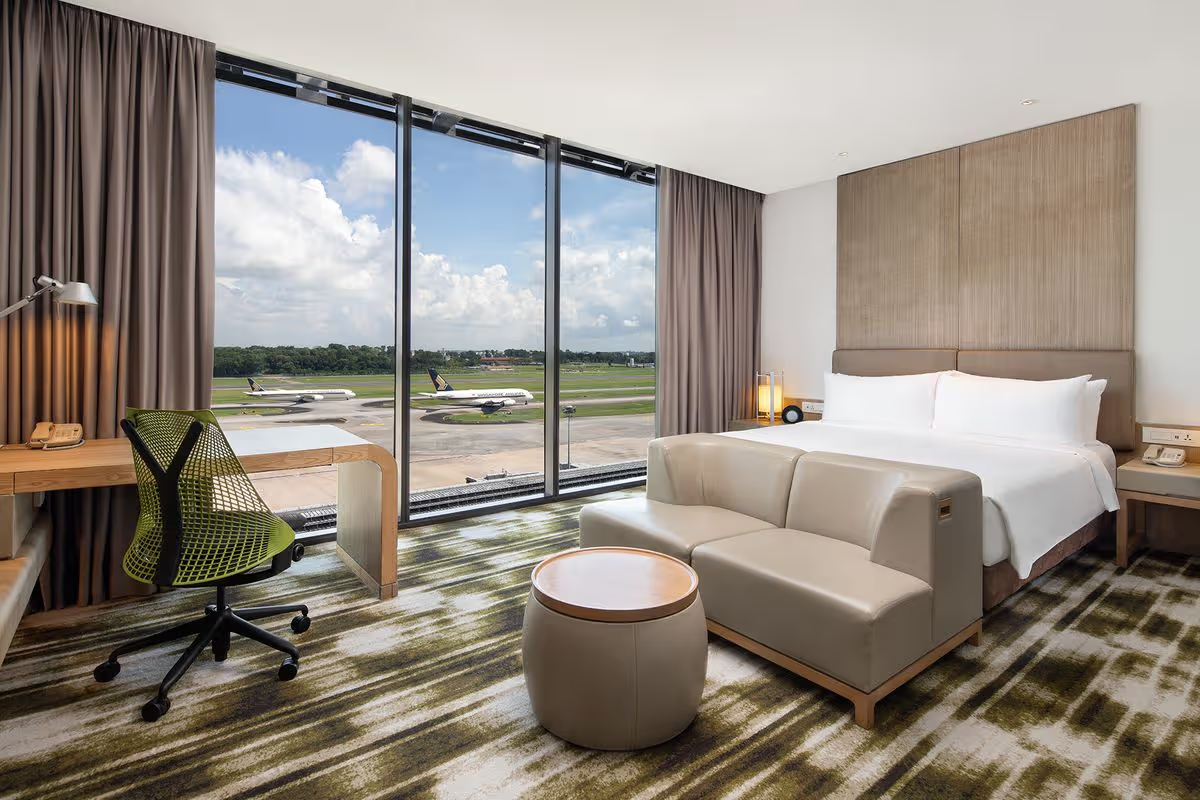
The same hotel has been crowned the best of its kind for 11 consecutive years, thanks to its connectivity, innovation, technology and the unusual experiences it offers
The hotel provides privileged access to its neighbouring airport
A five-star stay at one of the world’s busiest hubs has been named the best airport hotel in the world for the 11th consecutive year.
Skytrax’s 2026 World Airport Awards are commonly referred to as the “Oscars of the airport industry,” and are based on the largest annual airport customer satisfaction surveys in the world, which gather feedback from travellers across more than 550 airports.
This year, the awards have crowned the Crowne Plaza Changi Airport in Singapore as the World’s Best Airport Hotel yet again this year, in a ceremony at PTE World in London.
Pushing the boundaries of what is expected of a stereotypical airport hotel – business-focused, strictly practical and visually simple – the hotel transports guests into the world of aviation in more ways than simply by giving them seamless access to terminals.
Crowne Plaza Chang has aviation-themed family suites designed in collaboration with Kiztopia. There, kids can make their trip even more exciting by playing with plane-inspired spaces and interactive features.
For those looking for special experiences without having to venture into cities, the Crowne Plaza Changi also offers a range of curated experiences, from hands-on cooking to cocktail sessions: all part of the hotel’s Crowne Plaza Social feature.
And if you just want to kick your feet up and rest for the entire time you’re there, you’re also in for a treat with the wellness-focused routines called Daily Rituals, which are designed to help guests recover from travel.
But the hotel’s innovations don’t stop at interior design and experiences. It is the first hotel in Singapore to offer in-room NuCalm sleep technology in every room, making use of the patented neuroscience techniques for stress relief, better sleep, focus & recovery, and ensuring you wake up refreshed before or after that long flight.
If all of that wasn’t enough to justify its top spot on the ranking of best airport hotels, the Crowne’s location is another major highlight. It gives guests direct access to all of Singapore Changi Airport’s terminals and the impressive Jewel Changi Airport complex – so no need to stress about what time to catch the airport shuttle.
General manager Greg Gublani said: “We are deeply honoured to be named the World’s Best Airport Hotel by Skytrax for the 11th consecutive year. This remarkable milestone is a celebration of our incredible team and unwavering dedication to deliver True Hospitality every day. In addition to delivering unique experiences, our stays are designed to enrich guest journeys, bringing blended travel to life through curated experiences. – from Crowne Plaza Social, where guests engage in hands-on activities crafting fresh pastas and classic Negronis, to energising Daily Rituals that support well-being.”
Singapore Changi Airport itself once again topped the list of the world’s best airports for 2026, followed by Incheon International Airport in Seoul, Tokyo International Airport, Hong Kong International Airport and Narita International Airport in Greater Tokyo.
Weekly insights and analysis on the latest developments in military technology, strategy, and foreign policy.
In a follow-up to our recent story about a pair of U.S. Navy Independence class Littoral Combat Ships (LCS) configured for minesweeping appearing in the Pacific, those vessels have now moved further east from Malaysia to Singapore. USS Tulsa and USS Santa Barbara remain thousands of miles away from their primary assigned operating area in the Middle East, where the conflict with Iran grinds on. The highly strategic Strait of Hormuz notably remains closed to normal maritime commerce due to Iranian attacks. Though the regime in Tehran does not yet appear to have employed naval mines to a large degree in the Strait, this remains a major threat that will factor into any plans to reopen the critical waterway.
As to why the Navy sent two of its three mine hunters in the Middle East not just out of the line of fire, but literally across the globe at a time when the U.S. and its allies could be facing the mining of one of the world’s most critical waterways remains a mystery.
U.S. Naval Forces Central Command (NAVCENT) has confirmed to TWZ that USS Tulsa and USS Santa Barbara are in Singapore. Last year, the Navy sent Tulsa and Santa Barbara, as well as a third Independence class LCS, the USS Canberra, to Manama in Bahrain in the Persian Gulf. Canberra‘s current location remains unclear. All three ships were explicitly sent to the Middle East to fill capability and capacity gaps left by the decommissioning of four Avenger class mine-hunters that had been deployed in the region for decades beforehand.
Local spotters had already caught the two LCSs arriving in Singapore earlier today. Authorities in Malaysia had previously confirmed that the LCSs had left the Port of Penang in that country on March 16. Singapore is a city-state that lies roughly 370 miles southeast of Penang.
USS Santa Barbara (LCS 32) and USS Tulsa (LCS 16) Independence-variant littoral combat ships coming into Singapore – March 18, 2026 SRC: INST- yplanesonly pic.twitter.com/SahGsKy6yW
USS Tulsa (LCS 16) Independence-variant littoral combat ship coming into Singapore – joining USS Santa Barbara there – March 18, 2026 SRC: FB- Military Aviation Photography Singapore pic.twitter.com/dElkABOeyD
“Tulsa and Santa Barbara are conducting scheduled maintenance and logistics stop in Singapore. The U.S. and Singapore navies have an excellent and longstanding defense relationship,” a NAVCENT spokesperson told TWZ. “A testament to this relationship is the agreement to allow littoral combat ships to operate primarily from Singapore as a logistics and maintenance hub, as well as supporting regular port visits and logistics stops for other U.S. ships.”
NAVCENT had given TWZ an almost identical statement when asked previously about the arrival of the LCSs in Malaysia:
“Tulsa and Santa Barbara are conducting brief logistical stops in Malaysia. U.S. forces routinely make port calls in Malaysia as part of our operations, reflecting the close and enduring military cooperation between the United States and Malaysia.”
“These stops allow for logistical arrangements such as replenishments,” Malaysian Defence Minister Datuk Seri Mohamed Khaled Nordin separately told the New Strait Times newspaper yesterday. “Any foreign naval vessel must submit a request through its country to the Royal Malaysian Navy, which forwards it to the Foreign Ministry for approval.”
15 Mar – Two US Navy Littoral Combat Ships (LCS) that were assigned to mine-countermeasure (MSM) missions in the Persian Gulf are currently docked at Butterworth in Malaysia.
When Tulsa and Santa Barbara left the Middle East, to begin with, is unclear. There is no evidence of any U.S. warships having been in port in Bahrain since at least February 23, five days before joint U.S. and Israeli strikes on Iran began. Manama was almost immediately subjected to retaliatory attacks, making clear that sending American vessels elsewhere was, broadly speaking, a prudent security measure.
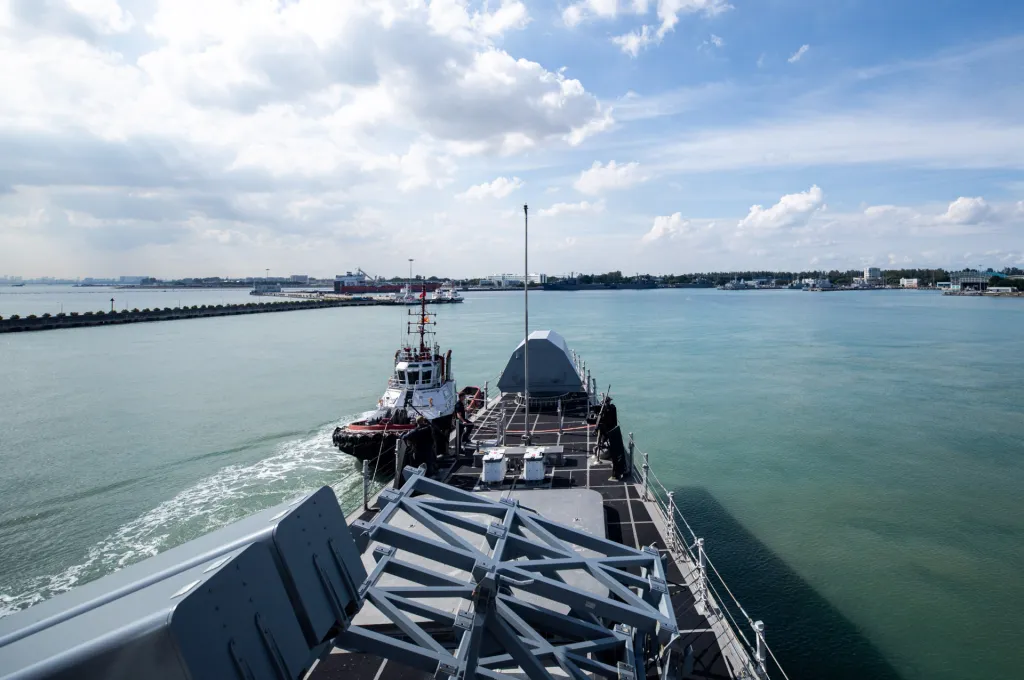
How long Tulsa and Santa Barbara will remain in Singapore, and where they might head to next, remains to be seen. As NAVCENT’s statement noted, Singapore’s Changi Naval Base has been a hub for forward-deployed LCSs in the Indo-Pacific region. U.S. naval vessels, in general, regularly make port calls there, including for maintenance.
A view from the USS Tulsa as it arrived for a visit to Changi Naval Base back in 2021. USN
As an aside, online ship tracking data indicates that the America class amphibious assault ship USS Tripoli and the San Antonio class amphibious warfare ship USS New Orleans are also now sailing through the same general area. The Tripoli Amphibious Ready Group (ARG) is reportedly on its way to the Middle East, loaded with Marines, as you can read more about here.
⛴️🇺🇸|🇮🇩🇲🇾🇸🇬 USS Tripoli (LHA-7) and USS New Orleans (LPD-18) have been detected approaching the Singapore Strait.
Additionally, two Littoral Combat Ships USS Tulsa (LCS-16) and USS Santa Barbara (LCS-32), have been detected in the Strait of Malacca after departing Bahrain. pic.twitter.com/RSQlViD4qC
Regardless of where they might head next, Tulsa and Santa Barbara have now moved even further away from their assigned station in the Middle East. This, in turn, means that two of three mine countermeasures ships that are supposed to be forward-deployed in that region, at least, are currently in an entirely different part of the world. Whether any other LCS or other ships configured for the mine countermeasures mission have been deployed closer to the Middle East, or are now on their way, is unknown. There are only four other Avenger class ships still in Navy service, all of which are in Japan and have been slated for decommissioning in the coming years.
A stock picture of an Avenger class mine hunter seen here during an exercise. USN
Generally speaking, the Independence class LCS is a far more advanced ship, overall, than the Avenger class mine hunter. When suitably equipped, the LCSs also offer new standoff mine countermeasures capabilities, including uncrewed mine-sweeping drone boats and helicopter-borne systems. It should be noted that the Navy had originally planned for both Independence and Freedom class LCSs to be readily configured and reconfigured for different operational needs using an array of different mission packages, or ‘modules.’ The service now deploys LCSs in static configurations.
The USS Canberra, one of the three LCSs forward-deployed to the Middle East last year to take over mine-sweeping duties. Seen in the background is a heavy lift ship bringing the four decommissioned Avenger class mine hunters from Bahrain back to the United States. USN
Still, questions continue to be raised whether LCSs fitted out for the mine countermeasures role are adequate replacements for ships purpose-built for this mission set, as you can read about in much more detail in our past reporting. Mine-clearing operations are complex and slow-going affairs that carry significant risks even in optimal conditions in benign environments.
As noted, Iranian naval mines have yet to make a major appearance in the current conflict. U.S. officials have largely downplayed the mine threat, especially when compared to the active ongoing attacks Iran has been launching on commercial ships in and around the Strait of Hormuz using drones, missiles, and uncrewed boats.
That being said, “we defend all these countries and then, ‘do you have any minesweepers?’ And they say, ‘Well, would it be possible for us not to get involved?’” U.S. President Donald Trump said earlier this week in response to a question from a reporter about the current conflict with Iran. This suggested that American officials had at least asked allies and partners about the possibility of them providing additional naval mine countermeasures capabilities to the region. If so, this is somewhat puzzling, coming as the Navy had sent the two LCSs to another hemisphere.
Trump:
We have 45,000 troops in Japan, 45,000 in South Korea, and 50,000 in Germany.
We defend all these countries, and then: “Do you have any minesweepers?”
Trump had previously appealed publicly for assistance, in general, in reopening the Strait of Hormuz, but had been soundly rejected by a number of countries. The President then said yesterday that any help was no longer required.
“I wonder what would happen if we ‘finished off’ what’s left of the Iranian Terror State, and let the Countries that use it, we don’t, be responsible for the so called ‘Straight?’ [sic],” Trump then wrote just earlier today in a post on his Truth Social site. “That would get some of our non-responsive ‘Allies’ in gear, and fast!!!”
Trump: “I wonder what would happen if we ‘finished off’ what’s left of the Iranian Terror State, and let the Countries that use it, we don’t, be responsible for the so called ‘Straight?’ That would get some of our non-responsive ‘Allies’ in gear, and fast!!! President DJT” pic.twitter.com/pwbF1lYELS
In an interview last Thursday with CNBC, U.S. Energy Secretary Chris Wright had said the prospect of U.S. Navy warships escorting commercial vessels through the Strait of Hormuz was still weeks away, at best. TWZ previously explored how risky such an operation would be, given Iran’s ability to turn the waterway into a super weapons engagement zone where mines would be just one of many concerns.
The fact that USS Tulsa and USS Santa Barbara have moved even further from the Middle East only underscores questions about what the U.S. government’s line of thinking might be now about how to get maritime commerce flowing again in and out of the Persian Gulf.
Tourism consultant David Evans has warned that the cost of flying is likely to rise sharply
Expert David Evans warned that the cost of flying could soon surge
A travel expert has advised folks to snap up flights now in anticipation of a predicted ‘surge’ in airfare costs. Tourism consultant David Evans revealed that aviation fuel prices have rocketed by 70 per cent in the wake of the US-Israeli strikes on Iran.
Speaking on BBC Radio 5 Live, he suggested that this could soon make flying considerably pricier. This situation is likely to be compounded by the financial strain many airlines are under due to the cancellation of numerous flights amid the unrest in the Middle East.
When asked by host Rachel Burden whether people should book now before flight prices soar, Mr Evans responded: “If you can get a flight that you feel is offering you a really good value-for-money price and it is via somewhere like Singapore (then yes).
“It’s also worth bearing in mind that, once all this blows over, which hopefully won’t be too far off, the Middle Eastern airlines will undoubtedly be introducing some attractive fares into the market to try and recoup the demand they’ve lost over the past few weeks.
“According to the data we’ve seen, the cost of jet fuel has risen by about 70 per cent. Fuel accounts for roughly a quarter of an airline’s operating cost, so the maths are pretty straightforward – if the fuel price is climbing that much, it won’t be long before air fares start to rise. If this carries on for many more weeks, travelling is likely to become more expensive.”
Mr Evans’ remarks follow revelations that holiday-goers are eschewing Easter trips to traditionally favoured destinations such as Cyprus, Turkey, and Dubai, opting instead for western locations like Spain, Italy, and Portugal, as well as the Caribbean and Mauritius. According to Thomas Cook, bookings to Portugal saw a 42 per cent surge in the fortnight leading up to 13 March.
British Airways has axed some Middle East flight routes until June due to ‘airspace instability’, whilst the UAE and Dubai have been compelled to repeatedly shut down both airports and airspace following retaliatory Iranian strikes. Iraqi officials reported that Iranian strikes over the country on Monday (March 16) were the most intense they had seen throughout the entire war.
Content cannot be displayed without consent
“I think the announcement from BA is probably good news in that it gives those people who would otherwise have been in complete limbo thinking, ‘crikey, is this situation going to improve or not over the next few months’ – now they know their flight is cancelled, they can either rebook on a different route or they can get a refund and use the money to either holiday domestically or to go to a different destination, so at least it provides certainty,” Mr Evans added.
“I guess we could say that the 2020s have been a bingo card of doom and this is the square for 2026, but it is also worth saying that the tourism industry and indeed tourists are incredibly resilient.
“Yes, clearly many people are being disrupted if they had either to or from the UK to or via the Middle East, but there are lots of other destinations that are still open for business and lots of other visitors able to get to the UK very easily.”