sidewalks

From South L.A.’s erupting sidewalks, 5 questions for Bass and Raman

OK, I’ll admit it. I’m going to miss Spencer Pratt.

I had never heard of the former reality TV star before he said God wanted him to be mayor of Los Angeles. And now that he’s out of the race, he’s still serving up lazy fastballs down the middle of the plate, calling the top two vote-getters — Mayor Karen Bass and Councilmember Nithya Raman — dummies and morons.

Quick question for Pratt: If you’re on record claiming that 9/11 was an inside job and the Sandy Hook massacre was a hoax, and you run for office in a deep blue city with President Trump’s backing but not much of a plan or even a clue as to what a mayor can or can’t do, should you be calling other people morons?

And yet the pouting Pratt pulled more than 200,000 votes. So sore loser or not, he tapped into a lack of faith in elected officials and simmering frustration with City Hall, which happen to be the essence of today’s column.

I have five questions for Bass and Raman. They’re somewhat inter-related and have to do with matters I hear about regularly from readers:

Infrastructure (sidewalks, streets, etc).

Homelessness (billions of dollars spent, and a long way to go).

Parks (L.A.’s national ranking for quality and accessibility just dropped again).

Trash and blight (no explanation needed, right?).

And focus. (Do the candidates have a clear set of goals and a plan for achieving them?)

We’ve got five months to visit and revisit these topics, and today I’m going to focus on the first, so here we go.

Infrastructure:

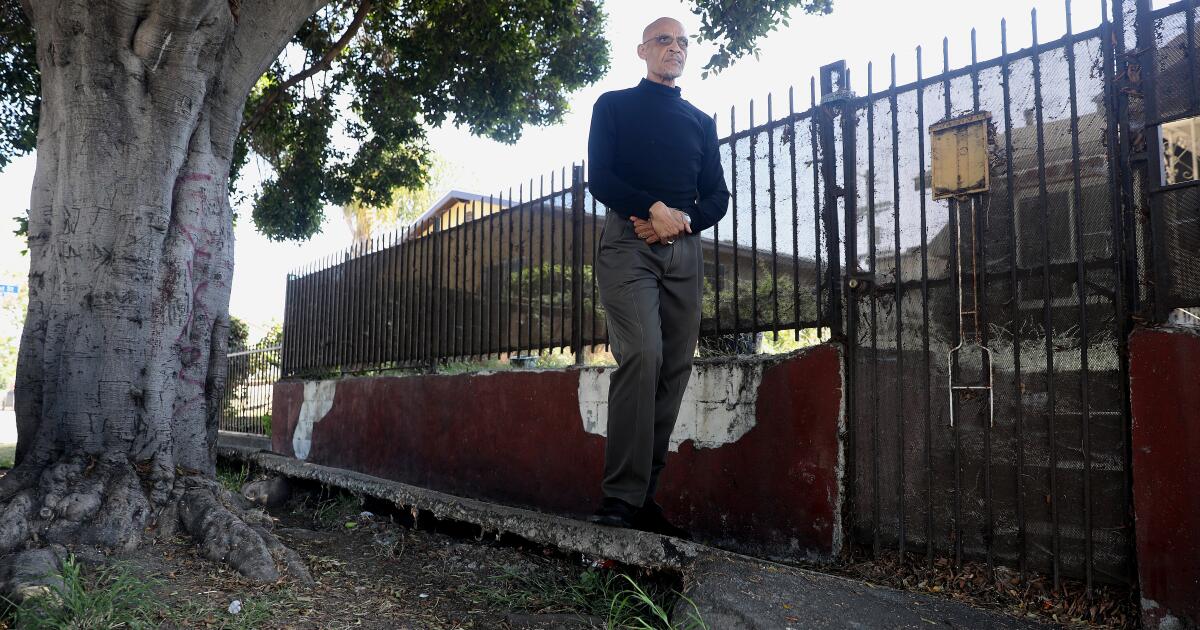
A few days ago, I met with Earl Ofari Hutchinson of the Los Angeles Urban Policy Roundtable. Hutchinson is a longtime community activist and commentator, and he had just launched a torpedo in the direction of City Hall.

“There are hundreds of busted, dangerous sidewalks in South L A that have gone unrepaired for years,” he wrote to his network of followers. “They cause hundreds of injuries, and have resulted in massive numbers of claims and payouts in settlements. LA City Officials must act now to jumpstart a crash program to fix these sidewalks.”

On my way to meet Hutchinson, I traveled west along Florence Avenue and saw dozens of typical rough patches on the street and sidewalks. But if there were a contest to identify the all-time worst sidewalks in Los Angeles, Hutchinson’s discovery of the one at 71st Street and 11th Avenue would be a Hall of Fame contender.

For starters, it’s got the classic uplift, and the villain is the usual suspect — ficus tree roots. A 20-foot slab of sidewalk is pitched sharply, as if designed by trip-and-fall lawsuit lawyers. Way back in 2014, in my early days on sidewalk patrol, I was able to crawl under a similarly ruptured sidewalk in West L.A., and I could’ve done the same at 71st and 11th.

But I thought better of it after Hutchinson peered into the opening and said it looked like a comfy home for rats and other vermin.

The homeowner, Sharon Kelly, can’t use her front gate because of the lopsided sidewalk. She let me borrow her tape measure, which revealed a 16-inch rise in the pavement.

“It keeps rising,” Kelly said. “But it was already lifted when we came here.”

That was in 1997. I asked if she’s called the city for help.

“Several times,” she said, and the only response was a slapdash temporary asphalt patch.

Hutchinson said residents have responded in force to his call for emergency sidewalks repairs, just as they did when he crusaded for a crackdown on widespread illegal dumping.

“Dozens of residents have come out of the woodwork, and here’s what they all say: ‘We have called our city council person and various city departments repeatedly, over and over again.’”

And the response?

“Nothing,” Hutchinson said.

While we were talking, two people with walkers steered clear of the worst spot near Kelly’s property. Charles McQuarn, 77, said traversing the neighborhood means zigzagging around all the hazards.

“I gotta come out into the streets, too,” he said.

When he was a teenager, McQuarn said, he worked for a community group that fixed sidewalks. I mentioned that Councilmember Monica Rodriguez has been using Conservation Corps youths to do the same, but it’s time to scale up that program and come up with other remedies to speed the process.

The city is fixing about 600 sidewalks each year, the backlog of requested repairs stands at about 30,000 and if you get onto the waiting list, you’re looking at about 10 years before help arrives.

When we were done on 71st Street, Hutchinson led me over to a nearby stretch of Florence where, for blocks and blocks, it appears as if there have been volcanic eruptions around the trees. Large chunks of cracked sidewalk form mounds, one after another. The Hutchinson Himalayas are a site to behold — a mile-long museum of municipal neglect.

And it’s been like this, Hutchinson said, “for years.”

The question for Bass and Raman: What will you do to speed the repairs?

Homelessness:

Voters have been generous when it comes to repeatedly taxing themselves more, and more, to address homelessness. There’s been Measure H, Measure A, Measure ULA and Proposition HHH.

Yet although billions of dollars have been spent and tens of thousands of people have been helped and housed, more than 40,000 people are homeless in the city and roughly 70,000 in the county. In her primary victory speech, Bass said families shouldn’t have to step around encampments, and Raman has said greater urgency is needed.

Questions for Bass and Raman: Why haven’t taxpayers gotten more for their money with the two of you at the helm, what are you going to do to speed progress and create more accountability, and what distinguishes you from each other?

Parks:

In the annual rankings by the National Trust for Public Lands, Los Angeles has dropped from 90th to a tie for 93rd in park investment and accessibility among the nation’s 100 most populous cities.

The City Council is about to consider a motion to increase park funding through charter reform (with dozens of community groups in support), and progress is ridiculously slow on an agreement to use schools as after-hours playgrounds.

Question for Bass and Raman: Do you support the charter reform, and what else are you going to do to address the sad state of the city’s parks?

Trash and blight:

In downtown L.A., vandalism, shuttered storefronts and post-COVID abandonment have crippled what was a vibrant, revenue-generating economy that benefited the whole city.

In Hollywood, a resident hired her housekeeper to help report illegal dumping of goods that are often used to construct more homeless encampments, leading to all sorts of problems.

On the south lawn of City Hall, a graffiti-tagged monument and fountain have been out of commission for most of the last six decades.

Question for Bass and Raman: At the very least, can you fix the fountain?

Focus:

Like any big city with great assets and unlimited challenges, many residents have a love-hate relationship with L.A. But years ago, someone told me he loves Los Angeles because it’s a messy, multi-cultural work in progress, set on a dramatic landscape between mountain and sea, trying to figure out what it wants to be.

Question for Bass and Raman: Whether in the realm of basic services or grand visions, what three or four primary objectives do you have over the next four years?

In other words, what do you want L.A. to be?

steve.lopez@latimes.com


Source link

Cracked L.A. sidewalks are a symptom of a bigger breakdown

When I wrote last week about one of my favorite mountain ranges — L.A.‘s sidewalks — I immediately began fielding questions.

People wanted to know about the scoring system that awarded just 15 points, out of 45, to John Coanda and his wife, Barbara, who uses a wheelchair because of ALS. The Mar Vista couple had applied to the city’s Safe Sidewalks program to have some busted-up sidewalk in front of their home repaired.

With several sidewalk hazards on both sides of their block, Barbara can’t safely make it down her street. So how is it possible that under L.A.’s “Sidewalk Repair Program Prioritization and Scoring System,” their meager 15 points means they could be waiting “in excess of 10 years” for help?

I have the answers.

The Coandas got 15 points for being in a residential zone. But they didn’t meet the requirements for getting two additional awards of 15 points. They do not live within 500 feet of a bus or transit stop. And they had not been in the sidewalk repair backlog queue for more than 120 days.

It is not clear, however, that moving up to a score of 30 will bring out city work crews in less than 10 years. Knowing what I know, I wouldn’t bet on it.

The scoring system exists because in a lawsuit settlement 10 years ago, the city agreed to spend $1.4 billion over 30 years to repair damaged sidewalks and other infrastructure failures that impede the mobility of people with disabilities.

But there’s a backlog. A huge backlog, in the thousands. At my request, the city disclosed on Friday that it’s receiving about twice as many new disability-access repair requests each year as it’s addressing. In addition, the backlog for disability access requests and from residents applying for a sidewalk repair rebate program stands at roughly 30,000, with about 600 repairs being made each year.

As I said in a previous column, L.A. might indeed be all buttoned up by the ‘28 Olympics, but that would be 3028, not 2028.

Cracked sidewalks, to be clear, are but a symptom of a deeper, decades-long breakdown at City Hall. Basic services have been sacrificed to pay for employee compensation and pension costs the city can’t afford, with homeless services adding to the budget crisis.

By the way, I heard from one reader in response to my suggestion last week that if you can’t wait 10 years or more for the city to fix a broken sidewalk, you can apply to the rebate program, which will cover a portion of repairs. Don’t bother, said Lori Lerner Gray, who owns a house in Silver Lake and applied two years ago, but finally gave up.

“There is a massive waiting list and it’s a very complicated procedure just to try to get on it, let alone speak with anyone to help,” Gray said. “Once you finally get into the program, it’s impossible to proceed because of permits, engineering reports and finally you are required to bring the entire area to ADA compliance on your own dime.”

She said she was told she’d have to pay to relocate a utility pole.

And sidewalks aren’t the only infrastructure problem, as other readers noted. The city is way behind on filling potholes, repaving streets, installing curb ramps, making park improvements and replacing broken lights. I recently wrote about all the blight around City Hall, including the graffiti-tagged monument and fountain that has been inoperable for most of the last 60 years.

Oren Hadar, a Mid-City resident who writes about housing and transportation on his The Future Is L.A. website, reported last year in a Times op-ed that city streets were falling apart because the city had switched from repaving entire roads to doing what it called “large asphalt repair.”

With the switch, the city avoided federal requirements to upgrade curb ramps on repaved streets, Hadar said. He told me that when he travels to other cities near or far, “I’m always jealous of everything. Sidewalks are in better shape or there are better bike lanes. … You could go to even Santa Monica or Culver City. You don’t have to go far to see infrastructure that’s better.”

Other major cities have had formal infrastructure plans for years, while L.A. has ducked and dithered. Finally, earlier this month, Mayor Karen Bass introduced the city’s long-awaited CIP (capital infrastructure program), and offered a brutal assessment of what went wrong.

“For too long,” she said in the executive summary, “information has been scattered across departments, buried in lengthy reports and budgets, and difficult to fully understand. These challenges have had real consequences, contributing to decades of underinvestment in our built environment.”

The summary reads like an indictment of City Hall leadership and the manner in which public spaces have deteriorated. With Bass running for reelection, voters have to decide whether her role in those failures is grounds for dismissal, or her campaign-season pitch for a new day should help earn her a second term.

The report, with backing by members of the City Council, cited “fragmented systems and data silos,” “no shared vision across city departments,” “growing maintenance deferrals,” “slow, inefficient capital planning,” no “project intake standards,” “highly decentralized and uncoordinated grants,” “resource planning and staffing misalignment,” and “opaque capital planning process.”

Way to go, team.

You could take many of those same critiques and apply them to the haphazard way in which city and county leaders have addressed homelessness.

However, the city’s infrastructure plan does offer a framework for assessing the damage and prioritizing projects, and using charter reform to create a public works director position with greater authority. None of this will happen quickly, and given the budget crunch, you might be wondering how any of this would be paid for.

The suggestions in the report include bonds, a parcel tax, grants, fees on tickets to concerts and sporting events, fees on taxi and rideshare trips, and much, much more. None of this will be popular, especially if the public is unconvinced that city leaders can be trusted with more money.

Urban planner Deborah Murphy, chair of the city’s pedestrian advisory committee, noted that L.A. has gotten grants or state funding in the past for specific projects and then, because of staffing shortages or other stumbles, failed to hold up its end of the deal.

“It kind of ruins our reputation for getting future money,” Murphy said.

Jessica Meaney, executive director of Investing in Place and a longtime advocate for the infrastructure plan, is thrilled that the city has finally taken this step.

“But the key question is: who is actually in charge of making it happen?” she asked.

It’s critical, Meaney suggested, for city leaders to push for charter reform that puts infrastructure authority under a newly empowered public works director. If the city gets this right, she said, implementation of the infrastructure plan “could finally show Angelenos the true scale of deferred maintenance, make trade-offs visible, and create a road map for better sidewalks, streets, parks, and accessibility.”

If the current fragmented authority remains in place, Meaney said, the headline would be:

“No one is in charge of your sidewalk and City Hall is determined to keep it that way.”

steve.lopez@latimes.com

Source link