shops

Major UK airport to get new £30million upgrade with more shops, seating and even a ‘hidden speakeasy bar’

WORK has officially begun on a major expansion project at a regional airport in the UK.

Bristol Airport has started its £30million upgrade with a new two-floor extension to connect the existing terminal and the departure gates.

Bristol Airport has started work on its £30million upgradeCredit: Farrans

The airport upgrade will include 17 new shops and restaurants including premium brands and a hidden speakeasy bar in the terminal.

Overall floor space at the airport will nearly double (45 per cent increase) as well.

In the newly created floor space, there will be more seating as well as the new ‘island’ shops, meaning shops will not just be at the edges of the terminal.

When it comes to arrivals, there will be a new reclaim area with an additional baggage carousel.

Read more on travel inspo

GO ON

All the little-known websites for cheap or FREE tickets to gigs, theatre & festivals


HOL YES

I’m a travel editor & mum-of-3… my favourite family holidays from just £3pp a night

When it comes to accessibility, the assisted travel lounge will double in size with new tables.

It will be located near the middle of the departure lounge and also have accessible toilets and a changing places facility.

A baby feeding room will be added as well.

Accessibility will be improved to the immigration area too, with new stairs and lifts.

The transformation to the airport is set to take place over the next three years and is part of a wider £400million investment plan to transform passenger experience at the airport.

By the end of it, the airport will be able to cater for up to 12million passengers, up from 10million currently.

The airport already has completed a number of improvements as well, such as “next generation security” and a new Public Transport Interchange with bus stops, bus bays, a car park and a larger M&S supermarket.

The departure lounge also has a new executive lounge called Escape.

Andrew Goodenough, Infrastructure Director at Bristol Airport said: “We have ambitious plans to transform our customer experience over the next couple of years, and we really appreciate our customers’ patience and understanding while all of these massive improvements are taking place.”

There will be 17 new shops as well as a ‘hidden speakeasy bar’Credit: Farrans

Gerard McNamee, Project Manager at Farrans – the building and engineering firm carrying out the works at the airport – said: “This is an exciting project which will be completed in a live environment in which all passenger routes need to remain open at all times.”

Last year, the airport announced how as part of its upgrade, it hopes to offer flights to the east coast of America and the Middle East in the future.

The airport is also planning to increase the number of flights from 85,990 per year to 100,000, which would mean an additional 35 flights per day in the peak season.

While the airport is planning to keep its night restrictions, it does want to increase night flights to 1,000 a year, which would mean four per night in the peak season.

In other airport news, a major airport could become the second biggest in the UK thanks to huge expansion plans.

Plus, these are the best and worst airports in the UK – with a regional airport coming in number one.

The project is expected to take three years to completeCredit: Farrans

Source link

Stunning views, honesty shops and community pubs: people power on the Llŷn peninsula in Wales | Wales holidays

Cliff is sitting in his farm truck scanning the hillsides with powerful binoculars. “It’s the rams,” he says. “They can stray at this time of year.” I follow his direction of gaze, down a golden hillside covered in bracken and boulders to a dark patch in the valley bottom. “Hopefully not down there,” he adds. “That’s the quaking bog.”

Sometimes a chance encounter can transform your appreciation of an area, and that is about to happen for me. I’m heading up Craig y Garn mountain to catch the sunrise over the Llŷn peninsula and the first rays are already stealing over the tops of distant Cadair Idris, rousing giant shadows from under the trees. Cliff, who also happens to be my landlord for the week, points to the house on a hill above the bog: “Where you’re staying was my great-grandmother’s house – or at least what is now the living room. She kept one pig, one sheep and one cow, and made buttermilk where the conservatory is.”

Llyn peninsula

Below the house, mostly out of sight, is the local village. “There used to be a pub and a shop. The school had 150 in it when I was there 70 years ago.” He grins. “I didn’t speak a word of English till I was seven.”

The tale of decline in rural amenities is a common one, but I am here to investigate an area that is pushing back hard. The Llŷn is leading the way in opening community pubs, restaurants, cafes and shops, facilities that, combined with the Wales Coast Path, make it a great area to explore.

For Cliff, the rural decline was a family lived experience. “Great uncle Bob left on a ship from Caernarfon in 1900 and joined the Klondike goldrush. Lots of people here were slate miners so could get jobs in North America.”

In fact, throughout the late 19th century, parts of Wales were gripped by emigration fever. Posters went up advertising passage on “fine fast-sailing barques”, usually with a “ballast of slates”. After many adventures, great uncle Bob settled in Whitehorse, in Canada’s Yukon, and is buried in its Pioneer Cemetery.

Kevin Rushby on Craig y Garn. Photograph: Kevin Rushby

I leave Cliff and run up to the summit. The shadow giants have all disappeared, but the view is still dazzling, a reminder that the Llŷn is an extraordinary place. To the east, Yr Wyddfa (Snowdon) is white with ice. Looking west, I can see the Irish Sea on both sides and on the north coast a trio of conical mountains, like volcanic plugs. The tallest, Garn Ganol (561m), is an extraordinary granite intrusion that was once a busy mining area, one of only two sources in the world for curling stones. Nearby is one of the first-ever community pubs in Britain, the Tafarn y Fic, established in 1988, where I aim to finish my first walk.

I start right under Garn Ganol peak, heading down a steep and spectacular valley towards a shingle beach and the village of Nant Gwrtheyrn. The settlement was abandoned when the mines closed, but local doctor Carl Clowes set about reviving it as a cultural centre in 1978, with courses in the Welsh language. (The doctor’s cultural impact didn’t stop there: two of his sons played in the rock band Super Furry Animals, a big part of the Welsh musical renaissance of the 1990s.)

From the beach, the path winds up over a headland to St Beuno’s chapel near the hamlet of Pistyll. This simple church is more like an ancient sacred cave with its bare stone walls and straw-covered floor. From here, I loop back over the hill to Tafarn y Fic in Llithfaen.

Tafarn y Fic in Llithfaen was bought by locals in the 1980s to prevent it closing down

Back in the 1980s, this village was in decline, but its relative isolation proved a vital factor in triggering community action. With alternative pubs and shops a long drive away, the defunct Victoria Hotel (the “Vic”, which transliterates as Fic in Welsh) was bought out by locals and reopened. When I drop in for a pint, there are teenagers playing pool and darts while a couple of locals are working on their laptops by the fire. Across the road is a community shop.

The pioneering Tafarn y Fic proved an inspiration to other villages in the area. My next walk is along the south coast from the village of Llanystumdwy, where Tafarn y Plu (The Feathers) stands. Here, they have a fun little honesty shop outside and a stage for concerts. “It got so busy last summer that we ran out of beer,” the barmaid tells me. “Luckily, all the other community pubs sent barrels over.”

Llanystumdwy is famous for its most successful son: David Lloyd George. The great political orator grew up here, deeply immersed in Welsh nonconformist liberalism, factors that are arguably still at play in the strong tradition of collective action. Not that community spirit is necessarily benevolent: when Lloyd George came back to speak here in 1912 as chancellor of the exchequer, suffragette hecklers were beaten unconscious by locals.

Dylan’s in Criccieth makes for a stylish lunch stop on the coast path. Photograph: John Davidson Photos/Alamy

I walk through the village, past the lovely stone bridge and the great man’s grave in the woods. There is a museum, too, closed for winter at the time of my visit. Back on the coastal path, I reach Criccieth, a lovely town with an impressive castle, still much as it was when sketched by JMW Turner back in 1798, having been left in ruins by Owain Glyndwr’s forces in 1404.

Just beyond, on the town beach, is a lovely art deco building, now Dylan’s restaurant. Designed by Clough Williams Ellis, known for nearby Portmeirion, it was not actually built until the 1950s and now makes a rather stylish lunch stop on the walk.

The coastal path here follows the long, broad beaches with stunning views of Harlech Castle, the Rhinogs and Cadair Idris mountains across the bay. No wonder Turner loved the area: there is always something going on with the light. The sea is suddenly snarling with whitecaps or else washed with an orange blush. As the bay narrows into the estuary, a steam train puffs out across the causeway and a squadron of curlews lands on one of many sandbanks.

I was hoping to catch the northern branch of the Ffestiniog and Welsh Highland Line to Caernarfon and pick up the coastal path again, but that plan is foiled by a landslip. In summer, however, this would be a great option. The two heritage lines, one up to Caernarfon and one to Blaenau Ffestiniog, are fine examples of community effort too, having been rescued from oblivion by volunteers and enthusiasts who even built four new kilometres of track after the Electricity Board unhelpfully flooded part of the line in 1954. Together with the mainline to Pwllheli, they are a convenient means to starting or finishing non-circular walks.

Ty’n Llan community pub and hotel in Llandwrog, where Welsh is the main language.

Once I reach Caernarfon, I find a lovely ancient town with a newly redeveloped old slate-loading quay, Cei Llechi, right under the famous castle walls. The coastal path here follows the Menai Strait, circling around Foryd Bay bird reserve, then the long beach at Dinas Dinlle. Just back from the beach in the village of Llandwrog is the latest addition to the roster of community ventures: the Ty’n Llan community pub, restaurant and hotel. This vibrant and extensive project is testament to the growing confidence and capability of the community-ownership movement. It’s also a great spot to start learning Welsh, as it’s the main language of the public bar. So, iechyd da – cheers!

The trip was provided by the Wales Coast Path which follows the Llŷn peninsula for 96 miles. Pen y Braich Uchaf cottage sleeps six and is bookable through Sykes Cottages from £714 a week. Tafarn y Plu will reopen in autumn 2026 after a £2m upgrade

Source link

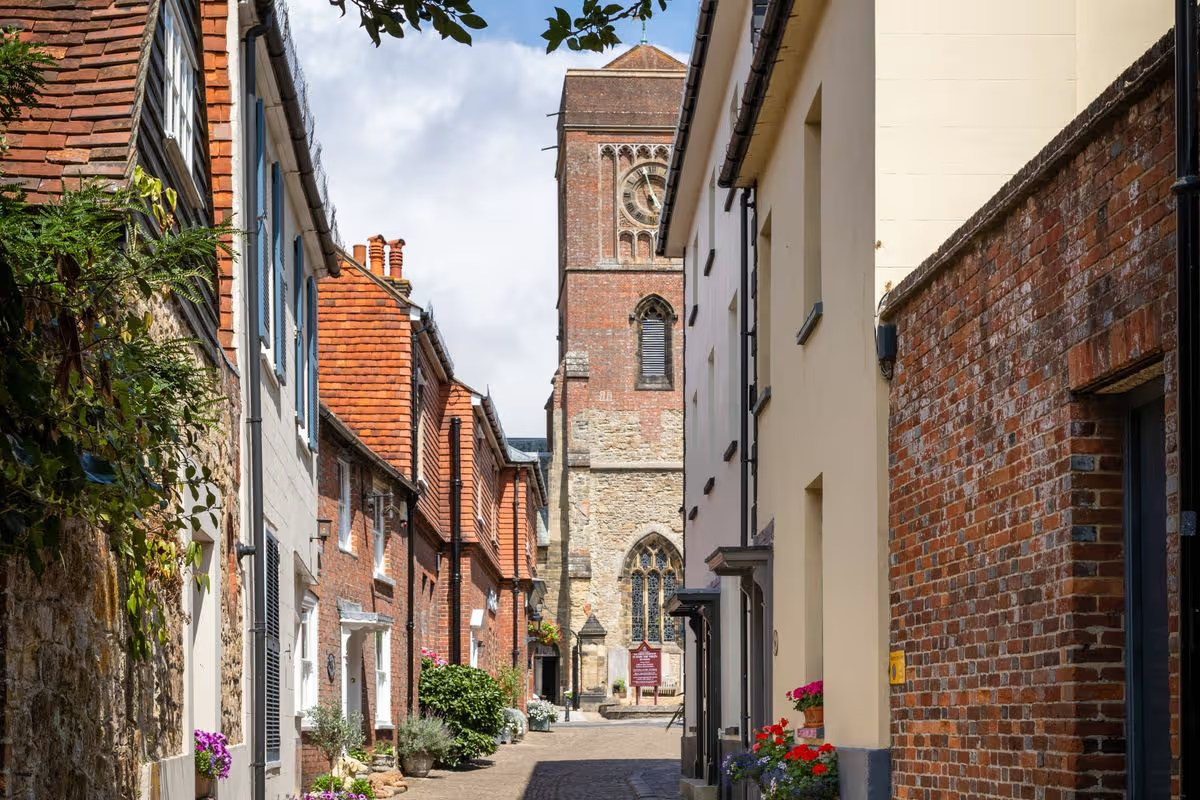
Unspoilt English town with cobbled lanes and independent shops is like stepping back in time

A pretty town deserves a spot on your itinerary with its cobbled streets, Georgian architecture, antique shops and cosy pubs, and a park home to hundreds of free-roaming deer

A quintessential English town, with narrow cobbled lanes and surrounded by diverse landscapes, offers a glimpse into bygone eras.

The historic town of Petworth in Sussex is characterised by meandering cobbled lanes, 17th-century Georgian buildings and quaint, stone cottages. It’s conveniently positioned just over half an hour’s drive from Chichester and around 50 minutes from Portsmouth, offering a delightful day out among its unspoilt landscapes.

There are narrow streets that lead to hidden gems scattered around the town, with antique emporiums and independent boutiques, complemented by cafés, delicatessens, and inviting pubs. Thanks to its scenic setting, it was even crowned by Condé Nast Traveller as one of the UK’s most picturesque towns.

READ MORE: Small village named ‘loveliest town in England’ with best-rated food and drinkREAD MORE: Rural town dubbed ‘the new Notting Hill’ is brimming with independent shops and Michelin-star restaurants

The medieval town, with more than 400 listed buildings, is also renowned for its thriving art and antiques community, with a wide range of galleries and more than 30 antique stores where you can find ancient treasures. One of the most popular spots for vintage goodies is Petworth Antiques Market, featuring more than 40 dealers offering everything from exquisite furniture to ornaments and an extensive selection of homeware.

One guest enthused on TripAdvisor: “I absolutely love going to the Petworth Antique Market, the customer service is amazing with extremely friendly, helpful staff, and I always always find beautiful treasures there!!”

You certainly won’t go hungry during a trip to Petworth with The Hungry Guest on Middle Street, among its standout establishments, serving up seasonal, locally sourced cuisine that has elevated the town’s reputation. Additionally, there’s an array of inviting pubs, including The Welldiggers Arms, The Black Horse Inn and The Angel Inn.

But away from the town centre, Petworth is a haven for avid walkers, with diverse landscapes within easy reach of the pretty town, including the rugged chalk hills of the South Downs National Park and the ancient woodland of The Mens Nature Reserve. Yet, the Petworth House and Park is the town’s most notable attraction, with its sprawling 700-acre park surrounding the impressive 17th-century Petworth House.

Visitors can explore the historic stately residence and discover an exceptional collection of world-class art and sculptures. The property represents one of the finest remaining examples of an English landscape designed by the renowned Lancelot ‘Capability’ Brown.

There are also hundreds of deer wandering freely across Petworth Park that can be easily admired, or you can soak up the spectacular views of the South Downs during a stroll around the grounds. The National Trust park has certainly put Petworth on the map, and even more so after appearing in major film productions, Napoleon, Rebecca, and Maleficent, as well as Netflix’s popular drama Bridgerton.

Following a visit, one traveller shared: “Another National Trust gem! Had a wonderful day there. So much to see and wonderful walks in the grounds and deer park. The art collection is outstanding, and as usual, the volunteers in the house were great. Had an interesting talk in the square dining room about the family’s history. Found the kitchens fascinating! Great cafe too. Highly recommend.”

Do you have a travel story to share? Email webtravel@reachplc.com

Ensure our latest lifestyle and travel stories always appear at the top of your Google Search by making us a Preferred Source. Click here to activate or add us as your Preferred Source in your Google search settings.

Source link

I visited an up-and-coming seaside town with 50 independent shops and a unique railway

Over the holiday period, I travelled to explore what this upcoming seaside town had to offer

Nestled along the British coastline, one “emerging” seaside destination is discreetly transforming itself into the perfect coastal getaway. Boasting over 50 independent retailers dotting its charming streets, it presents a welcome change from identical high streets dominated by familiar chain stores.

The town’s artistic flair complements its historical appeal. From mouth-watering bakeries, trendy bars and eateries to unusual boutiques, each street corner feels distinctly local and brimming with character. Here’s what I uncovered during my visit to the sandy coastal town of Folkestone in Kent.

The beach

Folkestone features six beaches, but the one that captivated me most was the sheltered Sunny Sands. This spot was utterly stunning and serene. My highlight was perched on the brick wall above, observing the freezing turquoise waves rolling in.

Numerous visitors had their amiable dogs wandering freely, bounding across the sand and along the shoreline, and it was such a liberating scene to observe. The temperature was bitterly cold, and the breeze was battering my face, but it was worthwhile spending every moment there in tranquillity.

There was something oddly meditative about the sea, particularly in Folkestone. Well-known seaside destinations like Brighton don’t quite deliver that same sense of calm and peacefulness.

High street full of Independent shops

I thoroughly enjoyed discovering the town, with its undulating hills offering views reminiscent of the South of France, complete with palm trees and vibrant buildings. Yet what truly captured my heart was witnessing what the locals had to offer.

Folkestone boasts a thriving high street packed with a variety of local independent businesses, from clothing boutiques and game shops to traditional pubs and cafés. This area is known as the Creative Quarter, “a true symbol of the regeneration of the town,” said Folkstone and Hythe.

The town is surprisingly artistic and wonderfully eccentric. The quarter is said to hold an “inspiring community of designers, filmmakers, musicians, web developers and artists around the 115 studios and offices and over 50 shops, as well as around 80 flats, making the area a playground for creative and digital businesses.”

I ended up departing with second-hand bags and jewellery, anime and comic book merchandise (who would have thought?), along with charming trinkets to adorn my room.

The unique railway

Sitting at the heart of the harbour is an elongated, disused railway station, which proved both intriguing and thoroughly enjoyable to stroll across. According to Folkestone Harbour Seafront, the station platforms form part of the restoration of the Harbour Arm and its heritage structures.

The former Folkestone Harbour station launched in 1850, with a steep branch line descending from the main station to the harbour, connecting trains with ferries to Boulogne and Calais.

Following the abolition of duty-free shopping in 1999, the ferry operation from Folkestone ceased in September 2000, eliminating the primary purpose for the harbour branch line’s existence.

The arrival of the nearby Channel Tunnel also diminished the requirement for the conventional ferry-to-train connection, resulting in the line being formally closed in 2014. The station was subsequently cordoned off and deteriorated.

Nevertheless, the station was later restored and reopened in spring 2018. The platforms, where passengers once waited for trains, are now sheltered areas to relax, sit, and enjoy the scenery.

Discussing the transformation of the station, a spokesperson for the company said: “When the Folkestone Harbour & Seafront Development Company took possession of the harbour buildings, it was clear that very little of the original 1850 station structure remained.

“Even though the physical structure lacked authenticity, we realised that the existence of a station on the Harbour Arm had been integral to the successful development of Folkestone. It was interlaced with layers of history, making it an important piece of the town’s story.”

London-inspired attractions

After we strolled along the platform, we followed the signpost, which directed us to the “Goods Yard.” There, we discovered what resembled a compact version of London’s Boxpark.

This came as a welcome discovery, as throughout most of our stay, we’d been mingling with locals who appeared to be pensioners, but the Goods Yard attracted predominantly younger people, teenagers and families.

Similar to London, the venue featured a large screen showing family-friendly films and was surrounded by numerous restaurants and drinking establishments.

The dining options include Little Rock and Rocksalt, which provide locally caught seafood alongside coastal panoramas. Fresh fish cuisine can also be found at Chummys.

According to FolkeLife, Plamil Foods manufactures plant-based milks and vegan chocolate, whilst El Cortador delivers Spanish tapas. For beverages, craft beer is available at Brewing Brothers, whereas the Potting Shed provides vibrant atmospheres.

My top dining recommendation

During my time there, the finest experience I had was undoubtedly the cuisine. Beyond the harbour area, my preferred dining destination is the Blackmarket on Tontine Street.

This neighbourhood establishment serves mouth-watering burgers, chicken wings and alcoholic drinks, occasionally hosting live musical performances.

The interior design was remarkable, showcasing an eclectic collection of photographs, art pieces, text, banners, and emblems. It’s incredibly contemporary, yet accommodates visitors of every age and character.

I selected a burger topped with blue cheese, chorizo and crispy onions, which I still fantasise about today. I polished off the soy honey garlic-glazed wings within moments.

While chatting with proprietor Nathan Roberts, he explained they source locally, partnering with one of the town’s few remaining butchers. The menu gets refreshed every couple of months, guaranteeing fresh offerings on each return trip.

Discussing Folkestone’s prospects, Nathan commented: “It’s definitely somewhere to watch, there’s a lot going on, a lot of moves being made. I’d say in the next 10 years, Folkestone will be on the map, especially for people in the city. It’s going to be somewhere to keep an eye on; it’s only going to get better around here.”

Source link

UK’s ‘quintessential market town’ that burned down now full of cafés and shops

The charming Georgian market town is packed with independent shops, cafés and a rich history dating back to the 1708 Great Fire – and it’s one to have on your staycation wishlist

Strolling through the delightful market town of Holt, situated near the north Norfolk coastline, you’ll undoubtedly be captivated by its wealth of exquisitely maintained Georgian architecture.

Yet without a devastating blaze, the town’s appearance might have been entirely different, and its heritage extends much further back than the Georgian period. Holt featured in the 1086 Domesday Book, where it was recorded as a market town boasting five watermills and twelve plough teams, establishing it as a thriving and affluent community by medieval measures.

Its fortunes shifted dramatically on 1st May 1708 when The Great Fire of Holt swept through the town, its timber-framed medieval structures proving powerless against the inferno. In just three hours, a substantial portion of the town’s heritage vanished forever, with damage exceeding £11,000 reported – equivalent to more than £2.1 million today.

Contributions flooded in from throughout the nation and reconstruction commenced, though this time with a striking Georgian character that persists to the present day. Among the handful of structures surviving in an earlier architectural style is the Norman church of St Andrews.

Whilst its thatched roof was consumed by flames, the majority withstood the fire and it remains amongst the town’s most ancient buildings. Many of the watermills were decimated and never restored, but Letheringsett Watermill emerged in their stead in 1802, reports the Express.

It now holds the distinction of being Norfolk’s oldest operational watermill, producing flour to this day. Visitors can delve into the mill’s rich history or indulge in a homemade cake at the tearoom, made with locally sourced ingredients.

The town boasts a delightful high street dotted with Georgian buildings that have been transformed into quaint independent boutiques. Meander through the streets and you’ll stumble upon cosy cafés, historic pubs, and traditional tearooms.

From April to December, on the first Sunday of each month, Holt Sunday Market commandeers the town centre, featuring a plethora of traders peddling crafts, artisanal local food and drink, and global street food.

Holt also serves as a gateway to some of north Norfolk’s top attractions. Baconsthorpe Castle is merely a 10-minute drive away, offering free entry to explore the remnants of this once magnificent 15th-century castle.

Once the pride of a wealthy family, the castle was gradually sold off piece by piece as their fortunes dwindled, though parts of the edifice still stand.

A short journey will also take you to the Muckleburgh Military Collection. This family-run museum, located in a former Royal Artillery Anti-Aircraft training camp, is a treasure trove for military enthusiasts, housing an extensive collection of tanks, weaponry, and uniforms.

It’s a must-visit for any history aficionado. For those seeking somewhere distinctive to rest their heads, Byfords in the town centre is worth considering. Housed within a grade II listed building that ranks among Holt’s most historic, it offers 16 well-appointed bedrooms alongside a favoured restaurant downstairs dishing up seasonal fare.

Alternatively, secure accommodation at The Feathers, a Georgian coaching inn boasting 24 rooms – including dog-friendly options – and a welcoming pub below complete with an open fireplace.

Source link