shohei ohtani economy

The Shohei Ohtani Economy: a two-mile ride to Dodger Stadium, for $85

It’s almost time for Dodger baseball. I am standing outside a hotel in downtown Los Angeles.

I could walk six blocks to Union Station and ride the free Dodger Stadium Express. I could jump into an Uber and pay about $18 for the two-mile ride.

Instead, to make that short hop to the ballpark, I am about to board a very nice bus that costs $85.

Is it worth it?

First, some background: The Japanese travel agency JTB last year signed a sponsorship agreement that makes the company the “official Japanese tourism partner” of the Dodgers. JTB sells tour packages to Japanese fans eager to make the pilgrimage to see Shohei Ohtani play.

“Some people go to Disneyland and Universal Studios,” said Masakazu Nakafuji, general manager of JTB’s New York office. “Mainly, people want to see the Dodgers for three straight days at Dodger Stadium.”

The tour packages include game tickets, hotel rooms and transportation. However, not every fan from Japan buys the entire tour package, so the company launched a shuttle service: If you get tickets and hotels on your own, we’ll sell you a VIP ride, with a bilingual guide.

“So far, our shuttle customers are 90% Japanese,” Nakafuji said. “We are going to try to expand in the English-language market.”

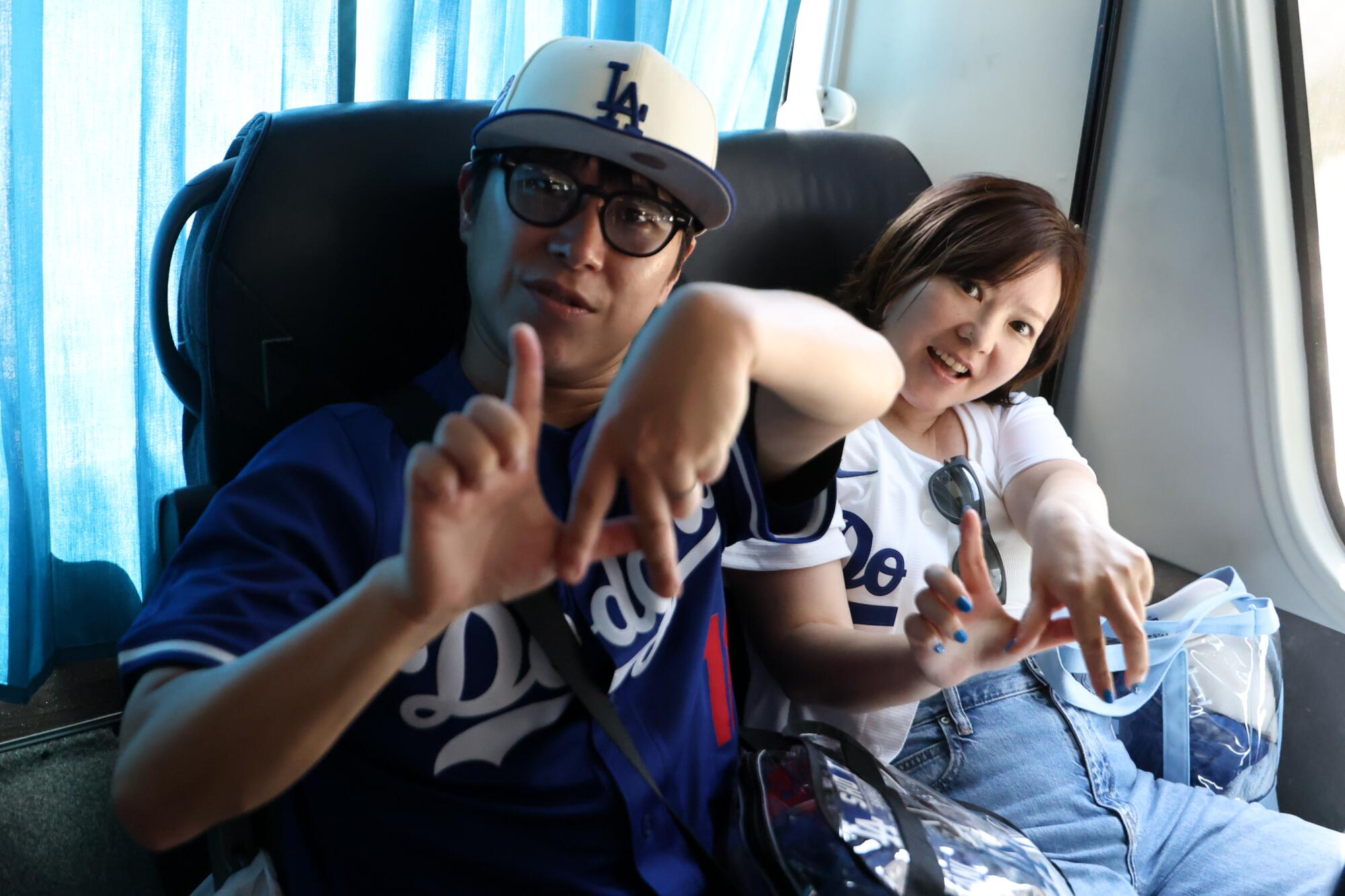
On the shuttle bus I rode last week, I met Tsutomu and Sayuri Ichikawa, a couple from Tokyo wearing his and hers Roki Sasaki jerseys. The Ichikawas visited in May, on a JTB tour in which they saw three Dodgers games. The couple came back to see six more Dodgers games on their own, so the shuttle offered them a familiar way to get to Dodger Stadium.

Tsutomu, left, and Sayuri Ichikawa hold up the LA hand sign as they ride the JTB shuttle to Dodger Stadium on July 30.

Tsutomu, left, and Sayuri Ichikawa were among those on a JTB shuttle bus for a July 30 Dodgers game against the Seattle Mariners.

(Jason Armond / Los Angeles Times)

I also met a woman named Colleen and her 8-year-old son, dressed in an Ohtani jersey. Colleen, who declined to give her last name, was visiting from Chicago. She said she had searched for shuttle buses online and considered them a better option than “having to take an Uber or take public transportation at night with a child” on a first visit to Dodger Stadium.

And I met Lina Endo of Seattle, here for three games against her beloved Mariners. She attended the first two games with friends and chose to take the shuttle for the third game, since she would be alone.

“I wanted to check out the early entry too, so it makes sense from a cost perspective,” Endo said.

Ah, yes, the cost. Is the $85 worth it?

As if the Dodgers do not already charge enough for tickets, the team offers an “early entry” add-on option for most games: For anywhere from $40 to $70, depending on the game, you can get in three hours before game time, an hour before most fans. That lets you watch the Dodgers take batting practice on the field, although Ohtani rarely does, and get to the head of the line for giveaway items, stadium attractions and team stores.

The JTB tours and shuttle buses include early entry. For one fan, $45 for Dodger Stadium parking plus $40 for early entry equals $85 for a JTB shuttle.

For a family of four, though, $45 for parking plus $160 for early entry is still less than $340 for four tickets for the shuttle bus. In fairness, JTB is not focusing its shuttle service on locals.

“They are driving, right?” Nakafuji said.

Shuttle bus driver points in the direction for a new shuttle bus that transports fans from downtown to Dodger Stadium July 30

The shuttle bus driver points in the direction he’s trying to go in the Dodger Stadium parking lot before a game last month.

(Jason Armond / Los Angeles Times)

They might be taking the Dodger Stadium Express from Union Station, or an Uber or Lyft. If there is a sales pitch to local fans, this is it: Just how long do you want to take getting out of Dodger Stadium? The wait for the Dodger Stadium Express or a rideshare pickup, and the slog out of the stadium and along Sunset Boulevard, can be excruciating.

“It’s a headache,” Nakafuji said.

The JTB shuttles leave exactly 30 minutes after the end of the ninth inning. If you want to stay for extra innings, a fireworks show, or a drone show, you risk finding your own way back.

Sounds harsh. But, on the night I rode the shuttle bus, it took just 15 minutes to escape the parking lot and return to the hotel. If time is money, maybe the $85 is worth it.

Of course, in 15 minutes, you can walk downhill from Dodger Stadium to the Metro Chinatown station, and another five minutes to Union Station.

Still, beyond the sales of takoyaki (octopus fritters) at a Dodger Stadium concession stand and Ohtani-endorsed skin serum in the team store, here’s another economic indicator in the Shohei Ohtani Economy: a two-mile bus ride for $85.
Source link

Inside the Shohei Ohtani Economy driving an auction for his cleats

How much would you pay for a pair of shoes? Someone else’s shoes, I mean.

Would you pay $7,000 for a chair on which Taylor Swift sat in a basketball arena — for an NBA playoff game, not for her wedding? Someone did.

There was one Swift chair up for bid. The Dodgers gave away 52,000 trading cards as part of a promotion for the Japanese animated series “One Piece” this month, and the current asking prices for one of those cards on eBay range from $784 to $15,656. Even at the low end … strike that, there is no apparent low end to the collectibles market these days.

Now add Shohei Ohtani to the mix. A pair of his cleats hit the auction block Monday, hyped by the promoter as “one of the most significant baseball artifacts ever” and “the greatest baseball footwear ever made available” and “the most culturally significant footwear ever worn on Japanese soil.”

In this case, the adjectives are more than breathless. Ohtani is the best player in baseball, the favorite to win his fifth most valuable player award in six years, an international tourist attraction, and a global pitchman making an estimated $125 million in sponsorships and endorsements this year.

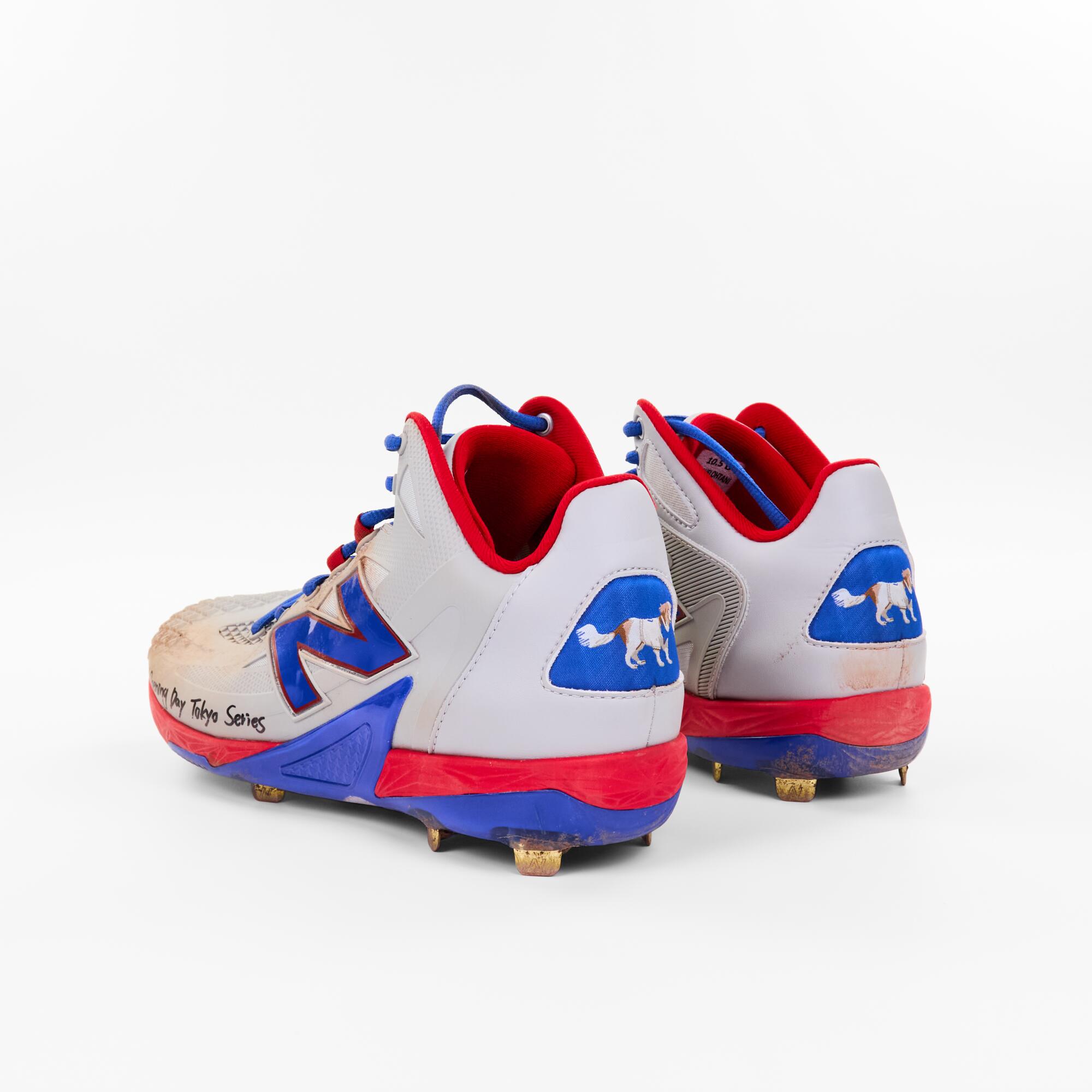
So, the footwear: These are the cleats Ohtani wore when the Dodgers opened the 2025 season in Japan, decorated with art of his world-famous dog Decoy and signed by Ohtani with Asian kanji characters rather than English letters.

The cleats were purchased last year by Take to the Universe (TTU), a Japanese company that distributes beauty and wellness products in Japan and throughout Asia. State records show the company registered a subsidiary in Los Angeles two months ago.

The cleats Shohei Ohtani wore during the Dodgers' 2025 season opener in Japan are on the auction block.

The cleats Shohei Ohtani wore during the Dodgers’ 2025 season opener in Japan are on the auction block.

(The Realist)

“We thought, hey, we could actually use this to market our company and enter into the U.S. market,” said Ryoji Iguchi, chief executive of the subsidiary. Iguchi declined to say how much TTU paid for the cleats.

For a Japanese company to leverage Ohtani and the Dodgers to introduce itself to an American audience is nothing new — not just for tangible consumer goods, but also for animated characters.

You wouldn’t actually go into a store and ask for a TTU product, though. You eventually might go into a store and ask for a beauty product made by another company. TTU would just get it there.

So how does selling a pair of cleats create brand awareness for a brand consumers would not even know?

“This interview,” Iguchi said.

The Ohtani Economy strikes again: You don’t know us, but we’re coming to America, we want to help you sell your wares — and we’re selling Ohtani’s cleats!

The sale was arranged by Scott Keeney, founder of the Realest, a Los Angeles-based enterprise specializing in sports and entertainment memorabilia.

The cleats Shohei Ohtani wore during the Dodgers' season opener in Japan in 2025 are on the auction block.

The cleats Shohei Ohtani wore during the Dodgers’ season opener in Japan in 2025 are on the auction block.

(The Realist)

Keeney talks about the “museum-grade” and “investment-grade” quality of the cleats. You might find a trading card marketed as one of one, but someone could make another. In this case, no one can make another pair of cleats worn by Ohtani on that particular day.

“It’s no different than art, where you’re seeing paintings selling for tens, hundreds of millions of dollars,” Keeney said. “The top grails are in a category of their own.

“It’s what the ultra, the top 0.0001% want, and they appreciate faster than anything else in the category.”

So how much might the Ohtani cleats command, given the combination of sport and celebrity?

Kobe Bryant’s sneakers from the game in which he tore his Achilles tendon — and hit two free throws before he left the court — fetched $660,000. Michael Jordan’s “Flu Game” shoes sold for $1.4 million. Kanye West wore “Air Yeezys” to the Grammys, and the pair sold for $1.8 million.

The ball Ohtani hit for his 50th home run in his 50-50 season: $4.4 million. And, speaking of holy grails: Judy Garland’s ruby slippers from “The Wizard of Oz” fetched $32.5 million.

I cannot afford that, in this lifetime or any other. Perhaps you can. If you cannot, the Realest is offering this free-to-enter contest: Guess the sale price of the Ohtani cleats and, if you come closest to the actual sale price, you win 1% of the price. In the event of a tie, the first submission wins.

The cash would be nice, because this is just a pair of someone else’s worn shoes. But, since everything else Ohtani does seems to be unprecedented, this auction just might be too.

Source link