Three of six passengers who fell ill from suspected rodent-transmitted virus have died, and one is in intensive care, the WHO says.
Published On 3 May 20263 May 2026
Three people have died on a cruise ship in the Atlantic, with at least one confirmed to have suffered from hantavirus, a rare disease transmitted to humans from rodents.
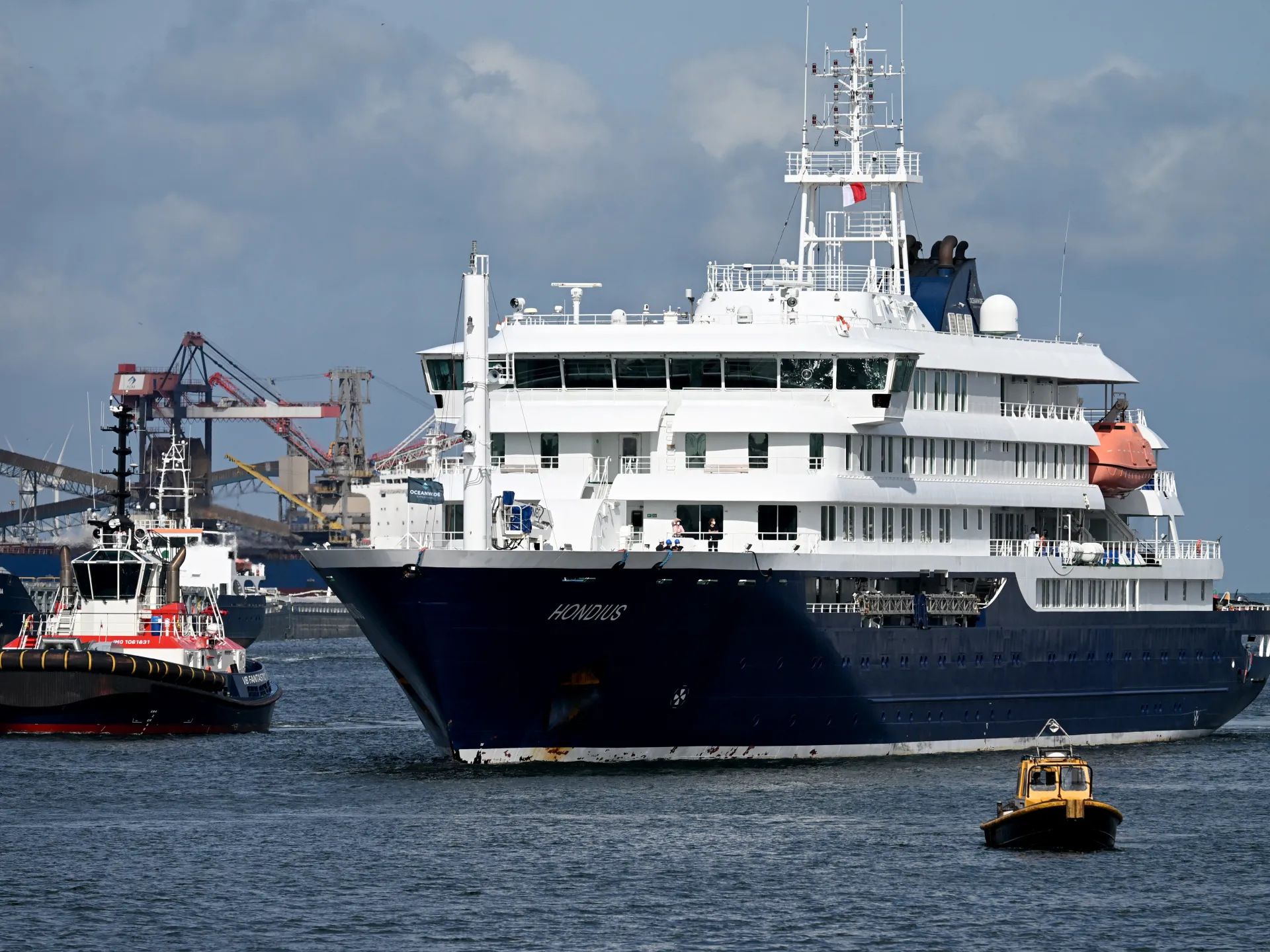
Health authorities are now investigating a suspected outbreak of the virus on the MV Hondius, which is sailing from Ushuaia in Argentina to Cape Verde.
Recommended Stories
list of 3 itemsend of list
In a statement on Sunday, the World Health Organization said that one case had been confirmed and at least five other passengers were suspected of being infected.
“Of the six affected individuals, three have died, and one is currently in intensive care in South Africa,” WHO said in a statement.
“Detailed investigations are ongoing, including further laboratory testing and epidemiological investigations. Medical care and support are being provided to passengers and crew. Sequencing of the virus is also ongoing.”
WHO added that it was “facilitating coordination” between countries to evacuate the two other passengers showing symptoms of the infection.
Hantavirus, a rare disease transmitted to humans through the droppings or urine of infected rodents, can be fatal in severe cases and cause hemorrhagic fever.
Infected couple among casualties
South Africa’s National Department of Health said earlier on Sunday that there had been an outbreak of a “severe acute respiratory illness”, which had killed at least two people, and that a third person was in intensive care in Johannesburg, according to the AFP news agency.
The ministry’s spokesperson, Foster Mohale, confirmed that the patient being treated in Johannesburg tested positive for hantavirus.
A 70-year-old was the first to develop symptoms. He died on the ship, with his body now being held on the island of Saint Helena, a British territory in the South Atlantic, the spokesman said.
The patient’s 69-year-old wife also fell sick and was evacuated to South Africa, where she died in a Johannesburg hospital, he added.
Mohale told AFP that authorities have not confirmed the nationalities of the deceased. But the person in intensive care was reported by AFP to be a 69-year-old Briton.
Ukraine’s attacks on Russia injure at least six people in the region of Vologda and the annexed Crimea.
Published On 26 Apr 202626 Apr 2026
Ukrainian officials say Russian attacks in several regions have killed at least five people and damaged a ship in the port of Odesa – as Moscow claimed to have intercepted more than 200 Ukrainian drones.
A Russian drone attack killed two men on Saturday in Ukraine’s northeastern Sumy region, according to Governor Oleh Hryhorov. He said civilians were hit in Bilopil close to the Russian border.
Recommended Stories
list of 4 itemsend of list
In the central Dnipropetrovsk region, Russian attacks on four districts killed one person and injured four others, Governor Oleksandr Ganzha said.
In the southern region of Kherson, Governor Oleksandr Prokudin said Russian shelling wounded seven people.
Further east, Russian forces launched more than 700 attacks on 50 settlements in the Zaporizhia region over the past 24 hours, killing two people and injuring four, according to Governor Ivan Fedorov.
Homes, vehicles and infrastructure were damaged, he added.
In Odesa region, Deputy Prime Minister Oleksii Kuleba said Russian forces again targeted port infrastructure.
“The attack damaged port and logistics infrastructure facilities, warehouses, technical equipment, cargo storage tanks, administrative buildings, as well as freight transport,” Kuleba said on Telegram.
He added that a civilian vessel flying the flag of Palau was damaged while loading in port. No injuries to the crew were reported.
Ukraine’s air force said it shot down or disabled 124 of 144 drones launched by Russia overnight with impacts recorded at 11 locations.
Russia reports Ukrainian drone attacks
Russia’s Ministry of Defence said its air defences destroyed 203 Ukrainian drones between Saturday evening and Sunday morning over Russian regions and the Black Sea.
The ministry said 95 Ukrainian drone control centres were destroyed over the previous 24 hours.
In Russia’s Vologda region, Governor Georgy Filimonov said five people were injured in a Ukrainian drone attack on a nitrogen complex.
In Sevastopol in Crimea, which was annexed by Russia, debris from downed drones struck the cardiology department of a hospital, injuring one person, according to Governor Mikhail Razvozhayev. He said 16 Ukrainian drones were shot down over the city overnight.
Razvozhayev added that drone debris also fell on rail tracks, damaging overhead power lines and causing train delays.
Peace efforts continue
The latest attacks came as diplomatic efforts to end the war, now in its fourth year, remained stalled.
Ukrainian President, Volodymyr Zelenskyy, said he signed agreements on security and energy cooperation with Azerbaijan’s President Ilham Aliyev in Baku on Saturday.
Zelenskyy said Kyiv wanted to draw on its experience defending airspace from Russian attacks. He also said he had discussed the possibility of holding future talks between Ukraine and Russia in Azerbaijan.
“We are ready for the next talks to be in Azerbaijan, if Russia will be ready for diplomacy,” Zelenskyy said.
Weekly insights and analysis on the latest developments in military technology, strategy, and foreign policy.
A collaboration between relative military newcomer Saildrone and defense contracting giants Lockheed Martin and Fincantieri has resulted in Spectre, a 170-foot drone boat capable of traveling nearly 35 miles per hour and optimized for anti-submarine warfare.
Saildrone Spectre: A new class of unmanned surface vessel
The Navy’s work with far smaller Saildrone platforms dates to 2021. In the Middle East, the 33-foot Voyager, specializing in persistent surveillance, has been at the heart of testing and experimentation by the service’s Task Group 59, focused on unmanned capabilities and teaming.
In the U.S. 4th Fleet area of responsibility, which includes the Caribbean and Central and South America, solar-powered Voyagers have been the USV of choice for Operation Windward Stack. This is an effort to integrate uncrewed systems into the work of apprehending drug trafficking and illegal fishing.
A Saildrone Explorer unmanned surface vessel operates alongside U.S. Coast Guard fast response cutter USCGC Emlen Tunnell (WPC 1145) in the Arabian Gulf, Nov. 29, during Digital Horizon 2022. The three-week unmanned and artificial intelligence integration event involves employing new platforms in the region for the first time. (U.S. photo by Sgt. Brandon Murphy) Sgt. Brandon Murphy
The Spectre design, which was unveiled Monday at the Sea-Air-Space Exposition near Washington, D.C., at which TWZ was in attendance, is the result of two years of work. It precedes the Navy’s current competition for a family of Medium Unmanned Surface Vessels, which formally launched last month. However, company executives said they now plan to enter Spectre.
“We didn’t fit to that. We didn’t change our course,” Saildrone founder and CEO Richard Jenkins said. “Now it’s changed, MUSV … it actually fits perfectly. We meet 100% of all the specs.”
Spectre comes in two variants. One is the Silent Endurance variant with the trademark sail, or “wing.” The other is the Stealth Strike variant that relies totally on its more powerful internal propulsion. While the sail-equipped variant is more focused on anti-submarine warfare and surveillance, it too can be equipped with modular VLS cells or other “concealed payloads.” The Stealth Strike variant possesses “higher-speed” and is capable of “low observable missions,” according to the company.
(Saildrone)
Powered by a 5,000-horsepower Caterpillar diesel engine, the Stealth Strike variant is designed to cruise at around 25 knots, or just under 29 miles per hour. The 30 knot, or around 35-mile-per-hour, speed that the company cites as the maximum for Spectre is likely reserved for brief “sprints” that the Stealth Strike variant may execute during operations.
The Silent Endurance variant is optimized for “infinite endurance,” Jenkins said, with an electric engine that can maintain speeds of 12 knots, or about 14 miles per hour, or the signature wing, a 43-meter composite structure made by yacht racing team American Magic Services that can harness the wind for propulsion “without any engine at all.”
(Saildrone)
Tony Lengerich, vice president of Naval Programs at the United Kingdom-based Thales Defense and Security, which made the active sonar for Spectre, described the drones as a forward lookout presence for conventional Navy ships.
“We’re looking forward to bringing that capability in active sonar … to the Navy fleet, particularly in the theater ASW context, where you really need a vessel that can take a sensor far out ahead of the battle group, if you will, loiter there, deploy the sensor and then move again,” he said. “That’s exactly what Saildrone brings to the table, and it’s exactly what we think the Navy needs.”
Paul Lemmo, vice president and general manager for sensors, effectors & mission systems (SEMS) at Lockheed Martin, called the drones a cost-effective way of “putting more players on the field.”
“The Chief of Naval Operations [Navy Adm. Daryl Caudle] has said it’s an important thing, so you’ve got more shooters on a fairly inexpensive platform instead of a multi-billion dollar destroyer,” he said.
From an ASW perspective, Lengerich said, the platform works for clearing and assessing “broad ocean areas” before moving a manned battle force in.
“This provides that capability to take an active sonar source forward – ping, if you will, and then your shooters … pick up the ping and identify where you have an adversary in an area that you eventually want to move the force to. So we think of this as a theater asset, one that means far ahead of the force, both in time and space, and then advances the ability for the battle force to move in and be certain of what’s waiting for them.”
The unit price of Spectre is around $40 million, Jenkins said. That’s compared to about $7.5 million for the unarmed, much smaller 20-foot Surveyor.
(Saildrone)
The Navy has struggled to get its arms around what it wants out of its drone ships and how exactly they will integrate with the manned fleet. One of its earliest unmanned surface vessel test articles, Sea Hunter, was christened a decade ago. Navy officials announced earlier this year that Sea Hunter, a medium-sized USV, and its sister ship, Seahawk, would finally leave experimental status in 2026. One of these vessels, reportedly Seahawk, is expected to deploy this year with a carrier strike group.
Last year, the Navy unveiled plans for a family of uncrewed Modular Surface Attack Craft (MASC), emphasizing containerized missile launchers and highly configurable payloads. The service replaced this strategy last month, however, with what it called a “marketplace” for MUSVs, giving would-be competitors a matter of weeks to submit proposals for mature vessels that could be fielded in Fiscal Year 2027. Core requirements were laid out for seakeeping, long range and endurance, and cargo capabilities, as you can read more about here. The need to be able to carry two forty-foot equivalent unit (FEU) containerized payloads is a key demand, though the Navy has not yet specified publicly what might go in them.
(Saildrone)
“Honestly, inside you could have a sensor, you could have repair equipment for ships,” Rebecca Gassler, the Navy’s Portfolio Acquisition Executive for Robotic and Autonomous Systems (PAE RAS), told TWZ and other outlets during a press call in March. “You could have any number of payloads inside those, and you basically are able to just swap them on.”
Navy officials have said they want 11 operational MUSVs by next year, and have projected that half the surface fleet will be uncrewed by 2045.
Saildrone has plans to demonstrate the ability of Surveyor to carry a JAGM launcher at the joint Rim of the Pacific exercise in July. Lemmo said the team plans to demonstrate the same capability on Spectre soon. The company says construction on Spectre is about to begin shortly, with sea trials for the first vessel set for early next year.
WASHINGTON — President Trump has turned to naval blockades to pressure the governments of Venezuela, Cuba and now Iran to meet his demands, but his preferred tactic is confronting a very different reality in the Middle East than in the Caribbean.
Unlike Cuba or Venezuela, Iran choked off a crucial trade route for energy shipments, meaning the longer the standoff persists, the more the global economy will suffer. Tehran also poses a greater military threat than those two adversaries in America’s own hemisphere and requires a sustained military presence far from U.S. shores.
Iran’s leverage over the Strait of Hormuz gives it power during a shaky ceasefire because the widening economic risks, especially higher U.S. gas prices in an election year, could force the Republican president to end the blockade on Iran’s ports and coastline, experts say.
“It’s really a question now of which country, the U.S. or Iran, has a greater pain tolerance,” said Max Boot, a military historian and senior fellow for national security studies at the Council on Foreign Relations.
Iran presents ‘major differences’ from other blockades
The effectiveness of Trump’s use of the world’s most powerful navy to block the trade of Iran’s sanctioned oil and other goods is very much up for debate. But it certainly appears to be intensifying as the war grinds on.
The U.S. military on Thursday announced the seizure of another tanker associated with the smuggling of Iranian oil, a day after Iran’s paramilitary Revolutionary Guards took control of two vessels in the crucial waterway.
Trump also announced he has ordered the U.S. military to “shoot and kill” Iranian small boats laying sea mines in the strait.
But the situation in Iran is not exactly analogous to what is playing out with the U.S. operations in Venezuela and Cuba.
Some experts say Trump’s success in Venezuela probably had more to do with the U.S. military raid that captured leader Nicolás Maduro than American warships seizing sanctioned oil tankers to enforce U.S. control over the South American country.
A U.S. oil embargo on Cuba, meanwhile, has caused the island’s most severe economic crisis in decades. While U.S. and Cuban officials have met recently on the island for rare talks, the financial strangulation has failed to produce the Trump administration’s stated goal of leadership change.
“I do think that the success of the Maduro mission in Venezuela has probably emboldened the president,” said Todd Huntley, director of Georgetown University’s National Security Law Program.
That does not make the situations in Venezuela and Iran similar — geographically, militarily or politically. “There are some major differences,” said Huntley, a retired Navy captain and judge advocate general.
While the blockade against Iran has delivered a severe blow to its economy, including stopping freighters from importing various supplies, the country has still been able to move some of its sanctioned oil, ship-tracking companies say.
Iran has rejected Trump’s demands to reopen the strait, where 20% of the world’s oil normally flows, and it has been firing on ships again this week. Stalled shipments through the strait have sent gasoline prices skyrocketing far beyond the region and raised the cost of food and a wide array of other products, creating a political problem for Trump before the November’s elections.
“Blockades are usually just one tool of a mechanism used in a conflict,” said Salvatore Mercogliano, a maritime history professor at Campbell University in North Carolina. “They can be important. But it’s only one element. And I don’t think it’s going to be enough to convince the Iranians.”
Effectiveness of U.S. blockade called into question
Adm. Brad Cooper, head of U.S. Central Command, claimed last week that “no ship has evaded U.S. forces.” The command overseeing the Middle East said it has directed 31 ships to turn around or return to port as of Wednesday.
Merchant shipping groups are skeptical.
Lloyd’s List Intelligence said “a steady flow of shadow fleet traffic” has passed in and out of the Persian Gulf, including 11 tankers with Iranian cargo that have left the Gulf of Oman outside the strait since April 13.
The maritime intelligence firm Windward said this week that Iranian traffic continues to flow “via deception.”
Iranian ships have several ways to sneak through the blockade, including spoofing their location tracking data or traveling through Pakistani territorial waters, Mercogliano said. He also noted that the sheer volume of shipping traffic the military needs to screen is a challenging task.
Blockades require patience to work
The last time the U.S. mounted a blockade similar to the one focused on Iranian ships was during the Kennedy administration in the early 1960s, against Cuba, Huntley said.
“And it wasn’t even called a blockade,” he said. “We called it quarantine.”
Some naval blockades over the course of history have had an impact, such as Britain’s blockade on Germany during World War I. “But they tend to be very long-term impacts, whereas Trump is looking for short-term, quick results,” according to Boot, the military historian.
He said Trump probably saw the blockade on sanctioned oil tankers tied to Venezuela as playing a large role in the success of leadership changes in that country. But Boot said it had more to do with the U.S. ousting Maduro and the subsequent cooperation from his vice president, Delcy Rodríguez, who is now the acting president.
“There is no Delcy Rodríguez in Cuba or Iran,” Boot said. “I think his success in Venezuela led him astray, thinking that this was a template that could be replicated elsewhere. He sees it as a huge success at little cost. And, in fact, it turns out to be a unique set of circumstances.”
Finley, Klepper and Toropin write for the Associated Press.
Iran’s revolutionary guard has released a video said to show its forces seizing a ship in the Strait of Hormuz. The container ship was one of two captured by Iran on Wednesday.
The IRGC says the aggression came in response to what it described as the US seizure of an Iranian commercial vessel.
Published On 22 Apr 202622 Apr 2026
An Iranian gunboat has fired on a container vessel near the coast of Oman, according to a British maritime monitoring agency, in an incident that occurred hours after United States President Donald Trump said he would extend a ceasefire with Iran.
The United Kingdom Maritime Trade Operations (UKMTO) centre said on Wednesday that the ship’s captain reported that the vessel had been approached by a vessel of Iran’s Islamic Revolutionary Guard Corps (IRGC) before shots were fired.
Recommended Stories
list of 4 itemsend of list
It “has caused heavy damage to the bridge. No fires or environmental impact reported,” the agency added. No casualties were reported, and all crew members were said to be safe.
British maritime security firm Vanguard Tech said the ship was sailing under a Liberian flag and had been informed it had permission to pass through the Strait of Hormuz, one of the world’s most strategically important waterways.
Iranian news agency Tasnim, however, said the vessel had ignored warnings issued by Iran’s armed forces.
The incident followed a warning from the IRGC’s Khatam al-Anbiya Central Headquarters after what it described as the US seizure of an Iranian commercial ship in the Sea of Oman, the IRNA news agency reported.
It accused Washington of violating the ceasefire and carrying out “armed piracy” after allegedly firing on the Iranian vessel and disabling its navigation systems.
Trump extends ceasefire
Trump earlier announced he would delay a planned military attack on Iran after requests from Pakistan’s army chief Asim Munir and Prime Minister Shehbaz Sharif.
Writing on Truth Social, Trump said the decision was made because Iran’s government was “seriously fractured” and needed time to present a unified position.
“We have been asked to hold our Attack on the Country of Iran until such time as their leaders and representatives can come up with a unified proposal,” he wrote.
He added, however, that the US naval blockade of the Strait of Hormuz would remain in place and said the military had been ordered to stay “ready and able”.
The announcement marked a shift from comments made a day earlier, when Trump said it was “highly unlikely” he would extend the truce beyond Tuesday.
‘Positive and negative signals’ from Tehran
Al Jazeera’s Tohid Asadi, reporting from Tehran, said Iranian officials were sending mixed messages over the ceasefire and the prospects for negotiations.
“Tehran is saying they won’t negotiate under imposed terms and conditions … when we compare the initial 10-point and 15-point proposals by the Iranians and Americans, we can understand that the two sides are poles apart,” he said.
“The atmosphere is also clouded by this mistrust in Tehran towards the United States, as well as the simultaneous military rhetoric related to a potential failed negotiation … It is a warning that another round of confrontation may be ahead.”
He said Iran still viewed the Strait of Hormuz as a key source of leverage in any talks.
“It’s trying to exercise authority over the ships and vessels transiting this strategically significant chokepoint,” he said.
Asadi added that Iranian officials framed their regional position as based on mutual security. “Iranians are saying that the basis of their foreign policy behaviour, particularly when it comes to Israel, is security for all versus security for none,” he said.
Weekly insights and analysis on the latest developments in military technology, strategy, and foreign policy.
A U.S. warship striking another vessel with its deck gun is very rare occurrence in modern times. When the Arleigh Burke class guided missile destroyer USS Spruanceopened fire on the Iranian cargo shipTouska on April 19th with its 5-inch MK 45 gun, it marked the first time in almost four decades something like that had happened. In fact, the prior incident took place almost exactly 38 years ago to the day in the same general vicinity against the same enemy.
“From what we are tracking, the last known irrefutable instance of a Navy ship firing its deck gun at another ship was on April 18, 1988 during Operation Praying Mantis,” a U.S. Navy official told us, referring to a duel between the U.S. and Iranian navies in the Persian Gulf.
That’s when the Belknap class guided missile cruiser USS Wainwright, Knox class destroyer escort USS Bagley and the Oliver Hazard Perry classguided missile frigate USS Simpson all fired upon the Iranian Karman class fast attack ship IRIS Joshan.
Aerial view of the Iranian frigate IS Alvand burning after being attacked by aircraft of Carrier Air Wing 11 from USS Enterprise. (USN)
In addition to launching anti-ship missiles at the Iranian ship, the Wainwright and Bagley engaged the Joshan with 5-inch deck guns while the Simpson used its 3-incher, the official noted. The three ships belonged to what was then known as Surface Action Group (SAG) Charlie.
Praying Mantis was part of the much larger Operation Ernest Will, which began in 1987 when Iraqi and Iranian forces increased attacks on merchant ships in the Persian Gulf during latter stages of the Iran-Iraq War.
Ernest Will involved reflagging Kuwaiti oil tankers under the American banner, allowing them to be escorted by U.S. Navy ships. In July, 1987, during the first such escort, one of those ships struck a mine, setting off a chain reaction of events that led to Praying Mantis. That operation was in response to the Oliver Hazard Perry class guided missile frigate USS Samuel B. Roberts striking an Iranian mine.
USS Samuel B. Roberts underway after the ship struck an Iranian mine on April 14, 1988. (USN)
The mine’s detonation against the Roberts “blew an immense hole in the ship’s hull,” according to a Navy history of the incident. “Ten Sailors from Samuel B. Roberts sustained severe injuries. Four were seriously burned. Commander Paul X. Rinn was hurt as well. The ship should have sunk, but thanks to an extraordinary damage control effort by all hands of an extremely well-trained crew, Samuel B. Roberts was kept afloat.”
A view of damage to the hull of USS Samuel B. Roberts while in dry dock in Bahrain. The damage was sustained when the ship struck a mine while on patrol in the Persian Gulf on April 14, 1988 (USN)
“The U.S. response was fierce,” the Navy history continued. “Operation Praying Mantis was the largest of five major U.S. Navy surface actions since World War II. It was the first, and so far only, time the U.S. Navy has exchanged surface-to-surface missile fire with an enemy, and it resulted in the largest warship sunk by the U.S. Navy since WWII.”
At 10:48 a.m. local time, “an approaching Iranian frigate, Joshan, was identified,” according to Defense Media Network. “The Joshan ignored three warnings issued from the Wainwright, and launched a Harpoon missile that narrowly missed the cruiser.”
The vessels in the U.S. Navy’s surface action group returned fire with SM-1 and Harpoon missiles, heavily damaging the Joshan. The burning frigate was then sunk with gunfire.
The Joshan wasn’t the only Iranian asset hit that day.
“In the one-day operation, the U.S. Navy destroyed two Iranian surveillance platforms, sank two of their ships, and severely damaged another,” according to a Navy history of the event.
A view of an Iranian oil platform after being strafed by US forces. Marines raided the platform to gather intelligence data and military equipment used by Iranians. The platform was later destroyed by gunfire from US destroyers in retaliation for the Iranian mining of the guided missile frigate USS Samuel B. Roberts in the Persian Gulf (USN)
Praying Mantis helped change the course of events.
While the Spruance attack on the Touska is the Navy’s first use of a deck gun on another ship since then, there are more differences than similarities between these engagements.
The Touska is an unarmed civilian cargo vessel that tried to evade the Navy’s blockade on Iranian ports. While the Spruance’s gun blew a hole in Touska’s engine room, the ship didn’t sink, but was instead boarded and seized. The vast majority of Iran’s navy has been destroyed during Epic Fury, leaving an array of small attack craft, but nothing the size of the Joshan still afloat.
You can see video of the Touska being hit with a 5-inch gun below:
US Navy seizes an Iran-flagged ship near the Strait of Hormuz
Here is a file video of a Arleigh Burke class destroyer firing its 5-inch gun:
5-inch 62-caliber Mk 45 Naval Gun Live Fire – Arleigh Burke-class Destroyer
The Touska encounter didn’t seem to have the same effect on Iran as Praying Mantis. If anything, as we previously noted, for at least certain factions within the fragmented Iranian power structure, it hardened the resolve not to enter a second round of negotiations to end the war. Though Trump has extended the deadline for a ceasefire, Iran has yet to indicate it will return to the bargaining table.
Iran, calling the Touska incident an act of piracy, has demanded the return of the ship and its crew and has threatened retaliation. However that has yet to happen.
Regardless, now we know the last time the U.S. Navy has used one of its main deck guns against another ship in anger was 38 years ago.
Weekly insights and analysis on the latest developments in military technology, strategy, and foreign policy.
For the first time since at least the launch of Operation Epic Fury on Feb. 28, an Iranian-linked vessel was interdicted in the Indo-Pacific Command (INDOPACOM) region, the Pentagon confirmed to The War Zone. The boarding of the Botswana-flagged oil tanker M/T Tifani came just days after Joint Chiefs Chairman Gen. Dan Caine told reporters, including from The War Zone, that the U.S. would “actively pursue any Iranian-flagged vessel or any vessel attempting to provide material support to Iran” anywhere in the world. The move also follows the U.S. firing on and seizing the Iranian cargo ship Touska on Sunday in the Arabian Sea.
Meanwhile, as the clock ticks down toward the end of a fragile ceasefire between the U.S and Iran, the future of peace negotiations remains very much uncertain, which we will discuss later in this story.
“Overnight, U.S. forces conducted a right-of-visit, maritime interdiction and boarding of the stateless sanctioned M/T Tifani without incident in the INDOPACOM area of responsibility,” the Pentagon stated Tuesday morning on X. “As we have made clear, we will pursue global maritime enforcement efforts to disrupt illicit networks and interdict sanctioned vessels providing material support to Iran—anywhere they operate. International waters are not a refuge for sanctioned vessels. The Department of War will continue to deny illicit actors and their vessels freedom of maneuver in the maritime domain.”
The oil tanker M/T Tifani with a U.S. Navy Expeditionary Sea Base (ESB) ship in the background (Pentagon) A U.S. Navy MH-60S Seahawk helicopter hovers over the deck of the Tifani. (Pentagon)
Video released by the Pentagon shows about two dozen armed troops boarding two MH-60S Seahawk helicopters on a U.S. Navy Expeditionary Sea Base (ESB) ship. The video then cuts to the troops repelling onto the deck of the Tifani and searching that vessel.
Overnight, U.S. forces conducted a right-of-visit, maritime interdiction and boarding of the stateless sanctioned M/T Tifani without incident in the INDOPACOM area of responsibility.⁰⁰As we have made clear, we will pursue global maritime enforcement efforts to disrupt illicit… pic.twitter.com/EGwDe3dBI3
The Pentagon did not say where the incident took place, however, according to MarineTraffic.com, the Tifani was last located yesterday in the Indian Ocean, about halfway between Sri Lanka and Indonesia and some 2,000 miles southeast of Iran.
The Pentagon told us that “multiple agencies” played a role in seizing the ship. We have reached out for additional details.
Gregory Brew, Senior Analyst, Iran and Oil for Eurasia Group, stated on X that the Tifani departed from Iran’s Kharg Island on April 5 and that the ship appears to have continued sailing on after the boarding. We asked the Pentagon for more details about the ship’s disposition and they referred us to the White House, which sent us back to the Pentagon.
Tifani embarked from Kharg on 5 April, bound for Singapore.
FWIW this post suggests the ship was boarded and searched but not seized.
As of 3 hours ago, it was still en route to Singapore, though its course had shifted south, per Kpler. https://t.co/Em2P9ZRKrT
The ship was sanctioned under a 2018 executive order issued by President Donald Trump during his first term designed to counter Iranian malign activities and prevent it from obtaining a nuclear weapon.
UPDATES
The status of peace talks in Pakistan remains murky. While Vice President JD Vance and other top officials are expected to leave for the negotiations today, Iranian officials have yet to officially commit. The main sticking points remain the future of Iran’s highly enriched uranium, the Strait of Hormuz, the status of its ballistic missile inventory and support for proxies like Hezbollah in Lebanon and the Houthis of Yemen.
“A diplomatic source in Pakistan says no diplomatic delegation from Iran has been dispatched to Islamabad ‘so far,’” the official Iranian IRNA news agency stated on Tuesday. “In response to speculations about possible negotiations in Pakistan, a diplomatic source told IRNA on Tuesday that no delegation from Iran has arrived in the Pakistani capital.”
The source clarified that “neither official nor unofficial information has been received regarding any Iranian involvement in the negotiations in Islamabad.”
#BREAKING: #Pakistan Information Minister: .Formal response from #Iranian side about confirmation of delegation to attend Islamabad talks is still awaited .Pakistan made sincere efforts to convince Iranian leadership to participate in second round of talks, efforts continue… pic.twitter.com/cw9rPb1F6X
In a brief phone call, Trump told CNBC host Joe Kernan he thinks the U.S. is “going to end up with a great deal” with Iran to end the war, even as he said he does not expect to extend a ceasefire due to expire on Wednesday.
“I think they have no choice,” Trump said during an interview on CNBC’s “Squawk Box,” when asked what he expected to come out of a second round of peace negotiations with Iran. “We’ve taken out their navy, we’ve taken out their air force, we’ve taken out their leaders.”
President Trump breaks down ongoing negotiations with Iran on @SquawkCNBC 🎙️
“I think we’re in a very strong negotiating position to do what other presidents should’ve done… we had 47 years with these bloodthirsty people.” – President Donald J. Trump 🇺🇸 pic.twitter.com/X7nceyI622
The president added that he is ready to resume the conflict if a deal with Iran does not appear in the offing.
“Well, I expect to be bombing because I think that’s a better attitude to go in with – but we’re ready to go,” Trump answered when asked if he needs at least the prospect for a signed deal either today or tomorrow.
.@JoeSquawk: “You’re saying that you need at least the prospects for a signed deal today and tomorrow or else you would resume bombing Iran?”@POTUS: “Well, I expect to be bombing because I think that’s a better attitude to go in with — but we’re ready to go.” pic.twitter.com/vEmOfes6Er
Trump also said “I don’t want to do that,” when asked if he would extend the ceasefire beyond tomorrow if talks with Iran appear promising.
Iran is banking on “market meltdowns” and domestic economic pressures to get Trump to back down on his demands, Fox News reporter Trey Yingst suggested Tuesday morning.
“Iran sees this as a game of endurance. They believe that time is on their side and that ultimately the domestic pressure, when it comes to energy markets and the stock market, will force President Trump to make a deal that’s in their favor,” he explained. “That is not the truth. That is not the reality…The president and his counterparts in Israel have the ability to continue this operation for months if they need to.”
TEHRAN’S TACTICS: Senior regional intelligence source indicates that Iran is betting on a game of “endurance,” banking on market meltdowns and domestic distress to force President Trump into a deal.@TreyYingst: “Iran sees this as a game of endurance. They believe that time is… pic.twitter.com/HTMz1dVt8H
Trump is “misleading” the world about “conditions on the ground,” Iran’s top military operational commander claimed.
“Holding the upper hand, the Armed Forces do not allow the lying and delusional president of the United States to exploit the situation or fabricate false narratives about conditions on the ground, particularly regarding the management and control of the Strait of Hormuz, during periods of silence in military confrontation,” proffered Major General Ali Abdollahi, commander of Khatam al-Anbiya Central Headquarters, which is responsible for coordinating operations between the country’s Army and the Islamic Revolution Guards Corps (IRGC).
Abollahi added that the Armed Forces “will duly respond to any breach of commitments” by the “adversaries,” a reference to the U.S. firing on and seizing the Iranian cargo ship Touska on Sunday.
Iran’s Armed Forces Ready to Deliver Decisive Response to Any Enemy Breach
Major Gen. Ali Abdollahi, commander of Central Khatam al-Anbiya HQ, declared that Iran’s armed forces are fully prepared to deliver a decisive & immediate response to any breach of commitments by enemies. pic.twitter.com/KzP1sIlEL3
Though the status of the peace talks is unclear, Pakistan has emerged as a winner on the world stage. However, it is an unlikely mediator, The Washington Post notes.
“Pakistan does not formally recognize Israel, one of the key countries involved,” the Post posited. “It became a nuclear power in secret, as the U.S. and Israel have accused Iran of seeking to do. And it did not start off on the right foot with President Donald Trump, who in his first term said Pakistan had given Washington ‘nothing but lies and deceit.”
But over the past year, “a focused campaign to win Trump’s favor appears to have paid off,” the newspaper added. “For months, Pakistan’s leaders wooed the Trump administration with flashy deals and public praise.”
“We read him right,” said Mushahid Hussain Syed, the former chairman of the Pakistani Senate’s Defense Committee. He said Pakistan recognized Trump’s transactional approach to diplomacy early.
“We delivered, and we delivered big time,” Syed said. “We gave him the three C’s: crypto, critical minerals and counterterrorism.”
Pakistan, a nuclear-armed power that doesn’t recognize Israel, is hosting talks to end the Iran war despite not always getting along with President Trump.
The country improved ties with the U.S. through deals in crypto, minerals and counterterrorism. https://t.co/KQPjiNH2nN
Recent events in and around the Strait of Hormuz – including the IRGC opening then closing the narrow body of water, its attack on several foreign vessels and the U.S. seizure of an Iranian cargo ship – are creating further instability in the world energy markets, according to global market intelligence firm Kpler.
Hormuz reopening misread
The declaration that the Strait of Hormuz was open prompted a rapid market repricing, with #oil falling and risk assets rising. Yet the reopening was conditional, requiring IRGC-managed transit rather than offering free passage. A short-lived surge in… pic.twitter.com/srAFRnb9M7
Shipping giant Maersk is urging ships to avoid the region.
“Volatility persists in the situation,” the company stated. “In coordination with our security partners, we have assessed that as of now, transit through the Strait should be avoided. We will continue monitoring developments and provide updates as clarity improves.”
The International Maritime Organization is “working on an evacuation plan for hundreds of ships that have been stuck in the Persian Gulf since US and Israeli strikes on Iran began more than seven weeks ago,” Bloomberg News reports, citing Secretary General Arsenio Dominguez.
The plan can only be put into action when there are clear signs of de-escalation, Dominguez said on the sidelines of Singapore Maritime Week on Tuesday. The United Nations agency would also need to ascertain if mines had been laid in the strait before sending ships through, he said.
Around 800 ships remain stuck in the Persian Gulf after traffic through the Strait of Hormuz slowed to a trickle following the outbreak of the war. Tehran’s threats and attacks on vessels had made most shipowners too nervous to attempt a transit, although the Islamic Republic had been allowing some vessels that followed approved routes to exit, and demanding payment in some cases.
The U.S. blockade of Iranian ports on April 13 — aimed at depriving Iran of revenue for the war — has made the situation even more perilous.
Even if the war ended today and the Strait was reopened, it will likely take several months – and maybe even into next year – for U.S. domestic gasoline prices to drop back down to pre-war levels, Axios noted.
There is disagreement on this even in Washington. Energy Secretary Chris Wright told CNN Sunday that gas might not drop all the way down to the pre-war level — just under $3 per gallon — until next year. President Trump, for his part, appeared to contradict Wright in comments to The Hill Monday, seeing a faster drop.
However, researchers and analysts Axios interviewed “see slower price drops — pretty close to Wright’s prediction,” the outlet posited.
“Even in the most optimistic of these scenarios, in which flows through Hormuz recover quickly with no restrictions, U.S. retail gasoline prices are likely to face an uphill battle to return to pre-war levels until 2027,” Rob Smith, S&P Global director of refining and marketing, told Axios.
China is lowering domestic retail gasoline and diesel price caps, Reuters reported. This marks its first cut this year as global oil prices retreated from their peaks of the Iran war.
The price drop “will save a private car owner about $3.23 to fill a 50-litre tank of 92-octane gasoline,” the outlet noted. “High gasoline and diesel prices have sharply curbed retail consumption, leading to a surge in inventories at independent refineries and prompting widespread wholesale price cuts to clear stocks, Chinese consultancy Oilchem said.”
Iraqi militias backed by Iran launched dozens of explosive drones at Saudi Arabia and other Gulf states during more than five weeks of fighting, in what is becoming a shadowy war within a war pushing some of the world’s largest oil producers toward open conflict, according to The Wall Street Journal.
According to at least one Saudi assessment described by a person familiar with it, up to half of the nearly 1,000 drone attacks on the kingdom came from inside Iraq, the publication pointed out.
Iraqi militias backed by Iran launched dozens of explosive drones at Saudi Arabia and other Gulf states during more than five weeks of fighting, in what is becoming a shadowy war within a war https://t.co/16B5sxake9
The container vessel Touska, seen here off Hong Kong’s Ap Lei Chau islet in November 2017, was seized by the U.S. military on Sunday. Iran’s Foreign Ministry demanded Tuesday that the United States release the vessel. Photo by Jerome Favre/EPA
April 21 (UPI) — Iran on Tuesday demanded the United States release the Iranian-flagged container ship the U.S. military seized over the weekend, threatening to use “all its capacities” to defend itself as the cease-fire neared its end.
The U.S. military seized Touska on Sunday as it enforced a military blockade of Iranian ports and ships, raising already high tensions during a two-week cease-fire rapidly nearing its end that negotiators from both countries are to use to secure an end to the war.
U.S. warships intercepted Touska transiting the north Arabian Sea en route to Iran’s Bandar Abbas port city for allegedly violating the blockade.
Iran responded with accusations of violating the cease-fire and drone strikes targeting U.S. military vessels, according to state-run media, though U.S. Central Command has yet to comment.
Iran’s Foreign Ministry on Tuesday condemned the seizure of Touska as an “unlawful and savage act of the terrorist U.S. army,” saying the “act of maritime banditry and terrorism” terrified the ship’s passengers and crew, some of whose family members were onboard.
“The Islamic Republic of Iran, while warning of the very dangerous consequences of this unlawful and criminal act by the United States, emphasizes the immediate release of the Iranian vessel, its passengers, its crew and its families,” the ministry said in a statement.
The ministry said the seizure is a violation of international and the fundamental principles and rules of the U.N. Charter, and that it had informed the U.N. secretary general, the Security Council and maritime organizations.
“There is no doubt that the Islamic Republic of Iran will use all its capacities to defend Iran’s national interests and security and to safeguard the rights and dignity of its citizens,” the ministry statement said.
“It is obvious that full responsibility for the further complication of the situation in the region lies with the United States.”
The cease-fire is to end at midnight Tuesday.
Iran has accused Trump of ducking real negotiations on ending the war in favor of trying to exert the United States’ economic and military might to force it to capitulate.
“Trump, by imposing a blockade and violating the cease-fire, wants — in his view — to turn the negotiating table into a table of surrender, or else justify starting the war again,” Iranian Parliament Speaker Mohammad Bagher Ghalibaf said late Monday in a statement.
“We do not accept negotiations under the shadow of threats, and over thee past two weeks we have prepared to reveal new cards on the battlefield.”
Trump has continued to boast online that he was “winning” the war while defending himself from criticism and vowing the deal his administration is working on with Iran will be “FAR BETTER” than the landmark multinational Joint Comprehensive Plan of Action the United States, Iran and several other countries signed during the Obama administration.
“If a deal happens under ‘TRUMP,’ it will guarantee Peace, Security and Safety, not only for Israel and the Middle East, but for Europe, America and Everywhere else,” he said on his Truth Social media platform.
“It will be something that the entire World will be proud of, instead of the years of Embarrassment and Humiliation that we have been forced to suffer due to incompetent and cowardly leadership!”
Turkey, Iran’s neighbor and U.S. ally, has been among nations working to de-escalate tensions in the Gulf and seek an extension to the cease-fire as negotiations appear to be at a stalemate over Iran’s nuclear program.
Though public rhetoric is fiery, negotiations behind closed doors are progressing, Ankara’s foreign affairs minister, Hakan Fidan, said Sunday during a forum in southeastern Turkey’s Antalya.
“The good thing is this: both sides continue to negotiate with a very serious intention, sincerely, they have the will to continue,” Fidan said.
“Now, no one wants a new war to start again with the end of the cease-fire next week.”
Turkey hopes that under international pressure, the United States, Israel and Iran will extend the cease-fire to solve outstanding issues, he said.
“A two-week period is good for a cease-fire, but the file in front of them is so comprehensive that it will not be possible to solve all these issues in two weeks,” he said.
“Therefore, a new extension will be needed. I hope this extension will come. I am optimistic about that.”
New video from the US military is said to show an operation by its forces to seize an Iranian-flagged ship which attempted to bypass the US blockade of Iranian ports. The US says the cargo ship Touska was linked to a sanctioned company, while Iran condemned the move as ‘piracy’ and a violation of the ceasefire.
US Central Command has published a video said to show a guided-missile destroyer firing at an Iranian-flagged cargo ship near the Strait of Hormuz. The USS Spruance fired several rounds into the Touska’s engine room for ‘violating the US blockade’, before marines boarded it.
I went behind the scenes on a Marella cruise and ended up getting a sneak peek at some of the rooms that the passengers usually don’t get to see
16:22, 16 Apr 2026Updated 16:23, 16 Apr 2026
This article contains affiliate links, we will receive a commission on any sales we generate from it. Learn more
The bridge wing is used for manoeuvring during docking, undocking and navigating tight spaces
Cruises are made to feel effortless – from island-hopping, flowing cocktails to all-inclusive dining. But behind the scenes, an army of staff are working around the clock to keep things powered to the highest of stands.
For my first Caribbean cruise on board the Marella Discovery, I was given access to areas passengers don’t normally see. After getting to grips with the 11-deck vessel – home to nine restaurants, six bars and everything from mini golf, an escape room and a climbing wall to keep you entertained, it was time to see the ship from a new angle.
Here’s everything I learned…
Where the magic happens
Only a handful usually get to see the command centre of any ship; the bridge. Here, the Captain and his crew navigate these huge vessels from ‘parking’ in tight corners at the docks, to steering the course when out in the middle of the ocean. The view from the bridge was unlike anything I’d seen before, and quite impressive. We watched how the crew navigated as our ship docked among huge superyachts owned by millionaire (just to add that extra bit of pressure).
Your air con affects the speed of the ship
Next, I head into the engine room where a team operates the smooth running of five engines, two massive propulsion motors and multiple air-conditioning systems – working 24 hours a day. Modern cruise ships like the Marella Discovery distribute power to meet the demand. That means lighting, kitchens and even your cabin’s air con will play a role. “If we were in Alaska in the middle of the night, with no air con running, we could reach 24 knots,” one crew member explained. “But during the day, when everything’s in use, it drops to around 22.” At full speed, the ship burns around 8,000 litres of fuel an hour. Efficiency is key.
It all comes out in the wash
In the laundry room, staff wash around 1000 towels a day with industrial machines and steam presses. It’s not just the passengers who are catered for. In these rooms tucked out of sight, the crew’s immaculately white uniforms are maintained. Since that’s a lot of similar looking clothing, every item is labelled with a unique number to make sure they go back to the right person.
The show must go on
As a theatre fan, I couldn’t wait to get up on the stage of the Broadway Show Lounge – from a view not many get to see. Behind the curtain, the performers do more than just sing and dance. I learned that they handle their own props, do their own hair and make-up, and of course all of the warm-ups they undergo. In the dressing room, wigs, hairspray and hairpins fill every space, but among the seeming chaos there’s a strong camaraderie. After working with each other for three months at sea at a time, it’s clear the performers are like family.
The motion in the ocean might be in your head
Unlike the seasoned sailor, I admit that being a cruise-newbie means I feel the ship moving especially at night. However, according to the crew, the tilting is far less dramatic than I was expecting. Thanks to stabilisers, the ship can only ever move to a maximum of one degree either side. “We keep your soup in your bowl and your drinks in your glasses,” one jokes.
The most eaten food on board? It’s not what you’d expect
I got a chance to see the ship’s galley – the central multi-floor hub of the ship where thousands of meals are prepared every single day. A team of 101 chefs work around the clock to fuel up 1800 passengers and 700 crew members every single day. The head chef shows me what is known as ”the manual’, a list of detailed recipes for every single food item on the menu – ensuring the exact same meal can be recreated anywhere in the TUI fleet. Around 3,600 meals are served at lunch and dinner, but breakfast is the real peak with passengers get through a staggering 7000 dishes a day. The most popular food on board? Eggs. Around 2,300 are served up at breakfast alone – that’s a lot of omelettes.
The customer service is down to a tea
It’s not just the big systems that are carefully thought out on Marella. As an avid Yorkshire tea drinker, I was thrilled to see the boat was well stocked even in the Caribbean. One crew member told me it’s something that was introduced after passenger feedback and quickly became a staple.
Book the holiday
Marella Cruises offers a seven-night Tropical Islesround trip from La Romana, Dominican Republic on Marella Discovery from £1573 per person. Price based on two adults sharing a Deck 2/3 inside cabin on an all-inclusive basis. Includes flights from London Gatwick, 20kg of luggage per person, transfers, tips, and service charges. Find out more at tui.co.uk/cruise.