shifted

How have Democrats’ policies shifted since the last major US election? | US Midterm Elections 2026 News

Two years after United States voters delivered a stunning rebuke of the country’s Democratic Party by electing Republican President Donald Trump to a second nonconsecutive term, some of the party’s midterm candidates are reassessing stances on a host of hot-button issues.

Whether they have dialled it back on issues like transgender rights or ramped up efforts to oppose Israel’s genocidal war on Gaza, Democrats in some of the toughest midterm battleground races are responding to voter concerns – or even breaking outright with party leadership.

Those shifts have resonated with some voters, while others have been alienated as the party tries to find its footing in Trump’s second term and wrestle away control of both houses of Congress from Republicans.

But in the time since Trump defeated former Vice President Kamala Harris in 2024, Democratic divisions have only grown deeper. Establishment and self-described moderates within the party have struggled to hold back a rising tide of progressive populism as voters increasingly demand stronger, bolder policies.

That movement, powered by groups like the Democratic Socialists of America, has forced a reckoning over what it means to be a Democrat in Trump’s second term, leading to significant differences among candidates on policies that often depend on where they are running.

Here’s how – and why – the party has shifted:

Democrats’ shifting views on Israel

The most notable shift among Democrats has, arguably, been on Israel.

Three years after Israel launched its genocidal war in Gaza and killed more than 74,000 Palestinians following Hamas’s October 7, 2023, attacks, polls have suggested that Americans hold increasingly negative views on Israeli military actions.

A Pew Research Center survey conducted earlier this year suggested that 60 percent of US adults had an unfavourable opinion of Israel. That number is significantly higher – 80 percent – among US Democrats.

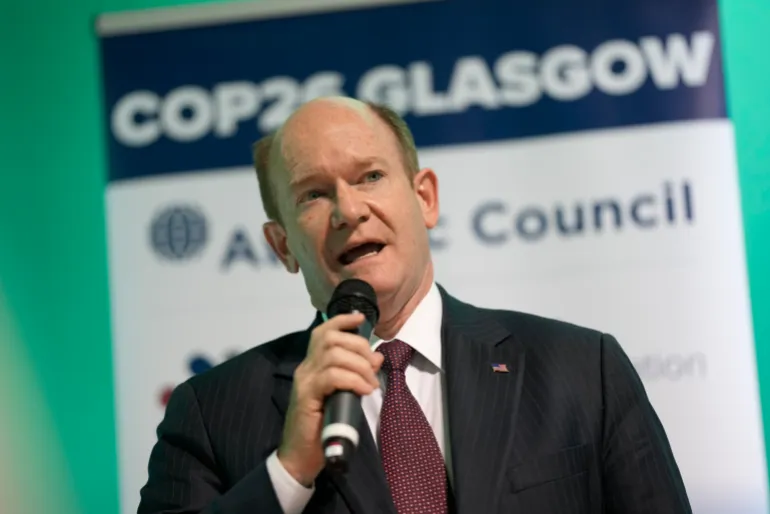
In response, some longtime Democratic supporters of Israel – including Senator Chris Coons, who is likely to chair the Senate Foreign Relations Committee if Democrats retake control of the Senate next month – have shifted, as voters, especially younger ones, demand greater accountability from the US ally.

US Democratic Senator Chris Coons of Delaware speaks at the COP26 UN Climate Summit in Glasgow, Scotland
US Democratic Senator Chris Coons of Delaware speaks at the COP26 UN Climate Summit in Glasgow, Scotland [Alastair Grant/AP Photo]

The moderate Delaware Democrat told Politico in an interview this month that he wants a “thorough reexamination” of the US-Israeli relationship and is even willing to impose sanctions on Israel’s prime minister, Benjamin Netanyahu.

It is a marked change in tone after Harris rejected calls to feature a Palestinian American speaker at the 2024 Democratic National Convention in Chicago.

Earlier this year, 40 Democratic senators voted in support of a motion that disapproved proposed military sales to Israel. Only seven Democratic senators voted with Republicans to block it.

But as a new Congress may include even more progressive voices demanding the US rethink its relationship with Israel, those calls would likely be met with stiff resistance from some in the Democratic leadership, including Senate Minority Leader Chuck Schumer.

The New York Democrat, who would likely become majority leader if Democrats retake the Senate, has said that the US “commitment to Israel’s security and defense must be ironclad”.

Have Democrats changed their positions on transgender rights?

Following years of attacks from Republicans, Democrats in tightly contested US House or Senate races have downplayed – or outright dismissed – support for the transgender community, mostly when it comes to the participation of transgender students in school sports.

In Ohio, Democratic Representative Marcy Kaptur ran an advertisement featuring her saying, “Boys should not play in girls’ sports”. And in North Carolina, Representative Don Davis released a television commercial in which the Democrat says there “should always be a safe and fair space for women and girls in sports”.

Next door in South Carolina, Democratic Senate candidate Annie Andrews, a doctor, said in a newly released advertisement that she opposes “biological men playing in women’s sports”.

Trump’s return to the White House was fuelled, in part, by a now-famous advertisement in the 2024 campaign that highlighted Harris’s support for transgender Americans.

“Kamala is for they/them,” a narrator said in the advertisement, referring to gender neutral pronouns used by some in the transgender and nonbinary community. “President Trump is for you.”

But the reassessment of transgender rights after the commercial’s airing is not taking place in every part of the party.

On Thursday at a “Students vs Billionaires” town hall in Portland, Maine, Representative Alexandria Ocasio-Cortez addressed concerns from a transgender college student who told the New York progressive that they felt “abandoned” by Democrats.

“They’re wrong”, Ocasio-Cortez said about some members of her party. “First and foremost, I want to just let you know how shameful and sorry I am that there are people out there that scare so easily after an election”.

The congresswoman added, “The moment you compromise the rights of a trans person in America, you compromise the rights of every citizen.”

What has changed on immigration and border security?

During former US President Joe Biden’s term, Democrats encountered near-daily attacks from Republicans on the country’s immigration system.

US Customs and Border Protection (CBP) recorded more than 8 million encounters at the US-Mexico border between 2021 and 2025, fuelling concerns among some voters that the Biden administration had ignored the issue.

In Texas’s closely watched Senate race, candidate James Talarico has positioned himself as a “border security Democrat”, advocating for stronger border enforcement and comprehensive immigration reform.

Third Way, a US-based organisation that pushes for moderate policies, said stances like Talarico’s resonate better with voters because they have taken a proactive, rather than a reactionary approach.

Democratic US Senate candidate James Talarico speaks at a campaign rally during his "Clear Eyes, Full Hearts Tour" at the Galveston Railroad Museum in Galveston, Texas, on October 22, 2026. (Photo by Mark Felix / AFP)
Democratic US Senate candidate James Talarico speaks at a campaign rally in Galveston, Texas, on Thursday [Mark Felix/AFP]

“I remember very clearly when Harris came out and spoke at the DNC in 2024; she… said we need order at the border and to have a strong immigration system”, Third Way’s senior political adviser, Lucas Holtz, told Al Jazeera.

“The problem is, after that, the Harris campaign really did not stick with that line in the sand… They stopped taking a stand on these issues, and more voters thought that she was too far to the left.”

“[Talarico] is making the case in a lot of his ads that the Biden administration failed on securing the border… It’s putting Republicans on their back foot in some of these races.”

But among progressives, Trump’s response to the nation’s immigration issue has also prompted a strong swing to the left.

After several high-profile incidents earlier this year – including federal immigration agents in Minneapolis, Minnesota, shooting dead US citizens Renee Good and Alex Pretti  – calls to abolish, or drastically overhaul, US Immigration and Customs Enforcement (ICE) have gained momentum.

Left-leaning political groups and politicians have united behind a message of “abolish ICE”, which would dismantle the federal agency and end its enforcement authority.

Do Democrats support Medicare for All?

As cost-of-living issues remain paramount for voters, Democrats of all stripes have coalesced behind the need for more government intervention in the country’s healthcare system.

But how exactly the party addresses rising medical costs remains up for debate.

Some progressives, including Michigan Democratic Senate candidate Abdul El-Sayed, have championed policies like Medicare for All, which would expand the nation’s federal health insurance programme for seniors so all US citizens would be guaranteed healthcare.

US Senate Democratic candidate Abdul El-Sayed gestures to supporters during a campaign rally in Dearborn, Michigan
US Senate Democratic candidate Abdul El-Sayed gestures to supporters during a campaign rally in Dearborn, Michigan [Rebecca Cook/Reuters]

Others running in more conservative states, like Andrews, have called for the return of Affordable Care Act subsidies that lapsed during Trump’s second term, as well as limits on health insurance companies’ profits.

Polling released by the independent health organisation KFF suggested that 66 percent of US adults now support Medicare for All, a 13-point increase from October 2020.

“Everybody’s going to have their own approach to this, but by and large, all Democrats want to move to a universal healthcare system in the best way possible”, Holtz said.

“We’re in agreement that we need to do better than what the Trump administration has done.”
Source link

Epstein, Iran and ‘drain the swamp’: Have Republicans shifted before vote? | Donald Trump News

United States President Donald Trump has long touted himself as a political outsider, someone who would expose the elites’ abuse of power and shift government focus from far-off conflicts to problems at home. Phrases like “drain the swamp” and “America first” have proved to be powerful rallying cries, sparking a whole cadre of “Make America Great Again” (MAGA) Republicans.

Halfway through his final term as president, though, Trump has backpedalled on many of those ideas, cosying up to the ultra-wealthy, sidelining investigations into convicted sex trafficker Jeffrey Epstein, and launching an ongoing war with Iran.

Recommended Stories

list of 3 itemsend of list

That about-face appears to be having a real impact on Republicans running in the US midterm elections in November, said Rina Shah, a geopolitical adviser and strategist and a former senior GOP congressional aide.

“In competitive races, some are quietly distancing,” Shah said, adding that they are “talking about gas prices, local issues, or [saying] ‘I’m focused on my district’ – because the Iran war and the Epstein drip are already showing up in attack ads and soft polling.”

Here’s what you need to know about whether the Republican Party has softened its stance on these issues.

Which Republicans have broken with Trump over the Epstein files?

During his 2024 presidential campaign, Trump said he would declassify troves of files kept by the Federal Bureau of Investigation (FBI) about Epstein and his global network of contacts. Trump’s future cabinet members, too, were enthusiastic about this, with Kash Patel, now head of the FBI, saying it was time to “put on your big boy pants and let us know who the pedophiles are”.

Yet a few months after taking office, Trump began dragging his feet, sparking a backlash from influential MAGA figures. Trump began calling the entire issue a “hoax” and saying Republicans were being duped by Democrats into calling for an investigation into Epstein’s network.

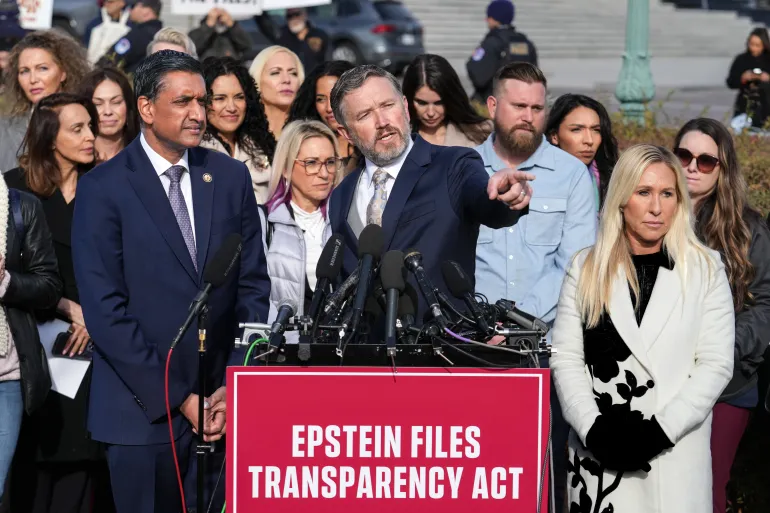
Rep. Ro Khanna, D-Calif., from left, Rep. Thomas Massie, R-Ky., and Rep. Marjorie Taylor-Greene, R-Ga., speak during a news conference as the House prepares to vote on the Epstein Files Transparency Act, at the Capitol in Washington, Tuesday, Nov. 18, 2025, as they are joined by survivors and family members who recounted their personal stories of Epstein. (AP Photo/J. Scott Applewhite)
US Congressional Representatives Ro Khanna, Thomas Massie, and Marjorie Taylor Greene speak during a news conference as the US House of Representatives prepares to vote on the Epstein Files Transparency Act, at the US Capitol in Washington, DC, the United States on November 18, 2025 [File: J Scott Applewhite/AP]

Congress did eventually force the release of the files, with help from a handful of Republicans who broke with Trump. The Trump administration has released batches of the heavily redacted files, but has continued to withhold some. Meanwhile, all the Republican lawmakers who voted to mandate releases have paid a price for their insubordination, with three even losing their offices.

US Representative Marjorie Taylor Greene left her Georgia seat in January 2026, after publicly clashing with Trump over Epstein. Nancy Mace, a Republican from South Carolina, lost her bid to become the party’s candidate in her home state after Trump refused to endorse her. Colorado’s Lauren Boebert barely won the primary in her own contest after angering Trump by supporting calls for transparency from Thomas Massie, another Republican bent on exposing what the files held. Massie, of Kentucky, also drew Trump’s ire, which likely cost him the primary.

Republican presidential nominee Donald Trump participates in a fireside chat with media host Tucker Carlson at the Desert Diamond Arena, in Glendale, Arizona, the US, October 31, 2024
Republican presidential nominee Donald Trump participates in a fireside chat with media host Tucker Carlson at the Desert Diamond Arena, in Glendale, Arizona, the US, October 31, 2024 [File: Brendan McDermid/Reuters]

No more foreign wars?

Trump had long said he would be reducing foreign military involvement, breaking with the interventionist tendencies of other recent Republican presidents. Now he and his party face tough questions about the US-Israel war on Iran, which influential figures in the MAGA movement like political commentator Tucker Carlson have called a mistake, saying, “This is Israel’s war. This is not the United States’ war.”

Amongst disgruntled MAGA supporters, a narrative has emerged of Trump using the war to also distract from the Epstein issue. Massie, the former congressman, summed up the sentiment by saying, “Bombing a country on the other side of the globe won’t make the Epstein files go away.”

Trump has tried to downplay the war’s impact, but voters, even in the Republican Party, think he broke his own promise, driving the overall approval rating for the ratings-obsessed president down to record lows. “Seven months into an open-ended campaign with shifting goals,” said Shah, “that promise looks different to a lot of his voters.”

Few Republicans, however, have responded to that public sentiment with their votes in Congress, where Democrats have tried repeatedly to curtail Trump’s war on Iran by passing resolutions pointing out he failed to get the body’s approval.

In September, just seven Republican House members joined Democrats to pass an anti-war bill. In the Senate, similar efforts have been supported by just a handful of Republicans. Trump called the Republican lawmakers supporting the anti-war bills “unpatriotic,” and said, “They should be ashamed of themselves.”

As with the Epstein files, Trump took action against rebellious Republicans over the Iran war, for instance backing a rival of Senator Bill Cassidy, who voted in favour of the anti-war bill, in a primary in Louisiana that the Republican senator ended up losing.

What happened to Trump’s promise to “drain the swamp”?

One of Trump’s most appealing promises had been to purge the government of a “deep state” establishment he says is running the country without being accountable to the public on social issues, and fiscal and foreign policy.

Priscilla Chan, Meta founder Mark Zuckerberg, Lauren Sanchez, Amazon founder Jeff Bezos, Google CEO Sundar Pichai and Tesla CEO Elon Musk attend Donald Trump’s inauguration ceremony on January 20, 2025
Priscilla Chan, Meta founder Mark Zuckerberg, Lauren Sanchez, Amazon founder Jeff Bezos, Google CEO Sundar Pichai and Tesla CEO Elon Musk attend Donald Trump’s inauguration ceremony on January 20, 2025 [Chip Somodevilla/POOL/AFP]

In a way, Trump did keep that promise. An entire federal government division – the Department of Government Efficiency (DOGE) – forced tens of thousands of federal workers out of their jobs and dismantled institutions like the US Agency for International Development (USAID). The military threw out notions of racial, gender, and economic diversity. Everything from universities to the Smithsonian Institution was subjected to a campaign against an unqualified, diversity-obsessed elitist class.

But lobbying groups, including some supporting foreign governments, have been given a free hand, and ethics rules and watchdogs who would tackle political corruption have been weakened, said Shah, the Republican strategist.

At his presidential inauguration, Trump literally surrounded himself with the wealthiest people in the world, some of whom have gone on to play some part in his administration.

Source link