Bangladesh held its first general elections since that uprising on February 12, and the Bangladesh Nationalist Party (BNP), led by Tarique Rahman, won a landslide victory.
Rahman, a scion of one of the country’s most powerful political dynasties, is set to serve as prime minister of the incoming government when it is sworn in on Tuesday, according to Bangladeshi media.
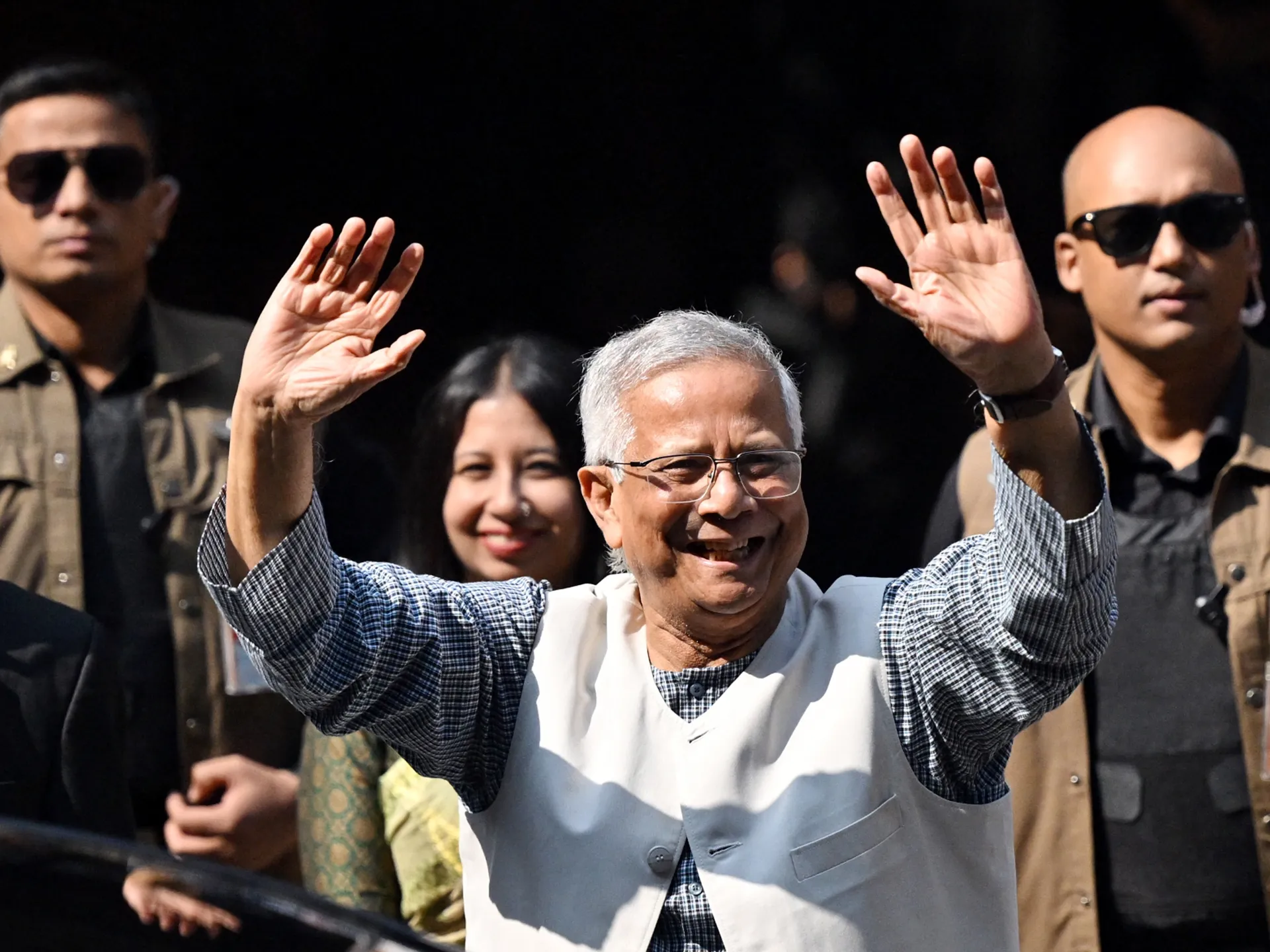
Yunus praised the recent elections, which European Union observers called “credible and competently managed” as a “benchmark for future elections”.
“The people, voters, political parties, and stakeholder institutions linked to the election have set a commendable example,” Yunus said.
‘We must remain united’
Rahman’s BNP-led alliance won at least 212 seats in the 300-seat parliament, giving it a strong mandate to lead. In second place was the Jamaat-e-Islami party, which won 77 seats, positioning it as the main opposition party. Hasina’s Awami League party was barred from participating.
Rahman appealed for unity in the wake of his party’s victory, saying “our paths and opinions may differ, but in the interest of the country, we must remain united”.
In addition to electing their new representatives, Bangladeshi voters also endorsed sweeping democratic reforms in a national referendum.
The lengthy document of reforms, known as the “July Charter” after the month when the uprising that toppled Hasina began, proposes term limits for prime ministers, the creation of an upper house of parliament, stronger presidential powers and greater judicial independence. It enshrines a key pillar of Yunus’s post-uprising transition agenda.
The referendum noted that approval would make the charter “binding on the parties that win” the election, obliging them to endorse it.
“Sweeping away the ruins, we rebuilt institutions and set the course for reforms,” said Yunus, praising the reforms.
However, several parties raised questions before the vote, and the reforms will still require ratification by the new parliament.
“The challenge now is to ensure good governance, law and order, and public safety, and to establish a rights-based state, which was at the heart of the aspirations of the 2024 mass uprising,” Rezaul Karim Rony, a Dhaka-based political analyst, told Al Jazeera.
An array of political parties and alliances will be vying for seats in the Bangladesh Parliament on February 12 in the country’s first election since the ousting of former Prime Minister Sheikh Hasina in 2024. About 127 million registered voters are eligible to cast votes to elect 350 members of the Jatiya Sangsad, the country’s parliament.
The South Asian country has been in the hands of a caretaker government led by Nobel laureate Muhammad Yunus since August 2024, when a student-led uprising ended Hasina’s long rule. Hasina ordered troops to crack down on protesters, killing 1,400 people. She has since been sentenced to death by a special tribunal in Bangladesh for the brutal crackdown, but remains in exile in India, and her Awami League party has been banned from political activity.
Recommended Stories
list of 3 itemsend of list
Besides the election on February 12, Bangladesh will also hold a referendum on the July National Charter 2025 – a document drafted following the student protests, setting the foundation for future governance of the country.
The two biggest groups competing for parliamentary seats across the country’s 300 constituencies are the Bangladesh Nationalist Party (BNP), which is leading a coalition of 10 parties, and Jamaat-e-Islami (JIB), which heads an 11-party alliance, including the National Citizen Party, a group formed by students who led the anti-Hasina movement in 2024. The Awami League, which dominated Bangladeshi politics for decades, has been barred from fielding candidates.
Besides the two main blocs, the Islami Andolan Bangladesh, which broke away from the JIB-led alliance, and the Jatiya Party, a longtime ally of Hasina’s Awami League, are contesting independently.
Here is a look at the main political parties and their leaders vying for parliament seats this year, and the key players influencing the election.
Bangladesh Nationalist Party
Led by Tarique Rahman, the son of the late former Prime Minister Khaleda Zia, the BNP is seen as one of the main contenders in the upcoming elections.
The party was founded in 1978 by Ziaur Rahman, Tarique’s father and one of the leading military figures of the country’s independence war against Pakistan in 1971, on the principles of Bangladeshi nationalism. According to the BNP website, this is an “ideology that recognises the right of Bangladeshis from all walks of life, irrespective of their ethnicity, gender or race”.
As a centre-right political party, the BNP has been a popular political force in the country for decades and has traditionally exchanged power with the Awami League.
For four decades after Ziaur Rahman’s assassination in 1981, his wife and Tarique’s father, Khaleda Zia, led the party. Khaleda served as the country’s first female prime minister from 1991 to 1996 and again from 2001 to 2006. In that period, Jamaat was an ally of the BNP as they together fought against Hasina’s Awami League.
After Hasina came back to power in 2009 – she had also ruled between 1996 and 2001 – the BNP faced the wrath of her government over corruption charges, and Khaleda was put under house arrest in 2018 in two related cases. She was acquitted of all charges after Hasina’s departure in 2024.
Since Hasina’s ousting in 2024, the BNP has risen again as a political frontrunner. A December survey by the United States-based International Republican Institute indicated the BNP had the support of 33 percent of respondents. That was also the only month when the BNP — seeking to position itself as a liberal force ahead of the elections — broke its alliance with Jamaat. Polls show Jamaat just marginally behind the BNP in popular support.
Tarique, 60, had been living in London, United Kingdom, since he fled Bangladesh in 2008 over what he called politically motivated persecution. He arrived in Dhaka on December 25, 2025 to take over the BNP leadership ahead of his mother Khaleda’s death on December 30.
“We will build a Bangladesh that a mother dreams of,” he said in December after returning to the country and calling on citizens from the hills and plains – Muslims, Hindus, Buddhists and Christians – to join him in creating a secure and inclusive nation.
In election rallies, he has pledged to improve the country’s infrastructure, among other promises.
“If elected, the healthcare system will be improved, a flyover will be constructed in Sherpur, permanent embankments will be built in the river erosion areas of Dhunat, and the youth will be made self-reliant through the establishment of IT education institutions,” he said.
According to Khandakar Tahmid Rejwan, lecturer in global studies and governance at the Independent University, Bangladesh, since Rahman’s return, the BNP has become more organised.
“The party has basically revived with a newfound spirit in both its central and grassroots-level leadership,” he said.
“Typical objections against BNP and affiliated party activists, like [allegations of] extortion … have also significantly declined. Top leaders of the central committee have also been comparatively cautious to avoid any statement that might create popular outrage. Significantly, the people are flocking in thousands to hear from Rahman at his electoral rally, even late at midnight,” he said.
Rejwan added that it is widely believed that Rahman is the only man who can currently unite Bangladesh with an “inclusive vision”, unlike his Jamaat rivals, who have failed to address any clear stance or acknowledge what are seen by many as their restrictive policies towards women and religious minorities.
Jamaat-e-Islami
The party was founded in 1941 by Sayyid Abul Ala Maududi during British rule in India.
In 1971, during Bangladesh’s war of independence, Jamaat supported staying with Pakistan, and was banned after the country won its freedom.
But in 1979, four years after the assassination of Sheikh Mujibur Rahman, who had fought for Bangladesh’s independence and is seen by many as the country’s founding father, BNP founder Ziaur Rahman, who was the country’s president at the time, lifted the ban. Ziaur Rahman was also assassinated in 1981.
Over the next two decades, Jamaat developed into a significant political force. It supported the BNP-led coalition in 1991 and 2001.
But while Hasina was in power from 2009 until she was toppled in student-led protests in 2024 and fled to India, five top Jamaat leaders were executed, while others were jailed for crimes committed during the independence war of 1971. The party was barred in 2013 from running in elections.
In June 2025, the country’s Supreme Court restored the party’s registration, paving the way for its participation in elections.
While Jamaat no longer has an alliance with the BNP, its current leader, 67-year-old Shafiqur Rahman, has also focused on reorganising the party into a strong contender in the election.
Speaking at an election rally in Jamalpur city on Sunday, Shafiqur Rahman said the upcoming election “will be a turning point”.
“It is an election to end the cries of the families of martyrs. It is an election to bury the rotten politics of the past,” he said, according to The Daily Star newspaper.
But his party’s resurgence has also prompted debate over whether Bangladesh is prepared to be led by an Islamist force, which some fear could seek to enforce Islamic law or try to restrict women’s rights and freedoms.
However, Jamaat has rejected such fears and has told reporters it is focusing on expanding its electoral power. Last December, the party announced an alliance with the National Citizen Party, founded by 2024 leaders of the student-led uprising, and with the Liberal Democratic Party, led by 1971 war hero Oli Ahmad.
For the first time in its history, Jamaat is also fielding a Hindu candidate, Krishna Nandi, from Khulna, in a bid to attract non-Muslim voters.
The International Republican Institute survey suggested the Jamaat-led alliance at number two, with 29 percent, closely behind the BNP.
According to Independent University’s Rejwan, Jamaat has an appeal across Bangladesh’s social classes.
“Its student wing has literally outperformed any other political rivals in the university union elections. We are also seeing the Jamaat-affiliated women’s wing reaching out door-to-door in both rural and urban areas to expand their women’s base of voters. Moreover, since the fall of Hasina, we are seeing pro-Jamaat active and retired elites from security forces, university academics, and civil services constantly pushing the pro-Jamaat narratives within their respective capacities,” he said.
“Jamaat’s upper hand and pragmatic postures are now being extended to its allies, like NCP, which is explicitly reaping all the benefits of its senior partner in the alliance,” he added.
National Citizens Party (NCP)
The NCP, one of Jamaat’s allies, was formed in February 2025 by students who led the mass protests in July 2024 over government job quotas, which ultimately toppled Hasina’s government.
Seeking to stand for the 2026 elections, the leaders told a rally in February 2025 that they had formed the party “to uphold the spirit of the July movement among students”.
Led by Nahid Islam, 27, the stated ideals of the NCP are to ensure “governance without corruption” and to unite the country. The party says it aims to uphold freedom of the press, increase women’s representation in parliament and improve Bangladesh’s relations with neighbouring countries, such as India.
But lacking adequate funds to run by itself in an election, the party has allied with Jamaat. However, the move has been received poorly by some in Bangladesh. It also triggered some resignations by some NCP members over ideological differences.
According to local media reports, those members submitted a memorandum stating that Jamaat’s controversial political history and historical views against Bangladesh’s independence in 1971 were contrary to the NCP’s values.
In an interview with ABC News last month, Nahid Islam defended the decision to unite with Jamaat and said, “When we are forming an electoral alliance, we are not abandoning our own political beliefs. It’s just a strategic alliance.”
“It’s unfortunate to see the leader of the political party that arguably claims to own and lead the 2024 mass uprising and depose Hasina, now become a junior partner to a major political party,” Rejwan said.
“As a result, we see defections of many top leaders of NCP, and astonishingly, by allying, it was only able to bargain for 30 seats for its own candidate. To sum up, Nahid has sold his political autonomy and image of an exclusive figure by de facto becoming subservient to Jamaat,” he added.
Who are the other key players in the election?
Besides the main political parties, Muhammad Yunus, who currently leads the interim government, and General Waker-Uz-Zaman, the army chief, are also influential figures in this election.
Yunus, who was selected to run the government after Hasina’s ousting, is facilitating the election in his capacity as the country’s chief adviser.
But while political parties are campaigning for the election, Yunus is focusing on the referendum on the July Charter, which will take place on the same day.
After Hasina’s ousting, Yunus formed the Constitution Reform Commission (CRC) in 2025, seeking to amend the governance of the country. The commission proposed an anticorruption mechanism, electoral reforms and new rules the police must follow, among other issues. The July Charter is the culmination of the CRC’s work and takes its name from the protests which dismantled Hasina’s government in July 2024. Bangladeshis will vote to approve or reject it in the referendum.
Last month, Yunus expressed confidence in the results of the referendum and told the media he expected people and political parties to agree to the charter. But some critics have said holding the referendum and establishing the charter is not constitutional.
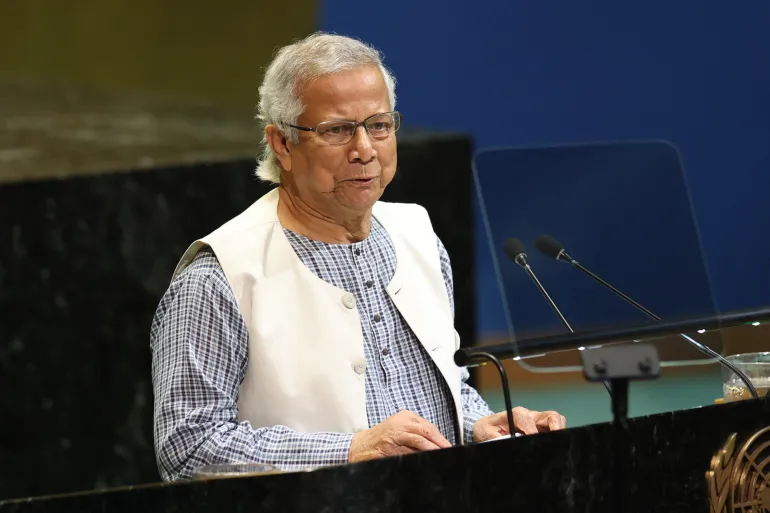
Muhammad Yunus addresses the United Nations General Assembly in New York, US [File: AFP]
General Zaman is also a key player in the election.
Following the 1975 assassination of Sheikh Mujibur Rahman, Bangladesh’s founding leader and then-president, the country entered a period marked by coups, countercoups and military rule, which reshaped the state.
Currently, the army is not vying for electoral power, but its focus will be on ensuring public order and security during the election, in light of political violence that has spread in the country since the upheaval of 2024.
The military also plays a role with respect to backing the political party in power or deciding how to govern the country during a political crisis.
In September 2024, after the protests against Hasina, Zaman told the Reuters news agency that he would back Yunus’s interim government “come what may”, while also floating a timeline for elections within 18 months, placing him central to the political debate.
A successful election will require goodwill from both Yunus and the army chief, according to Rejwan.
“Executives under the leadership of Yunus are critical to ensure the nationwide voting, while the Chief of Army Staff Waker’s forces, which would be deployed throughout the country, are indispensable to maintain public order and prevent the proliferation of political instability, violence and chaos,” he said.
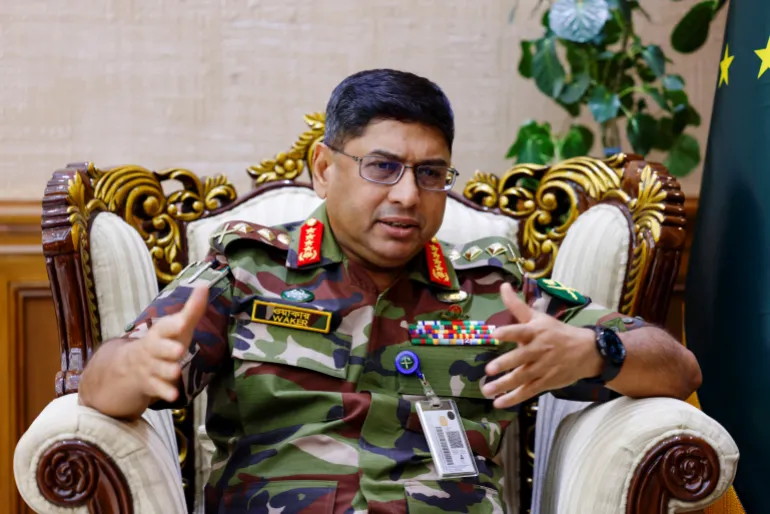
General Waker-uz-Zaman gestures during an interview with Reuters at his office in the Bangladesh army headquarters in Dhaka [File: Mohammad Ponir Hossain/Reuters]
Does Hasina have any power at all?
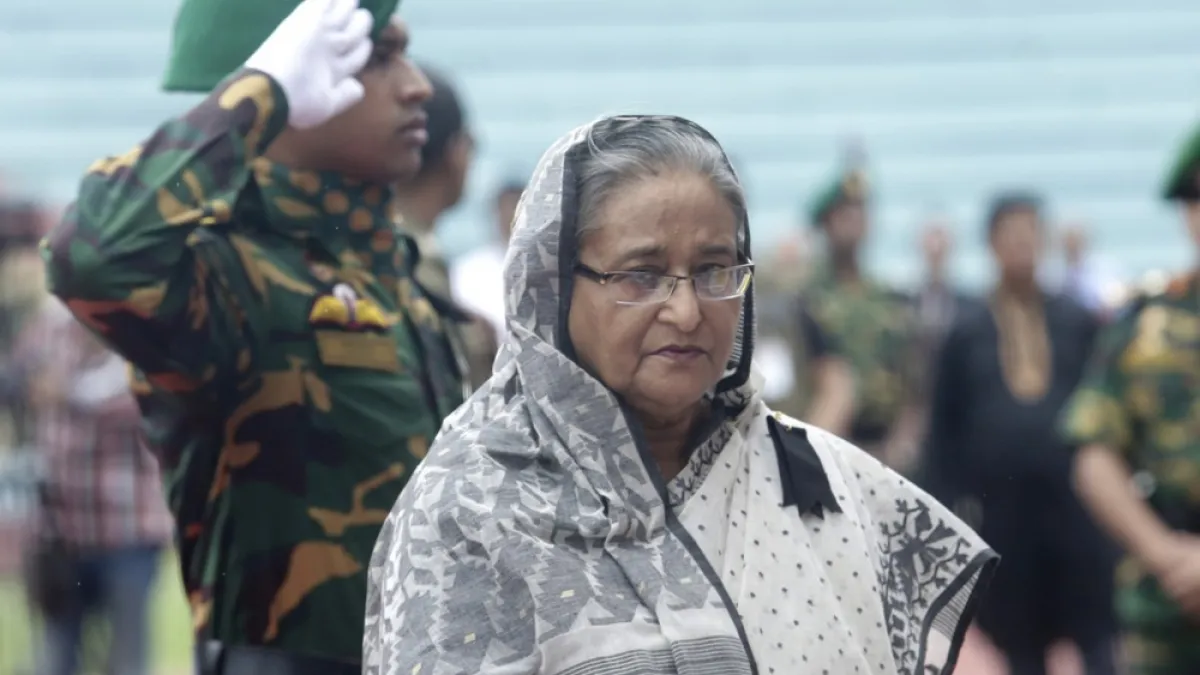
Hasina, who is currently in exile in India, has denounced the upcoming elections since her party, the Awami League, has not been allowed to take part. However, those who voted for her in the past must now choose how to vote this time.
In a message sent to the media last month, Hasina stated that “a government born of exclusion cannot unite a divided nation”.
“Each time political participation is denied to a significant portion of the population, it deepens resentment, delegitimises institutions and creates the conditions for future instability,” the former leader warned in an email to The Associated Press news agency.
Bangladesh’s Ministry of Foreign Affairs said it was “surprised and shocked” that Hasina had been allowed to make a public address in India. Her speeches and statements are banned from the media in Bangladesh.
“Allowing the event to take place in the Indian capital and letting mass murderer Hasina openly deliver her hate speech … constitute a clear affront to the people and the Government of Bangladesh,” the ministry said in a statement.
Hasina was sentenced to death in absentia by a tribunal in Bangladesh last November, and Dhaka has called on New Delhi to extradite her.
But she remains in India, and Rejwan says she will be a key political instigator of unrest as the elections approach.
“If Hasina were a negligible figure, then the interim government wouldn’t have banned all of her speeches and statements from being aired on television or printed in newspapers … the interim government would also not have reacted so firmly against India for allowing her to speak,” he noted.
“This means Hasina is a factor that the interim government implicitly believes has an influence over the Awami League populace, who are yet undecided on whom to cast their vote for, given that AL is banned from the polls,” he said.
“The reality is that AL has its own clear political ideology and a base of loyal cadres, many of whom have declined to change their allegiance despite living a harsh clandestine life in Bangladesh or abroad,” he added.
Ousted premier says the exclusion of her Awami League party “deepens resentment” on Muhammad Yunus’s interim government.
Bangladesh’s toppled leader Sheikh Hasina has denounced her country’s election next month after her party was barred from participating in the polls, raising fears of wider political division and possible unrest.
In a message published by The Associated Press news agency on Thursday, Hasina said “a government born of exclusion cannot unite a divided nation.”
Recommended Stories
list of 3 itemsend of list
Hasina, who was sentenced to death in absentia for her crackdown on a student uprising in 2024 that killed hundreds of people and led to the fall of her 15-year government, has been sharpening her critique of the interim government of Nobel Peace winner Muhammad Yunus in recent days, as the election that will shape the nation’s next chapter looms.
“Each time political participation is denied to a significant portion of the population, it deepens resentment, delegitimises institutions and creates the conditions for future instability,” the former leader, who is living in exile in India, warned in her email to the AP.
She also claimed that the current Bangladesh government deliberately disenfranchised millions of her supporters by excluding her party – the former governing Awami League – from the election.
More than 127 million people in Bangladesh are eligible to vote in the February 12 election, widely seen as the country’s most consequential in decades and the first since Hasina’s removal from power after the mass uprising.
Yunus’s government is overseeing the process, with voters also weighing a proposed constitutional referendum on sweeping political reforms.
Campaigning started last week, with rallies in the capital, Dhaka, and elsewhere.
Yunus returned to Bangladesh and took over three days after Hasina fled to India on August 5, 2024, following weeks of violent unrest.
He has promised a free and fair election, but critics question whether the process will meet democratic standards and whether it will be genuinely inclusive after the ban on Hasina’s Awami League.
There are also concerns over security and uncertainty surrounding the referendum, which could bring about major changes to the constitution.
Yunus’s office said in a statement to the AP that security forces will ensure an orderly election and will not allow anyone to influence the outcome through coercion or violence. International observers and human rights groups have been invited to monitor the process, the statement added.
Tarique Rahman, the son of former prime minister and Hasina rival, Khaleda Zia, returned to Bangladesh after his mother’s death in December.
Rahman, the acting chairman of Khaleda’s Bangladesh Nationalist Party, is a strong candidate to win the forthcoming election.
On Friday, Hasina made her first public speech since her ouster, telling a packed press club in Delhi that Bangladesh “will never experience free and fair elections” under Yunus’s watch.
Her remarks on Friday were broadcast online and streamed live to more than 100,000 of her supporters.
The statement was criticised by Bangladesh’s Ministry of Foreign Affairs, which issued a statement saying it was “surprised” and “shocked” that India had allowed her to make a public address.
Bangladesh has been asking India to extradite Hasina, but New Delhi has yet to comment on the request.
India’s past support for Hasina has frayed relations between the South Asian neighbours since her overthrow.
In Dhaka’s political chatter, one word often keeps resurfacing when people debate who really holds the reins of the country: “Kochukhet”.
The neighbourhood that houses key military installations has, in recent public discussions, become shorthand for the cantonment’s influence over civilian matters, including politics.
Bangladesh is weeks away from a national election on February 12, the first since the 2024 uprising that ended then Prime Minister Sheikh Hasina’s long rule and ushered in an interim administration led by Nobel laureate Muhammad Yunus.
The army is not vying for electoral power. But it has become central to the voting climate as the most visible guarantor of public order, with the police still weakened in morale and capacity after the upheaval of 2024, and with the country still reckoning with a “security apparatus” that watchdogs and official inquiries say was used to shape political outcomes under Hasina.
For nearly a year and a half now, soldiers have policed the streets of Bangladesh, operating under an order that grants them magisterial powers in support of law and order. On election duty, the deployment will scale up further: Officials have said as many as 100,000 troops are expected nationwide, and proposed changes to election rules would formally list the armed forces among the poll’s “law-enforcing agencies”.
Bangladesh, a nation of more than 170 million wedged between India and Myanmar, has repeatedly seen political transitions hijacked by coups, counter-coups and military rule, a past that still shapes how Bangladeshis read the present. Analysts say that the army today is not positioned for an overt takeover, but it remains a decisive power centre: an institution embedded across the state, able to narrow civilian choices through its security role, intelligence networks and footprint inside government.
Bangladesh’s Chief of Army Staff General Waker-uz-Zaman, seen here during an interview with Reuters at his office in the Bangladesh Army Headquarters, in Dhaka, Bangladesh, September 23, 2024 [Mohammad Ponir Hossain/ Reuters]
The military’s role now
Thomas Kean, the International Crisis Group’s senior consultant on Bangladesh and Myanmar, said the army has been “backstopping the interim government” not only politically but also “through day-to-day security amid police weakness”.
He said the institution is eager to see a transition to an elected government so the country returns to a firmer constitutional footing and so troops can “return to their barracks”.
“There are different factions and views within the army, but overall I would say that the army wants to see the election take place as smoothly as possible,” Kean told Al Jazeera.
Kean argued that if the army chief, General Waker-uz-Zaman, and the military “had wanted to take power, they could have done so when the political order collapsed on August 5”, the day Hasina fled to India amid a popular student-led revolt. But the military chose not to, he said, in part because it had learned from the fallout of past experiments with its direct political control.
Asif Shahan, a political analyst and professor at Dhaka University, said the military was aware that a takeover would have also jeopardised key interests, including Bangladesh’s United Nations peacekeeping deployments, which carry both financial benefits and reputational weight for the armed forces. Bangladesh has for decades been one of the biggest suppliers to UN peacekeeping missions, and receives between $100m and $500m a year in payouts and equipment reimbursements for these services.
But Shahan argues that the military remains “an important political actor”. Today, he said, its influence is “less about overt intervention than the institutional weight it carries through the security and intelligence apparatus”.
He also pointed to what he called the army’s “corporate” footprint. That footprint spans involvement in major state infrastructure projects, the military’s own business conglomerate, and the presence of serving and retired officers across commercial and state bodies.
Shahan said the last Hasina government “gave them a share of the pie”, leaving “a kind of culture of corruption … ingrained”. He suggested that this could translate into informal pressure on whoever governs next to do the same, and anxieties inside the force over whether “the facilities and privileges” it has accumulated will shrink.
On the election itself, Shahan too said that the possibility of the army trying to gain overt control was “very low” unless there is such a major law and order breakdown that there is public demand for the army to step in as the “only source of stability”,
Others who track the military closely agreed. Rajib Hossain, a former army officer and author of the best-selling book Commando, said he “strongly believes” the army will avoid partisan involvement for its own sake. “The army will play a neutral role during this election,” he said. “What we’ve observed on the ground over the past year and a half, there is no record of the army acting in a partisan way.”
But, he added, pressure on the institution has been intense since 2024. “Internally, there’s an understanding that if the army fails to act neutrally, it could lose even the public credibility it still has,” he said.
Mustafa Kamal Rusho, a retired brigadier general at the Osmani Centre for Peace and Security Studies, also told Al Jazeera that the military does not have “any clear intent” to influence politics, though “it still remains a critical power base”.
That leverage was clearest during the 2024 uprising, Rusho said, when Bangladesh’s political crisis reached a point that many Bangladeshis and international watchdogs viewed the military’s posture as decisive. “If the military did not take the stand that it took, then there would have been more bloodshed,” he said.
With protests escalating, the military refused to fully enforce Hasina’s curfew orders and decided troops would not fire on civilians. It enabled Hasina to flee to India on an air force plane, and the army chief then announced an interim government would be formed.
In an Al Jazeera documentary on the uprising last year, Waker-uz-Zaman, who is related to Hasina and was appointed less than two months before her collapse, also stressed that his forces would not turn their guns on civilians. “We don’t shoot at civilians. It’s not in our culture … So we did not intervene,” he said.
In the same interview, he added: “We believe that the military should not engage in politics … It’s not our cup of tea.”
Bangladesh’s military leader and president, Hussain Muhammad Ershad, meeting British PM Thatcher at Downing St. London on February 16, 1989 [Wendy Schwegmann/ Reuters]
When the military ruled
That hasn’t always been the military’s position.
After the 1975 assassination of Sheikh Mujibur Rahman, Bangladesh’s founding leader and then-president, by a group of military officers, the country entered a period marked by coups, counter-coups and military rule upheavals that reshaped the state and produced political forces that still dominate elections.
One of them was the Bangladesh Nationalist Party (BNP), founded by army general-turned-ruler Ziaur Rahman, who emerged as the country’s most powerful figure in the late 1970s before moving into civilian politics. Rahman was assassinated in 1981 in a failed coup attempt by another group of military officers. The BNP remains a key contender in the February 12 vote, now led by Rahman’s son, Tarique Rahman, who has returned to front-line politics after a long exile.
In 1982, then army chief Hussain Muhammad Ershad seized power and ruled for much of the 1980s. Writer and political historian Mohiuddin Ahmed has described Ershad’s takeover as coming only months after he publicly argued that “the army should be brought in to help run the country”.
Eventually, a pro-democracy movement led by Zia’s wife, Khaleda Zia, and Hasina, also Mujibur Rahman’s daughter, forced him from office. The BNP won a landmark election, and in 1991, Khaleda became the country’s first female prime minister.
Since then, Rusho said, the military’s influence “became more indirect”, though Bangladesh still saw an abortive May 1996 showdown when the then army chief, Lieutenant General Abu Saleh Mohammad Nasim, defied presidential orders, and troops loyal to him moved towards Dhaka. Nasim was arrested and removed from office.
A decade later, in 2007, the military in effect “fully backed” a caretaker government that was formed to replace Khaleda’s second administration, which had ruled between 2001 and 2006. That caretaker government was installed in January 2007 after a breakdown in the election process and escalating political violence. The International Crisis Group described the caretaker administration as “headed by technocrats but controlled by the military”, while then-army chief Moeen U Ahmed argued the political climate “was deteriorating very rapidly” and that the military’s intervention had “quickly ended” street violence.
It was only after 2009, when Hasina came back to power – her Awami League had first ruled between 1996 and 2001 – that the military became “subordinate to the civilian regime”, Rusho said.
Bangladeshi military force soldiers on armored vehicles patrol the streets of Dhaka, Bangladesh, Saturday, July 20, 2024 [Rajib Dhar/ AP Photo]
Blurred lines
But even though the military today insists that it does not want power, it has often drifted into the political terrain.
A major moment arrived just weeks after Hasina’s ouster, in September 2024, when General Zaman told the Reuters news agency he would back Yunus’s interim government “come what may”, while also floating a timeline for elections within 18 months. The interview, which critics described as something unprecedented for a serving army chief, placed the military close to the country’s central political debate.
Hossain, the former army officer and author, criticised the public nature of the intervention. “If he [Zaman] had discussed this after sitting with all the stakeholders … the interim [administration], political parties, protest leaders … and then gone to the media, that would be acceptable,” he said. “But here, he declared it unilaterally and blindsided the government from his position of power. He had no authority to do that.”
“You may say this is an extraordinary, transitional time and the military has a role to play,” Hossain added. “But then, why do we have an administration at all?”
Shahan, the Dhaka University professor, said Zaman “came very close” to crossing the line and explained it as a product of military institutional culture after August 5. “Military organisations … like to follow standing operating procedures, order, stability,” he said. But August 5, he added, was “a political rupture” that forced the army and the nation into uncertainty: about the interim government’s longevity, legitimacy and how it would deal with the military.
Those anxieties, Shahan said, likely pushed Zaman to speak. In principle, he said, it is reasonable for the army chief to say elections are needed for stability. But “when he set a specific timeline – within 18 months – that is beyond his role”, Shahan said. “It then appears as if he is dictating.”
Shahan added that the problem becomes sharper when that kind of specificity appears to respond to a party demand; he was referring to a time when only the Bangladesh Nationalist Party was repeatedly pushing for a vote timetable.
Eight months later, in May 2025, Zaman again weighed in, telling a high-level military gathering, according to local media reports, that his position had not changed and that the next national vote should be held by December 2025. After that, Faiz Ahmad Taiyeb, a special adviser to Yunus, wrote on Facebook that “the army can’t meddle in politics” and argued that the military chief had failed to maintain “jurisdictional correctness” by prescribing an election deadline.
Military personnel stand in front of a portrait of then Prime Minister Sheikh Hasina in Dhaka, Bangladesh, on July 30, 2024 [Rajib Dhar/ AP Photo]
The shadow Hasina left
Another reason that analysts say the military’s role is being debated so intensely now is because of Bangladesh’s recent wounds.
During Hasina’s 15-year rule, human rights organisations argued Bangladesh’s security apparatus was often used for political control. Human Rights Watch has described enforced disappearances as a “hallmark” of Hasina’s rule since 2009.
When the United States sanctioned the Rapid Action Battalion (RAB) in 2021 over allegations of extrajudicial killings, the US Department of the Treasury said, “These incidents target opposition party members, journalists, and human rights activists.” Critics argue that security institutions became central to governance, and questions about how that machinery was used are now part of the post-Hasina political settlement.
Hossain, the former officer, said the Hasina-era legacy still echoes inside the top brass. “If you look at the leadership, the general, five lieutenant generals, and some major generals and brigadier generals, a lot of them were part of Hasina’s apparatus,” he said, “aside from a handful of professional officers”.
A report by Bangladesh’s Commission of Inquiry on Enforced Disappearances says disappearances were used as a “tool for political repression” and that the practice “reached alarming levels during key political flashpoints”, including in the run-up to elections in 2014, 2018 and 2024. The commission said it verified 1,569 cases of enforced disappearance.
In cases where political affiliation could be confirmed, the Jamaat-e-Islami and its student wing accounted for about 75 percent of victims, while the BNP and its affiliated groups accounted for about 22 percent. Among those “still missing or dead”, the BNP and its allies accounted for about 68 percent, while the Jamaat and its affiliates accounted for about 22 percent, the report said.
The commission also noted that the Directorate General of Forces Intelligence (DGFI), the military-run intelligence agency, had been “accused of manipulating domestic politics and interfering in the 2014 parliamentary elections”, and argued that perceived alignment with the Awami League compromised its neutrality.
Several senior military officers, including 15 in service, are now facing trial in a civilian tribunal on charges of enforced disappearances, murders and custodial tortures.
The proceedings have become a delicate issue in civil-military relations, as cases against serving officers in civilian courts are rare in Bangladesh’s history.
Former army chief Iqbal Karim Bhuiyan wrote on Facebook that local media had reported disagreements over the “trial process” for officers accused of crimes against humanity and that those disagreements had created what he described as a “chasm” between the interim government and the army’s top leadership.
Hossain, the former officer, however, said he disagreed. “These trials are not defaming the army,” Hossain said. “Rather, they are a kind of redemption for the institution to recover from the stigma created by the crimes of some self-serving officers.”
He argued that accountability could motivate younger officers and reduce the risk of the military being politically exploited again. Rusho, the retired brigadier general, also argued that politicisation under Hasina was driven less by formal doctrine than by executive control over careers.
“Promotions, important postings, placements … they were influenced considerably by the executive branch,” he said. “When you influence postings, some people’s loyalty often gets diverted to political masters, [and] it affects … professionalism and capability.”
Kean of the International Crisis Group said the real test for Bangladesh now would be whether it can stop the security state from being reabsorbed into partisan politics.
“The military is going to remain a powerful institution in Bangladesh, with a level of influence in domestic politics,” he said. “One hopes that the lesson of the past 18 months is that the military is better to support civilian administrations rather than be in power directly – that it can be a stabilising force, and one that is ultimately committed to democracy and civilian leadership.”
But, he added, the onus to do that isn’t only on the generals. Civilian politicians, too, needed to resist the temptation to misuse the military. That alone, he suggested, would help Bangladesh keep the army in the barracks and politicians accountable to the people, not to men in khakis.