U.S. Air Force’s Containerized Surface-To-Air Missile Program Comes Into Sharper Focus
The U.S. Air Force has awarded a flurry of contracts to support its pursuit of a new, lower-cost anti-air missile, as well as containerized launchers to fire them. The Counter-Air Missile Program (CAMP) is targeting designs that cost no more than $500,000 apiece and can be produced at a rate of at least 1,000 per year. The war with Iran, as well as other conflicts in recent years, has driven home a critical need, in general, to expand the depth and breadth of ground-based options for tackling a wide range of aerial threats. CAMP also aligns with Air Force efforts to expand its organic ground-based air defenses, which it has historically relied on the Army to provide.
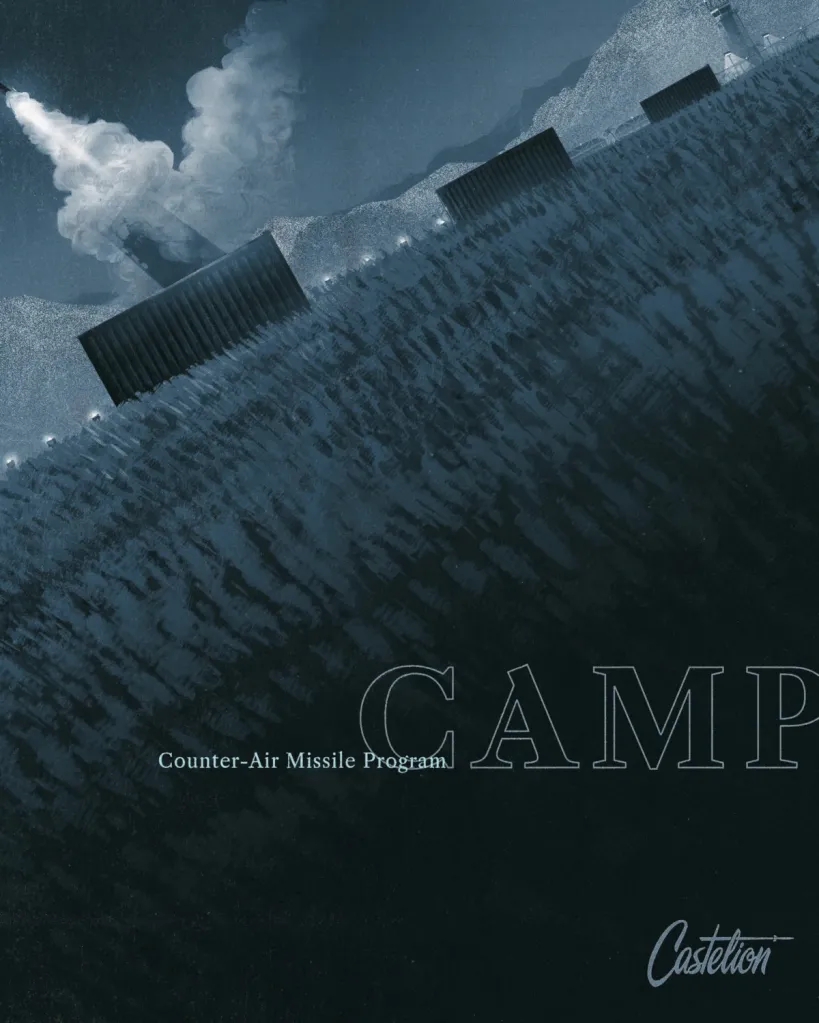
The Sierra Nevada Corporation (SNC) announced today that it, in partnership with Specter Aerospace, had received a $124 million award from the Air Force to develop an anti-air missile under CAMP. This follows news yesterday from Castelion that it had received two separate CAMP contracts covering work on an interceptor, as well as a launch pod to load them into and a containerized launcher. Anduril shared last week that it had also secured a deal to develop a launcher in support of this program.

The Air Force first shared details about CAMP, which is focused initially on a surface-to-air capability, last year. The service has said the program could also lead to a new air-to-air missile. It is an outgrowth of a ‘family’ of programs that have been focused primarily on the development of lower-cost and readily producible cruise missiles, rather than anti-air interceptors, for the U.S. military and its allies and partners. This includes the Extended Range Attack Munition (ERAM) program, under which munitions have already been provided to Ukraine, and the Family of Affordable Mass Missiles (FAMM) effort geared toward the Air Force’s own use.
“CAMP is designed to deliver a long-range offensive missile, capable of production at a fraction of the cost of legacy systems, while enabling the higher production volumes needed to restore affordable mass to the U.S. arsenal,” SNC explains in its press release today. “The program’s initial phase will produce a ground-launched prototype, laying the foundation for a formal Program of Record.”
Anduril’s press release last week separately said the initial phase of CAMP was set to last approximately 10 months.
“The highest priority of this effort is the development and demonstration of an affordable, open system, modular, and highly producible ground-launched capability. Ground-launch efforts will serve as a risk reduction effort expediting missile design maturation and evaluation for future affordable air-to-air missile capabilities,” the Air Force also said in a contract notice back in November 2025. “A ground-launch system will also serve as a new weapon class of Enterprise Test Vehicle (ETV), providing a lower cost, rapid capability to integrate and demonstrate future sub-systems and components in a relevant environment prior to integration into a Program of Record weapon.”
The term ETV here is one the U.S. military has been using in recent years to describe ‘air vehicles’ that increasingly blur the line between traditional cruise missiles, long-range one-way-attack drones, and decoys. The Air Force also refers to the land-based component of CAMP as Ground Launched Counter Air (GLCA). At the time of writing, no separate name appears to be given yet to the air-to-air spiral that may follow.
“The CAMP system All-Up Round (AUR) cost is desired to be below $500K, at a production quantity of at least 1,000 units,” per the Air Force’s contracting notice last year. “The Government desires the counter air weapon solution to trade exquisite capabilities for affordability and producibility in support of delivering quantities of 1,000-3,500 per year in full rate production.”
The notice also said designs would have to balance “performance, affordability, modularity, and producibility” by following the “Modular Weapon M-Series approach.” Beyond general modularity, this framework puts particular emphasis on open architecture systems and use of digital design tools, as well as U.S. ownership of data rights. All of this is intended to make it easier to add new and improved functionality in the future, and leverage a competitive market space beyond the original manufacturer to do that work in the most cost-effective manner.

To date, details about the kind of performance envelope the Air Force is eyeing for CAMP and what threats it wants the interceptors to be able to tackle have been scant. SNC’s press release today offers the first real hint about capability requirements in saying the missile it is working on now with Specter Aerospace will be able to reach supersonic speeds.
“The Air Force’s CAMP selection is representative of Specter’s vertically integrated approach to developing high-speed air-breathing weapons,” Arun Chundru, Chief Technology Officer at Specter Aerospace, said in a statement. “This award reflects the improved missile performance that comes from developing the airframe and air-breathing propulsion system together. We are proud to be working hand in hand with SNC to deliver the most affordable weapon system possible to the Joint Force, strengthening our supersonic readiness and deterrence at a critical point in time.”
Castelion has not yet shared any firm details about its design for CAMP. The company is best known publicly now for its Blackbeard lower-cost hypersonic strike missile, but it is unknown whether its new anti-air interceptor design will be related in any way. Blackbeard is under development in air-launched forms for the U.S. Navy and the Air Force. The U.S. Army is also looking to acquire versions of Blackbeard for employment from ground-based launchers.

As a point of comparison, the latest versions of the AIM-9X Sidewinder missile, which can be employed in air-to-air and surface-to-air missions, have unit costs around $500,000. However, the CAMP cost point is not necessarily reflective of expected capabilities.

“In the ground-launched surface-to-air realm, a price tag under $500,000 would put CAMP at the higher end of the cost range of shorter-range interceptor designs that the Army, and the Marines to a lesser extent, have been working to field in recent years. Many of these designs, like Raytheon’s combat-proven Coyote Block 2, which the Air Force is now also operating on some level, are focused primarily on providing added layers of defense against drones. Systems that use APKWS II rockets in the surface-to-air role are increasingly part of the equation, as well. Last month, the Army announced its newest planned addition to this end of its air defense arsenal, AeroVironment’s Freedom Eagle-1. The Army’s Patriot ground-based surface-to-air missile systems lie at the other end of the cost and capability spectrum, being able to fire various interceptors that all cost multiple millions of dollars apiece.”
…
“A missile even approaching AIM-120-like capability, in either the surface-to-air or air-to-air mode, at half the price would offer particular value. If that weapon could also be made smaller than the AIM-120, it would open up additional possibilities in terms of launch environments. A modular, scalable design could be even more advantageous in that regard, creating additional flexibility while retaining commonality in components that could help with keeping costs and production times low. Owning key technical data rights would give the Air Force more opportunities to hold competitions for various aspects of the program, fostering competition that could be beneficial.”

“There are inherent challenges to doing all this with anti-air missiles, due to the general performance required, especially to be able to tackle a broader array of aerial threats. Very different capabilities can be required to successfully intercept various tiers of drones and cruise missiles, as well as traditional fixed-wing aircraft and helicopters, all operating with equally different engagement envelopes.”
It is worth noting here that the Air Force separately laid out requirements last year for a less expensive AIM-120-sized anti-air weapon it dubbed the Low-Cost High-Speed Air-to-Air Missile. The service is now pursuing other much longer-range and otherwise more capable air-to-air missiles, as well. The latter efforts are in line with very-long-range anti-air missile developments that have been steadily emerging from the U.S. Navy.
The Air Force also previously confirmed to TWZ that it was at least looking into anti-air derivatives of the lower-cost cruise missile designs being acquired under the ERAM program. The effort would leverage technology developed originally for the anti-air optimized version of the laser-guided APKWS II rocket, also known as Fixed Wing, Air Launched, Counter-Unmanned Aircraft Systems Ordnance (FALCO).
Whether or not the Air Force plans to eventually down-select to one particular design under CAMP is unclear. What we have seen to date with the ERAM and FAMM programs points to the distinct possibility that the service could pursue the acquisition of several different types of missiles under this anti-air offshoot.

Diversity of stockpiles and supply chains has been a central underlying aspect of lower-cost munitions programs across the U.S. military in recent years. As mentioned at the start of this piece, the ongoing war with Iran, as well as other conflicts in the Middle East and in Ukraine, have driven home the point that it is not enough to just have stocks of any particular weapon when hostilities break out. Depth to existing inventories and the ability to replenish them quickly are also vital, especially in larger-scale fights that become protracted. When it comes to ground-launched capabilities, in particular, more flexible launch options, including containerized and palletized systems, which can fire multiple types of munitions, are also increasingly becoming the norm.
Underlining the latter point here, “Anduril is developing a launcher that could integrate missiles from different companies and can operate across dispersed locations for extended periods with minimal personnel support,” per that company’s press release. “Anduril is incorporating manufacturing requirements into the design from the outset, including component selection, assembly, supply chain, testing, and tooling. If the Air Force selects the launcher for production, this work will reduce production costs and allow us to rapidly scale deliveries.”
In general, containerized launchers offer inherent benefits in terms of mobility and flexibility. They can be deployed via truck and rail, as well as by cargo aircraft and ships, including rapidly to forward locations. These attributes could be especially beneficial for future expeditionary or distributed operations, which the Air Force, as well as other branches of the U.S. military, see as key to future operations. Depending on how launchers loaded with CAMP interceptors are linked together with sensors and fire control nodes, it might also be possible to distribute them further away from human operators. This, in turn, could reduce the vulnerability of friendly forces while also offering greater air defense coverage over broader areas.
As noted earlier, the Air Force’s new push forward on CAMP comes as the service is now working to take on more responsibility for protecting bases abroad and at home from aerial threats, especially drones. The U.S. Army has historically been the service in charge of providing surface-to-air missile systems and other ground-based air defenses to help shield Air Force facilities. As we’ve seen with ERAM, new capabilities developed through CAMP could well make their way to other branches of the U.S. military, as well as foreign armed forces facing the same kinds of requirements, too.
With multiple companies now actively working on interceptor and launcher prototypes under CAMP, a full sense of the program’s objectives and the kinds of threats it is intended to address may noe begin to come into sharper focus.
Contact the author: joe@twz.com