shakes

Syria ‘shakes off’ past with removal from US ‘terror’ list, says al-Sharaa | Syria’s War News

The US move would be a major sanctions relief for Syria, aiming to boost post-war reconstruction.

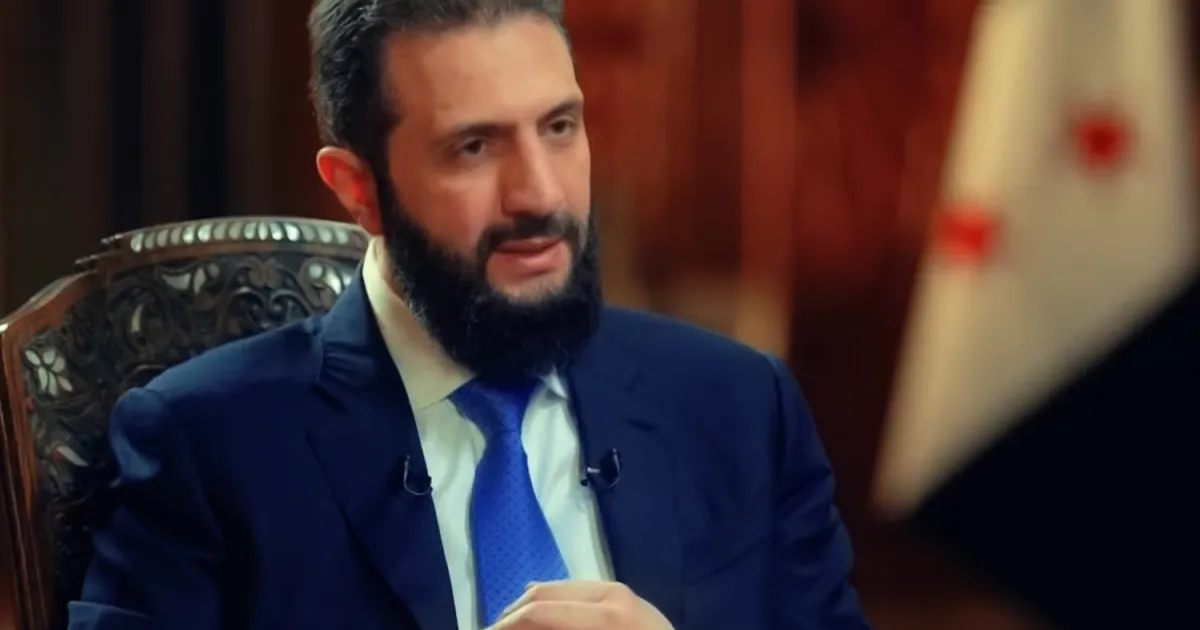
Syrian President Ahmed al-Sharaa hailed the United States’ removal of his country from the “state sponsors of terrorism” list, a major sanctions relief step for a country aiming to boost post-war reconstruction.

“Today, Syria shakes off a dark stain and tears away a painful chapter of its past to embark on a path of development, reconstruction and rebuilding,” al-Sharaa said in a speech.

Recommended Stories

list of 4 itemsend of list

Washington’s decision on Monday rescinded a decades-old designation that came with severe economic restrictions, marking another step in warming ties between the countries following the 2024 ouster of longtime Syrian ruler Bashar al-Assad.

Al-Sharaa expressed his “many thanks to the President of the United States of America, Donald Trump, and to all the friendly and supportive nations that stood by us”.

US Treasury Secretary Scott Bessent said in a statement that Monday’s move “will help foster additional investment in Syria to promote political and economic stability”.

But the Treasury stressed that its removal of restrictions on Syria “does not change Treasury’s posture with regards to countering global terrorism and our commitment to hold bad actors in Syria accountable”.

The US listed Syria as a “state sponsor of terrorism” in 1979, accusing the country, then under the rule of Hafez al-Assad, Bashar’s father, of supporting Palestinian fighter groups and other armed movements in neighbouring Lebanon.

Monday’s move gave Syria “a path to prosperity”, according to US Secretary of State Marco Rubio. The action “eliminates the final major barriers for private sector investment in Syria and promotes Syria’s economic recovery and reintegration into the global economy,” he said in a statement.

The World Bank estimates post-war reconstruction to cost more than $216bn.

Several countries welcomed the US move. Turkiye, a key backer of Syria’s new authorities, said the decision will “lend momentum to efforts to strengthen Syria’s ties with the international community and to establish lasting security and stability in the country”.

“At this stage, we call on the international community to unite its efforts toward the goal of a prosperous Syria and to fulfill its responsibilities to bring an end to aggressive actions that jeopardize this vision,” Ankara said.

Qatar and Jordan also welcomed the US decision, saying the move would support stability and recovery efforts in the country.

Qatar’s Ministry of Foreign Affairs said in a statement that the step “supports the path of a political settlement in line with international legitimacy resolutions and the aspirations of the Syrian people”.

Jordan’s Foreign Ministry also welcomed the US decision, calling it “an important step” towards supporting Syria’s reconstruction, recovery and development.

Welcoming the move, Saudi Arabia wished Syria “further security, stability, and prosperity, and continued progress in its reconstruction and development efforts” in a way that would benefit the “aspirations of its people”.

Ukraine’s Foreign Minister Andrii Sybiha said in a post on X that Ukraine had consistently supported Syria’s new government and people since the ouster of the Assad regime in their efforts to achieve recovery, peace and development.

In another sign of Syria’s growing international reintegration, Damascus also moved to expand its diplomatic outreach on Monday by launching an English-language social media account for its foreign media department.

Syrian Airlines will also begin operating regular direct flights from Damascus to Denmark’s capital, Copenhagen, and Austria’s capital, Vienna, on September 21, Syria’s civil aviation authority announced.

Omar al-Hosary, head of Syria’s General Authority of Civil Aviation and Air Transport, told the SANA news agency that the new routes are part of continuing efforts to expand the national carrier’s international network and strengthen air links between Syria and Europe.

Source link

Africa Shakes Up Customs, but Trade Problems Persist

A customs revamp is a welcome change, but logistics and transit bottlenecks still stifle African trade.

To curb revenue and income losses and accelerate trade across 50 member states, the African Continental Free Trade Area (AfCFTA) Secretariat partnered with Nigeria’s Bergmans Security Consultants and Supplies Ltd. in a $3.1 billion deal to roll out a unified continent-wide customs system.

The project aims to digitize customs processes, streamline cross-border procedures, and provide real-time cargo tracking, with the goal of reducing corruption, revenue leakage, and trade misinvoicing.

The initiative could be “potentially very significant,” Phyllis Wakiaga, a Kenyan lawyer and former Kenya Association of Manufacturers CEO, told Global Finance in an email. “One of the biggest barriers to intra-African trade is the friction businesses face at borders through slow clearance, duplicated documentation, and inconsistent customs procedures.”

Bergmans, based in Abuja, Nigeria, intends to help AfCFTA achieve its goal of doubling intra-African trade by 2035. However, fundamental trading challenges, such as payments, persist across the continent.

AfCFTA did not respond to requests for comment.

Currently, companies often have to route transactions through hard currencies and third-party intermediaries. As a result, high costs will remain even if customs procedures improve, Wakiaga said.

The 2022 launch of the Pan-African Payments and Settlement System (PAPSS) could potentially unlock the anticipated benefits of AfCFTA, she added. However, rollout is slow. As of 2025, the network only connects 19 countries so far (the African Union has 55 member states).

Logistics Creates Another Headache

Jacqueléne Coetzer, founder and CEO of a pan-African business advisory and trade firm, described to Global Finance just how convoluted transporting cargo across the continent by land, sea, and air can be. Goods, she said, are frequently routed through South Africa, Europe, or the Middle East—adding significant transit time and cost.

Furthermore, political will remains inconsistent, as individual governments often resort to protectionist measures and informal barriers to shield domestic industries.

Ultimately, while modernizing customs creates an essential foundation, Coetzer said that it’s not a complete solution. Without parallel investments in logistics, payment systems, standardized regulations, and physical infrastructure, a streamlined customs framework will fall short.

“A perfectly digitized customs declaration does not help much if the truck cannot cross the border efficiently because the road is inadequate, or if the cargo then spends days waiting for space at a congested port,” she said.

AfCFTA took effect in January 2021, aiming to counter global isolationism through cross-border cooperation. Since then, the picture has shifted somewhat. Africa’s population has grown to roughly 1.6 billion people as of 2026. That’s up from 1.2 billion when the agreement was first signed.

On intra-African trade, the AfCFTA-era numbers show real but modest progress. Intra-African trade hit about $220.3 billion in 2024 and roughly $213.8 billion in 2025. African Export–Import Bank, or Afreximbank, projects it will reach $230 billion in 2026.

But, as Coetzer explained, getting customs right is only part of the challenge. If logistics, payments, infrastructure, standards, production capacity, and political implementation remain unresolved, it will simply create a faster system for moving goods through borders that still cannot move enough goods efficiently.

“The real objective should therefore be much more ambitious,” she added. “AfCFTA needs to build an integrated continental trading system, not simply a continental customs system.”

Anthony Noto covers corporate finance and private credit. Contact him at anoto@gfmag.com

John Njiraini and Charles Wachira contributed to this report.

Source link

‘Union County’ review: Will Poulter shakes off his demons

Wrestling with the realities of drug addiction is an endeavor rife with pitfalls for any filmmaker hoping to avoid easy judgment. To judge from the earliest, straight-on view in “Union County” of Will Poulter’s Cody — a weary-looking, tight-lipped young Ohio man absorbing the rules of a treatment program as explained by a courtroom judge — the sense is that we’re in for a ride-along hinged to honesty and the unfettered character work of a fine actor.

That empathy is welcome from first-time writer-director Adam Meeks, and he supports his approach with a gentle aura of verisimilitude, a mostly locked-down camera and, in the snippets of other testimonials, a suggestion that we’re in genuine spaces, not movie locations. Eventually, as the film tracks Cody’s progress through this rural stretch of central Ohio, it becomes clear we’re in a fictionalized story surrounded by real recovery participants and counselors, a backdrop of sincerity that allows a well-intentioned performance to breathe on its own.

That unaffected authenticity helps gird us for the quietly complicated tale “Union County” has to tell. Cody, who is living in his car when we meet him, isn’t alone as he starts this journey. Also in that courtroom that first day is his brother Jack (Noah Centineo), a more visibly restless and outgoing soul compared to Cody’s protective reticence. Jack, who is further along in the program and seems to bring Cody out of his shell, also helps him land a job at a lumber mill where he works. Tagging along to a campfire hang, Cody allows himself to talk to Anna (Elise Kibler) and we notice a potential spark.

But with that connection to Jack, initially forged as foster siblings but later as opioid buddies, comes risk. There’s a sister, too, played by Emily Meade, and her stone-faced appearance during a backslide in Cody’s recovery is a sign that with his past comes a lot he hasn’t faced yet. But as we learn more about Cody, Jack and the hard road ahead, “Union County” doesn’t pitch its treatment as a cure-all, nor engineer candidness into dramatic gold. Rather, Meeks merely asks us to clock the humanity in our every minute of observing Cody, to recognize what struggling looks like whether we “know” someone going through it or not.

Necessary to that approach, which brings to mind the watchful grace of last year’s stellar memory drama “Familiar Touch,” is the wonderful Poulter’s lived-in presence as someone trying to not even have a presence. Meeks knows when and where to give his lead character distance, respecting that opacity. In group sessions, where Cody typically doesn’t say much, the others speak for what Cody might be going through, Greek chorus-style. The effect is of watching someone float around the outside of a safe space. There’s tension in wondering if he’ll notice when it’s time to slip inside.

Social realist dramas aren’t new and they include award-winning landmarks by Ken Loach and Chloé Zhao. But they’re having a moment and “Union County” underscores why some work as well as they do. The right mix of true and imagined can give the simplest of humane narratives — in this case, the possibility of renewal in an epidemic of hurt — a fresher chance to touch us.

‘Union County’

Not rated

Running time: 1 hour, 37 minutes

Playing: Opens Friday, Aug. 14 at Landmark’s Nuart Theatre

Source link

Iran shakes up security leadership amid talks to open Hormuz Strait

Aug. 9 (UPI) — Iran has replaced its top security official with another commander of its powerful Islamic Revolutionary Guards Corps, a spokesman for Iranian Masoud Pezeshkian said late Sunday.

Mohsen Rezaei, who had been an adviser to Supreme Leader Ayatollah Mojtaba Khamenei, will be the new secretary of the Supreme National Security Council. He replaced Mohammad Bagher Zolghadr, who resigned.

Zolghadr had been in the post since his predecessor, Ali Larijani, was killed in an Israeli air strike in March. He will serve as political adviser to Khamenei.

The shakeup came as Foreign Minister Abbas Araghchi said Iran is not talking directly with the U.S. to end the war with Tehran and open the Strait of Hurmuz, despite claims by U.S. officials that the sides are near a deal.

Araghchi was quoted by the Mehr news agency as saying that “messages are being exchanged through intermediaries” and Iran isn’t talking directly with Washington. He reportedly added Washington must meet conditions by Iran if a deal is reached with Oman to open a trade route through the waterway.

U.S. President Donald Trump told Axios on Sunday his administration is “low keying it” in negotiations with Tehran.

“We are only semi-negotiating with them. We are just watching Iran with its huge inflation and the fact they have no money,” Trump said. “It will work out. It always works out. It’s like a chess game.”

Iran’s Supreme National Security Council and Khamenei would have to agree to any deal to open the strait.

On Saturday, Zolghadr said U.S. forces should be withdrawn from near Iran. He added that the U.S. should compensate Iran for war damages as well as lift sanctions.

Iranian diplomats said earlier last week that Tehran and Oman were near a new agreement to manage the strait.

Source link