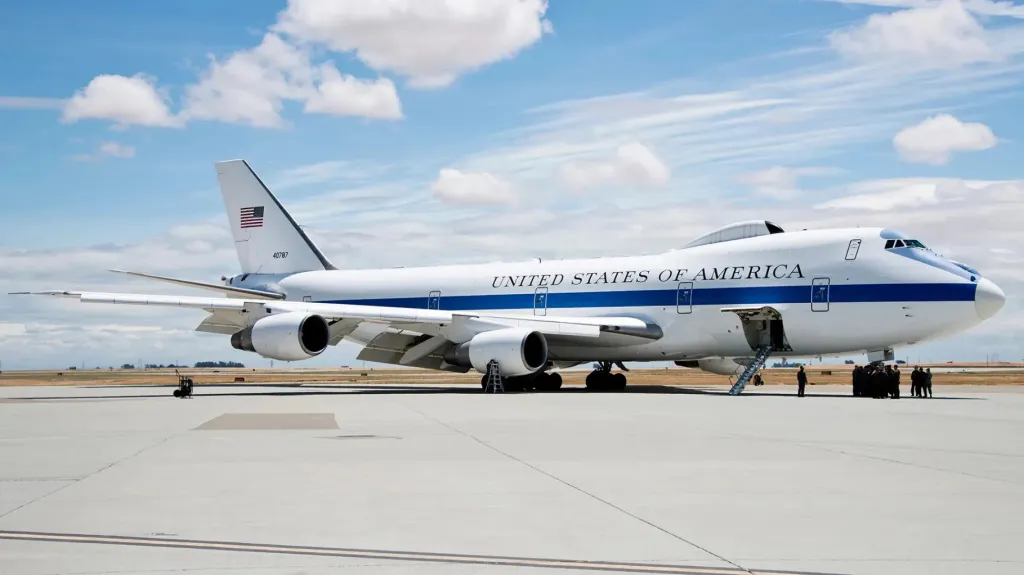
The Jet That Always Shadows Air Force One When The President Travels Abroad
U.S. President Donald Trump’s recent visit to China has drawn particular attention from online flight trackers. This is in no small part due to the fact that all three of the U.S. Air Force’s current Boeing 747-based Air Force One aircraft – the two older VC-25As and the new ex-Qatari VC-25B “Bridge” jet – have supported the trip. Another militarized 747, an E-4B Nightwatch, commonly referred to as a ‘doomsday plane,’ was also spotted shadowing the group to and from Asia.
While this drew a lot of attention online, including blog posts from defense-focused sites, the reality is this is absolutely standard practice. The E-4B is just another part, albeit a very unique and shy one, of the massive aerial logistics ballet that occurs whenever the President leaves the country.
The Air Force currently has four E-4Bs, also known as National Airborne Operations Centers (NAOC), all based at Offutt Air Force Base in Nebraska. Based on the 747-200 model, three of these planes first entered service in the 1970s as E-4A Advanced Airborne Command Posts (AACP). Those aircraft were subsequently brought up to the E-4B NAOC standard in the 1980s, and were eventually joined by a fourth example converted straight to that configuration. The jets have been continuously upgraded over the years. In addition to supporting presidential travel, the Nightwatch aircraft also regularly transport the Secretary of Defense (now also referred to as the Secretary of War) and their staff during overseas trips, among other roles.

The VC-25s carrying Trump and the rest of his entourage left Andrews Air Force Base just outside Washington, D.C., on November 16. An E-4B was tracked heading out from Offutt at around the same time.
Trump headed first for a brief visit to the Philippines before traveling on to China. Plane spotters had a rare opportunity to see all three VC-25s parked together at Ninoy Aquino International Airport in Manila.
The Nightwatch jet headed separately to Kadena Air Base on the Japanese island of Okinawa.
All three VC-25s left China carrying Trump and the rest of the U.S. delegation earlier today. As the trio began to pass over Japan’s home islands, the E-4B took off from Kadena to follow them.
As mentioned at the start, the E-4B shadowing the VC-25s and being forward-deployed in Kadena during Trump’s visit to the Philippines and then China is no surprise. This is standard operating procedure for when the President of the United States travels abroad. Flight trackers notably caught a similar procession of aircraft during Trump’s trip to China back in May.
While the E-4Bs are nowhere near as luxurious as the VC-25As or the new VC-25B, they are just as capable of serving as airborne command posts, if not more so in many respects. They are unofficially referred to as ‘doomsday planes’ because they are specifically configured to provide the president and other senior military officials with a flying headquarters they can use for any and all duties, including directing nuclear strikes during the most serious crises. They are hardened against electromagnetic pulses caused by nuclear detonations and have the ability to stay airborne for days. Their very existence, at least one being on alert at all times to support the National Command Authority, is a critical component that underpins America’s nuclear deterrent. Even if an adversary destroys much of the country, an E-4 can remain airborne to order the counter-attack.
With all this in mind, the E-4B fleet is key to so-called continuity of government plans, which are in place to make sure key elements of the federal government remain functional following an attack or a similarly serious contingency. As a prime example, President George W. Bush rode on one of the VC-25A Air Force One aircraft in the immediate wake of the 9/11 terrorist attacks, but there were discussions about transferring him to a Nightwatch jet. Bush ultimately decided against making the change, but an E-4B was still scrambled and orbited over Washington, D.C., for a time. This is hardly the only time a president has made use of an E-4B, or one of its predecessors, as well as command ships, as TWZ has examined in the past.
Within this broader context, E-4Bs have been a key feature of overseas presidential travel for decades now, although they are the least visible of the presidential aerial armada. This massive airlift and logistics effort includes bringing in multiple examples of the presidential motorcade, Marine One helicopters, and various force protection assets. This involves many sorties by C-17 and C-5 cargo aircraft that cover many thousands of miles each. The videos below from Trump’s visit this week to the Philippines give a sense of just one portion of these options, albeit the most visible one, the vertical airlift component.
Beyond its strategic command and control mission, having an E-4B positioned in the region the president is visiting during overseas trips offers a critical option for refuge and escape, as well as an additional backup aircraft to Air Force One, should any emergencies arise. The exact parameters for where the Nightwatch aircraft go are unknown, but would be based on what suitable airports are available and what potential threats and contingencies could arise. They are never seen at the same locations as Air Force One and are always separated by a distance of dozens of miles, at least, in friendly countries — close enough to be accessed by Marine One in an emergency — or generally in a region for more sensitive locales where such close proximity basing isn’t an option.
E-4Bs do not need to be airborne to act as command and control platforms and secure communications relay nodes, either. This further feeds into their continuity of government role. These are capabilities that can also be made available, if required, to assist the Federal Emergency Management Agency (FEMA) during major natural disasters or to help serve as command posts and communications nodes in other emergencies.
The changing character of the Air Force One fleet could put new emphasis on the E-4Bs, as well as the replacement E-4C Survivable Airborne Operations Center (SAOC) jets the Air Force is now in the process of acquiring.
Trump’s trip back from China has notably underscored a significant difference between the VC-25As and the new VC-25B Bridge aircraft, which is that the latter lacks aerial refueling capability. Two fully-outfitted VC-25Bs that Boeing is still in the process of converting for the Air Force will also not be capable of refueling in flight. The E-4Bs can refuel in flight, and the E-4Cs will be able to do so, as well.
TWZ has previously explored the Air Force’s decision to axe the aerial refueling requirement for the VC-25B in detail. The ostensible logic is that the VC-25Bs are based on newer 747-8i aircraft with more capable and fuel-efficient engines than the aging 747-200-based VC-25As. The new aircraft are, as a result, capable of longer unrefueled flights, though maximum range requirements were also watered down.
At the same time, in-flight refueling allows the VC-25As (as well as the E-4Bs) to remain aloft for days at a time. This, in turn, could be critical in a major crisis where access to secure airfields might be limited, if not completely unavailable, for a prolonged period of time.

The VC-25B Bridge jet has prompted a whole new array of operational security questions, which TWZ was calling attention to even before the decision was formally made to outfit it for presidential use. The circumstances of Trump’s return from the NATO summit in Turkey in July had prompted a further flurry of reports about whether the modified, Qatari-gifted jet lacked sufficient defensive features and other capabilities in line with the existing VC-25As. The President had flown to Turkey on the Bridge jet, but was reportedly covertly moved between other aircraft on the way back. This was said to have been done as a security precaution amid then-escalating fighting with Iran.

President Trump subsequently downplayed the series of events, but said that the Bridge aircraft would be sent to have its capabilities “maxed out.” The White House confirmed that the jet would receive “additional upgrades and enhancements,” but did not elaborate. It is unclear how the aircraft’s configuration has changed in the ensuing months.
It is worth noting here that the upgrades in question would have to be limited to defensive systems. The Bridge aircraft could also have entered service without certain communications and networking capabilities found on the VC-25As. Another way to mitigate any such limitations could be to have a VC-25A or an E-4B operating closely enough to establish a line-of-sight data connection relatively quickly so it can leverage the better-equipped aircraft’s communications systems if needed.
As an aside, Trump arrived in China aboard the Bridge aircraft and was seen boarding it to head back to the United States. Reporters onboard had their phones taken away during the return flight for still unexplained security reasons. Fox News has reported that the president is aiming to set a record for the longest continuous flight for an Air Force One aircraft. At the time of writing, its unclear whether the president has touched back down anywhere publicly since leaving Shenzhen.
Where the E-4B is now is also unclear, but it was last tracked continuing along a path shadowing behind Air Force One, where one would expect to see it.
Contact the author: joe@twz.com