Sewing

Great British Sewing Bee Esme Young’s life from tragic loss to hidden ‘problem’

The Great British Sewing Bee is currently delighting BBC viewers – but what do we know about judge Esme Young’s life?

The Great British Sewing Bee judge Esme Young has faced her fair share of struggles.

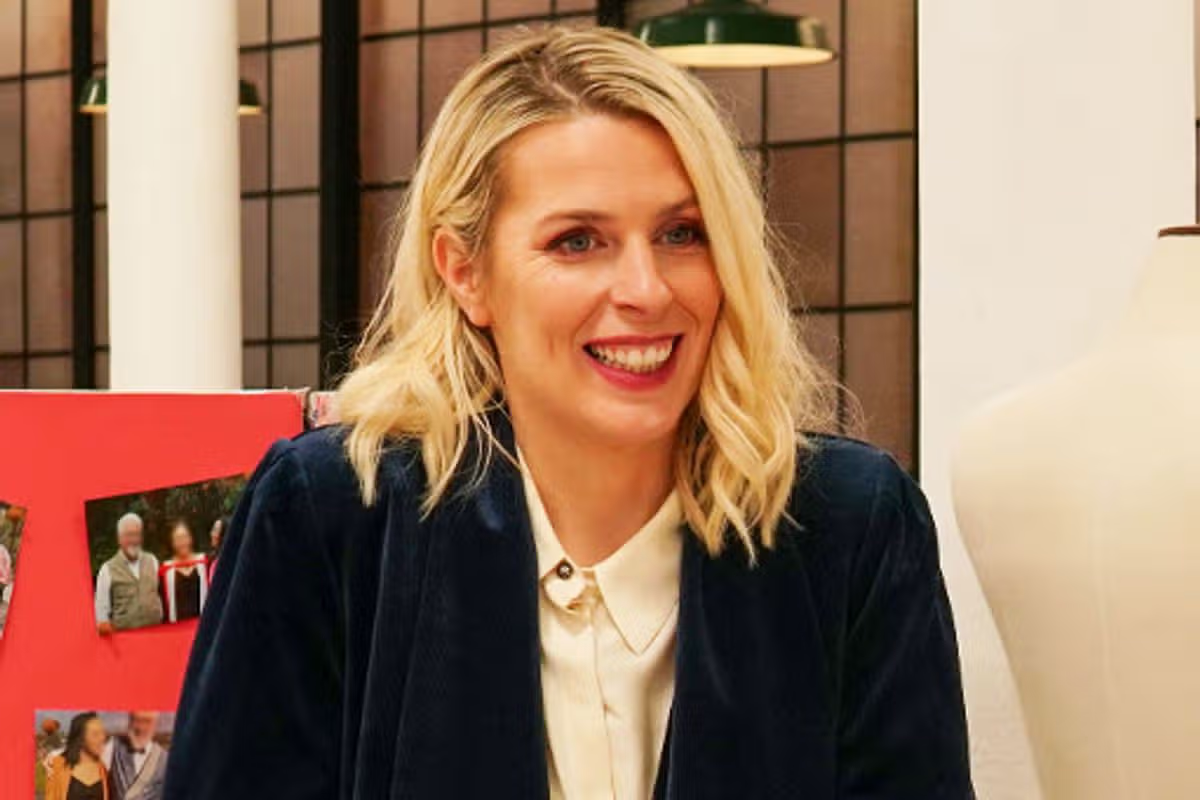
In 2016, Esme replaced May Martin as a judge on the hit BBC competition. She has since delighted BBC viewers alongside Patrick Grant and a number of hosts, including Joe Lycett, Sara Pascoe and Sophie Willan.

Over the years, Esme has established herself as an esteemed British fashion designer. In 1972, she founded a shop in Camden Town called Swanky Modes, alongside fellow designers Judy Dewsbury, Melanie Herberfield and Willie Walters.

Throughout the 1970s and 1980s, Swanky Mode’s clothing appeared in Vogue, Honey and The Face, and was photographed by David Bailey, Nick Knight, and John Swannell.

Since then, Esme has made costumes for many films, including The Beach, Bridget Jones’s Diary, Romeo and Juliet, and Trainspotting. She notably designed the bunny costume worn by Renée Zellweger in the first Bridget Jones movie.

That’s not all, as one of Esme’s most famous designs was the Amorphous Dress worn by Linda Kozlowski in the 1986 movie Crocodile Dundee – a dress that is now in the V&A Collection.

But away from her successful career, Esme has also been through a number of challenges.

Personal struggles

Content cannot be displayed without consent

Esme grew up in Bedford with her stay-at-home mum and her dad, who was an RAF pilot. He was a fighter pilot in World War Two.

Speaking with The Telegraph in 2022, Esme opened up about her life in north London, after moving into a one-bedroom flat in 1983.

“I’ve never been able to afford my own home. I’ve lived in social housing since 1983 – in a one-bedroom flat in Islington, north London, rented from the charitable housing trust Peabody,” she explained.

Reflecting on her previous money struggles, Esme told This is Money: “I could not afford to pay rent so I lived in a squat with my brother and friends… We had to pay for our electricity via a meter but otherwise we lived rent-free.”

The designer has previously shared her support for the Macmillan cancer charity, after her mum died of cancer.

“Even though I do not have much money, I give as much as I can to Macmillan Cancer Support. My mother died of cancer and it gave her and all the family lots of support,” she shared.

Hidden condition

In an interview with SheerLuxe, Esme revealed that she was “partially deaf” and therefore only learned to read when she was seven years old.

“My teachers thought I was thick and my father used to describe me as ‘dreamy’ – but, really, I was in my own little world because I couldn’t hear anyone,” she explained.

“I also didn’t learn to read until I was seven because I didn’t know how to make the right sounds. It’s still a bit of a problem today because I have to look at everything visually.”

The Great British Sewing Bee is available to stream on BBC iPlayer

Source link

After a deadly raid, a displaced Nigerian mother finds a lifeline in sewing | News

Jibia, Katsina State, Nigeria – Safiya Musa’s sewing machine has given her something violence had taken away: a way to provide for her children.

But the livelihood she built after losing her husband and two of her children has left her facing a painful choice: whether to return home or risk losing the fragile independence she has created after being forced to flee.

Safiya cannot remember which month it was, only that it was 2023, when armed bandits raided the town of Kankara in Katsina State, where she and her husband had built their life after moving from their hometown of Batsari. Kankara is a small rural community where farms sit close to homes, and her husband worked as a farmer and foodstuffs trader. They lived there with their two youngest children, Umar (4) and Maryam (6), while their three older children, Sani (12), Hajara (10) and Zubaida (8), were staying with relatives in Batsari.

The attackers had come to kidnap the town head, but the attempt failed. As gunfire spread through the community, Safiya locked herself inside her room while Umar and Maryam were outside playing with other children. Her husband had left for the farm when the attack happened. The bandits killed about 20 people as they left the town.

Three days later, after she had learned that her husband had also been killed during the attack, she fled to Batsari, where she was reunited with Sani, Hajara and Zubaida. When another bandit attack reached Batsari, she fled again with her three surviving children – now aged (15), (13) and (11) – to Jibia, where they eventually settled in a camp for displaced people.

She still remembers the night she lost much of her family.

“Minutes later, silence overwhelmed the atmosphere,” she recalled. “Then I started thinking about my husband, who had left for the farm, and my children, who were outside playing with other kids.”

The thought of them pushed her out of hiding.

But she was too late.

“They were all killed,” she told Al Jazeera.

Safiya’s experience reflects a wider crisis affecting communities across northwest Nigeria. For more than a decade, the region has faced attacks, kidnappings and village raids by armed groups commonly called bandits.

The violence has forced thousands of families from their homes, disrupted farming and trade, and left many people struggling to rebuild their lives.

Katsina State, which borders Niger, has been among the areas hardest hit.

After arriving in Jibia, Safiya survived by taking whatever work she could find. She ground grain for local residents and relied on temporary jobs to support her children.

She was then selected for a handbag-making training programme organised by the United Nations Development Programme (UNDP) through its Climate Security Project.

The initiative provides women affected by conflict with vocational training and equipment to help them start small businesses.

Months later, the programme gave her a source of income. The work brought stability, but it also created a new uncertainty: whether she could continue the business if she returned home.

“The essence is to give them an opportunity to become self-reliant,” said Muhammad Hamisu, the project coordinator in Jibia.

A skill that changed her circumstances

After completing the training, Safiya turned handbag-making into a source of income for her family.

With sewing materials and new skills, she began cutting fabric, stitching designs and producing handbags she could sell to support her children.

The work did not erase the pain of what she had lost, but it gave her something she had struggled to regain since fleeing: the ability to provide for herself.

“I used to wake up with nothing to offer my children,” she said. “There were days I sent my boys out with bowls to beg for food because I had nothing to give them. Now I can feed them myself.”

In March 2024, the Climate Security Project trained 20 women in Jibia in handbag production and provided sewing machines and materials to help them begin working.

Jibia’s location near the border with Niger also gives traders access to cross-border markets, including those in the Maradi region, one of Niger’s major commercial areas.

For some women, the business has become an important source of income.

“I make approximately $50 a month,” said 30-year-old Karima Sule, who has lived in Jibia since fleeing violence four years ago. “When demand is high, I earn even more. I help my husband and pay the school fees for my two older children from this business.”

A business shaped by insecurity

But building a business in a conflict-affected area remains difficult.

Safiya said her biggest challenge is finding enough money to buy materials.

“Sometimes I run out of stock and don’t have the funds to buy more,” she said. “When that happens, I lose customers.”

Karima said violence continues to affect sales.

“Whenever violence happens, market activities slow down for days,” she said. “People stop buying, and we lose income.”

Their growing economic activity may also expose them to new risks, according to Abdussamad Ahmad Yusuf, a human security researcher at HumAngle, a Nigerian newsroom that reports on conflict.

“Kidnapping for ransom in that region is becoming more targeted,” he said. “Authorities should conduct regular conflict and security risk assessments to identify high-risk trading routes, markets and emerging threats before expanding commercial activities.”

The Katsina government established the Community Watch Corps in 2023, a local security initiative that uses community members to gather intelligence and support responses to attacks.

Officials said security has improved in some communities, but many families who fled violence remain uncertain about returning home.

An uncertain future

Safiya hopes to return home one day and reunite her children with their relatives.

But the livelihood she has built in Jibia has become a reason to hesitate.

The handbag business has allowed her to buy food, support her children and depend less on unstable work. Leaving it behind could mean losing the independence she has worked hard to build.

She has been told that conditions in her hometown are improving, but she remains unsure whether she could rebuild the same source of income there.

For Safiya, returning home is not only about finding safety again. It is also about whether she can continue providing for her family.

“I want to go back home because my children need their relatives,” she said. “But I am afraid of losing this business. If I cannot continue it there, how will we survive?”

Source link

BBC Great British Sewing Bee star issues four-word remark as they’re forced to leave

BBC viewers bid farewell to another contestant during the latest episode of The Great British Sewing Bee.

The Great British Sewing Bee is back with the BBC competition officially in full swing.

During Tuesday’s episode of The Great British Sewing Bee (July 28), BBC viewers saw the remaining contestants tackle three challenges to earn their place in next week’s episode.

First, they needed to make three pairs of knickers from an old T-shirt in the Pattern Challenge.

They were then tasked with making a garment from items that were heading to the landfill in the Transformation Challenge.

Finally, the sewers had to make an outfit with an environmental message made to measure their models.

Anna impressed judges Patrick Grant and Esme Young during week three, earning garment of the week.

However, Angie’s time in the competition came to an end, and she was eliminated from progressing further in the show.

As her fellow contestants rushed to give her a hug when her name was announced, one of them praised her for being ‘amazing’ during the competition.

Speaking about her time in the programme, she told the camera: “It’s been so special sharing this love of sewing with other like-minded people. I feel really fortunate.

“You’d think, having spent, you know, day after day sewing and planning sewing, that I’d want a rest. No, I’m going to make a coat, might make some trousers, might make a few more knickers. You know, loads.”

Issuing a four-word remark before leaving, she added: “Not going to stop.”

Next week, the show celebrates the rich fashion and textile traditions of Mexico.

A synopsis reads: “The pattern challenge sees the sewers create a folkloric top, using fabrics created by indigenous communities in Mexico’s Oaxaca region.

“For the transformation, they use a tablecloth to create a garment with an eye-catching structure, before coming up with a made-to-measure outfit inspired by one of the many Mexican festivals found across the country.”

The judges will also be joined by guest judge Erika Alvarez, the renowned fashion designer.

The Great British Sewing Bee continues Tuesday’s on BBC One from 8pm.

Source link

BBC Sewing Bee star opens up about ‘chronic’ health condition

The Great British Sewing Bee returned with 11 amateur sewers hoping to be crowned winner.

A contestant on The Great British Sewing Bee has opened up about her health condition.

The popular BBC competition has returned for its 12th season, with Esme Young and Patrick Grant reprising their roles as judges, whilst comedian Sophie Willan replaced Sara Pascoe as presenter.

As the new season aired its second week, the 11 remaining amateur sewers took part in three challenges.

First, they faced the Pattern Challenge, constructing a top with adaptive elements, then they faced a Transformation Challenge, where they had to convince the judges that their least favourite colours, brown and purple, could be transformed into attractive garments.

Finally, in the Made-to-Measure, the sewers had to use one colour to create an eye-catching outfit.

During the first task in the show, two contestants opened up about their passion to promote adaptive clothing.

Oxfordshire engineering PhD student Beth shared: “The adaptive side of it is really great because it’s quite a personal thing for me.

“My dad broke his neck in a motorbike accident. Very luckily, he’s still with us but he can’t feel with his hands.

“I’ve used really big buttons with quite large button holes so he can do them himself.”

Beth, 24, also shared how she creates clothes for her own needs, explaining: “I have scoliosis which is the curvature of the spine, and so being able to make dresses or tops that celebrate my back from all the lifting I do is quite an empowering thing.

“Without sewing that wouldn’t be possible for me.”

Not long later, another Sewing Bee star shared their health condition, after suffering from pain.

Contestant Rebecca, 27, revealed she made garments adjusted for her own needs.

She said: “Almost everything I make for myself is adaptive. I have chronic stomach pain, so for me, adaptive fashion is making sure there is nothing tight around my stomach.”

The chartered actuary from London was crowned winner of the first challenge, and celebrated: “I’m so thrilled to have specifically won the adaptive fashion challenge as an invisibly-disabled person.”

The Great British Sewing Bee airs Tuesdays at 8pm on BBC One and iPlayer.

Source link