sevenday

Trump rejects Iran’s seven-day roadmap to reopen Strait of Hormuz | US-Israel war on Iran News

United States President Donald Trump has rejected a roadmap submitted by Iran to open the Strait of Hormuz within a week.

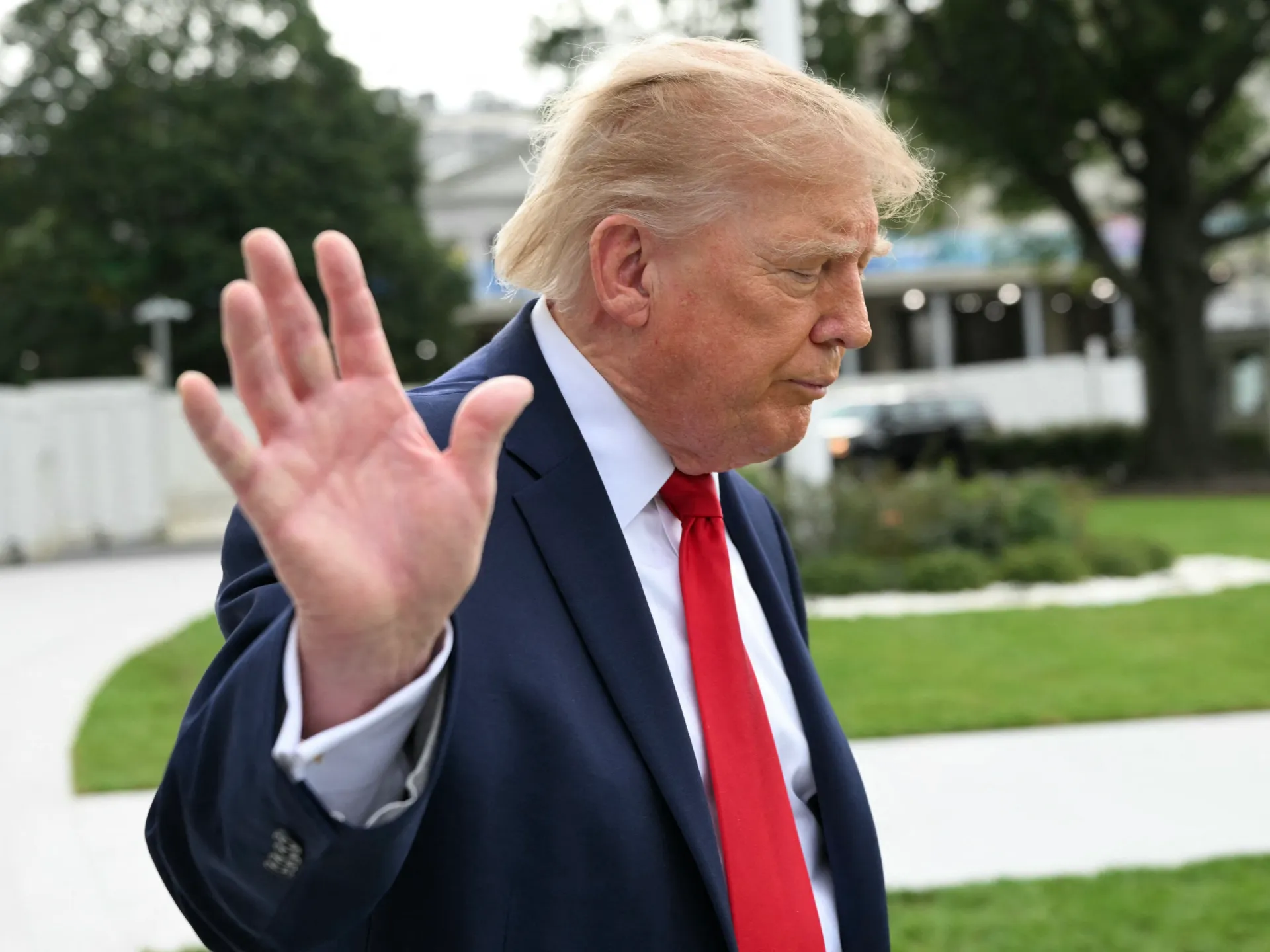
“I reject their proposal,” Trump told reporters outside the White House on Saturday, before departing for Tennessee by helicopter.

Recommended Stories

list of 3 itemsend of list

Iranian Foreign Minister Abbas Araghchi said on Friday that Tehran formally submitted a seven-day roadmap to the US via mediator Qatar, and was awaiting Washington’s response.

“It appears as though the proposal is dead in the water,” said Al Jazeera’s Mike Hanna, reporting from Washington, DC.

Late on Friday, US media reports indicated Trump would reject the proposal.

Trump was “privately sceptical” that Tehran would meet his demands, and reportedly told aides that he expects a renewed bombing campaign on Iran after the November US midterm elections, The Wall Street Journal reported, quoting unnamed US officials.

“President Trump has vacillated between extreme optimism, saying that ‘talks are going well’ to ‘I want to annihilate Iran’,” Hanna said about the recent diplomacy between Washington and Tehran.

“There is no consistency in terms of the [Trump] administration’s reaction,” he said.

But “the one thing that has been made clear by President Trump is that he is content to stay in the status of limbo”, Hanna added, despite concerns from much of the American public that the Iran conflict is turning into another “never-ending war”.

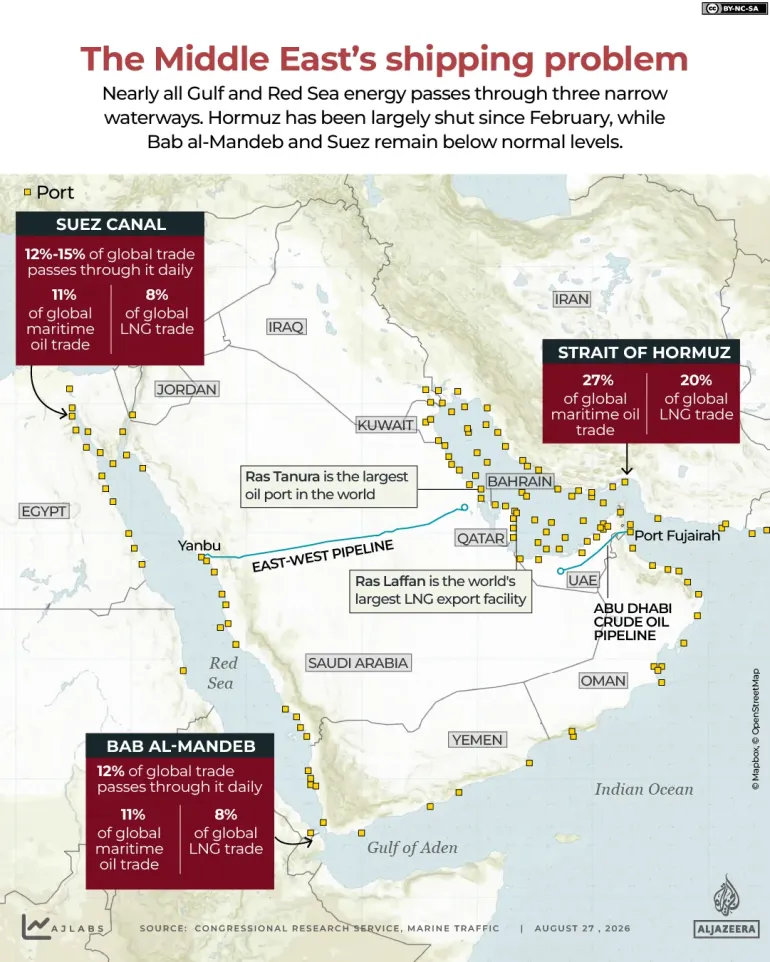
The Strait of Hormuz, a waterway key to the world’s oil supply, is central to the conflict between the US and Iran, which is at an impasse after nearly seven months, though new mediation efforts took place this week.

Earlier in the week, Araghchi held talks with Trump’s envoy Steve Witkoff, and previously set out conditions for ending the war and reopening the vital shipping channel.

On Friday, the top Iranian diplomat said: “Iran has conveyed to the United States, through Qatar, a concrete seven-day plan. If the necessary conditions are met, the strait can be reopened, and normal maritime passage restored within seven days.”

He was speaking at the United Nations in New York, where he and other senior Iranian officials were attending the General Assembly.

Under the plan, Washington would lift its naval blockade of Iranian ports, waive sanctions on Iranian oil sales, release an estimated $12bn in frozen Iranian assets and observe a ceasefire covering the region, including Lebanon and Yemen.

“The choice now rests with the United States. Iran does not accept coercion, threats or intimidation, and Iran will not surrender its sovereign rights under pressure,” Araghchi had said.

On Saturday, Iranian President Masoud Pezeshkian told Al Jazeera that Tehran no longer trusts negotiations with the US after previous rounds of talks were followed by attacks and sanctions.

“We have no trust in the American side and do not know on what basis an understanding can be reached with it,” said Pezeshkian, who was also in New York for the UNGA.

He denied that Iran was responsible for blocking the Strait of Hormuz, saying the US “closed the routes before us”. He described the closure as “a natural response when routes are cut off to Iran”.

The Iranian president said the crisis could be resolved through negotiations rather than force, and that the waterway would reopen to commercial shipping if talks ended the war.
Source link

What’s in Iran’s seven-day plan to reopen the Strait of Hormuz? | US-Israel war on Iran News

Iran says it has put forward a plan to the United States to reopen the Strait of Hormuz within seven days, as Qatar passes messages between the two countries at the United Nations General Assembly in New York.

Speaking on the sidelines on Thursday, Iran’s Foreign Minister Abbas Araghchi said the timetable could begin as soon as Washington accepted the proposal.

Recommended Stories

list of 4 itemsend of list

Both sides have described the indirect contact facilitated by Qatar in New York positively, but neither has indicated any diplomatic breakthrough as the war approaches its seven-month mark.

Analysts have told Al Jazeera a firm peace deal remains unlikely, with Iran still wanting to follow the approach set out in an earlier agreement, which would give it and Oman a main role in managing the strait before moving on to discussing terms for a broader peace deal.

For its part, the US, which has claimed to be “in total control” of the Strait of Hormuz, wants Iran’s nuclear programme to be the subject of discussions straight away.

Iran has previously made clear that it will not engage with broader peace talks, including addressing the issue of its nuclear programme, until the US naval blockade of its ports in and around the Hormuz strait is lifted, sanctions are repealed and the US provides a guarantee of an end to strikes, among other conditions.

Here’s what we know.

What has Iran proposed?

Araghchi told reporters in New York that Iran had presented its plan to the US through intermediaries. “If certain conditions are met, the Strait of Hormuz would be open on the end of the seventh day and [peace] talks would restart,” he said.

He did not give details but said the proposal resembles the June 17 memorandum of understanding (MoU) signed by Iran and the US, which briefly eased the conflict before breaking down. “The moment they accept this plan, from the next day, this timetable can start, and after seven days, the strait will be open,” he said.

Under the June agreement, Iran undertook to allow ships to pass through the strait without paying tolls for 60 days – that was the period of time given for peace talks to take place. But the MoU left open what would happen after that period.

Araghchi did not say whether the same arrangement formed part of his new proposal. Nor did he spell out what Washington would have to do before the seven-day timetable began, how either side would verify those steps, or what rules would govern shipping once the strait reopened.

It is highly unlikely Iran would be offering to cede control of the Strait of Hormuz, analysts say.

Urban Coningham, a research fellow at the Royal United Services Institute, told Al Jazeera that Tehran is unlikely to receive the sanction relief it has previously demanded and, therefore, sees the strait as its primary ticket to helping it recover from the war economically.

“Hormuz is a clear Iranian red line,” he told Al Jazeera. “The Iranians will not get reparations for the war, so control of the strait is the only way they can recover economically. I cannot see them backing down from that.”

[Al Jazeera]
[Al Jazeera]

Why does the June agreement matter?

The MoU signed in June set out an immediate halt to military operations on all fronts, including in Lebanon, where Israel has launched strikes and occupied part of the country, and triggered a 60-day period for negotiations on a lasting peace settlement. It included US waivers for Iranian oil exports and provisions to restore maritime traffic through the strait.

It deferred other issues, including the future of Iran’s enriched uranium stockpile, to broader peace talks.

But the agreement unravelled the following month amid renewed confrontation over shipping routes through the strait.

Coningham told Al Jazeera that Iran’s latest proposal follows this earlier model: “Open the strait within seven days, then start talks on the nuclear file.”

But “the US does not want to compartmentalise the issues, it wants them discussed as one package”, he said.

How else does this new proposal place pressure on the US?

Coningham also sees a political calculation in making the offer publicly at the UN as Americans contend with high fuel prices. “By explicitly saying this may be the only chance before the midterms, Iran is putting pressure on Trump over oil and gas prices and the strait,” he said. “It is a tactic to put more pressure on the US.”

The strait, which runs between Iran and Oman, is a vital route for oil and gas exports from the Gulf. Disruption to shipping has driven up energy prices far beyond the region, giving both governments an economic reason to reach an agreement despite their differences.

With the US midterm elections approaching, a deal to get it reopened could give Trump a chance to bring down fuel prices before voters go to the polls – potentially giving the Republican Party a much-needed electoral boost before the midterms.

Trump has presented the electoral calculation differently, however. In his address to the General Assembly on Tuesday, he accused Iran of waiting to see how his Republican Party performs in November and predicted a deal would happen after the vote. He also threatened to “annihilate the Islamic Republic” if there was no agreement.

Trump claimed the election did not affect his own decision-making on Iran: “The only thing that does is that Iran will never have a nuclear weapon.”

That leaves an open question about whether the prospect of lower energy prices is enough to persuade his administration to accept Iran’s proposed order of talks. Coningham doubts it. “Trump is prepared for this to go on through the midterms,” he said. “The same problem remains where the proposal does not answer questions about the nuclear file.”

Where do broader US-Iran peace talks stand?

Araghchi met US envoy Steve Witkoff and Trump’s son-in-law Jared Kushner on Tuesday in talks mediated by Qatar. The Iranian foreign minister described the exchange as productive and said messages continued to pass between the sides.

US Secretary of State Marco Rubio said it would be wrong to describe the meeting as a major breakthrough, however.

Burcu Ozcelik, a senior research fellow for Middle East security, told Al Jazeera that the major blockage for Washington and Tehran is that each is making different assumptions about how much pressure they can exert on the other. The Trump administration is unlikely to revive the failed MoU, she said, because it assesses its naval blockade and tighter sanctions as working.

“The US appears to believe it can wait this out until Tehran is prepared to make meaningful concessions,” Ozcelik said.

“But Iran remains defiant despite indications that it is hurting economically.”

Source link