Russia’s Lavrov to discuss US war and regional security during Tehran visit | US-Israel war on Iran News
Tehran, Iran – Russia’s Foreign Minister Sergey Lavrov is due to meet with senior Iranian officials in Tehran to discuss the war with the United States and efforts to end it.
Lavrov landed in the Iranian capital on Monday afternoon on his first visit to Iran since February 2025. Moscow said the trip was part of efforts to ease months of tension, since the US and Israel launched their war on Iran on February 28. The Russian minister is scheduled to hold talks with President Masoud Pezeshkian and Foreign Minister Abbas Araghchi later on Monday.
Recommended Stories
list of 3 itemsend of list
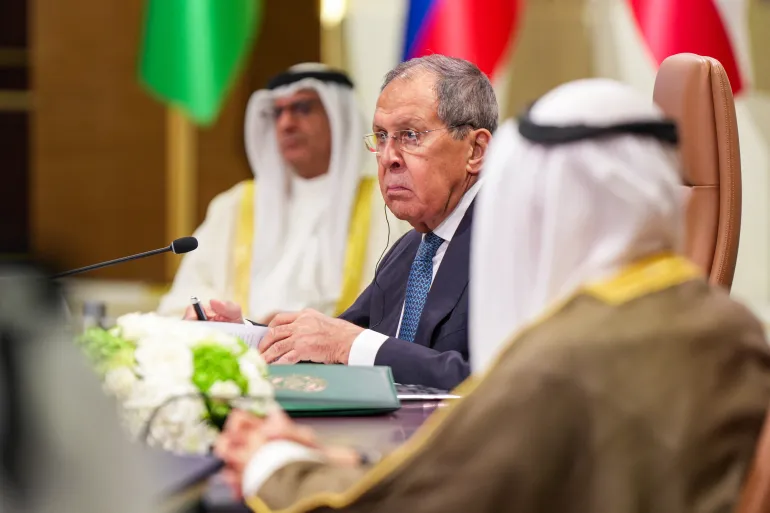
On Sunday, Lavrov was in Bahrain, which was heavily targeted by Iran during the war, to participate in a strategic dialogue session between Russia and the Gulf Cooperation Council (GCC).
He was urged by GCC members to use Moscow’s influence with Tehran to press for “serious dialogue” and restore shipping through the Strait of Hormuz, which has been severely disrupted by attacks on commercial vessels.
GCC chief Jasem Al-Budaiwi said member states had faced more than 7,000 Iranian missiles and drones since the start of the war.
In the council’s closing statement, the six Arab countries said they wanted Iran’s nuclear and missile programmes, as well as its support for regional armed groups, to be included in future talks to end the war.
Nikita Smagin, an analyst and researcher on Iran and Russia’s role in the Middle East, said Lavrov’s trip reflects Moscow’s efforts to maintain working relations with all countries in the region.
He said Lavrov also wants to maintain Russia’s status as a mediator, despite the impact of the Ukraine war on its global reputation.
“The timing of visits to the Gulf monarchies and Iran, taking place almost simultaneously, is a deliberate signal: Moscow wants to show that it approaches relations with all these countries on broadly equal terms and is equally interested in cooperation with each of them,” Smagin said.
How does Russia fit in?
Lavrov told GCC ministers in Manama that the region was once again teetering on the brink of a full-scale war and Russia wanted to establish a regional architecture for “collective security”.
He said this could include combining initiatives from countries in the region, along with those put forward by Russia and China, with the aim of restoring maritime traffic and achieving lasting peace. The Russian foreign minister urged other regional states such as Iraq and Jordan, which have also been hit by Iranian strikes, to participate.
Lavrov expressed support for the Memorandum of Understanding (MoU) signed between Iran and the US in June, which later collapsed, as a framework for reducing tension.
Iran has said it wants a return to that agreement, and for Washington to honour a finalised bilateral deal between Iran and Oman to manage territorial waters in the Strait of Hormuz. This has been opposed by the US, which has established its own route in the waterway for shipping.
Intelligence reports cited by US media said that Russia and China are providing military support to Iran in the form of satellite imagery for targeting purposes and components for weapons.
But US President Donald Trump contradicted those reports last week, saying Moscow and Beijing would have “too much to lose” if they helped Iran.
Washington has also issued sanctions waivers for Russia in a bid to lower fuel prices driven up by the war against Iran.

Mixed intentions
Russia’s position on the Iran war is somewhat unusual, said Smagin. It has a partial interest in the conflict continuing, as higher oil prices and the severe restrictions on Iranian oil reaching China all benefit Moscow.
“Russia and Iran have been competing primarily for the Chinese market, so China is now effectively forced to buy Russian oil at higher prices because Iranian supplies are largely unavailable,” he said.
Smagin added that Russia does not want the conflict to escalate further, as the consequences could be unpredictable, but its leverage over either Iran or the US to influence the course of the conflict remains limited.
Russia will continue to expand relations with Tehran, Smagin said, including through Caspian Sea trade, and limited military cooperation with Iran.
“These efforts appear to be aimed less at generating economic returns than at expanding Russia’s political influence over Iran and the course of events,” he said.
Military strikes by Iran and the US to wrest control of the waterway have continued, with the US midterm elections approaching on November 3 .
In comments to the media, Trump threatened to “soon finish the job” with Iran, to which Iranian Foreign Minister Araghchi replied: “We have unfinished jobs too.”