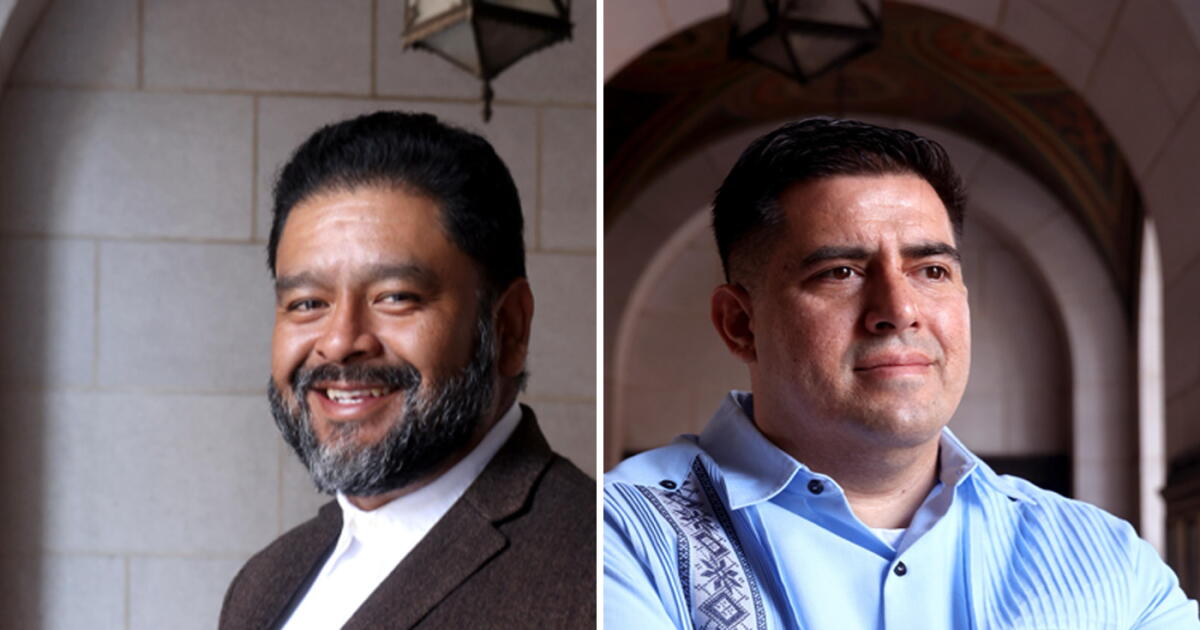
A week after polls closed, Jose Ugarte and Estuardo Mazariegos are still locked in a tight race to see who will succeed Curren Price for the Los Angeles City Council’s 9th District seat.
Ugarte was leading Mazariegos by just 156 votes, 19,200 to 19,044, according to the latest tally released by the Los Angeles County Registrar-Recorder Tuesday night.
Tuesday was the last day for mail-in ballots to be counted, said Mike Sanchez, spokesperson for the office. Sanchez said he couldn’t estimate how many votes remained to be counted.
Because of the Veterans Day holiday Wednesday, the next vote tally will not be released until Friday, he said. District 9 encompasses South L.A. neighborhoods, the Convention Center and USC.
The current councilmember, Price, must leave office because of term limits and is currently facing charges of embezzlement and conflict of interest and he has denied wrongdoing. Price has endorsed Ugarte, whose platform includes protecting city residents from federal immigration enforcement and the Trump administration. Mazariegos is backed by the L.A. chapter of the Democratic Socialists of America. He has worked as a community organizer for decades and said he’s running to improve quality of life in the city, including by making housing more affordable and spending money on basic services other than policing.
Mazariegos’ campaign made claims this week against the Ugarte campaign and shared images of unsealed and sealed ballots, alleging the ballots were collected during “an Ugarte canvassing operation.”
“Taking people’s ballots, filling them out, and not following legal voter assistance guidelines in a district that has faced so much disenfranchisement is disgusting,” Mazariegos said in a statement.
Among their claims, the campaign shared a photo of a USC student volunteering for Ugarte’s campaign delivering a stack of ballots to a drop box.
The registrar-recorder’s office forwarded the complaint to the district attorney’s office for review, Sanchez said. Sanchez said the photo of the student, which circulated online, didn’t raise alarms because California law allows voters to authorize another person to return their completed ballots.
The district attorney’s office said it was looking into the matter.
Ugarte said in a statement that the allegations made by Mazariegos’ campaign “are categorically false and defamatory.”
The 9th District seat is one of two council races determined in the Nov. 3 election. Barri Worth Girvan declared victory in the west San Fernando Valley’s 3rd District seat Friday night, after the latest vote tally showed her widening her lead over rival Tim Gaspar, with 51% of the vote to Gaspar’s 48%.
“I will bring competence, transparency, follow-through, and ethical leadership to City Hall, which Angelenos deserve and too often do not get,” Worth Girvan said in a statement.
Worth Girvan will replace Councilmember Bob Blumenfield, who is leaving office because of term limits. The 3rd District seat includes Woodland Hills, Reseda and Canoga Park.
Before entering the race, Worth Girvan was L.A. County Supervisor Lindsey Horvath’s district director for three years, handling constituent services on the Westside and in the Valley, and has spent nearly 20 years working in public service. Gaspar is a former insurance company owner who had been backed by business groups.
The dispute between the two dominant political forces in the semiautonomous Kurdistan Regional Government, which traditionally has operated under a power-sharing agreement, escalated after a parliamentary session was held last week in Erbil without the PUK’s participation.
Recommended Stories
list of 3 itemsend of list
PUK leader Bafel Talabani responded by withdrawing his party from the government, and a threat is growing that a rival administration could be formed in the party’s Sulaimaniyah base.
Independent Kurdish politician Yasin Aziz said the latest developments have deepened the historical divisions between the KDP and PUK.
“I believe the spectre of two administrations in Kurdistan is now very close, and the outlines of such a scenario are becoming clear. … The events have been painful and rapid. The differences between the two parties were significant and have now led to a breakdown in relations,” Aziz told Al Jazeera.
“There had been hopes that the two sides would reach an agreement, but activating parliament without the PUK deepened the divisions between the KDP and PUK.”
The KDP, which is led by Massoud Barzani, is the biggest party in the region, and its strongholds are in Erbil and Dohuk.
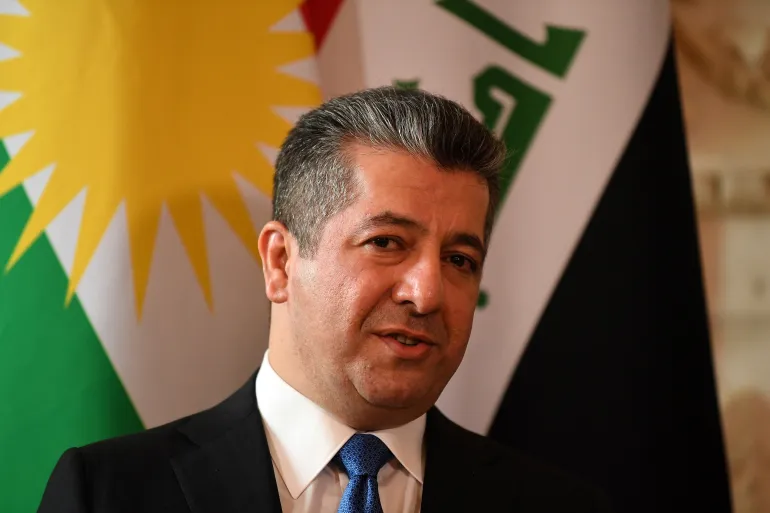
Kurdistan Regional Government Prime Minister Masrour Barzani of the KDP visits 10 Downing Street during a 2022 visit to the UK [File: Daniel Leal/WPA Pool/Getty Images]
Two powers
Since the first Gulf War in 1990 and 1991 and the establishment of a US-led “no-fly zone” in northern Iraq, Iraq’s Kurds have largely governed themselves, separate from the national government in Baghdad.
The Iraqi Constitution enacted after the 2003 US-led invasion of Iraq recognised the northern Kurdish region as a federal entity with its own legislative, executive and judicial powers.
There is a historical precedent for the possible separation of powers in this region between two rival authorities. When a conflict erupted between elements of the KDP and PUK in the 1990s, the two parties formed separate local governments in Erbil and Sulaimaniyah, respectively.
While there have been no recent violent flare-ups between the two parties, political distrust remains deep.
But the KDP’s ability to form a new government was still dependent on reaching an agreement with the PUK and other parties, such as the New Generation Movement, which secured 15 seats in the last election.
The PUK has so far refused to collaborate, so after a two-year wait, the KDP reactivated the regional parliament on Wednesday without its rivals.
Bafel Talabani, the leader of the Patriotic Union of Kurdistan, is the son of former Iraqi President Jalal Talabani [File: Hadi Mizban/AP]
Divisions but no conflict
Although the rivalry between the two parties is longstanding, Aziz argued that the current crisis is more serious and deeply rooted than previous political disputes.
“Given the political stubbornness of both parties, I do not expect an agreement or understanding to be reached soon,” he said. “Both sides must make concessions to each other. The party willing to make greater concessions will demonstrate greater concern for the Kurdistan region.”
Aziz was clear in laying blame for the deepening divide.
“The responsibility for deepening this conflict lies with the leaderships of Kurdistan’s two main parties,” he said. “Their failure to recognise the risks posed by continuing these disputes is one of the reasons we have reached this point.”
Subhi Mandalawi, a member of the KDP, blamed the current impasse on the refusal of the PUK to form a new government with the KDP.
“Following the Kurdistan parliamentary elections, the PUK delayed the formation of the new government. They were counting on the KDP being unable to secure the legal quorum needed to convene a parliamentary session,” Mandalawi told Al Jazeera. “But we held a parliamentary session without the PUK in 2018 as well, and they subsequently joined the government and parliament.”
The KDP’s Nechirvan Barzani is the current president of the Kurdish region in Iraq [File: Getty]
Mandalawi insisted that the door remains open for the PUK and other political parties but warned that prolonged divisions would lead to deeper problems for the Kurdish region.
“Continuing to obstruct legislative institutions two years after the elections is unacceptable and harms the Kurdistan region domestically, regionally and internationally,” he said.
“Threatening to divide the Kurdistan region is a hasty, ill-considered and unrealistic decision. No party leader can take such a step, and the PUK would be the biggest loser if it went ahead with it.”
Despite the differences, there is little risk of a return to conflict between the two parties. “We are brothers, and there can be no fighting among us,” Mandalawi said.
Separation threats
Mahmood Khoshnaw, a senior PUK official, said the KDP’s decision to convene parliament without his party has worsened political tensions in the region.
“Activating parliament without the PUK represents a departure from the principle of partnership and from political realities, and there will be consequences. If a prime minister is appointed in Erbil, we will take the same step in Sulaimaniyah. Whatever the KDP does, we will do the same in Sulaimaniyah,” Khoshnaw warned.
KDP fighters celebrate in the street in front of the rival PUK’s headquarters in Erbil after the tide in the 1996 Iraqi Kurdish Civil War turned in their favour [File: Burhan Ozbilic/AP]
“The situation in the Kurdistan region is heading towards chaos unless the crisis is addressed rationally and realistically. Activating parliament without reaching an understanding with the PUK has had a negative impact on relations between the two parties.”
Despite this, there are questions about whether Sulaimaniyah could legally separate from the Kurdish regional government.
Ramadan Albadran, an independent political analyst and constitutional affairs expert, said the dispute is not a constitutional issue about the KDP’s convening of parliament but a deep political crisis with the potential to create security repercussions for the region.
The Iraqi constitution also provides no mechanism for dividing the region into zones of influence between the KDP and PUK.
“If the PUK moves to separate Sulaimaniyah from the Kurdistan region, that would not be a legal or constitutional act,” Albadran said.
“If it takes place without a mandate from the elected Kurdistan Regional Government, it would be closer to an act of rebellion since there is no legal provision permitting withdrawal from or the dismantling of a region in this manner.”