senate republicans

GOP senators balk at Trump’s $1.8-billion ‘anti-weaponization’ fund, force delay in key vote

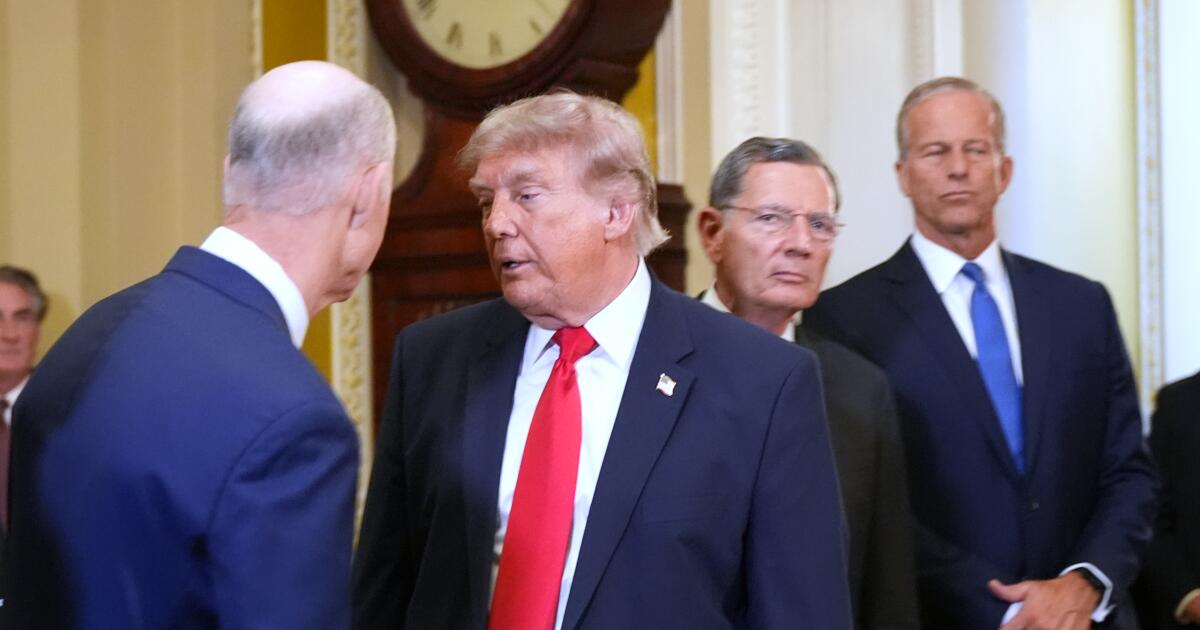
President Trump’s grip on his party slipped on Thursday as anger boiled over among Senate Republicans about a growing list of issues.

In a striking display of defiance, GOP senators abruptly derailed plans to vote on legislation to fund Trump’s immigration crackdown amid deep disagreements over security funding for a White House ballroom and a $1.8-billion fund to pay people who claim to have been politically persecuted.

The discontent had been building for weeks. Many senators had grown frustrated over Trump’s decision to endorse candidates running against longtime Republican incumbents.

Others, worried about rising costs as a result from the war in Iran, had aired concerns ahead of the midterm elections. But the breaking point came when the Justice Department, with little warning, pushed to create what it termed the “anti-weaponization fund.”

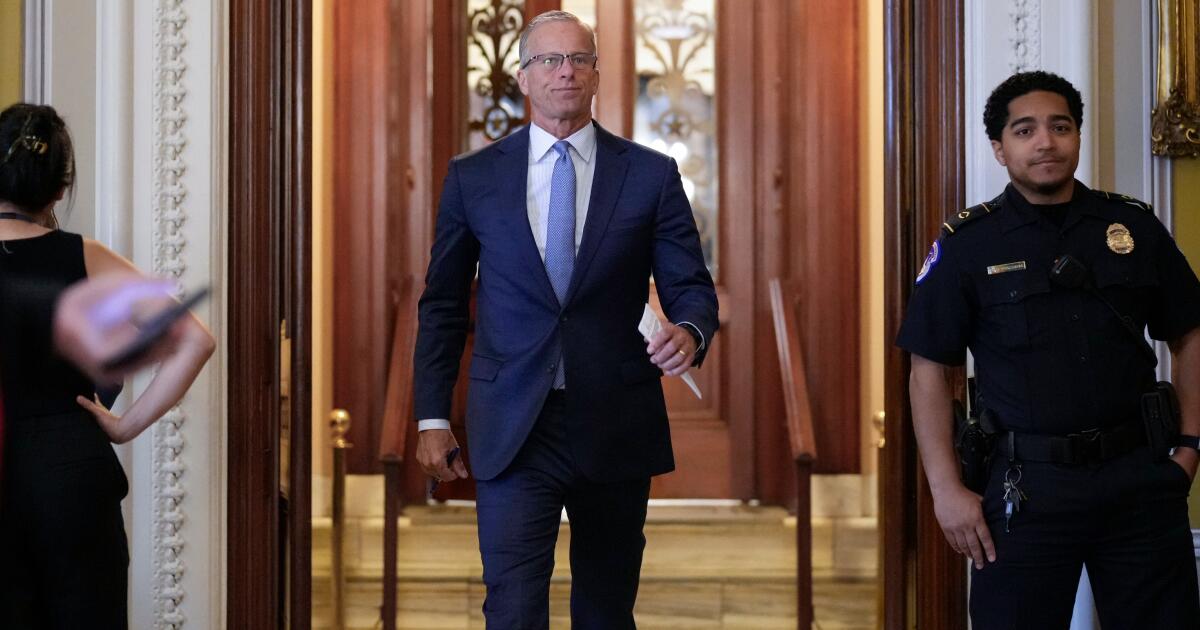
Senate Majority Leader John Thune (R-S.D.) acknowledged the concerns over the fund Thursday after a reportedly contentious private meeting about it between Senate Republicans and acting Atty. Gen. Todd Blanche. He also conceded midterm politics had added to the tension.

“It’s hard to divorce anything that happens here from what’s happening in the political atmosphere around us,” Thune told reporters. “You can’t disconnect those things.”

A day earlier, Sen. Bill Cassidy, a Louisiana Republican who lost his primary race on Saturday to a Trump-backed challenger, expressed strong disagreement with the creation of the fund, which would be controlled by appointees without congressional oversight.

“People are concerned about paying their mortgage or rent, affording groceries and paying for gas, not putting together a $1.8 billion fund for the president and his allies to pay whomever they wish with no legal precedent or accountability,” Cassidy wrote on X. “If there needs to be a settlement, the administration should bring it to Congress to decide.”

Sen. Mitch McConnell (R-Ky.) also had harsh criticism for the fund.

“So the nation’s top law enforcement official is asking for a slush fund to pay people who assault cops? Utterly stupid, morally wrong — take your pick,” he said in a statement.

The discord was striking, partly because Republicans have largely steered clear of checking the president’s power, and Congress has been largely sidelined under the second Trump administration on the war in Iran and other issues.

“I don’t think the Republicans had any choice but to pull the plug until we come back in June, because they’re facing a bit of a mutiny within their conference,” Sen. Adam Schiff (D-Calif.) told The Times, saying he had heard that the meeting between Blanche and Republicans “didn’t go well.”

As tension simmered on the background, Trump seemed unbothered by the group of Republicans’ public rebellion against his agenda. When asked whether he was losing control of the Senate, he said he didn’t know.

“I only do what is right,” he told reporters in the Oval Office.

However, he expressed annoyance at lawmakers who would not support $1 billion in federal funding for security costs related to the ballroom project. He said the structure is being privately funded by him and other “great patriots.”

“We are making a gift to the United States,” Trump said. “This is being made as a gift from me and other people that are great patriots and spent a lot of money. We are building what will be the finest ballroom anywhere in the world.”

The $1 billion for security funding would be “very much a good expenditure,” he said. If Congress does not sign off on the money, Trump said the “White House won’t be a very secure place.”

Trump did not immediately comment on Thursday about the Senate’s delaying of the funding bill. The White House declined to comment on the matter.

Trump’s second-term actions have frequently tested the loyalty of Republican lawmakers, who have largely stayed in line. The settlement fund, with its ethical questions, appears to have crossed a line for some senators in a party that has traditionally opposed wasting taxpayer funds.

The money comes from the judgment fund, which is a Congress-approved ongoing appropriation that allows the Justice Department to settle cases and make payments.

Stephen Miller, a top aide to Trump, told reporters at the White House that the $1.8-billion settlement was “just a small measure of the justice” that many people are owed after being targeted by the federal government. Miller declined to say whether the White House was reaching out to senators to ease concerns about the fund.

Republicans in Congress decried the use of similar third-party settlements during the Obama administration, with House lawmakers repeatedly passing a bill aimed at stopping settlement slush funds, noted Molly Nixon, a senior fellow at the Cato Institute.

Though the Trump administration’s plan is novel because the settlement money isn’t going to a third party, the general concept has been offensive to Republicans in the past; the Republican-controlled House Judiciary Committee termed it an abuse in 2017.

“If you’re taking a consistent view, you’d be at least equally as opposed to this settlement,” Nixon said of Republican lawmakers.

That could be driving some of the opposition now, along with concerns about who is going to get the money and whether it could be distributed to people who wouldn’t have been able to make a successful case before a court of law, Nixon said.

“The fund is going to plaintiffs who were victims of lawfare or weaponization. … Those are pretty ambiguous terms. They’re sort of in the eye of the beholder,” Nixon said. “It’s pretty easy to see how this could very easily become a quiet political claims process.”

Police officers who defended the U.S. Capitol during the Jan. 6, 2021, riot have already filed a federal lawsuit seeking to block the creation of the fund, arguing in part that it would compensate extremist convicted of committing violent crimes.

“The fund’s mere existence sends a clear and chilling message: those who enact violence in President Trump’s name will not just avoid punishment, they will be rewarded with riches,” the lawsuit says.

When Trump returned to office in January 2025, one of his first acts was pardoning or commuting the prison sentences of the 1,500 people who were charged in connection with the attack. Vice President JD Vance on Wednesday did not rule out that settlement money could go to those rioters, saying the money would be given out on a “case-by-case basis.”

Thune told reporters on Thursday that the Justice Department would have to come up with some guardrails to ease concerns among senators.

“We need to get some clarity,” he said.

Though the number of Republicans angry with Trump is significant enough to make or break legislation, the caucus appeared far from falling apart.

Senate Republicans blocked an attempt by Sen. Alex Padilla (D-Calif.) on Thursday to pass a bill to prohibit federal funds from reaching Jan. 6 rioters, an attempt to prevent the fund from being used to compensate them.

“I’m encouraged hearing some of my Republican colleagues agreeing with me,” Padilla said on the Senate floor. “Let’s stand up for congressional oversight as a unified Senate.”

Sen. Tommy Tuberville (R-Ala.) objected to Padilla’s bill, later writing on X: “PROUD to object today to Senator Padilla’s RIDICULOUS bill and stand up for ALL FREEDOM-LOVING AMERICANS.”

Schiff, who is working on an amendment that would target the fund, said other Republican colleagues he spoke to Wednesday evening were unhappy with the position Trump has put them in. He said Trump’s actions have helped underscore Democrats’ arguments against his party.

“All [it’s] doing is helping us make the case that the Republicans couldn’t care less about people’s cost of living … that there’s plenty of money for golden ballrooms for the president, there’s plenty of money for the president’s cronies, but there’s no money for the average family,” Schiff said.

Source link

Republican progress on immigration bill stalls out over Trump’s ballroom, DOJ settlement

Senate Republicans appeared increasingly unlikely to meet their self-imposed deadline for passing a roughly $70-billion immigration enforcement bill this week as disputes over security funding for the White House and the Trump administration’s $1.8-trillion settlement fund effectively derailed progress.

Republicans were already expected to abandon $1 billion in security money for the White House complex and President Trump’s ballroom amid backlash from members of their own party. But then questions about the settlement fund added to some of the senator’s concerns. They are questioning who would get the money.

Republican senators met with acting Atty. Gen. Todd Blanche on Thursday as they worked to finalize the bill’s text and whether to put parameters on the settlement, which was designed to compensate Trump’s allies who believe they have been politically persecuted. Sen. John Thune (R-S.D.) told reporters that senators had questions and wanted to know “how we might make sure that it’s fenced in appropriately.”

But senators who emerged from the meeting were tight-lipped and indicated that lawmakers would not hold a vote on the package before leaving Washington for a Memorial Day break, risking failure to meet Trump’s June 1 deadline.

Asked about a vote this week, Sen. Susan Collins (R-Maine) responded, “I don’t even know.” Sen. John Kennedy (R-La.) was more blunt: “We’re going home,” he said.

The last-minute scramble comes as Democrats have criticized Republicans for trying to fund Trump’s ballroom when voters are concerned about basic affordability issues — and as some GOP lawmakers have grown increasingly frustrated with Trump. Several GOP senators have spoken out against the settlement, which was announced this week, and many were upset by the president’s endorsement Tuesday of Texas Atty. Gen. Ken Paxton in the party primary runoff next week against Sen. John Cornyn.

Asked Thursday at the White House if he was losing control of the Senate, Trump replied: “I don’t know, I really don’t know. I can tell you — I only do what’s right.”

Possible parameters on Trump’s settlement fund

The “anti-weaponization” fund, part of a settlement that resolves Trump’s lawsuit against the IRS over the leak of his tax returns, unexpectedly became one of the main complications in the bill. Democrats said they would force votes to block it or place restrictions on it.

Democrats have an opening because Republicans are trying to pass the immigration enforcement bill through a complicated budget process that requires a long series of amendment votes. Democrats are considering multiple amendments, potentially to block that new fund outright or to ban any payments to Trump supporters who harmed law enforcement officers in the Jan. 6, 2021, attack on the Capitol.

Presenting a united front, Democrats from both the House and Senate rallied on the Capitol steps Thursday to show their opposition. Senate Democratic leader Chuck Schumer of New York said the amendment process “will give Republicans countless chances to do the right thing.”

He added that if they declined to make changes, it would show voters that “Ballroom Republicans are not working for you, they are busy fighting for Trump.”

Those amendments, along with others, could pass as a growing number of Republicans have voiced reservations about the fund. So Republicans are now discussing their own last-minute additions to head that off, potentially placing some parameters on the settlement and who could receive compensation, according to two people with knowledge of the private discussions who requested anonymity to discuss them.

It was unclear how any Senate changes would be received in the House. House Speaker Mike Johnson (R-La.) said Wednesday that the House will pass the bill “whatever form it takes.”

Tensions rise between Senate and White House

As Republicans challenged the settlement and parts of his agenda, Trump unloaded on the Senate in a social media post on Wednesday.

He urged Republicans to fire the Senate parliamentarian, Elizabeth MacDonough, who said over the weekend that parts of the $1-billion security proposal cannot remain in the ICE and Border Patrol bill. Trump also renewed his long-standing calls for the Senate to pass the SAVE Act, a Republican bill that would require all voters to prove U.S. citizenship, and to end the Senate filibuster.

Republicans need to “get smart and tough,” Trump said, or “you’ll all be looking for a job much sooner than you thought possible!”

While they have been loyal to Trump on most issues, Senate Republicans have resisted his repeated calls — even in his first term — to kill the filibuster, which triggers a 60-vote threshold in the Senate.

Hanging over the growing GOP rift is Trump’s surprise endorsement of Paxton. That intervention has Republican senators privately fuming that it could cost them their majority in November as they view the incumbent, Cornyn, as the better candidate in the November general election.

Secret Service request falters

Under the Secret Service’s request, about $220 million would fund security improvements related to the ballroom. The rest would go for a new screening center for visitors, training and other security measures.

Sen. Thom Tillis (R-N.C.) said the effort to add the security package to the bill was a “bad idea.” The bill should not have included the other security improvements, he said, “because it’s just giving everybody the ‘billion-dollar ballroom.’”

Several other Republicans in the House and Senate have questioned the request, and senators left a briefing with the director of the Secret Service last week saying they needed a lot more information.

People “can’t afford groceries and gasoline and healthcare, and we’re going to do a billion dollars for a ballroom?” asked Louisiana Sen. Bill Cassidy, who lost reelection in his GOP primary on Saturday after Trump endorsed one of his opponents.

Left in the bill is the money for ICE and Border Patrol, which Democrats have blocked for months in protest of the administration’s immigration enforcement crackdown.

Democrats demanded changes for the agencies, but negotiations with the White House yielded little progress. So Republicans are using the complicated budget maneuver called reconciliation — the same process that allowed them to pass Trump’s tax and spending cuts bill last year — to fund the agencies through the end of Trump’s term with a simple majority and no Democratic votes.

Still, passage requires sign-off from the parliamentarian and unity from Republicans.

Jalonick, Freking and Groves write for the Associated Press. AP writers Collin Binkley, Lisa Mascaro and Joey Cappelletti contributed to this report.

Source link

GOP bill would fund $1 billion in White House security upgrades for Trump’s ballroom

Senate Republicans have added $1 billion in White House security upgrades to legislation that would fund immigration enforcement agencies, a proposed boost for President Trump’s ballroom project after a man was charged with trying to assassinate him at the White House Correspondents’ Assn. dinner last week.

The GOP bill released late Monday would designate the money for the U.S. Secret Service for “security adjustments and upgrades” related to the ballroom project, which Trump and Republicans have been pushing since Cole Tomas Allen allegedly stormed the April 25 media dinner at the Washington Hilton with guns and knives. The legislation says the money would support enhancements to the ballroom project, “including above-ground and below-ground security features,” but also specifies that the money may not be used for non-security elements.

White House spokesperson Davis Ingle praised Republicans for including the money for the “long overdue” project, saying it would “provide the United States Secret Service with the resources they need to fully and completely harden the White House complex, in addition to the many other critical missions for the USSS.”

The money is part of a larger bill to pay for Immigration and Customs Enforcement and Border Patrol, as Democrats have been blocking funds for both agencies since mid-February. Congress passed bipartisan legislation to fund the rest of the Homeland Security Department on April 30 after a record-long shutdown, but Republicans are using a partisan budget maneuver to push through the ICE and Border Patrol dollars on their own. The House has not released its bill yet, but the Senate is expected to start voting on its version of the legislation next week.

It is unclear exactly how the $1 billion would be used, and the amount far exceeds the proposed $400 million for construction of the ballroom. The White House has said in court documents that the East Wing project would be “heavily fortified,” including bomb shelters, military installations and a medical facility underneath the ballroom. Trump has said it should include bulletproof glass and be able to repel drone attacks.

The National Trust for Historic Preservation has sued to block construction of the project, but a federal appeals court said last month that it can continue in the meantime.

The White House has said that private money would pay for the construction but public money would be used for security measures. Some Republicans have suggested that public money pay for all of it, arguing the security breach at the dinner shows the president needs a secure place to host events.

“It would be insane” to hold the dinner at a hotel again, said Republican Sen. Lindsey Graham of South Carolina, who introduced a bill to pay for the ballroom’s construction with Sen. Katie Britt, R-Ala.

Democrats have said they will oppose any efforts to pay for the ballroom.

“While Americans are struggling to make ends meet as a result of President Trump’s failed policies, Republicans are focused on providing tens of billions of dollars for the President’s vanity ballroom project and cruel mass deportation campaign,” said Illinois Sen. Dick Durbin, the top Democrat on the Senate Judiciary Committee, which oversees the U.S. Secret Service.

Jalonick writes for the Associated Press. AP writer Darlene Superville contributed to this report.

Source link