Clay is not Sabalenka’s strongest surface even though she has won three times in Madrid, where the high altitude makes the conditions similar to a hard court.
Nor did she have a good build-up to Roland Garros. Six match points were squandered in a quarter-final defeat by Hailey Baptiste in Madrid in April, before she let a set and a break lead slip against Romanian veteran Sorana Cirstea in Rome.
But, given her quality and pedigree compared to the other Paris quarter-finalists, it is hard not to think another golden opportunity has slipped through Sabalenka’s fingers.
Sabalenka’s four Grand Slam singles titles – two Australian Open and two US Open triumphs, all on hard courts – are more than most people can dream of.
But she has also lost four finals and six major semi-finals, despite a consistency on the biggest stages that is unrivalled among her peers.
Sabalenka has the proud record of not losing before the quarter-finals of a Grand Slam since the start of the 2023 season.
However, she has not always dealt well with the pressure of the latter stages – particularly during the period where she has clearly been the best player in the world.
Sabalenka was the heavy favourite to beat underdog Madison Keys in the 2024 Australian Open final, but came unstuck. Twelve months later, she reached another Melbourne final – and a flurry of mistakes saw her squander a break lead in the deciding set against Elena Rybakina.
At last year’s French Open Sabalenka played what she described as the “worst final” of her life, hitting 70 unforced errors in windy conditions as she lost from a set up.
Against Shnaider, Sabalenka looked in control at 6-3 4-1 up before losing 12 of the final 13 games.
“I just think that there is something in specific moments during the match [where] I lose control,” said Sabalenka, whose 57 unforced errors outweighed her 46 winners.
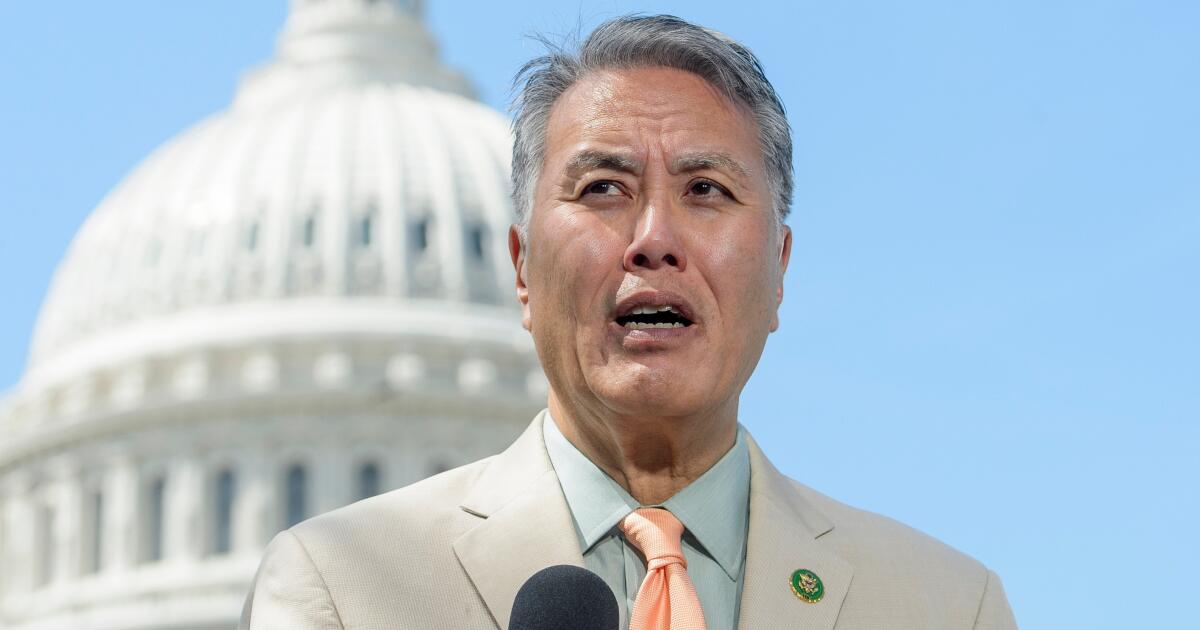
WASHINGTON — The congressman returned home last Fourth of July to startling stories in Southern California as immigration patrols swept through communities, and one constituent told him about starting to carry a passport as proof of the right to be in the country.
Rep. Mark Takano, whose American-born parents were both incarcerated as young children with their families during the forced relocation of Japanese Americans during World War II, could not help but see the parallels between that chapter of American history and this one.
“I do feel like there’s a similarity of circumstance of my own 2-year-old father and my 1-year-old mother being labeled as enemy aliens and they’re considered a danger to national security,” the Riverside Democrat told the Associated Press in a recent interview.
“They’re put into these incarceration camps,” he said. “Similar arguments have been made by this administration — that immigrants pose a grave danger to our country and it’s for the security of our country that we’re doing this.”
Echoes of history
President Trump’s campaign to achieve the largest mass deportation operation in U.S. history is at an inflection point. Americans are seeing what it looks like to round up, detain and deport thousands of people, particularly in the aftermath of the deaths this year of Renee Good and Alex Pretti, U.S. citizens protesting the federal crackdown in Minneapolis.
The White House changed the leadership at the Department of Homeland Security as it reframes its approach. New Secretary Markwayne Mullin promised to keep the department off the front pages.
But Trump is also under mounting pressure from conservative groups not to let up on the goal of deporting 1 million people a year. The president’s Republican allies in Congress are fueling the immigration and deportation actions with billions of dollars in special funds.
Takano, the ranking Democrat on the House Veterans’ Affairs Committee, has drawn from his own family history — and the country’s eventual redress to Japanese Americans who were detained — to challenge Trump’s approach.
“We look back on that era of history as a shameful one, as a time when our political leaders failed the Constitution, failed the American people,” he said.
One family’s story among many
A high school history teacher before being elected to Congress in 2012, Takano grew up in Southern California and came to understand the family stories.
His grandfather Isao Takano arrived in the U.S. from Hiroshima and married Kazue Takahashi, a U.S.-born citizen. Together they settled in Bellevue, Wash., and started a business growing tomatoes, strawberries and chrysanthemums for the marketplace in Seattle.
When the U.S. entered the war after the Japanese attack on Pearl Harbor, they were among some 120,000 people of Japanese ancestry, immigrants and those born in the U.S., forcibly relocated.
His father, William, was 2 years old when his family was sent in 1942 to the incarceration camp at Tule Lake in Central California. His mother, Nancy Tsugiye Sakamoto, born in California to American-born parents, was a year old when she was relocated to the detention facility in Heart Mountain, Wyo.
Then, as now, he said, people are being swept up in the anti-immigrant detentions.
“Will Americans generations from now visit ‘Alligator Alcatraz’ and think to themselves, how could our government do this?” Takano said during a House floor speech, referring to the Trump administration’s immigration detention facility in Florida.
“These future generations of Americans will look to us, the Congress, to see what we did to try to stop it.”
A Reagan-era law seen as model
Takano remembers his father taking him to see the land the family once owned. He learned about his great-uncles who served in the Army’s 442nd Regimental Combat Team of Japanese American soldiers; one was killed in action in Italy. He recalls his own father later collected donations for the national redress campaign.
In 1988 Congress passed the Civil Liberties Act, which sought to apologize for the “grave injustice” that had been done and provide $20,000 to each person detained. President Reagan signed it into law.
Takano’s parents were among those who received a letter of apology from the federal government, he said, and a payment.
Talks are underway among some in Congress, he said, for a similar redress to the people who have had their car windows smashed in, their homes raided and livelihoods upended as part of Trump’s immigration enforcement operations.
“Remarkably the country did come to realize the mistake,” he said. “I believe we’re living through one of those eras of mistakes, and I believe we can come out of this moment stronger.”
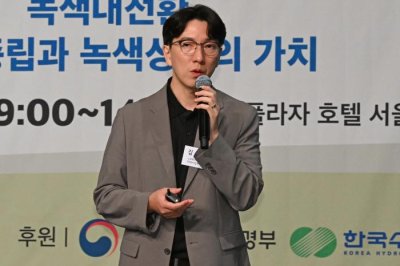
Kim Hyun-tae, executive director of product planning and strategy for LG Energy Solution’s energy storage system business division, speaks Friday at the second Asia Today Environment Forum at The Plaza Seoul. Photo by Asia Today
May 29 (Asia Today) — LG Energy Solution sees the electric vehicle slowdown as an opportunity to expand its energy storage system business as artificial intelligence data centers drive surging electricity demand, a company executive said Friday.
Kim Hyun-tae, executive director of product planning and strategy for LG Energy Solution’s energy storage system business division, said the EV “chasm” has created risks but also opened a path for the company to shift more aggressively into ESS.
“In the carbon-neutral era, we must move beyond simply increasing renewable energy and improve both grid stability and energy efficiency,” Kim said.
Kim made the remarks at the second Asia Today Environment Forum held at The Plaza Seoul, where he gave a presentation titled “LG Energy Solution’s vision for power grid stabilization and decarbonization.”
He outlined LG Energy Solution’s strategy for shifting toward ESS and responding to electricity infrastructure needs in the AI era.
Kim said South Korea’s battery industry had built large-scale production bases in the United States, viewing it as a core automotive market. But the market contracted after the second Trump administration took office and reduced electric vehicle subsidies while changing related policies.
“We secured new business plans by proactively converting U.S. plants from EV-centered production to ESS production,” Kim said.
LG Energy Solution produces ESS products in South Korea, Europe and the United States, Kim said. Its ESS production capacity in North America is now about 50 gigawatt-hours, and the company plans to expand that to more than 80 gigawatt-hours by next year.
“The United States has the highest ESS demand after China,” Kim said. “An ESS boom is taking place in the United States because investment subsidies of at least 30% and as much as 60% are provided when ESS and renewable energy facilities are built.”
Kim said the spread of AI data centers is also driving ESS demand.
“AI data centers are called a hippopotamus that eats water and electricity because they consume enormous amounts of power,” Kim said. “Nvidia’s next-generation Rubin graphics processing unit is expected to consume about four times more power than the Blackwell chip currently being sold, so securing stable power is essential.”
Kim said global Big Tech companies are focused on “time to power,” or how quickly new power capacity can be secured.
“Because connecting to existing power grids takes a long time, demand is growing for quickly building onsite and off-grid power sources that combine solar power, ESS and small gas turbines,” he said.
Kim also proposed an ESS-based distributed power grid model as an alternative to delays in building new transmission networks.
“Large-scale electricity demand sites are increasing, such as the Yongin semiconductor cluster, but building new transmission networks or high-voltage direct current systems usually takes six to seven years,” Kim said.
“For example, a realistic alternative could be storing electricity generated from renewable energy in the Honam region in ESS and then using existing transmission networks to distribute it to demand centers,” he said.
In the medium and long term, Kim said sodium-ion batteries, sometimes called “salt batteries,” could become a game changer in the ESS market.
“When renewable energy’s share expands to about 50%, large-scale ESS will be needed to offset intermittency, but costs are currently high,” Kim said. “LG Energy Solution plans to test sodium-ion batteries that can replace lithium in the United States in 2027 and pursue large-scale commercialization in 2029.”
Kim also said the global ESS market is being reshaped around domestic protectionism.
“The United States is encouraging the use of U.S.-made products through subsidy policies based on the Inflation Reduction Act, and Europe is also pursuing the introduction of the Industrial Accelerator Act, which is being called a European version of the IRA,” Kim said. “In a blocked supply chain environment, policy consideration is also needed to protect domestic industries and strengthen supply chain competitiveness.”
Kim said LG Energy Solution is building a decarbonization system that includes its supply chain and recycling operations as it works toward achieving RE100 by 2030 and carbon neutrality across its value chain by 2050.
Taipei, Taiwan– For Li, an engineer at Taiwanese computer giant ASUS, the AI boom sweeping Taiwan has made it an exciting time to work in tech.
Taiwan is a semiconductor powerhouse, producing about 90 percent of the most advanced chips used to power leading AI models such as ChatGPT and Claude.
Recommended Stories
list of 4 itemsend of list
“I’ve felt Taiwan’s tech and computer industry becoming more vibrant,” Li, who asked not to be identified by his real name, told Al Jazeera, pointing to events such as the upcoming Computex tech and AI expo running from June 2 to 6.
Still, Li worries that the spoils of Taiwan’s AI windfall are not being shared equally.
“Most industries unrelated to tech don’t seem to be feeling the benefits, so it doesn’t feel evenly distributed at the moment,” Li said, explaining that many of his former classmates working outside of tech do not appear to be doing as well.
“It’s mainly the industries at the front of this tech wave that are benefitting.”
Taiwan’s economy is growing at a pace that would be the envy of any country.
Gross domestic product (GDP) rose 8.63 percent in 2025, followed by a heady 13.69 percent expansion in the first three months of this year.
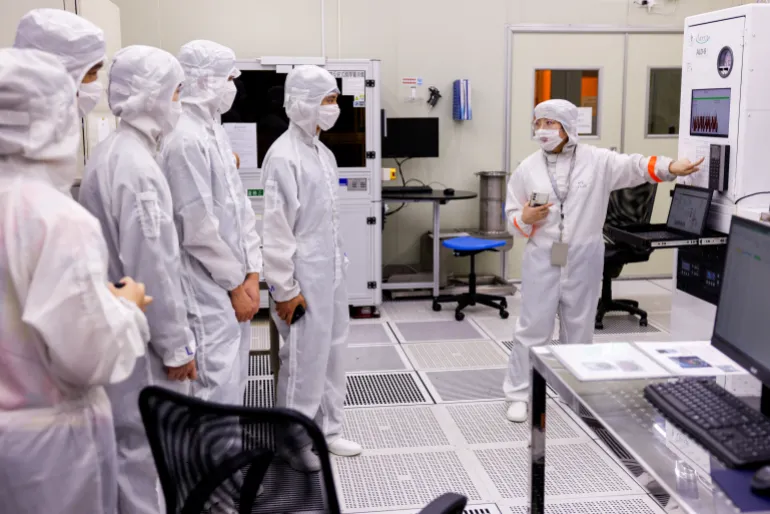
Students dressed in white protective suits and face masks visit a clean room as part of a summer camp organised by US chip designer Synopsys with the goal of attracting more youth to Taiwan’s semiconductor industry, in Hsinchu, on July 18, 2025 [Ann Wang/Reuters]
Exports surged 34.9 percent last year to $640.7bn, with more than two-thirds of the total being tech-related goods and services.
Semiconductors alone account for more than 20 percent of Taiwan’s GDP, according to US trade data, with the vast majority of production handled by Taiwan Semiconductor Manufacturing Company (TSMC), whose top customers include Nvidia and Apple.
TSMC by itself accounts for more than 40 percent of the value of the island’s stock market.
While impressive, the rapid economic expansion has raised concerns about being overreliant on the growth of AI.
Taiwan’s Central Bank Governor Yang Chin-lung has sounded the alarm about an emerging “K-shaped economy,” where certain sectors grow rapidly while others fall into stagnation.
While critical to Taiwan’s economy, the semiconductor industry is far from the largest source of jobs.
The sector employs only about 300,000 people in a workforce of 11 million, according to data compiled by Dachrahn Wu, director of National Central University’s Research Center for Taiwan Economic Development.
The broader electronics and IT manufacturing industry employs about one million people, compared with about seven million working in the service sector, according to Wu’s data.
The heavy reliance on a single industry for growth marks a shift from the Asian Tiger era of the 1960s to 90s, when Taiwan’s economy was driven by hundreds of thousands of small and medium-sized enterprises (SMEs), according to James Lin, a historian who specialises in Taiwan’s post-war economic transformation.
“From the 1970s to 1990s, economic growth was concentrated in the hands of small and medium family enterprises that exemplified the ‘living room factory’ model, where family-owned businesses focused on producing one part for a consumer product,” Lin told Al Jazeera.
“The benefits of this period were thus more widely distributed across Taiwanese society,” Lin said.
“By contrast, today, wealth inequality is growing in Taiwan as land is becoming more expensive and large corporations like TSMC attract the lion’s share of foreign capital investment rather than small corporations.”
Alicia Garcia Herrero, chief economist for Asia Pacific at French investment bank Natixis, said Taiwan’s economic model has left it at risk of becoming a “dual society” where tech sweeps up talent, funding and resources at the expense of other industries.
“It’s very hard if you’re not in [the semiconductor] sector in Taiwan right now,” Garcia Herrero told Al Jazeera, pointing to low wages for workers in non-tech roles and rising costs for businesses.
Some of Taiwan’s challenges are out of its control, said Chao-Hsi Huang, associate dean at the Taipei School of Economics and a former director at Taiwan’s central bank.
Those challenges include US President Donald Trump’s tariffs, which have partially exempted semiconductors but hit exporters in non-tech industries.
“The traditional [manufacturing] sector suffers higher tariffs than other competing countries like Korea or Japan, or even Southeast Asian countries, due to the fact we are not able to sign free trade agreements,” Huang told Al Jazeera.
“We are treated differently, and that’s a difficulty we are facing.”
Critics have placed other issues on the shoulders of the government, including a weak currency that has made exports more competitive but chipped away at consumers’ purchasing power.
Taiwan’s government denies engaging in currency manipulation, though it acknowledges intervening in the market to smooth out “volatility” when the new Taiwan dollar falls or rises sharply against other currencies.
After two decades of stagnation through the 2010s, wages are growing again – albeit unevenly.
Real average wages grew 1.4 percent in 2025, while median wages rose 1.35 percent, according to the Directorate-General of Budget, Accounting and Statistics (DGBAS).
Still, 70 percent of Taiwanese earned less than the average, a statistic attributable to the distorting effect of much higher salaries in the tech sector, where pay is nearly double the national average.
A miniature-sized wafer sorter machine model by Rorze on display at the Science Park Exploration Museum in Hsinchu, Taiwan, on February 6, 2023 [Ann Wang/Reuters]
For Taiwanese frustrated with stagnant pay, Taiwan’s soaring stock market has offered some consolation.
Riding the AI boom, the Taiwan Stock Exchange (TWSE) more than doubled in value between 2019 and 2025 to $2.2 trillion, according to HSBC.
Regulatory changes introduced in 2020 made it easier for small-time investors to buy single stocks, encouraging a rush of everyday Taiwanese into the market.
In January, the TWSE reported that the number of trading accounts had reached 13.77 million – equivalent to 60 percent of Taiwan’s population – while hailing the bourse as a “cornerstone for inclusive prosperity and shared growth”.
Though more equal than neighbours such as Singapore, Hong Kong and China, Taiwan’s wealth divide has grown over the decades.
In 1980, Taiwan had a Gini coefficient of 0.308 – a measurement of wealth distribution where 0 indicates perfect equality – putting it on par with contemporary Norway, according to the DGBAS.
By 2024, Taiwan’s Gini coefficient had grown to 0.341 – lower than many countries but still a significant rise.
“I feel that the benefits of economic growth haven’t been distributed evenly,” Ryan, an engineer in the local tech sector who asked not to be identified by his real name, told Al Jazeera.
“Some industries or asset holders benefit significantly, but ordinary office workers often experience a rise in prices and housing costs, rather than an easier life,” he said.
Wei-ting Yen, an assistant research fellow at the research institution Academia Sinica, said while the semiconductor and stock market booms have helped some Taiwanese, they have heightened the angst of others.
In a survey of 1,195 Taiwanese voters carried out last month, 40 percent said their household was financially either “anxious” or “very anxious” due to rising living costs, particularly housing.
“I think subjectively, they’re anxious that they’re not accumulating wealth and it’s not enough to help them buy a house or an apartment,” Yen told Al Jazeera.
“Housing prices have been going crazy worldwide, and the stock market has been going crazy, [but] for people who do not have extra money to invest in those two options, it creates even more frustration and anxiety around them,” she said.
Although the Supreme Court, in general, and conservative appellate courts, in particular, have bowed and granted President Trump permission to do pretty much anything he wants, they haven’t thoroughly capitulated to his endless grasping for ever more power. (The way invertebrate congressional Republicans have.)
And it’s not just the fears of a lot of shaggy-thinking liberals.
“The nation is strong as is its commitment to the rule of law,” said one appellate judge, a Republican appointee. “The current president presents the greatest threat in decades.”
The survey was conducted by Bright Line Watch, a nonpartisan academic group that monitors the health and resilience of American democracy, in conjunction with the Safeguarding Democracy Project at UCLA’s School of Law.
Conducted between mid-February and early March, the poll anonymously surveyed 21 federal judges, 113 lawyers, 193 law professors, 652 political scientists and a nationally representative sample of 2,750 Americans.
What leapt out to UCLA’s Rick Hasen, director of the Safeguarding Democracy Project, was that “across the ideological spectrum and across judges, lawyers and law professors, there was considerable agreement that the rule of law in the U.S. is under tremendous stress.” That consensus, he said, suggests “a real risk to democracy.”
Most legal experts agreed that Trump is using executive power excessively, with a majority doubting the conservative-leaning Supreme Court would handle cases involving the Trump administration impartially. The experts also expressed concern about politicized law enforcement — Trump seeking to persecute his perceived enemies — executive branch overreach, and the failure of Congress or the Supreme Court to do more to rein in the rogue president.
Talk about contempt of court — not to mention our vital system of checks and balances.
There was, unsurprisingly, a split among conservatives and liberals who took part in the survey. (The study defined legal conservatives as those saying the Supreme Court should base rulings on its understanding of what the Constitution meant as originally written. Liberals, who made up most of the respondents, were defined as those saying the court should base its rulings on what the Constitution means in current times.)
There were also differences between legal experts — those most intimately involved in the judicial system — and the public at large. The experts were more concerned about Trump’s excesses and threats to the rule of law, which, Hasen said, stands to reason.
The legal system is not something most people encounter daily in the same way they do, say, gasoline prices or the cost of groceries. “Yet,” Hasen said, “it’s one of these background things that really matters.”
Why?
Hasen put it this way: “Imagine that a person had a dispute with their neighbor and it ended up in small claims court before a judge and the judge made the decision not based on the merits of the case but based on whether he was friends with one of the parties, or didn’t like people who were similar to one of the parties.”
If, for instance, “people know that the government can successfully seek retribution from people who criticize it, people will be less likely to criticize the government,” Hasen said, leaving the country worse off by muzzling those who would hold their elected leaders to account.
Happily — and who couldn’t use a bit of good cheer right about now — all is not lost.
People “can demand that their elected representatives take steps to assure that the rule of law will be followed,” Hasen said, and can insist “that the government [not] play favorites or seek retribution against perceived enemies.”
That’s the power people have, come election time. That’s why voting matters.
There are lots of things riding on the outcome in November, not least the sanctity and integrity of our legal system.
WASHINGTON — Bold conservative thinkers with clear public records need not apply.
An increasing number of conservative activists fear that is the message President Bush is sending with his two choices for the Supreme Court.
This week’s nomination of White House Counsel Harriet E. Miers, following Bush’s earlier selection of John G. Roberts Jr. as chief justice, means that the president has chosen two Supreme Court nominees with limited — or virtually no — public records on the key constitutional controversies dividing the parties. In the process, he’s bypassed a long list of judges with consistent conservative records on state and federal courts.
“I don’t know that there is a deliberate message — I think he is just trying to avoid trouble — but the message comes through: Do not be controversial, do not express strong opinions that arouse opposition,” said Robert H. Bork, the conservative legal scholar and former federal judge. Bork’s extensive writings keyed an explosive confirmation battle that culminated in his rejection by the Senate when President Reagan nominated him to the Supreme Court in 1987.
During almost five years of bruising partisan warfare on issues from taxes to Iraq, few people have ever accused Bush of dodging a fight. But that’s exactly the charge he is now facing from disgruntled conservatives.
They contend that Bush has chosen Miers, and even Roberts, largely because he fears Democratic resistance to conservatives with more concrete public records, such as appellate court Judges J. Michael Luttig and Edith H. Jones.
“Is the president sending a message that these distinguished conservatives are too controversial to be nominated for the high court, even with a Senate containing 55 Republicans?” a Wall Street Journal editorial asked Tuesday.
White House officials and some Bush allies on the right deny the charge that he is gun-shy about promoting nominees with extensive public records. They note that the president has consistently appointed known conservatives, such as Janice Rogers Brown and Priscilla R. Owen, to the powerful federal appellate courts — even renominating them after they were initially blocked by Democratic filibusters.
“In the president’s mind, it is not disqualifying if you have a public track record of conservatism, and he has proved that through his appellate court appointees,” said White House counselor Dan Bartlett.
Bush, at a Tuesday news conference, sought to assure his supporters that Miers shared his conservative views and would remain steadfast to them.
“I know her well enough to be able to say that she’s not going to change, that 20 years from now she’ll be the same person, with the same philosophy, that she is today,” he said.
But Bush’s critics on the right maintain that his reluctance to nominate a known conservative for the Supreme Court sends a strong signal encouraging caution and consensus among conservative legal thinkers and judges.
“I suppose a lot of people are not going to want to join the Federalist Society,” said Bork, in a reference to a conservative legal group.
Both sides agree that the 1987 defeat of Bork marked a turning point in Supreme Court nominations. Since then, both parties have generally favored nominees without the detailed and controversial record he carried to the witness table.
“It’s almost become a qualification,” said Bork, a senior fellow at the conservative Hudson Institute think tank.
But Bush’s conservative critics say he has carried this tendency to a new height through his selection of Roberts, who had served just over two years as a federal judge, and Miers, who has never served on the bench or written publicly on major legal questions.
In contrast, both of President Clinton’s Supreme Court appointees — Stephen G. Breyer and Ruth Bader Ginsburg — had served for more than a decade on federal appellate courts. And Ginsburg had written widely as a law professor and general counsel for the American Civil Liberties Union.
Bush’s conservative critics acknowledge that Roberts’ limited public record made it more difficult for Democrats to organize against him, an advantage that Miers may also benefit from.
But the president’s critics maintain that Bush is underestimating his ability to win confirmation for a more clearly defined candidate while Republicans hold 55 Senate seats; only twice since 1930 has a president’s Supreme Court nomination been rejected while his party controlled a Senate majority.
“If Bush feels he could have put a Mike Luttig on there without a fight, he would have done it,” said Mark Levin, president of the conservative Landmark Legal Foundation and a former chief of staff to Edwin Meese III, who was attorney general under Reagan. “It’s a political calculation that he’s got enough on his table right now, and why instigate a fight?”
Luttig, of Virginia, is a favorite of conservative activists.
The critics on the right see two principal risks in choosing justices without a long pedigree. One is that without a firm anchor in conservative legal views, they will trend leftward on the court — the way almost all conservatives believe David H. Souter, appointed by President George H.W. Bush, has done. This fear is greater about Miers because Roberts’ advocacy for conservative positions in previous GOP administrations has left the right considerably more, though not completely, confident about him.
The other fear is that the nomination of candidates without lengthy public records will discourage conservatives from advancing controversial positions that challenge legal conventional wisdom — either in their writings or on the courts. The Wall Street Journal said that by appointing Miers, the president “missed a chance to send a message that taking firm sides in our judicial debates is not politically disqualifying.”
Bush advisors and allies say such conclusions misread his logic for the Miers appointment. They say his long personal relationship with Miers gives him more confidence about her judicial philosophy than he could obtain from reading a judge’s opinions or from a short interview.
“Harriet Miers reflects less a reticence to appoint someone with a record and more a commitment to appoint someone he knows shares his judicial philosophy,” said Leonard Leo, a former vice president of the Federalist Society now working with groups supporting the president’s court nominees.
Still, the uneasiness on the right about Bush’s decision-making has reached the point that two prominent legal conservatives this week joked that the best thing that ever happened to Roberts was the refusal by the Senate, then controlled by the Democrats, to confirm him after President George H.W. Bush nominated him to the Court of Appeals for the District of Columbia Circuit in 1992.
If Roberts had been confirmed then, his lengthy legal record might have dissuaded the current President Bush from nominating him to the Supreme Court this summer, said one of the conservatives, who asked not to be identified.