Austin Reaves, Walker Kessler lead Lakers past the Clippers
The Lakers appeared to be on their way to almost being whole Friday night when guard Collin Sexton returned to play for the first time this season. Then word came that key role player Jake LaRavia was out because of an ankle injury.
Still, the Lakers pressed on in their second game, a game against the crosstown rival Clippers, a game with meaning for both teams.
Though the Lakers were sloppy with the ball in the fourth quarter, having six players score in double figures helped them pull out a 125-117 win over the Clippers at Crypto.com Arena.
Austin Reaves led the way with 28 points and nine assists, but he had six turnovers. Luka Doncic had 23 points, seven assists and six rebounds, but he had 11 of the Lakers’ 21 turnovers.
Walker Kessler was a force again, scoring 22 points on 10-for-14 shooting, grabbing eight rebounds and blocking six shots.
The Lakers led by 15 points in the second half after the score was tied at halftime, but kept turning the ball over and saw the lead sliced to six with three minutes and 18 seconds left on a basket by Darius Garland, who finished with 26 points.
But Kessler played big in the final few minutes, making two free throws and blocking a shot late in the game.
Kessler sopened the game with his defensive presence. He stole the basketball and took it the length of the court for a two-handed dunk in the first quarter.
Kessler blocked a shot by Derrick Jones Jr., leading to a three-pointer by Reaves for an 89-77 Lakers lead in the third quarter.
Kessler then went to work on the backboards, grabbing an offensive rebound and scoring on a reverse layup while being fouled by Brook Lopez. Kessler flexed and yelled. He missed the free throw, but his basket had given the Lakers a 91-77 in the third quarter and it kept their momentum going.
Kessler kept up his fantastic play in the fourth quarter, challenging a shot on defense by Rui Hachimura and then running on the fast break to catch a lob from Reaves for a two-handed dunk and a 15-point Lakers lead.
It was also the return of Hachimura, who spent 3 ½-seasons with the Lakers before joining the Clippers this summer on a two-year, $28-million deal. The well-liked Hachimura was shown just how much when the Lakers played highlights from when he played with them.

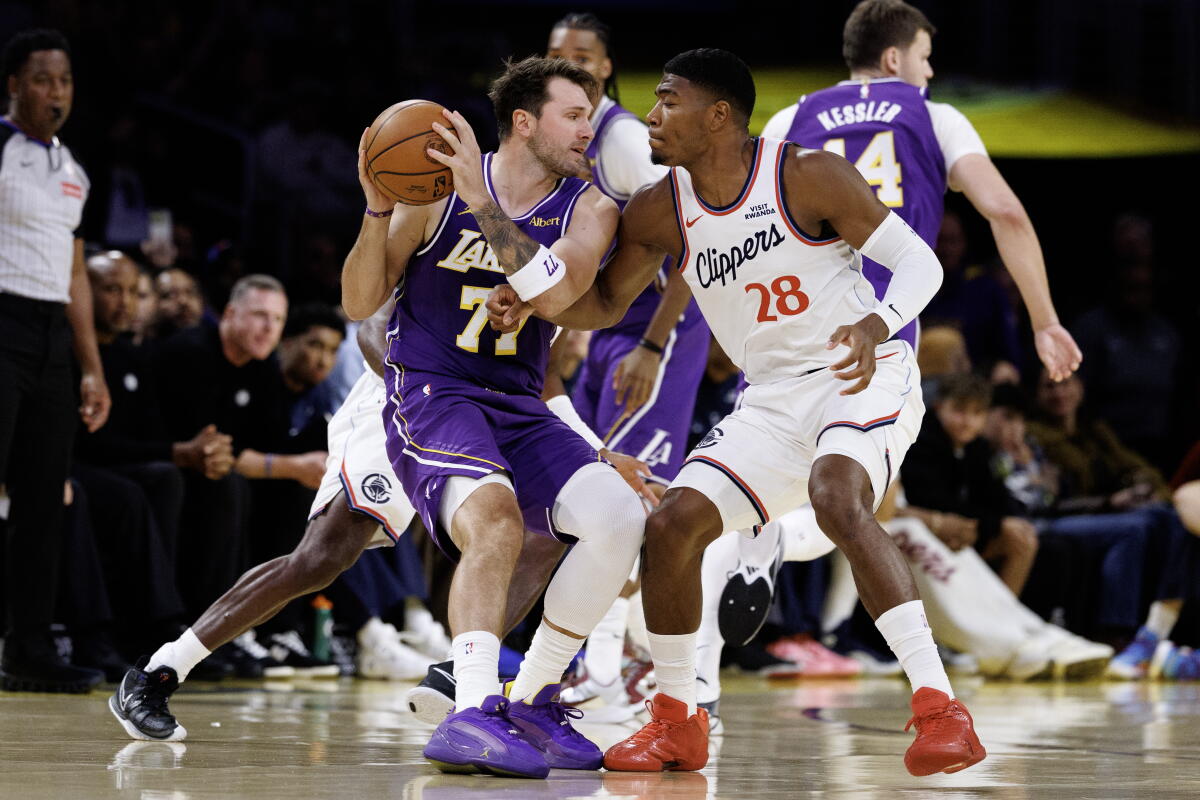
Clippers forward Rui Hachimura, playing tight defense on Lakers guard Luka Doncic, returned to Crypto.com Arena where played for parts of three seasons. He had 16 points, six rebounds and two steals.
(Gina Ferazzi / Los Angeles Times)
Hachimura had 12 points at the half, doing his part to help the Clippers stay at 64-64.
Before the game, Lakers coach JJ Redick spoke glowingly of how Hachimura played during the preseason for the Clippers.
“They’re running a lot of the same stuff for Rui that they ran for PG [Paul George] and at times Kawhi [Leonard],” Redick said. “He’s playing free and he’s playing ultra-aggressive right now.”
With three minutes and 52 seconds left in the first quarter, Sexton checked into the game, and his first play was a steal.
Sexton missed the first regular-season game and five exhibition games because of lower leg injury. He played 16 minutes and had five points and three steals.
Etc.
LaRavia didn’t play because of a sprained right ankle. LaRavia played in all 82 games last season for the first time in his career. His goal was to play in all 82 this season, but he’s already missed his first game and might not be available to play until Sunday at Utah or Tuesday at home against the Portland Trail Blazers.
“We talked last week and mentioned that was one of his goals for the season. He had the same goal last year and he was able to do that,” Redick said. “Play through some stuff at times last year. Wanted to play. We talked to him this morning before shoot-around and I was going to try to give it a go and went to the treatment room and just it’s not there, but he’s hopeful he could be back Sunday, if not Tuesday.”