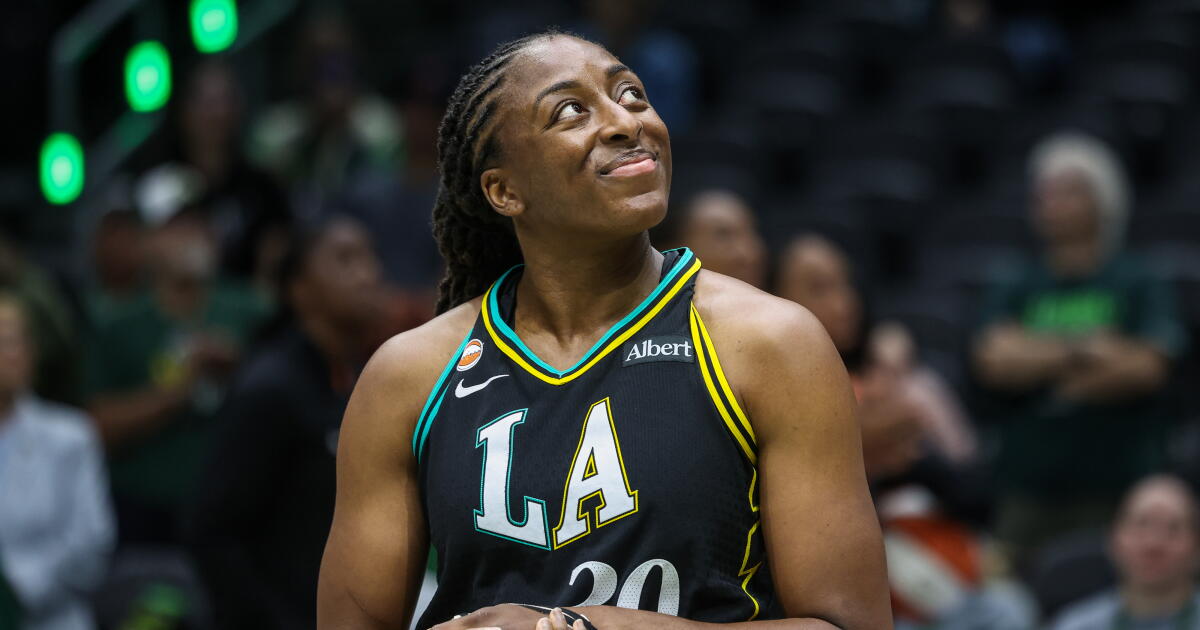
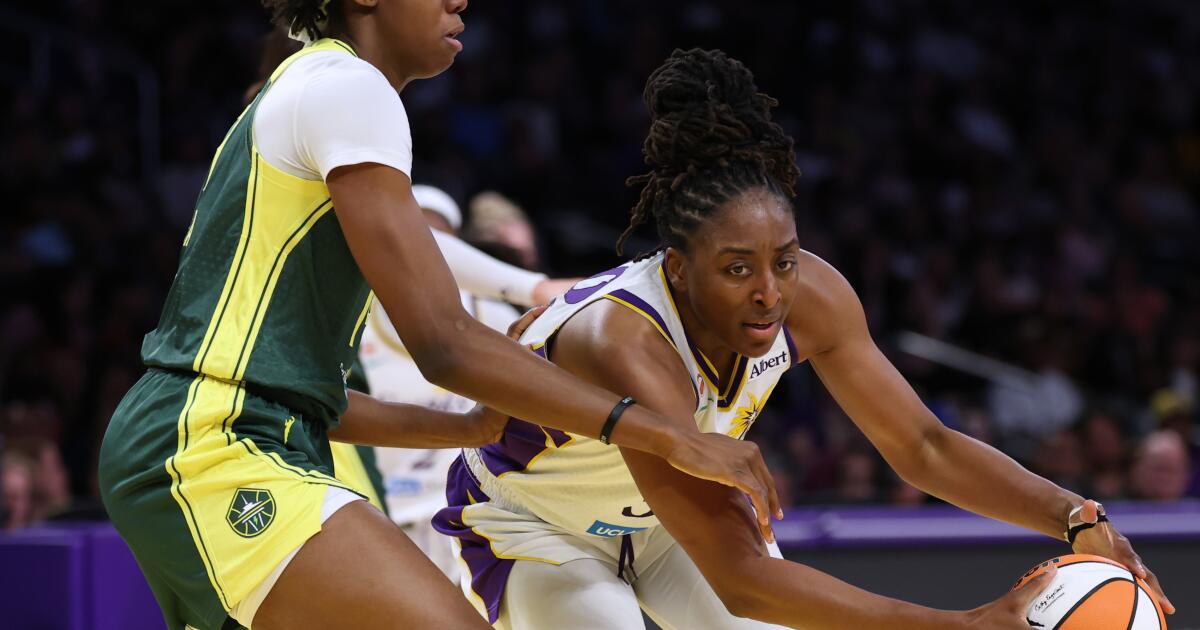
SEATTLE — Nneka Ogwumike had 23 points and 12 rebounds, Rae Burrell scored 22 points, and the visiting Sparks beat the Seattle Storm 90-74 on Sunday in their final game before the FIBA World Cup break.
The Sparks scored the first 13 points in an opening 18-2 run and Dearica Hamby’s layup with 5:45 left in the first half capped an 11-0 spurt that gave them a 39-20 lead. Seattle shot 32% (12 of 38) from the field and two of 11 (18%) from behind the arc before going into halftime trailing by 19. The Storm were just as bad from three-point range in the second half, finishing four of 22.
Cameron Brink had 11 points on three-of-15 shooting for the Sparks (15-25).
Flau’jae Johnson scored 11 of her 19 points in the fourth quarter and Dominique Malonga had 17 points, on eight-of-21 shooting, and 15 rebounds for the Storm (8-32). Zia Cooke made six of 17 from the field for 14 points.
Seattle is 1-18 against Western Conference teams this season, its only win coming at the Sparks, 82-64, on July 6.
The Storm’s Jordan Horston fell awkwardly midway through the third quarter, limped to the locker room and did not return.
Awa Fam and Natisha Hiedeman did not play for the Storm.
PORTLAND, Ore. — Sophie Cunningham said she’s unconcerned that the rallies against transgender participation in women’s sports that have accompanied the Indiana’s Fever’s recent games are a distraction for the WNBA team.
Cunningham made the comments before the Fever’s game Friday night against the Portland Fire. Outside, a group rallied for the second consecutive game in support of Cunningham and her recent comments about transgender athletes.
“I think at the end of the day, I come in and I do my job,” Cunningham said. “I think everyone who knows me personally, they know that I’m full of love. I’m bubbly. I love the people around me. I love basketball. I love inspiring the next generation and doing that in a positive light. And so that doesn’t even cross my mind. Doesn’t cross my teammates’ minds.
“And again, I’m here to play basketball, but I’m also here to be me, and I’m not gonna like shadow that or hide or, you know, dim my light just because maybe people don’t agree with that.”
Portland’s rally came after a similar rally for Cunningham earlier in the week before the Fever’s game at the Seattle Storm. Both rallies only attracted about two dozen participants and a bevy of onlookers.
“I have honestly had nothing to do with them,” Cunningham said. “I think it’s people just practicing their rights of freedom of speech and doing what other fans have been doing since the WNBA has started. And so props to them, props to everyone who is able to be competent and be bold and courageous enough to to speak their truths.”
People rally in Portland to support WNBA star Sophie Cunningham after her comments on transgender athletes in women’s sports.
(Craig Mitchelldyer / Associated Press)
Another rally was planned for Sunday in Minneapolis when the Fever play the Minnesota Lynx.
In Seattle on Tuesday, two Cunningham supporters sat courtside at Climate Change Arena holding signs. A co-owner of the Storm, Celeste Keaton was later fined an undisclosed amount and suspended for five games by the WNBA for an exchange with the two supporters.
The Storm also apologized for the incident, but did not provide details about the exchange, releasing a statement that said: “We remain committed to creating a welcoming and respectful environment for anyone who attends a Storm game.”
The Seattle rally promoted statewide ballot initiative, IL26-638, that would bar transgender students from participating in girls’ athletics at Washington schools. It also praised Cunningham, who voiced support for barring transgender athletes from girls’ and women’s sports in recent interviews.
“I am here to be a cheerleader for Sophie Cunningham, who has so bravely put her head above the parapet to protect women and girls in our sports and in our locker rooms,” said Amy Souza, who was among those at the Portland rally. “I was an organizer of this event, I was a co-organizer of the Seattle event. I’m also here, standing in solidarity with those teen girls who, unfortunately, were harassed when they were just trying to be fans of the sport, fans of Sophie Cunningham.”
Cunningham was booed by the Moda Center crowd in Portland when she entered the game midway though the first quarter. Many waved small pink, blue and white transgender flags.
The Fever defeated the Fire 112-98 for their fifth straight win. Cunningham finished with 13 points and Caitlin Clark had her fourth career triple-double with 26 points, 10 rebounds and 10 assists.
Coach Stephanie White said she was concerned that the controversy was distracting from the team’s play.
“You know there is a frustration, of course, because we want to we want to talk about basketball and we want to continue to work on our game and we want to continue to grow as a team.,” White said. “But I also understand this is part of our growth edge as a league, right?
“It’s part of our growth as a league, and we have to to be able to manage, we have to be able to insulate as much as we can, and then we have to be able to lead with conversation.”
Forty-nine seconds. That’s all it took for the Seattle Storm’s Flau’jae Johnson to fire off a 27-foot three-point jumper to take the lead. In less than a minute, she sank the Sparks’ hopes of beating one of the worst teams in the WNBA, leaving 39 more minutes for the Sparks to consider just how the team got there.
Johnson, already the main act in Seattle, bolstered her WNBA Rookie of the Year case by scoring 23 points as the Storm defeated the Sparks 82-64 Monday night at Crypto.com Arena.
Each time the Storm drove down the court, there was Johnson, her ponytail fluttering as she skirted around the arc before driving into the paint, nonchalantly tossing up layups as if it was still shootaround. Not even the relentless defense chants summoned from the Sparks’ MCs stopped her.
“I don’t know,” coach Lynne Roberts said after the game. “We just weren’t good offensively.”
And while her teammates supplied Johnson with enough passes to at one point secure a 13-point lead, the Sparks (8-11) lost because the team couldn’t build enough momentum.
In the end, Seattle outmaneuvered and outbodied the Sparks, snatching steals and flipping the ball around the perimeter until the Storm fired off a shot. Even when the ball bounced off the rim or backboard, Johnson or Storm center Dominique Malonga, who had nine rebounds, was there, hoisting the basketball away from the closest white jersey.
When asked how the team could’ve compensated defensively, Dearica Hamby kept it short: “Stop them from scoring.”
In comparison, the Sparks, without an offensive rebound until the end of the third quarter, were forced to make perfect shots, though that was far from the team’s grasp. Hamby, who went six for nine, led the team with 17 points, but even she couldn’t go toe-to-toe with Johnson alone. Worse, the Sparks’ abysmal 17.2 three-point percentage all but abandoned that avenue of attack, leaving the team to face Malonga in the paint.
“I’m not trying to let us off the hook at all, but sometimes you just have nights like that, and we all had them at the same time,” Roberts said. “Shooting 17% from three doesn’t help.”
The Sparks struggled to transition to the basket, giving up 19 turnovers resulting in 25 free baskets.
“I don’t think that there is a strong line of playing in transition,” Nneka Ogwumike said. “Sometimes we attribute taking an early shot to transition when in reality, if you’re taking an early, contested shot in transition, it’s probably not the most ideal shot.”
So as the Sparks fell further behind, the holes left by the injured Cameron Brink and Kelsey Plum widened.
In the Sparks’ previous matchup against the Storm a month ago, the two had totaled 34 points in the nail-biting 88-83 win. But in Monday’s game, the Sparks could only cling to the game with clenched fists as the gap widened.
“Credit them,” Roberts said. “They played hard and made shots. We missed them.”
By the end, the Sparks spent the game playing catch-up, never regaining the lead after surrendering it in the first 49 seconds to Johnson.
Cameron Brink said she’d appreciate some grace. She really would.
Sparks fans should give her some, because where else is she going to get it?
Certainly not from WNBA refs. Not from opponents with more to play for than ever. Certainly not from the game itself; basketball moves fast, and a bummer can become a bust in a blink.
But Brink, 24, is not on the brink of bust territory, no. Block that thought. Technically, it’s Year 3, but after a torn ACL derailed her as a rookie two summers ago, it’s practically like Year 2 for the former Stanford star. And by design, the WNBA is testing her confidence, her decision-making and her patience as she tries to reestablish herself as one of the WNBA’s best young players.
So, grace.
The recognizable 6-foot-4 forward — she’s the long-blond-haired hooper in the New Balance ads — was the No. 2 overall pick in 2024.
Now she’s her team’s No. 3 option in the post. She’s coming off the bench behind Nneka Ogwumike and Dearica Hamby for the Sparks, who are a modest 6-6 after wins this week over the expansion Portland Fire and the struggling Seattle Storm.
Against the Fire, Brink scored two points and picked up four fouls in nine minutes. Then she went to Seattle and had 15 points in 18 minutes but was pulled with more than five minutes left in the fourth quarter after getting her third, fourth and fifth fouls in 86 seconds. (WNBA players get six fouls before being disqualified.)
For the season, Brink has been called for 49 fouls in 208 minutes. A foul about every four minutes!
They’re silly fouls and they’re phantom calls. Egregious and ticky-tack. Costly and common. A real fouled-up buffet. She sets screens that get scrutinized as if by the most vigilant TSA agent. And sometimes, yes, she’s doing the accidental tripping. Other times, the officials are.
Her reputation precedes her, so everyone gets a superstar’s whistle when being defended by Brink. Opponents bake it into their game plans.
That can’t continue.
All that fouling is hindering Brink’s development because it’s robbing her of important in-game reps — which she needs, foremost, to figure out how to stop fouling.
Sparks forward Cameron Brink, left, blocks the shot of the Tempo’s Laura Juskaite during a game last month.
(Jeff Lewis / Associated Press)
“At the pro level,” said Tara VanDerveer, Brink’s coach at Stanford, “every young player always has a lot of work to do. And I saw her make a three. I see her block shots. She rebounds, she can handle the ball, she’s unselfish, she’s a terrific talent. But there’s always things players need to work on.”
We know what Brink’s thing is.
“She has to be disciplined,” VanDerveer said. “And if you want something so badly, if you want to be an All-Star someday or make the Olympic team, you’ve got to be dependable … and I think anyone can change, if it’s behavior they recognize is not in their best interests or not in their team’s best interests. It’s hard, but it’s something I think people can do.
“That’s what Cam is working on.”
And, VanDerveer added, “I’m really so excited that Nneka is there, because she will give her such great guidance and mentorship.”
And grace. Brink is getting that from Ogwumike — also a former Stanford star, the Sparks legend returned to L.A. this season after two seasons in Seattle — and her other teammates.
“I just do my best to lead by example,” Ogwumike, 35, said. “But then also let [Brink] know that she’s very capable, that she’s more than capable, which is exactly why she’s here with us and it’s exactly why we need her on this team.”
Sparks forward Cameron Brink, wearing a facemask, controls the ball while defended by Sun forward Raegan Beers.
(Joe Buglewicz / Getty Images)
But how long will Brink get grace from the Sparks in the what-have-you-done-for-me-lately business of basketball?
The foul trouble tells us why a win-now team wouldn’t trust her, why the Sparks would give meaningful minutes to two veteran post players ahead of her. Why they wouldn’t prioritize Brink’s development alongside winning as they strive to snap a previously unthinkable five-year playoff drought.
And what about fans? How patient will you all be with a player who was drafted immediately after Caitlin Clark and five spots in front of Angel Reese?
These days, that might depend on what the parlay calls for.
Or, preferably, whether you remember Brink’s first 15 WNBA games. All starts, all signs pointing to stardom. She showed up in 2024 throwing lavish block parties. Her 2.3 blocks per game were message-sending spikes, like what Lisa Leslie used to enthrall Sparks crowds with.
From the jump, she had guys coming to games at Crypto.com Arena wearing her No. 22 jersey and little girls arriving in groups with No. 22 painted on their cheeks and “I love Cam Brink” signs in hand.
And then the torn ACL cost her 25 games of her rookie season and another 25 last season, plus her spot on the United States’ Olympic 3×3 women’s basketball team in Paris in 2024.
She had to start over. Lost a lot of ground. But you see that masked woman stuck on the Sparks’ bench for all but 17 minutes per game?
You can’t miss her. She’s looking uncomfortable in protective facial gear that either hinders her breathing or her peripheral vision, her only options to protect the torn septum she suffered in a victory over the Las Vegas Aces last month.
She’s the one with the 6-8 wingspan who’s averaging 9.2 points, 4.3 rebounds and 1.5 blocks while shooting 52.1% from the field in her limited minutes.
She’s still Cameron Brink. Between fouls, she’s fluid and fast and covers more of the court than almost anyone in the WNBA, able to leap from defending guards to centers in a single bound.
“It’s just looking at every day as a new opportunity to learn and grow and not getting too bogged down when things don’t go exactly as you planned,” Brink told me. “Because more times than not, things are not going to go how you want them to. And that’s life. So I just want to be able to put my best effort out there every single night.
She knows what the Sparks need from her: “To perform, just come on the floor and compete.”